HubSpot chatbot integration that layers AI on top of your existing stack
Asyntai provides a HubSpot chatbot integration that drops into your Site Header HTML, trains on your published HubSpot pages and blog, and adds an always-on AI layer that answers prospects in 36 languages without replacing anything you already run.
Test the HubSpot chatbot integration on your own site
Enter your HubSpot site URL and watch how the integrated chatbot handles real visitor questions
Absorbs everything you have published across your HubSpot CMS
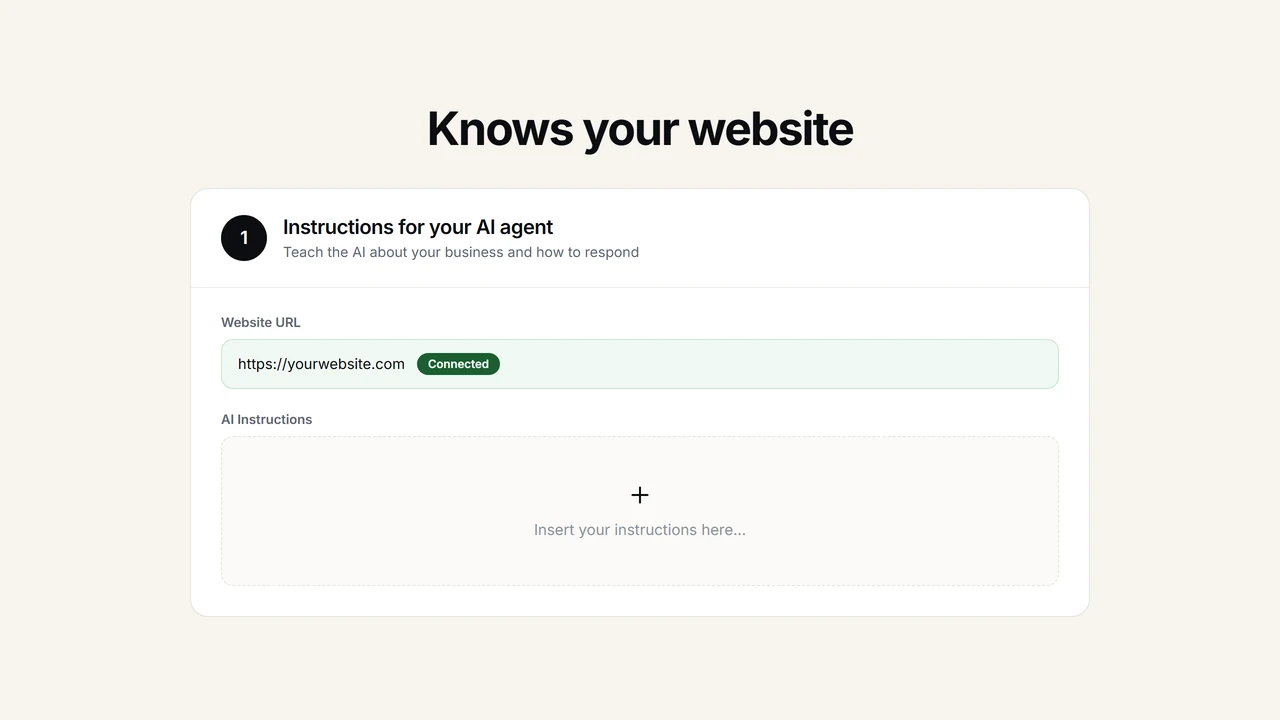
The HubSpot chatbot integration works by reading the content you have already created. Point Asyntai at your domain and it indexes your HubSpot pages, landing pages, blog articles, knowledge base entries, and any gated content you unlock for crawling — building a single answer layer across your entire HubSpot-hosted presence.
- Full HubSpot CMS crawlSite pages, campaign landing pages, pillar content, blog clusters, resource libraries — every published URL under your HubSpot domain becomes part of the chatbot's knowledge without manual entry.
- Supplement with off-site materialsSales decks, competitive battle cards, product roadmap summaries, internal objection-handling docs — uploaded as PDFs or pasted text to fill the gaps between what your site says and what prospects actually ask.
- Tone and guardrail instructions"Mirror our brand voice from the blog." "When competitors are mentioned, acknowledge and pivot to our differentiators." "Always include a demo booking link when deal size is mentioned." You dictate the conversational boundaries.
Every captured lead arrives with the full conversation — ready for your intake process
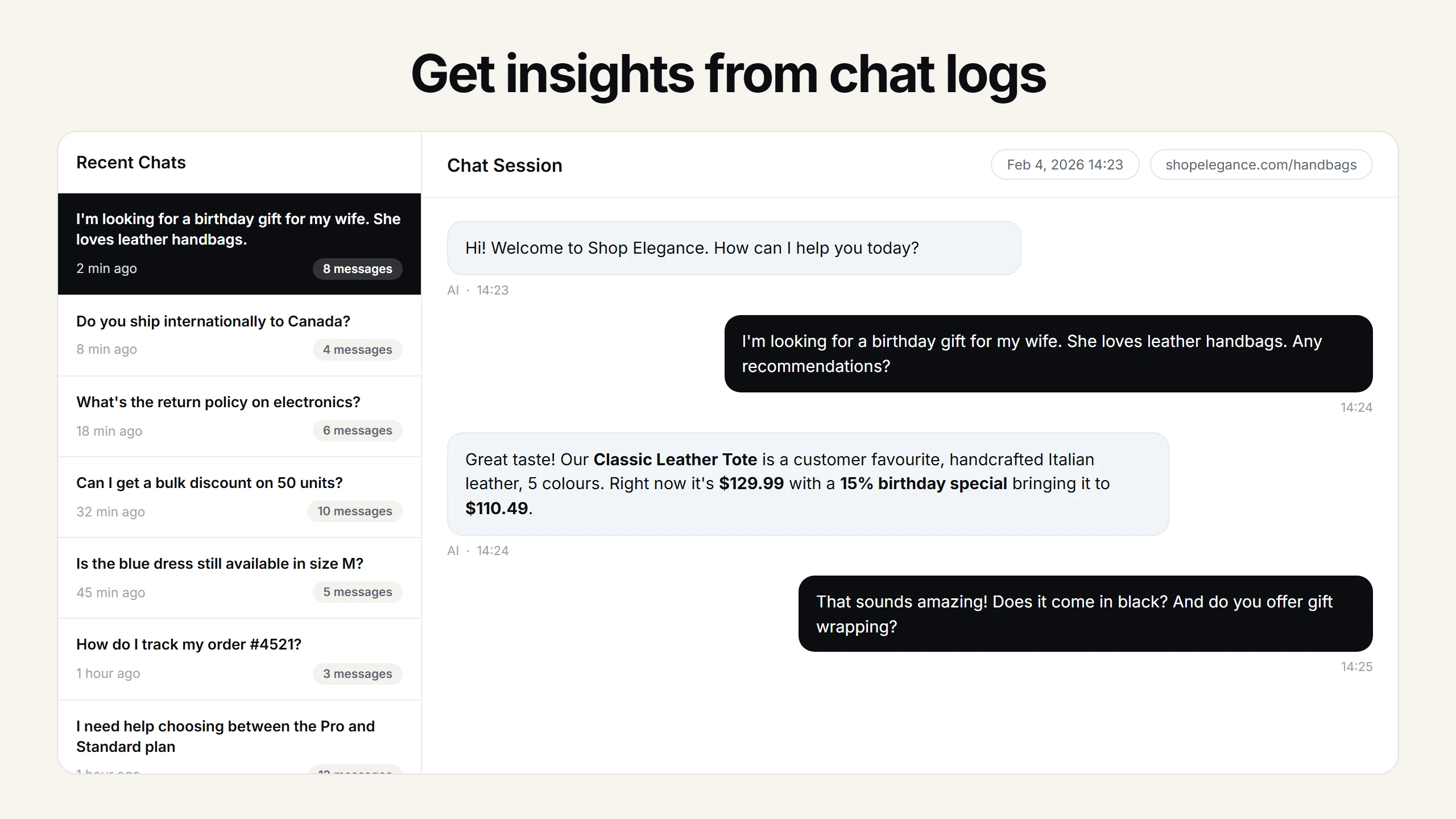
The HubSpot chatbot integration captures prospect details during natural dialogue and delivers them to your Asyntai dashboard and email inbox. From there, your team imports the contact into HubSpot CRM through the workflow you already maintain — manual entry, form submission, or an automation tool you prefer.
- Contextual lead captureThe AI collects name, email, and optional phone at a conversational inflection point. Each lead record includes every message exchanged so your rep has full context before the first outreach.
- Dashboard plus email deliveryLeads accumulate in the Asyntai dashboard for review, and real-time email notifications push each new lead to your team the moment it is captured — no polling required.
- User Context for known visitorsOn Standard and Pro plans, your HubSpot site can push visitor data into window.Asyntai.userContext — contact name, lifecycle stage, deal value, membership tier — so the chatbot tailors its replies to each returning visitor.
Installs through HubSpot Site Header HTML in three minutes
The HubSpot chatbot integration does not require a HubSpot Marketplace listing, an OAuth approval, or a developer sprint. You paste a JavaScript snippet into the same Site Header HTML field where you would add any third-party tracking tag, save, and the chatbot is live across every page under that domain.
- Sign up for a free Asyntai account and copy the JavaScript snippet from your dashboard.
- In HubSpot, navigate to Settings → Website → Pages and open the Site Header HTML field (or per-domain settings on Marketing Hub Professional).
- Paste the snippet, save the settings, and the chatbot appears on every HubSpot-hosted page.
- Feed Asyntai your HubSpot domain URL, let it crawl your published content, and activate the AI.
<script src="https://asyntai.com/widget.js"
data-id="your-site-id" async>
</script>
# Paste into HubSpot Site Header HTML field — live immediately.
HubSpot chatbot integration — FAQs
What HubSpot teams ask before integrating an external AI chatbot alongside their CMS.
How does this differ from HubSpot Conversations and Chatflows?
HubSpot Conversations routes messages to your team inbox and ties threads to CRM contact records. Chatflows use branching logic to qualify visitors through predefined paths. The Asyntai integration is a generative AI chatbot that reads your published content and produces original answers to open-ended questions. It is strongest at fielding the anonymous top-of-funnel traffic that arrives before a contact record even exists, while HubSpot Conversations excels once the contact is in your CRM and you need agent routing.
Does the integration sync leads into HubSpot CRM automatically?
No — there is no native CRM sync. Captured leads arrive in the Asyntai dashboard with the complete chat transcript, and email notifications push each one to your sales inbox in real time. Your team then adds the contact to HubSpot CRM through your preferred method — a manual CRM entry, a form workflow, or an intermediary automation tool. For teams that require zero-touch CRM injection, HubSpot's own Chatflows will be a tighter fit for that specific requirement.
Where exactly do I paste the snippet in HubSpot?
Go to Settings → Website → Pages in your HubSpot portal. The Site Header HTML field accepts any JavaScript snippet — Asyntai's goes in the same place you would put Google Tag Manager or LinkedIn Insight Tag. If you run multiple domains on Marketing Hub Professional or Enterprise, each domain has its own header field and you can decide which domains get the chatbot.
Will it conflict with HubSpot tracking scripts or existing chatflows?
No. The widget loads asynchronously as a self-contained overlay. It does not modify the DOM elements that HubSpot's own tracking, analytics, or chatflow scripts depend on. The two systems operate in parallel on the page without interference.
Can the chatbot speak languages that HubSpot Chatflows do not support?
Yes. The Asyntai widget UI supports 36 languages and the AI responds in whatever language the visitor uses. HubSpot Chatflows support a smaller set of languages for automated replies. If your HubSpot site serves a multilingual audience — particularly in regions where HubSpot's native language coverage has gaps — this integration provides full-spectrum language support from a single installation.
Can I personalize chatbot replies for visitors already in my HubSpot database?
Absolutely — through User Context, which is available on Standard and Pro plans. Your HubSpot CMS pages can push visitor-specific data — contact name, deal stage, product interest, membership level — into a JavaScript object before the widget loads. The AI uses that data to tailor its responses. You control exactly what is shared; no broad CRM API access is granted.
What does pricing look like for a HubSpot team?
Free tier: 100 messages per month, 1 site. The first paid tier runs $39/month and includes 800 messages. For HubSpot teams already paying for Marketing Hub or Service Hub, Asyntai is a separate, smaller line item that adds AI chat without triggering a HubSpot tier upgrade. The two costs are independent.
Can I run it on multiple HubSpot domains or subdomains?
Yes on paid plans. Free supports 1 site, Starter supports 2, Standard supports 3, and Pro supports up to 10. Each HubSpot domain or subdomain gets its own separate chatbot instance — relevant for agencies managing client HubSpot portals or companies running distinct brand sites.
HubSpot chatbot integration: adding an AI answer layer without disrupting your pipeline
Teams that have committed to HubSpot rarely do so casually. The CRM, the marketing automation sequences, the contact lifecycle stages, the reporting dashboards, the content strategy built around pillar pages and topic clusters — all of it forms a deliberate system. Introducing an external chatbot into that system triggers a reasonable question: does this complement what we have, or does it create friction? The answer depends entirely on what the chatbot does that HubSpot's native tools do not, and where it honestly falls short. A HubSpot chatbot integration worth deploying has to be transparent about both sides.
HubSpot's own conversational toolkit is built around structured interactions. Chatflows use branching logic — if the visitor clicks Option A, show Message B; if they type a keyword, route to Inbox C. This works well for qualification workflows where the goal is to sort visitors into buckets and hand them to the right team. It works poorly for the visitor who types a nuanced question about your service, your pricing model, your technical compatibility, or your onboarding process and expects a thoughtful answer rather than a menu of options. That visitor, statistically, is the majority of your anonymous site traffic. They arrived from a search result or an ad click, they have a real question, and they will judge your company by whether they get a real answer or a scripted redirect.
The HubSpot chatbot integration from Asyntai handles that second category of visitor. It reads your HubSpot CMS content — every published page, every blog article, every landing page, every knowledge base entry — and produces answers that draw on what you have actually written. When a visitor asks "how does your onboarding process work for enterprise accounts," the chatbot does not offer three buttons; it assembles an answer from your onboarding page, your enterprise FAQ, and any supplementary documents you uploaded. The response is specific to your business because the knowledge base is your content, not a generic model output.
Where the integration sits in your existing HubSpot architecture is a practical question that deserves a concrete answer. The snippet goes into Site Header HTML — the same settings field where you paste Google Tag Manager, your Meta Pixel, your LinkedIn Insight Tag, or any other third-party script. There is no HubSpot Marketplace app to install, no OAuth authorization flow, no CRM permissions to approve. The chatbot operates as an independent layer on your site. It coexists with HubSpot tracking scripts, HubSpot forms, and even HubSpot's own Chatflows if you choose to run both simultaneously. The two systems do not share data, which is both a limitation and a benefit: a limitation because leads do not flow into your CRM automatically, a benefit because no broad API permissions are granted and the integration has zero surface area for breaking your existing marketing automation.
Lead capture through the HubSpot chatbot integration works as a conversation-native flow rather than a form interruption. When the AI determines that a visitor is expressing genuine buying intent — asking about pricing, requesting a demo, wanting to compare plans — it asks for their name and email within the natural rhythm of the dialogue. The captured lead, with the complete conversation transcript attached, arrives in two places: the Asyntai dashboard and your team's email inbox via real-time notification. What happens next is your decision. Some HubSpot teams manually create a CRM contact from the transcript. Others forward the notification email to a HubSpot-connected inbox that generates a ticket. Others use a Zapier or Make workflow to push the data into a HubSpot form submission. The flexibility is genuine, but so is the manual step — there is no magic connector that auto-populates your HubSpot pipeline.
Acknowledging that gap honestly matters more than burying it in marketing language. If your organization processes hundreds of chat leads per week and needs every single one to appear as a CRM contact record with lifecycle stage, lead source, and first conversion attribution within seconds of capture, HubSpot's native Chatflows routed to a team inbox will serve that specific requirement better. If your chat lead volume is moderate and your team already has a lightweight process for importing contacts — as most small and mid-market HubSpot customers do — the transcript-to-inbox workflow adds minimal friction while giving you something HubSpot's native tools cannot provide: an AI that actually answers questions instead of routing them.
Content indexing reveals a secondary benefit that HubSpot marketers appreciate once they see it in action. The chatbot's conversation logs become a continuous audit of your content effectiveness. When the same question surfaces repeatedly — "do you offer monthly billing," "what integrations do you support," "is there a self-serve plan" — it signals a gap in your published HubSpot pages. Your pillar content missed a subtopic, your pricing page buried a detail, or your product page assumed knowledge the visitor does not have. Conversation analytics group these patterns by frequency inside the Asyntai dashboard, giving your content team a prioritized backlog of pages that need revision. For HubSpot teams that invest heavily in content marketing, this feedback loop is often worth the integration cost on its own.
Multilingual coverage is the feature that HubSpot teams evaluating a chatbot integration tend to underestimate until they see the data. HubSpot Chatflows can display messages in whatever language you manually configure, but the branching logic and automated replies are limited to the languages you explicitly build flows for. The Asyntai chatbot detects the visitor's language from their first typed message and responds accordingly — German to a German visitor, Japanese to a Japanese visitor, Portuguese to a Portuguese visitor — without you configuring anything per language. For HubSpot sites that attract international traffic, which is common for B2B SaaS, consulting, and professional services firms, this means every visitor gets a native-language experience from the same single snippet installation. No duplicate chatflows, no separate language bots, no translation plugin.
Timezone coverage is the other dimension that matters for teams already running HubSpot. Your marketing automation runs around the clock — emails drip at scheduled times, workflows trigger on form submissions regardless of when they happen, contact scoring accumulates passively — but your live chat coverage stops when your team signs off. The HubSpot chatbot integration runs continuously. A prospect who arrives at your HubSpot site at 11 PM because they finally have time to research vendors gets the same quality answer as someone who visits at 2 PM during your business hours. For B2B companies where the research phase often happens after hours, this coverage shift converts sessions that would otherwise become anonymous bounces in your HubSpot traffic analytics.
The User Context feature on Standard and Pro plans bridges the gap between anonymous and known-visitor experiences. If your HubSpot CMS site can identify a returning visitor — through a login system, a cookie handshake, or a URL token from a HubSpot email — your pages push that visitor's data into a JavaScript object before the widget loads. The chatbot then sees whatever context you shared: contact name, company, lifecycle stage, product interest, deal value, membership tier. A returning prospect who opens the chat gets greeted by name and given answers relevant to their status, because your site pushed the data that makes personalization possible. The mechanism does not require CRM API access; it uses whatever data your HubSpot CMS template already has available on the page.
Pricing for the HubSpot chatbot integration exists on a completely separate axis from your HubSpot subscription. This matters because HubSpot's own advanced chat features — removal of branding, advanced chatbot actions, custom coded bot steps — are gated behind Marketing Hub Professional or Service Hub Professional tiers that cost several hundred dollars per month and include many capabilities you may not need. Asyntai is $39 per month for 800 messages on the lowest paid tier, with a free plan covering 50 messages for testing. For HubSpot teams on Starter tier or even Free CRM who want AI chat without a HubSpot upgrade, the math is straightforward: you get a generative AI chatbot for a fraction of the cost of jumping to the next HubSpot tier, and you keep your HubSpot subscription exactly where it is.
Multi-site support scales with the plan tier. Free covers 1 domain, Starter covers 2, Standard covers 3, and Pro covers up to 10. Each domain receives its own separate chatbot with its own knowledge base and conversation history. This is directly relevant for HubSpot agencies managing multiple client portals — each client's HubSpot CMS domain gets an independently configured AI chatbot under a single Asyntai account, with separate analytics and a separate knowledge base per client site.
The strongest test of whether a HubSpot chatbot integration belongs in your stack is a two-week pilot on your primary HubSpot domain. Install the snippet in Site Header HTML, feed Asyntai your domain URL, let it crawl your published content, and switch on the chatbot. Watch the conversation logs. See what your visitors actually ask. Compare the AI's answers to what your sales team would have said. If the quality holds and the lead capture workflow fits your process, scale to paid. If it does not, remove the snippet — the entire integration uninstalls in ten seconds. For HubSpot teams that want AI chat without architectural disruption, that low-commitment entry point is usually the most convincing argument.