HubSpot AI chat that works on any HubSpot CMS site
Asyntai offers HubSpot AI chat that installs as a single script tag in your HubSpot CMS header — reads your pages and blog content, answers visitors 24/7 in 36 languages, and captures leads with full context for your team.
Try HubSpot AI chat on your site
Paste your HubSpot site URL and see how the chat would answer your actual visitors
Answers from your HubSpot pages, landing pages, and blog
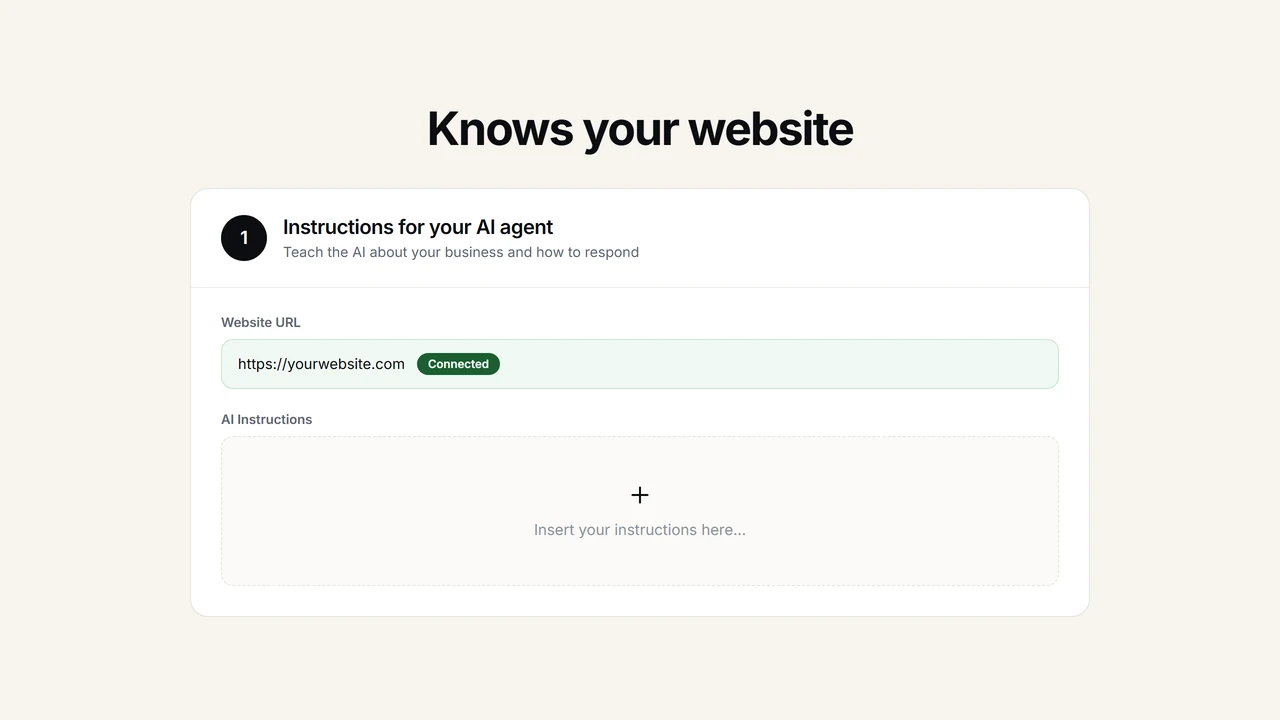
Asyntai crawls your HubSpot-hosted site and reads everything public — core pages, landing pages, blog articles, pricing, case studies, policy pages — then blends anything private you upload into a single knowledge base.
- Auto-reads your HubSpot siteEvery published page, landing page, and blog post becomes part of the chat's working knowledge. No manual Q&A curation required.
- Upload private documentsInternal pricing guides, proposal templates, product spec sheets, onboarding docs — added as PDFs or pasted text to cover content not on your public HubSpot site.
- Voice and rules in plain English"Offer a demo when pricing is asked." "Route enterprise inquiries to sales." "Mention our case studies when industry questions come up." You write the rules; the HubSpot AI chat follows them.
Captures leads with full conversation context — then hands them to your workflow
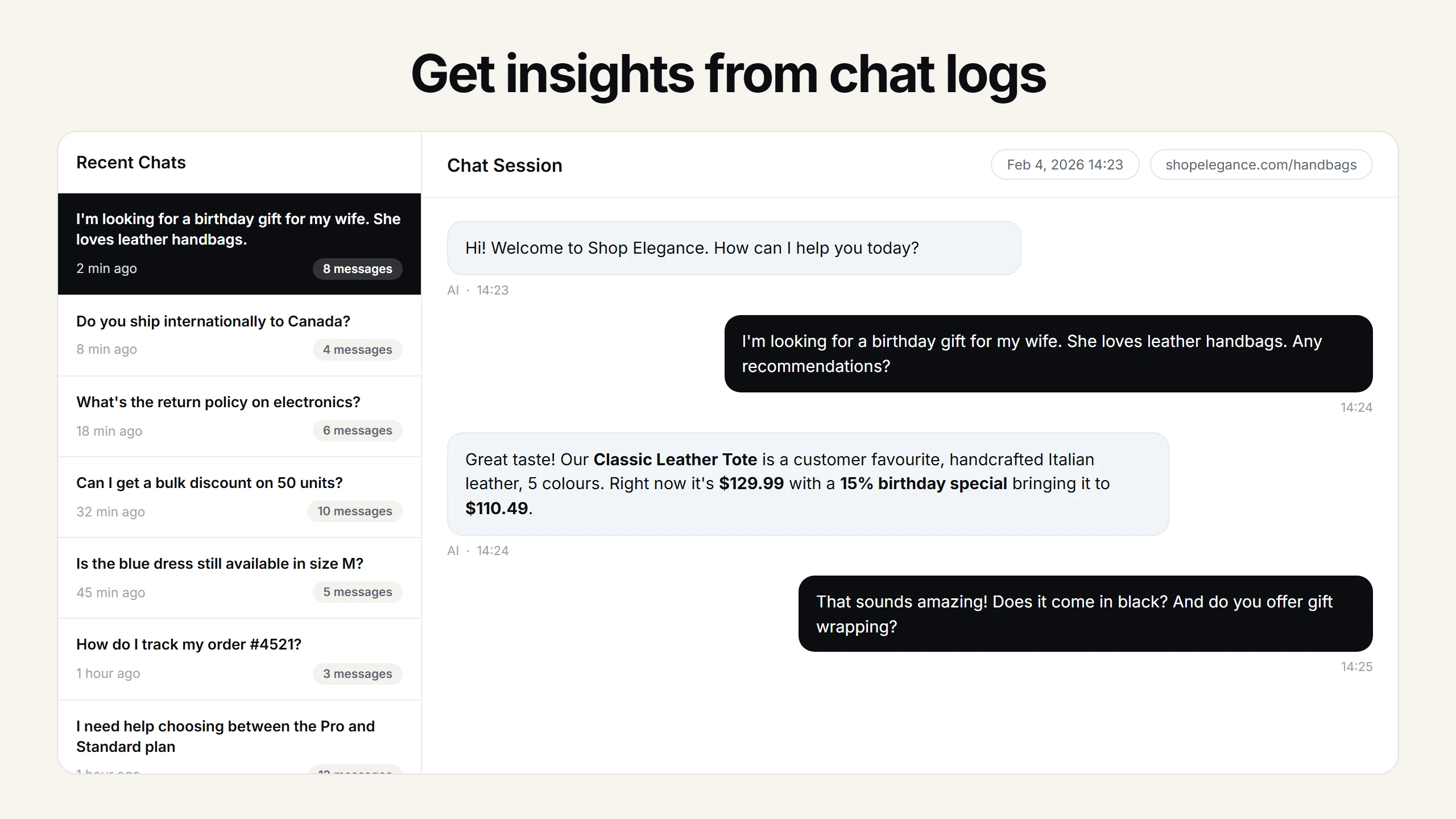
Asyntai captures contact details mid-conversation and delivers them to your Asyntai dashboard and email inbox, so your team can review the transcript and add the contact to HubSpot through your existing lead-entry process.
- Smart lead capture in chatThe AI asks for name, email, and optionally phone at the right moment. Every lead arrives with the full chat transcript attached.
- Real-time email notificationsTurn on notifications and every new lead lands in your sales team's inbox the moment it happens, transcript included.
- User Context for logged-in visitorsWith User Context on Standard and Pro plans, your HubSpot site can pass known visitor data into the chat for personalized replies — account tier, pipeline stage, or any other context you choose.
Installs on HubSpot CMS in two minutes
Adding HubSpot AI chat from Asyntai doesn't require a HubSpot marketplace app or an IT ticket. Paste a single JavaScript snippet into your HubSpot CMS site settings under Website Header HTML, and the chat is live on every page.
- Sign up for a free Asyntai account and copy your personal snippet.
- In HubSpot, go to Settings → Website → Pages → Site Header HTML (or per-domain header settings on Marketing Hub).
- Paste the snippet into the Site Header HTML field and save.
- Point Asyntai at your HubSpot site URL so the AI learns your content, then go live.
<script src="https://asyntai.com/widget.js"
data-id="your-site-id" async>
</script>
# Paste into HubSpot Site Header HTML — done.
HubSpot AI chat — FAQs
What HubSpot users typically check before adding AI chat to their CMS site.
Does this replace HubSpot Conversations or ChatSpot?
No — it's a complementary option. HubSpot Conversations is built around your HubSpot CRM data and is great if you want chat tightly coupled with HubSpot's native workflow. Asyntai is an AI-first chat that trains on your site content and answers visitors around the clock, regardless of whether they're in your CRM yet. Many teams use Asyntai on their public pages and switch to HubSpot's native tools for logged-in customer support inside gated apps.
Does Asyntai integrate directly with HubSpot CRM?
Not with a native HubSpot CRM sync. Leads captured in the HubSpot AI chat land in your Asyntai dashboard with the full conversation transcript, and email notifications send the same transcript to your team's inbox. From there, your sales team adds the contact to HubSpot CRM through whatever lead-entry workflow you already use. For teams that want true automated CRM sync, a traditional HubSpot-native tool will be a closer fit.
How do I install Asyntai on a HubSpot CMS site?
Paste the Asyntai JavaScript snippet into Settings → Website → Pages → Site Header HTML (or your per-domain header settings in Marketing Hub). That's the same place you'd add Google Tag Manager or any other third-party script. No HubSpot marketplace app required.
Can the AI personalize replies for logged-in contacts?
Yes, via the User Context feature on Standard and Pro plans. Your HubSpot CMS site passes data about the logged-in visitor — name, account tier, lifecycle stage, anything you choose — into a JavaScript object before the widget loads. The AI uses that context to give personalized answers. You control exactly what the chat sees, because the data is pushed from your own site.
Does the chat handle multiple languages?
Yes. The widget UI supports 36 languages and the AI detects the visitor's language from their first message. A French visitor gets French, a Japanese visitor gets Japanese, a German visitor gets German — without any translation setup on your HubSpot site.
Will the snippet conflict with HubSpot tracking or other scripts?
No. The Asyntai widget loads asynchronously and runs as a separate overlay on top of your HubSpot site. It coexists with HubSpot tracking scripts, Google Tag Manager, Meta Pixel, LinkedIn Insight Tag, and any other third-party tags you're already running.
How does the cost compare to upgrading HubSpot tiers for chat features?
HubSpot's advanced chat and chatbot features scale with their Marketing Hub and Service Hub tiers, which can be significant step-ups. Asyntai starts free for 50 messages per month and paid plans begin at $39/month for 800 messages. For teams already on a lower HubSpot tier, Asyntai often provides more capable AI chat without triggering a HubSpot upgrade.
Can I run Asyntai on multiple HubSpot sites?
Yes on paid plans. Free: 1 site, Starter: 2, Standard: 3, Pro: up to 10. Each HubSpot site gets its own separately trained AI chat — useful for agencies managing multiple client sites in HubSpot or businesses running several HubSpot domains.
HubSpot AI chat, explained for teams already on the stack
If you're running your website on HubSpot CMS and your sales pipeline inside HubSpot CRM, you've already made a meaningful commitment to how the front-of-funnel works. HubSpot's built-in Conversations tool gives you a chat widget that pairs cleanly with your CRM records, and ChatSpot adds an AI layer for your team's internal use. For a lot of HubSpot customers, that's enough — especially if the vast majority of your chat traffic is from known logged-in contacts whose data is already in HubSpot. But a growing number of teams hit a specific limitation: the native chat feels like a lead-routing tool rather than an answer engine for the anonymous majority of your website traffic. That's the gap HubSpot AI chat from Asyntai is designed to fill.
The first distinction worth naming is the type of visitor each tool serves best. HubSpot Conversations is at its strongest when a logged-in contact — someone whose record already lives in your HubSpot CRM — starts a chat that benefits from CRM context. The routing to a team inbox, the timeline attachment to the contact record, the lifecycle stage updates — all of this works well for existing relationships. The tool is less effective when the visitor is completely anonymous, has never engaged with your site before, and wants an answer in seconds. That second category tends to be the larger traffic pool on most HubSpot sites. AI chat that's already read your actual content serves them much better, because the AI can actually answer rather than route.
Training is where the practical difference shows up. HubSpot's built-in chatbot relies heavily on rule-based flows — you construct branches of predefined responses, and the bot routes visitors through those branches. This approach works for a narrow set of predictable scenarios and breaks the moment a visitor asks a question in an unexpected phrasing. Asyntai skips the flow-building entirely. You point the HubSpot AI chat at your site URL and the AI crawls your HubSpot pages, landing pages, and blog posts automatically. Any internal content — pricing guides, proposal templates, partner lists, technical documentation that isn't public — gets uploaded as PDFs or pasted text. The chat then answers freely, grounded in your actual content, without you having to predict every possible question in advance.
The integration question is where teams evaluating HubSpot AI chat want a clear answer rather than marketing copy. Asyntai is honest about its shape: it installs as a JavaScript snippet in your HubSpot CMS site's header, behaves like any other third-party script, and does not have a native HubSpot CRM integration. Captured leads do not automatically push to contact records in your HubSpot CRM the way HubSpot's native chat does. Instead, leads land in your Asyntai dashboard with the full conversation transcript, and — if you turn on email notifications — in your sales team's inbox the moment the lead is captured. Your team reviews the transcript and adds the contact to HubSpot CRM through your existing lead-entry workflow, whether that's a form submission, a Zapier step, or a manual add.
Framing that limitation honestly matters, because the right answer depends on your team's volume and workflow. If you're a small or mid-sized business whose lead volume through chat is manageable by hand, the "transcript to inbox → manual HubSpot add" flow is straightforward. If you're an enterprise running thousands of chat sessions a week and need every lead to automatically sync as a HubSpot contact, HubSpot's native Conversations tool is a better fit for that specific workflow. Many teams actually use both: Asyntai as the AI-powered first-response layer on anonymous visitor traffic, and HubSpot Conversations for logged-in customer support where the CRM integration is essential.
Install on a HubSpot CMS site is one of the simpler experiences across the web. HubSpot lets you paste arbitrary script tags into the site header through Settings → Website → Pages → Site Header HTML, or through the per-domain settings if you're on Marketing Hub Professional or Enterprise. The Asyntai snippet goes into that field the same way you'd add a Google Tag Manager container, a LinkedIn Insight Tag, or a Meta Pixel. No HubSpot marketplace app, no OAuth flow, no permission grants. The snippet loads asynchronously and coexists with every other tracking and measurement script you're already running on the site.
The 24/7 coverage question is where HubSpot AI chat earns its keep for most teams. HubSpot Conversations is human-agent-first by design; even with the chatbot feature handling some routing, the more substantive responses depend on someone from your team being online. That's viable during business hours and hard to justify outside them. Asyntai answers every question, at every hour, in every language it supports, without anyone needing to be at a desk. For teams where the bulk of chat volume arrives outside business hours — global audiences, evening product-research traffic, weekend browsers — this shift in coverage is often worth more than any specific feature.
Languages are the other quiet multiplier. HubSpot's native chatbot supports a limited set of languages for its automated replies, and human agent coverage in other languages depends on who you've hired. The Asyntai widget supports 36 languages in the UI and the AI detects the visitor's language directly from their message — so the HubSpot AI chat responds in French to a French visitor, in German to a German visitor, in Japanese to a Japanese visitor, from the same single installation. For HubSpot sites serving international audiences, this alone is often the reason the team adopts an AI chat layer in addition to their existing HubSpot setup.
Personalized answers for logged-in HubSpot visitors work through the User Context feature on Standard and Pro plans. Your HubSpot CMS site can pass logged-in visitor data — contact name, account tier, lifecycle stage, any relevant context — into a JavaScript object before the widget loads. The AI uses that context for personalized responses without needing any API integration with HubSpot's backend. A returning contact who opens the chat can be greeted by name and given answers specific to their status, because your site has already pushed the data that makes that possible. You decide exactly what's shared; nothing is pulled in a way that would require broad CRM permissions.
Pricing is where HubSpot AI chat gets interesting for teams on lower HubSpot tiers. HubSpot's more advanced chat and chatbot features are gated behind Marketing Hub Professional, Service Hub Professional, or higher — tiers that often cost several hundred dollars a month and include a lot of other capabilities you might not need. Asyntai is a separate, smaller spend: free for 50 messages per month, $39 per month for 800 messages, scaling up from there. For teams already paying for HubSpot's CRM and core Marketing Hub features but not needing the full Service Hub suite, adding Asyntai for the AI chat layer is usually cheaper than upgrading HubSpot tiers. The two costs are orthogonal, and the feature sets you're paying for are different.
What visitors ask the HubSpot AI chat becomes a running audit of where your site needs better content. Every recurring question points at something your pages, landing pages, or blog posts aren't communicating clearly enough. If twenty visitors this month asked about your pricing model, your pricing page needs tightening. If most international visitors ask which regions you serve, your about page needs geographic clarity. If the same question keeps surfacing under a specific blog post, that post needs a better conclusion or its own FAQ section. Conversation analytics group these patterns by frequency and topic inside the Asyntai dashboard, so you can see what to fix rather than guessing from scattered form submissions.
The HubSpot customer segments that benefit most from adding Asyntai to their stack are predictable. B2B SaaS companies running HubSpot for marketing and sales win on pre-sale qualification — the AI answers "what's your pricing" and "do you integrate with X" questions instantly, routing only the high-intent prospects to humans. Agencies and consultancies using HubSpot CMS for their own site win on after-hours inquiry capture. Professional services firms win on scope qualification before booking. Growing ecommerce brands that use HubSpot alongside Shopify or BigCommerce win on international-language coverage that HubSpot native chat doesn't provide. Enterprise teams with dedicated support organizations might still prefer HubSpot's native tools end-to-end — but for most HubSpot customers in the small and mid-sized range, the AI-first layer adds value without conflicting with their existing setup.
The practical recommendation for teams evaluating HubSpot AI chat is to install Asyntai on a single HubSpot subdomain or a secondary site for a week or two, watch how it handles your actual visitor traffic, and compare the answer quality and lead capture against whatever you're currently doing. The snippet is live in five minutes. The AI trains on your content in under an hour. The free plan covers enough conversations to evaluate whether the approach fits your business. For HubSpot customers who want AI chat without uprooting their existing setup, that pragmatic test is usually the fastest way to decide.