GoHighLevel conversation AI — real dialogue, not scripted flows
Add conversational AI to your GHL funnels that understands what visitors mean and answers naturally using your site's own content. No decision trees. No rigid menus.
See the conversational AI in action
Enter a website URL and have a real conversation with the AI — notice how it follows context, understands intent, and answers naturally
Understands what visitors mean, not just what they type
Traditional chatbot flows rely on button menus and keyword triggers. If a visitor phrases a question differently than expected, the flow breaks. Conversational AI works differently — it understands intent. Whether a visitor types "what's the price" or "how much would this run me" or "can I afford this", the AI recognizes they're asking about pricing and answers from your content. This is the fundamental shift from scripted chat to actual conversation.
- No keyword matching or decision treesThe AI reasons about meaning. It doesn't need exact phrases to trigger responses. "Do you guys deliver to Vancouver?" and "What areas do you service?" both get the same accurate answer from your coverage information — even though the words are completely different.
- Follows the thread of a conversationVisitors don't ask questions in isolation. They ask a follow-up. They refer back. They change topics. The AI tracks the full conversation context and understands pronouns, references, and topic shifts naturally — "what about the premium version?" after discussing a basic service makes sense to the AI without re-stating what they were talking about.
- Responds in complete, natural sentencesNo bullet-point dumps or form-letter answers. The AI composes responses that read like a knowledgeable human wrote them. Tone, length, and detail level adjust based on what the visitor asked — a quick factual question gets a concise answer, a complex comparison gets a thorough one.
Every answer comes from material you wrote
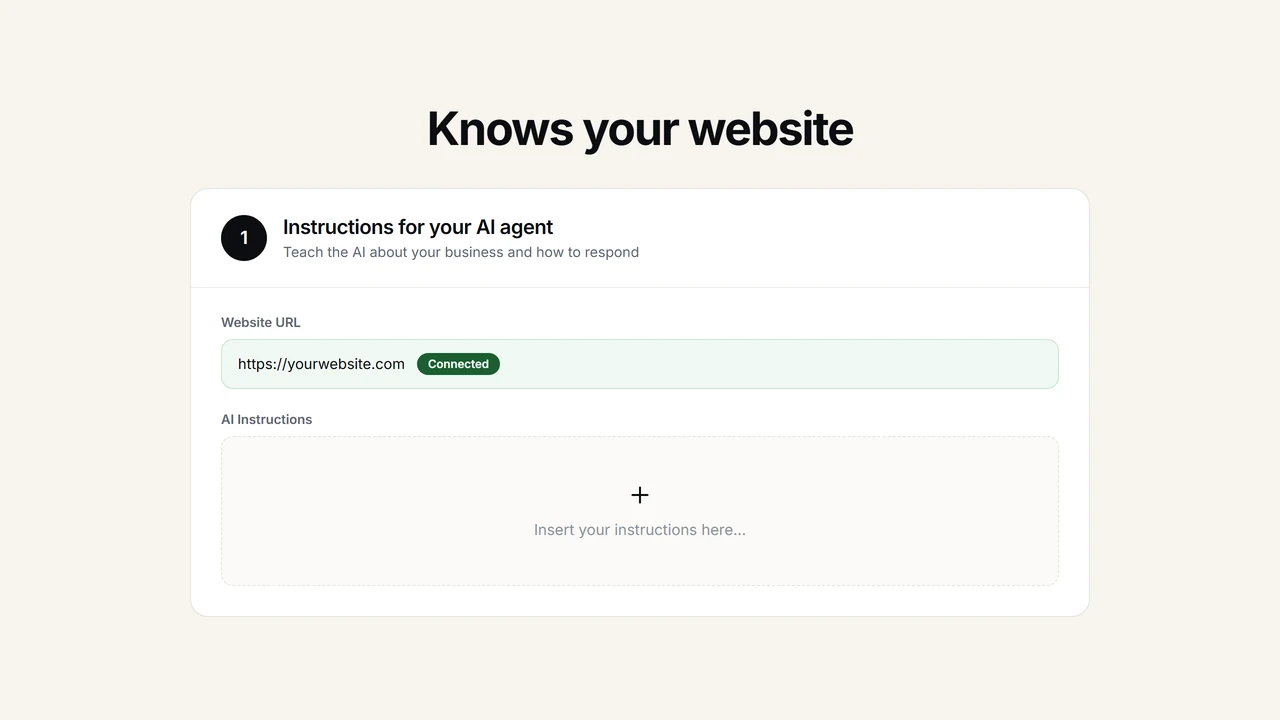
The AI crawls your website and reads your pages — services, pricing, policies, FAQs, product details, team information, location pages. When a visitor asks a question, the AI finds the relevant content and uses it to compose a natural answer. It is not generating information from generic training data. It is answering using your content. This is retrieval-based AI: the AI retrieves the relevant passages from your site and formulates responses grounded in what you actually published.
- Crawls up to 50 pages automaticallyPoint the AI at your website URL and it reads every accessible page — service descriptions, pricing tables, FAQ answers, about pages, blog posts, location details. The knowledge base is built in minutes with no manual data entry required.
- Stays accurate because it stays groundedThe AI does not make things up. When it answers, it draws from your content. If a visitor asks about something not covered in your pages, the AI says so honestly rather than fabricating an answer. You can also add custom content directly in the dashboard for topics not on your website.
- 36 languages from one content setWrite your content in English. The AI answers in whatever language the visitor uses — Spanish, German, Japanese, Arabic, 36 in total. The translation happens at response time, meaning one website in one language serves a global audience through the conversational AI.
Add conversational AI to your GoHighLevel site
A JavaScript snippet in your GHL funnel or website's custom code section. No marketplace app, no OAuth, no third-party connector. The AI starts learning your content as soon as you add your site URL.
- Create an Asyntai account and enter your website URL. The AI crawls your pages and builds a knowledge base from your content within minutes.
- Customize the chat widget — set the name, greeting message, colors, and avatar to match your brand or your client's brand.
- Copy the one-line script tag from your dashboard and paste it into the header custom code section of your GoHighLevel funnel or website.
- Publish the page. The conversational AI widget is live immediately. Visitors can start asking questions in natural language.
<script src="https://asyntai.com/widget.js"
data-id="your-site-id" async>
</script>
</head>
# Real conversation. One snippet.
GoHighLevel conversation AI — FAQs
Questions from agencies and funnel builders about adding conversational AI to their GoHighLevel pages.
How is conversational AI different from GHL's built-in chat features?
GoHighLevel's built-in chat and bot features rely on workflow-based logic — if/then rules, keyword triggers, and button menus that route visitors through predefined paths. Asyntai's conversational AI uses natural language understanding to interpret what visitors mean and answer from your website content. There are no flows to build, no keywords to define, no menus to design. The visitor types a question in their own words and gets a natural answer. Both tools can coexist on the same page — they serve different purposes.
Does the AI just repeat what's on my website?
No. The AI reads your website content and uses it as source material, but it composes original answers tailored to each question. If a visitor asks "is this service good for beginners?", the AI might pull from your service description, your FAQ, and your testimonials page to construct a complete answer. It synthesizes information from across your pages into a coherent response — it doesn't just copy and paste a paragraph from your site.
Can the AI handle follow-up questions?
Yes. The AI maintains conversation context throughout the chat session. If a visitor asks about your premium package, then says "how does that compare to the basic one?", the AI understands "that" refers to the premium package and compares both. If they later ask "and what's the refund policy on either?", the AI knows they're asking about refunds for the packages discussed. This contextual understanding is what makes it conversational rather than a series of disconnected Q&As.
Is this a native GoHighLevel integration?
No. Asyntai is a standalone AI chatbot that you add to GHL-built pages through a JavaScript snippet pasted into the custom code section. It does not integrate with GHL's CRM, calendar, or workflow system. It runs independently on the page as a conversational AI widget. The benefit of this approach is portability — the same widget works on GHL funnels, GHL websites, WordPress sites, Shopify stores, or any other platform where you can add a script tag.
What if the AI encounters a question it can't answer?
You configure fallback behavior through custom instructions in your dashboard. Options include: escalate to a live human through Asyntai's built-in handoff, tell the visitor to contact you at a specific email or phone number, collect the visitor's contact information and promise a follow-up, or simply acknowledge that the topic isn't covered. You can set different fallback rules for different topics — the AI follows your rules and doesn't guess at answers it doesn't have.
Can I control how the AI talks?
Yes. Custom instructions let you shape the AI's tone, boundaries, and priorities in plain English. "Be friendly but professional." "Never discuss competitor services." "Always mention our free trial offer." "Keep answers under three sentences unless the visitor asks for more detail." "If someone asks about enterprise pricing, ask for their company size and email." The AI reads your rules and applies them to every conversation.
How much does this cost for an agency with multiple clients?
Each client site is a separate Asyntai site with its own knowledge base and widget. The Starter plan covers 2 sites for $39/month. Standard covers 3 sites for $139/month with 15,000 messages. Pro covers 20 sites for $449/month with 50,000 messages and full white-label branding — no Asyntai logo visible anywhere. Agencies typically choose Standard for their first few clients and scale to Pro as the client count grows.
Does it work for non-English visitors?
Yes. The AI supports 36 languages and automatically detects which language the visitor is using. A visitor on an English-language GHL funnel can ask a question in French and get a complete, natural answer in French — drawn from your English content. No separate funnels, no translation plugins, no multilingual content management. One knowledge base serves every language automatically.
Can visitors tell they're talking to an AI?
That's up to you. You can name the widget anything — "Support", "Sarah", "Help Desk" — and set any avatar image. Some businesses are transparent about it being AI; others present it as an assistant without specifying. The conversational quality is natural enough that many visitors simply interact with it as they would with a human. Either way, the AI's responses are grounded in your content, so the answers are accurate regardless of how you brand the widget.
Conversational AI on GoHighLevel — what changes when the chat actually understands you
There's a moment in most chatbot interactions where the illusion breaks. The visitor types a genuine question. The chatbot responds with a button menu: "Which of the following best describes your question?" or "Please select a topic." The visitor didn't ask for a menu — they asked a question. But the chatbot doesn't understand questions. It understands clicks. This is the experience that GoHighLevel users know well from workflow-based bots, and it's the experience that conversational AI replaces entirely.
Conversational AI means the chat widget can read a visitor's message, understand what they're actually asking, and compose an answer in natural language. Not from a script. Not from a flow. From actual comprehension of the question matched against actual content from your website. The difference in visitor experience is immediate and dramatic. Instead of navigating a menu tree to find information, the visitor types "how much does the deluxe package cost and what's included?" and gets a complete answer in seconds. The conversation feels like talking to someone who knows the business — because the AI has read the entire website and uses that content to answer.
GoHighLevel agencies build funnels that convert well for visitors who arrive ready to act. The headline hooks them, the social proof reassures them, the CTA tells them what to do next. But a significant percentage of funnel visitors aren't ready to act — they're ready to ask. They have a question about the service, the pricing, the process, the qualifications. Traditional GHL funnels give these visitors two options: find the answer somewhere on the page, or leave. Neither option leads to a conversion. A conversational AI widget gives them a third option: just ask.
The technology behind this is retrieval-augmented generation — the AI retrieves relevant passages from your crawled content and uses them to generate a natural response. This is not the AI making things up from its general training data. When a visitor asks "do you offer weekend appointments?", the AI finds your scheduling page or FAQ entry about hours and constructs its answer from that material. If your site doesn't mention weekend hours anywhere, the AI says it doesn't have that information rather than guessing. The responses are grounded in your content, which keeps them accurate and on-brand.
The quality of the conversation hinges on two capabilities that simple chatbots lack: intent recognition and context tracking. Intent recognition means the AI understands that "what'll it set me back?" and "pricing information please" and "is this expensive?" are all asking about cost. You don't need to anticipate every possible phrasing and map it to a response — the AI reasons about meaning. Context tracking means the AI remembers what was discussed earlier in the conversation. If a visitor asks about the premium plan, then says "what about the basic one?", the AI knows "the basic one" is being compared to the premium plan. This makes conversations feel natural rather than like a series of disconnected queries.
For GHL agencies, the practical appeal of conversational AI over flow-based chatbots comes down to setup time and maintenance. A workflow-based bot requires you to anticipate every question, write every response, and build every branch in the decision tree. If clients add a new service, you update the flows. If visitors ask questions you didn't anticipate, the flow breaks. Conversational AI eliminates this entirely. You point the AI at the website, it crawls the content, and it can answer any question the content covers. When the client updates their site, the AI picks up the changes on the next crawl. No flow maintenance, no keyword lists, no branch updates.
The 36-language capability changes the math for agencies serving diverse markets. A GHL funnel for a real estate agent in Miami might get visitors in English, Spanish, Portuguese, and Creole. With a flow-based bot, you'd need separate flows for each language — quadrupling the build and maintenance work. With conversational AI, one English website serves as the knowledge base, and the AI answers in whatever language the visitor writes in. A Spanish-speaking visitor asks a question in Spanish and gets a fluent, accurate Spanish response drawn from the English content. No separate funnels. No translation management. The AI handles the language gap natively.
Installing conversational AI on a GHL page is deliberately simple. You paste a script tag into the custom code section of your funnel or website in the GoHighLevel builder. The widget appears on the page. That's the full installation. Asyntai is not a GHL marketplace app and does not connect to GHL's internal systems. It's an independent AI widget that happens to be installed on a GHL-hosted page. This distinction matters because it means the conversational AI works identically on any website platform. If a client has a GHL funnel and a WordPress blog, the same Asyntai widget runs on both with the same knowledge base.
Customization options let you shape both the visual appearance and the conversational behavior. Visually, you control the widget name, avatar, colors, greeting message, and input placeholder. On the Pro plan at $449/month, white-label branding removes the Asyntai name entirely — the widget looks like your own product. Conversationally, you write custom instructions in plain English that define how the AI should behave: "Always recommend the premium package when discussing options." "If someone mentions they're a student, mention the student discount." "Never promise specific delivery dates." "End every conversation by asking if they'd like to book a call." These rules apply to every conversation without building any logic flows.
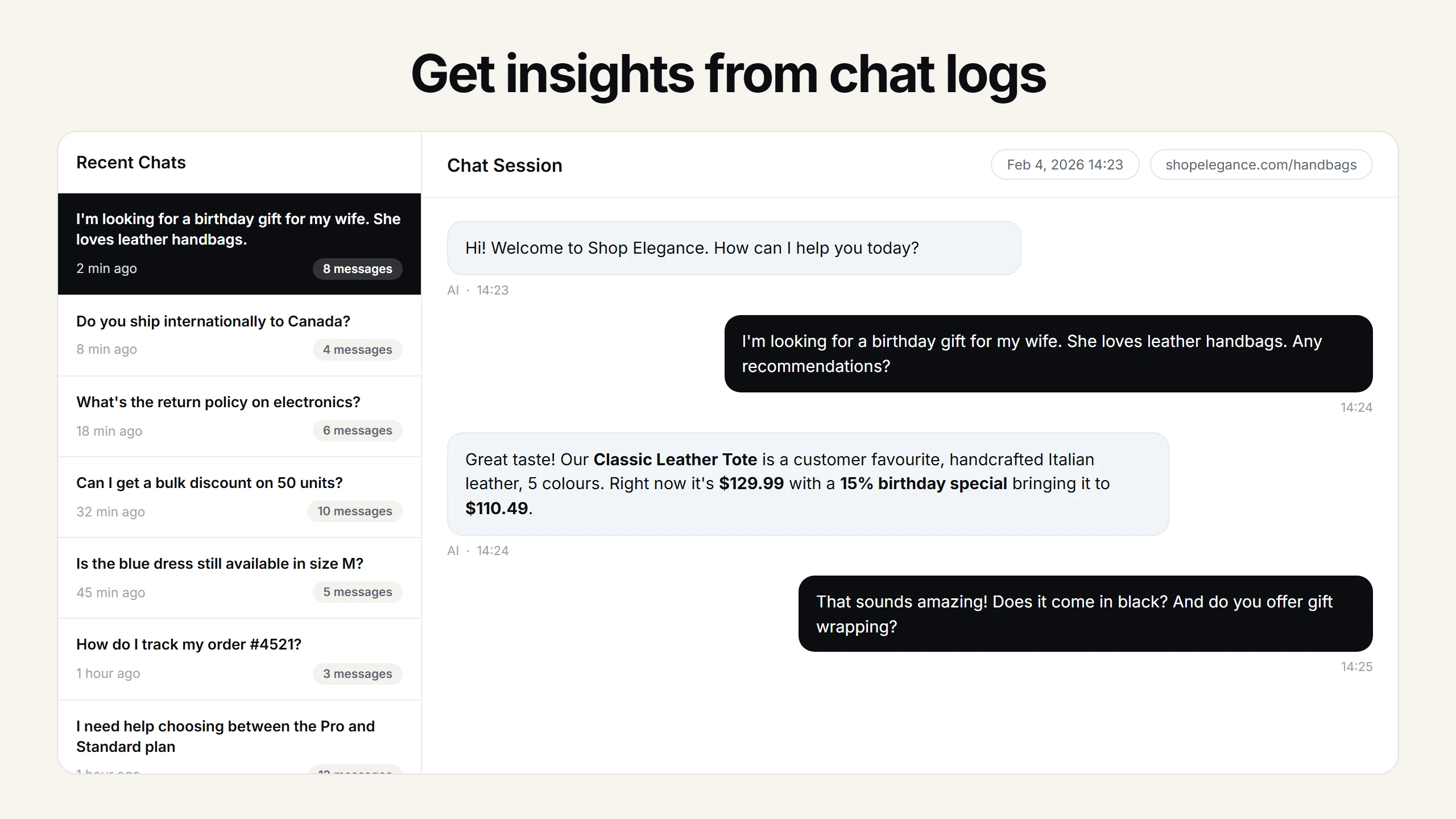
The visitor data captured through conversational AI is qualitatively different from what you get with form-based or flow-based chat. A flow-based bot captures structured answers to structured questions — name, email, budget range from a dropdown. Conversational AI captures what visitors actually want to know, in their own words. When you review the conversation logs in the Asyntai dashboard, you see the real questions: "Is this service appropriate for someone who's never done this before?" or "I had a bad experience with another provider — how are you different?" This is unfiltered voice-of-customer data. It tells you what your funnel copy should address, what objections visitors have, and what information gaps your pages leave open.
Human handoff preserves the safety net for conversations the AI can't fully resolve. When a visitor asks something not covered by the knowledge base, or when a situation requires human judgment — like a billing dispute or a custom pricing request — the AI can escalate to a live person through Asyntai's built-in handoff system. You configure the triggers: "If a visitor mentions a complaint, escalate immediately." "If the AI doesn't have the answer after two attempts, offer to connect with a team member." The transition is smooth — the human agent sees the full conversation history and picks up where the AI left off.
For agencies pricing conversational AI as a client service, the value proposition is cleaner than with traditional chatbots. Traditional chatbots require ongoing maintenance — new flows, updated responses, additional branches. Conversational AI maintains itself by recrawling the client's website. The agency's role shifts from bot builder to strategist: configuring the AI's custom instructions, reviewing conversation analytics, and optimizing the client's content based on what visitors are actually asking. This is a more sustainable recurring service than manually updating chatbot flows every time the client changes a menu item or adds a service.
The conversational AI doesn't replace GHL's built-in features — it complements them. GHL handles the backend: CRM, calendar, email sequences, workflow automations. The conversational AI handles the frontend: answering visitor questions, providing information, reducing friction on the funnel page. A visitor chats with the AI, gets their questions answered, gains confidence in the service, and then uses the GHL booking calendar or form to take action. The AI clears the informational hurdles; GHL converts the informed visitor into a lead or customer. Each tool operating in its strength zone.
Agencies that have deployed conversational AI on client funnels report a consistent pattern: the visitors who use the chat widget convert at higher rates than those who don't. This isn't because the AI is selling — it's because visitors who have lingering questions either get those questions answered (and proceed to book) or don't get them answered (and leave). The conversational AI makes "get them answered" the default outcome. A visitor who would have bounced with an unanswered question about pricing now has the answer in seconds and scrolls down to the booking calendar. The AI didn't change the funnel. It changed the visitor's readiness to act.
The gap between a scripted chatbot and conversational AI is the gap between a phone tree and a phone call. One forces you into a predetermined path and hopes your question fits a category. The other listens, understands, and responds. For GoHighLevel funnels where every visitor matters and every bounce costs ad dollars, that gap is the difference between a page that answers questions and a page that leaves visitors guessing. Conversational AI closes the gap with a single script tag.