GoHighLevel AI agent — the chat widget that actually does things
Deploy an AI agent on your GHL sites that answers questions from your content and calls your APIs to look up data, check status, and take action mid-conversation.
Watch the AI agent handle real requests
Enter a website URL and see how the AI answers knowledge questions and takes action — all in the same conversation
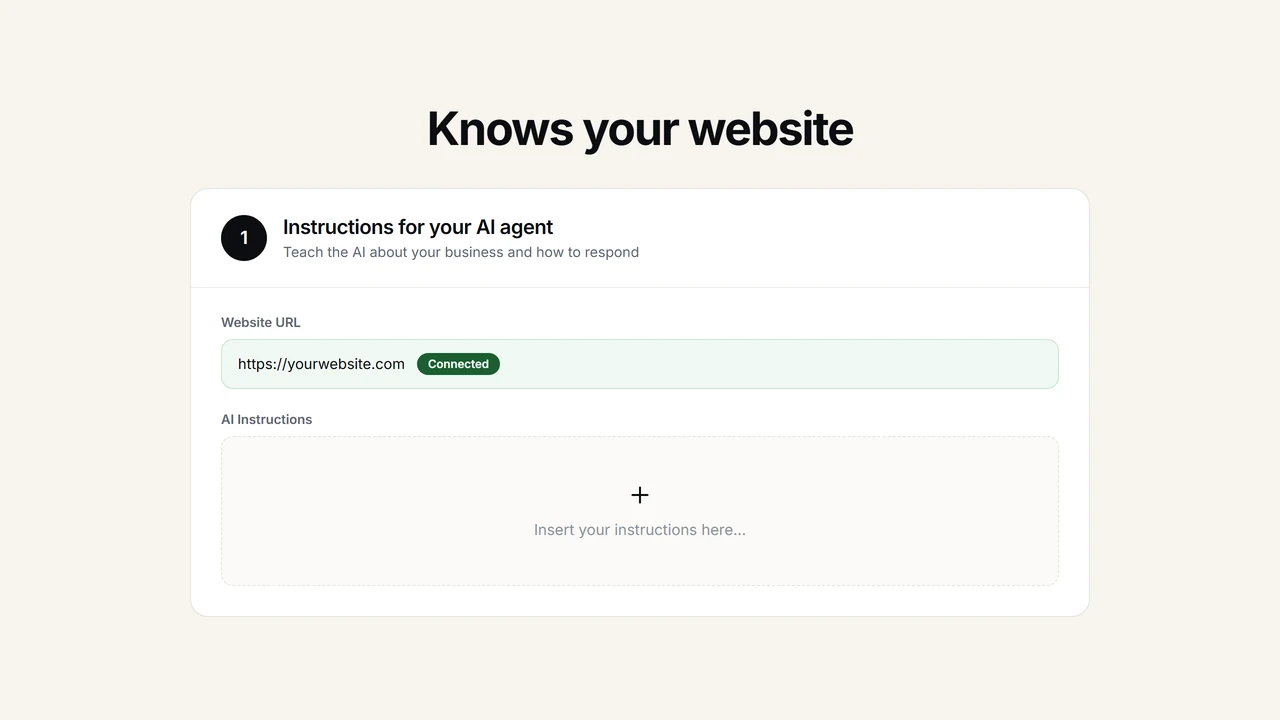
Learns your content and answers like someone who works there
The foundation of every AI agent is knowing the business. Asyntai crawls your client's website — service pages, pricing, policies, help articles, product descriptions — and builds a knowledge base the AI uses to answer visitor questions. No manual entry required. The AI reads the content, understands it, and delivers accurate answers to questions visitors phrase in any way, in any of 36 languages. This is the baseline that makes everything else work.
- Crawls the site, builds the knowledge basePoint the AI at a URL and it reads every page it can reach — up to 50 pages. Service descriptions, pricing tables, FAQ answers, return policies, team bios, location details. All of it becomes part of the AI's knowledge within minutes.
- Handles any phrasing, not just exact matchesVisitors don't ask questions the way FAQ pages are written. "What do you charge?" and "how much is a session?" and "pricing info" are all the same question. The AI understands intent and pulls the right answer regardless of how the question is worded.
- Multilingual from day oneThe AI detects the visitor's language and responds in kind — 36 languages supported. A Spanish-speaking visitor on an English-language GHL funnel gets answers in Spanish. No duplicate funnels or translation plugins needed.
Calls your APIs to look up data and take real action
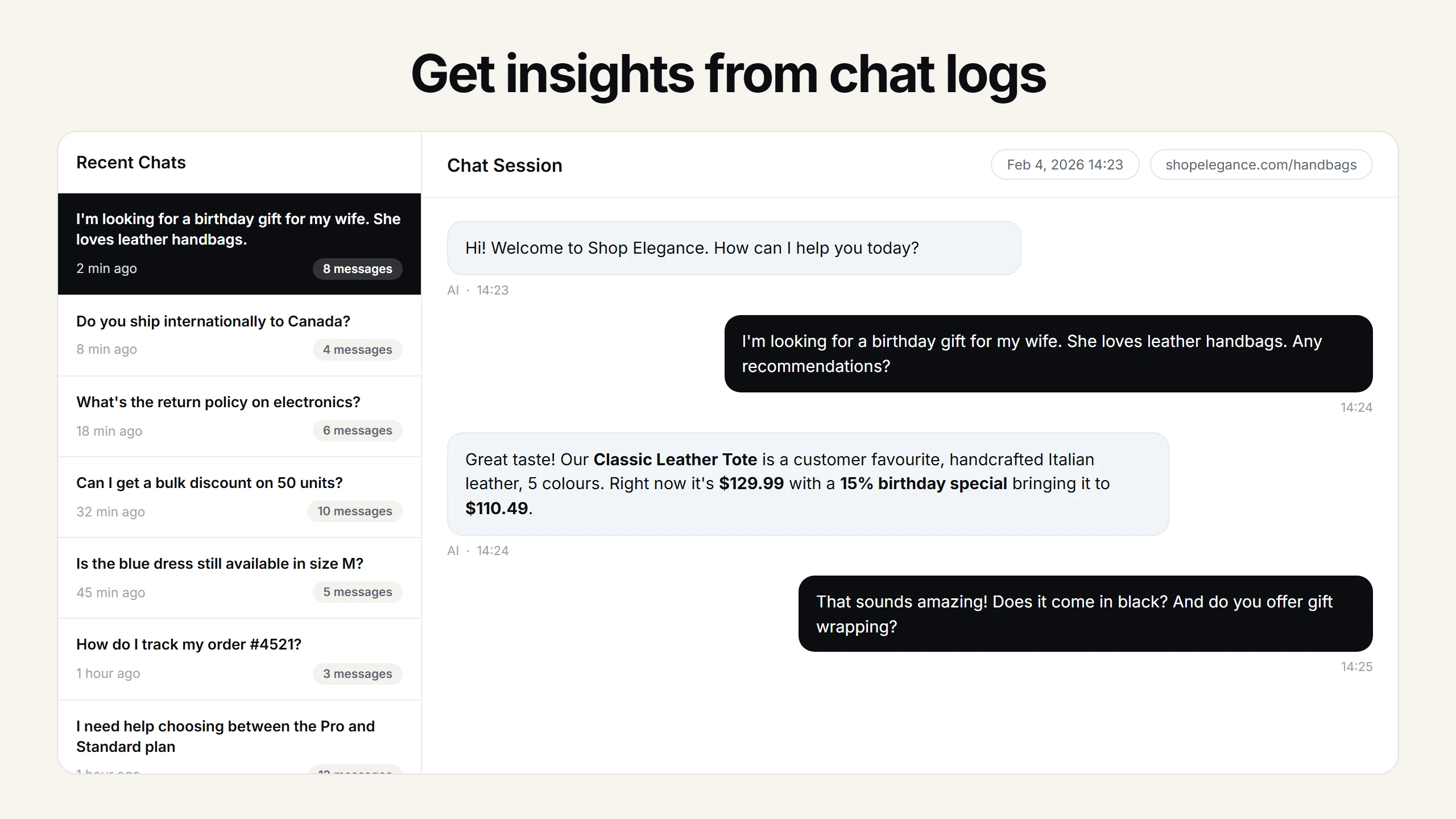
Knowledge answers cover half of what visitors ask. The other half needs live data — order status, account details, inventory counts, appointment availability. With Custom Tools, the AI agent calls your own API endpoints during a conversation, pulls real data, and responds with specifics. This is what separates an AI agent from a chatbot. Available on Standard ($139/month) and Pro ($449/month) plans.
- Define tools in your dashboard, no code on Asyntai's sideEach Custom Tool is a form: name the tool, describe when the AI should use it, paste your API endpoint URL, and define the parameters the AI should extract from the conversation. Save it and the tool is live.
- AI extracts parameters from natural conversationIf your tool needs an order number, the AI pulls it from whatever the visitor typed — "check order 4817" or "my order number is ORD-4817" or "I placed an order last Tuesday, number 4817." No rigid input formats required.
- Knowledge and action combine in a single replyA visitor asks about returning an item. The agent calls your order lookup API for the purchase date, reads your return policy from the knowledge base, and answers with both: "Your order is 12 days old and your return window is 30 days — here's how to start the return."
Deploy the AI agent on your GoHighLevel site
Asyntai installs on GHL pages through a JavaScript snippet — not through the GHL marketplace. Paste the code into your funnel or website's custom code section, and the AI agent is live.
- Sign up at Asyntai and add your client's website URL. The AI crawls the site and builds the knowledge base automatically.
- Copy the script tag from your Asyntai dashboard.
- Open the GHL funnel or website builder, navigate to settings, and paste the snippet into the header custom code section.
- For the agent capabilities, open Custom Tools in your dashboard and connect your API endpoints — order lookups, inventory checks, or anything your system exposes via REST.
<script src="https://asyntai.com/widget.js"
data-id="your-site-id" async>
</script>
</head>
# Knowledge + action. One snippet.
GoHighLevel AI agent — FAQs
Common questions from GHL agencies evaluating AI agents for their client sites and funnels.
Is this a native GoHighLevel integration?
No. Asyntai is an external AI chatbot that you add to GHL-built pages through a JavaScript snippet in the custom code section. It does not connect to GHL's internal systems (CRM, calendar, workflows) directly. It runs independently on the page, providing an AI chat widget for visitors. The advantage is that it works on any platform — GHL today, WordPress or Webflow tomorrow — with the same snippet.
What makes this an "AI agent" rather than just a chatbot?
A chatbot answers questions from stored content. An AI agent does that and also calls external APIs to fetch live data and take action. With Custom Tools, the Asyntai AI agent can look up order status, check inventory, verify account details, calculate shipping costs — anything your backend exposes through a REST endpoint. The AI decides when to use knowledge and when to call a tool, within the same conversation.
What kinds of tools can I connect?
Any REST API endpoint. Common examples: order status lookups, inventory availability checks, appointment slot queries, subscription tier verification, shipping cost calculators, warranty eligibility checks, and lead qualification forms. If your system has an endpoint that accepts parameters (like an order number or email) and returns data (like shipping status or account details), you can connect it as a Custom Tool.
Which plans include Custom Tools?
Custom Tools are available on the Standard plan ($139/month, 3 sites, 15,000 messages) and the Pro plan ($449/month, 20 sites, 50,000 messages). The Free plan (100 messages) and Starter plan ($39/month, 800 messages) include the full knowledge-base chatbot with multilingual support but not tool calling. You can start on any plan and upgrade when you need the agent capabilities.
Can I white-label the AI agent for my clients?
Yes. On the Pro plan, the chat widget carries no Asyntai branding. You can customize the widget colors, avatar, name, and greeting to match each client's brand. Clients see your agency's chatbot, not Asyntai. This is included in the Pro plan at no extra cost — 20 sites, all white-labeled.
How does the AI decide whether to answer from knowledge or call a tool?
Each Custom Tool has a plain-English description — for example, "Look up order status when a customer provides an order number." The AI reads the visitor's message, determines what they need, and either pulls from the knowledge base (for static information) or calls the appropriate tool (for live data). You write the descriptions; the AI handles the routing. No decision trees or flow builders to configure.
Can I deploy this on multiple client funnels with separate knowledge bases?
Yes. Each client funnel or website gets its own Asyntai site with its own crawled knowledge base and its own set of Custom Tools. A dental practice's AI agent knows about dental services and calls dental-specific APIs. A coaching business's agent knows about coaching programs and calls coaching-specific endpoints. They're completely independent — different knowledge, different tools, different widget branding.
Does the AI agent work in multiple languages even when calling tools?
Yes. A visitor asks in Portuguese, the AI extracts the relevant parameters (like an order number), calls your English API endpoint, receives the response, and composes the answer in Portuguese. Your API does not need to support multiple languages. The AI handles the language layer while the tools handle the data layer. All 36 supported languages work across both knowledge answers and tool-driven answers.
What happens when the AI can't resolve something?
You control this through custom instructions. You can tell the AI to escalate to a live human via Asyntai's built-in handoff, collect the visitor's email and promise a follow-up, or provide a phone number. You can set different escalation rules for different scenarios — "for billing disputes, always escalate to a human" while "for general questions, collect the email and respond within 24 hours." The rules are written in plain English.
What a GoHighLevel AI agent actually does — and what it doesn't
The phrase "AI agent" gets thrown around loosely in the GoHighLevel ecosystem. Automation workflows are called agents. Chatbots with branching logic are called agents. Even simple auto-responders get the label sometimes. So when someone searches for a GoHighLevel AI agent, the first useful thing to do is define what that actually means — and what it means specifically on GHL-built pages.
An AI agent, in the meaningful sense, is software that can both understand a request and take action to fulfill it. Not just acknowledge the request. Not just route it to a human. Actually do something — pull data from a system, check a status, verify information, calculate a result — and deliver the outcome to the person who asked. That's the line between a chatbot and an agent. A chatbot says "I understand your question about order status — let me connect you with someone who can help." An agent says "Your order #3892 shipped yesterday via FedEx. Here's the tracking number. It should arrive Thursday."
Asyntai delivers this capability on GoHighLevel-built websites and funnels through a combination of two systems. The first is a knowledge base built by crawling your client's website. The AI reads service pages, pricing information, FAQs, policies, product descriptions — everything publicly accessible — and uses that content to answer visitor questions accurately. This handles the "understand" part. The second system is Custom Tools — API connections you define in your dashboard that let the AI call your backend systems during a conversation. This handles the "take action" part.
The distinction matters because most GHL agencies have tried chatbots before and found them underwhelming. A traditional chatbot on a GHL funnel can answer "what services do you offer?" but chokes on "is my appointment still confirmed for Thursday?" The first question has a static answer. The second requires checking a real system. Agencies that deployed chatbots saw them handle maybe 40-50% of conversations and punt the rest. The missing piece wasn't better FAQ content or smarter conversation flows — it was the ability to actually do things.
Custom Tools fill that gap with a surprisingly simple setup. You don't write code inside Asyntai. You fill out a form: give the tool a name like "Check appointment status," describe when the AI should use it in plain English, paste the URL of your API endpoint, and define what parameters the AI needs to extract from the conversation. If the endpoint requires an email address, you tell the tool "the customer's email address." The AI figures out how to get that value from the chat — either the visitor already mentioned it, or the AI asks for it naturally: "Sure, I can check your appointment. What email did you use when booking?"
The types of actions GHL agencies connect are specific to their clients' industries. A med spa connects appointment status and treatment pricing endpoints. A home services company connects job status tracking and availability checks. An ecommerce business connects order lookups and inventory queries. A SaaS company connects subscription status and usage metrics. Each Custom Tool is independent — you add them one at a time, and the AI figures out which one to call based on what the visitor is asking. Five tools or fifteen tools, the visitor experiences the same seamless chat.
Installing the AI agent on a GHL page is straightforward, and it's worth being clear about what that means. You paste a JavaScript snippet into the custom code section of your GHL funnel or website. The chat widget appears on the page. That's the entire installation. Asyntai does not integrate with GoHighLevel's internal systems — it doesn't read from GHL's CRM, it doesn't trigger GHL workflows, it doesn't access GHL's calendar. The AI agent runs on the page as an independent widget. Its knowledge comes from crawling the client's website. Its action capabilities come from Custom Tools you connect to your own API endpoints. GHL is the hosting platform; Asyntai is the AI layer on top.
This independence from GHL's internals is a deliberate design choice, not a limitation. It means the AI agent works identically on GHL funnels, GHL websites, standalone WordPress sites, Shopify stores, or any other platform where you can add a script tag. Agencies that serve clients across multiple platforms don't need separate chatbot solutions for each one. The same Asyntai widget, same knowledge base, same Custom Tools — deployed anywhere with one snippet. If a client migrates away from GHL, the AI agent follows them without any reconfiguration.
For agencies managing multiple client sites, the Pro plan at $449/month is the operational sweet spot. It covers up to 20 sites, each with its own knowledge base and Custom Tools, with full white-label branding — no Asyntai logo or name visible anywhere. You can brand each widget with the client's colors, name, and avatar. To the end visitor, it looks like the client's own AI. To the client, it looks like your agency's product. This is how GHL agencies monetize AI agents as a recurring service: deploy the widget under your brand, charge the client a monthly fee, and use Asyntai's infrastructure to power the AI.
The knowledge base side of the AI agent deserves attention because it's what makes the agent's actions useful. An agent that can call an API but can't answer "what's your return policy?" is incomplete. When a visitor asks about returning an item, the AI agent checks the order via a Custom Tool to get the purchase date, then pulls the return policy from the crawled knowledge base, and combines both into one answer: "Your order was placed 11 days ago, and our return window is 30 days, so you're eligible. Here's what to do next." That synthesis of live data and stored knowledge is the hallmark of a real AI agent — and both halves need to work.
Custom instructions give you granular control over how the AI agent behaves on each client's site. You write rules in plain English: "Never discuss competitor services." "Always ask for the visitor's email before checking appointment status." "If someone asks about a refund over $500, escalate to a human." "When answering pricing questions, mention the current promotion." These rules shape every conversation without you needing to build decision trees or flow diagrams. The AI reads the rules, reads the visitor's message, and responds accordingly.
The 36-language support extends across both knowledge answers and tool-driven answers. A visitor on a client's GHL funnel can ask a question in German, and the AI answers in German — whether it's pulling from the English knowledge base or calling an English API endpoint. The AI handles the translation layer automatically. This matters for GHL agencies in multilingual markets and for agencies whose clients serve diverse communities. One AI agent, one set of content, one set of tools — and every visitor gets served in their language.
Measuring the AI agent's impact is straightforward in the Asyntai dashboard. You see every conversation, every question asked, every tool called, every escalation. You can track resolution rate — what percentage of conversations the AI handled without human intervention. You can see which questions come up most often, which tools get triggered most frequently, and where visitors still need human help. This data tells you exactly what the AI agent is handling and where it's falling short. For agencies billing clients for AI agent service, this data is proof of value.
The economic case for a GoHighLevel AI agent rests on one number: how many conversations it resolves without a human. A knowledge-only chatbot resolves maybe 40-50% of incoming chats. Adding Custom Tools pushes that toward 70-85%, because the tool-driven answers cover the live-data questions that would otherwise require a person. Each resolved conversation saves the cost of a human agent minute. At Asyntai's pricing — even on the Pro plan at $449/month across 20 sites — the cost per resolved conversation is pennies compared to the $5-15 per human support ticket. For agencies charging clients $200-500/month for AI agent service, the margin is significant.
GHL agencies looking at AI agents face a genuine choice: build custom solutions with GHL's built-in tools, or deploy a purpose-built AI agent like Asyntai. GHL's native AI capabilities focus on workflow automation — if/then logic, templated responses, SMS sequences. Asyntai's AI agent focuses on real-time, natural-language conversations with knowledge base answers and live API calls. They're complementary, not competing. GHL automates your backend workflows. The AI agent automates your client-facing conversations. The visitor chats with the agent; the agent resolves the question; if needed, the outcome feeds into your GHL workflow through the data you capture. Both systems doing what they're best at.