Customer onboarding that never leaves a learner stranded
Asyntai absorbs your LMS modules, setup guides, and help articles — then sits beside every new user as an AI assistant that answers onboarding questions instantly, in 36 languages, around the clock.
See how it handles your onboarding content
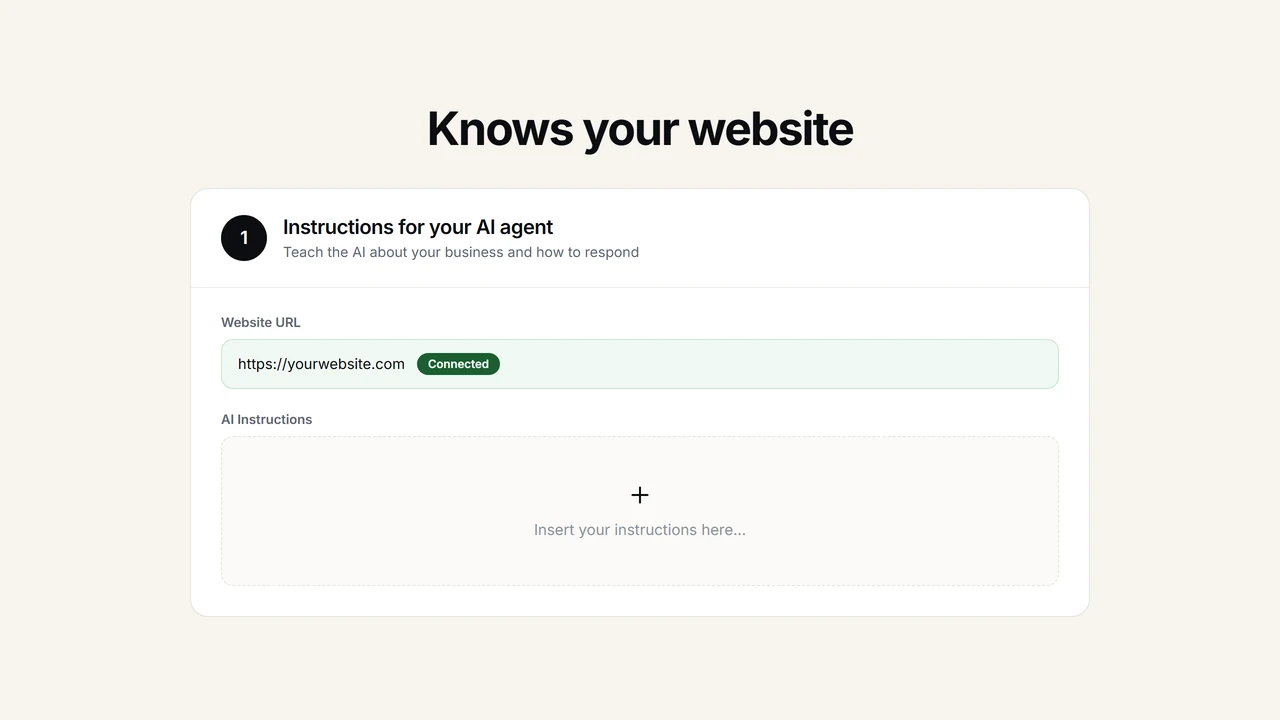
Paste your LMS or help center URL — the AI will answer the questions new users typically ask during their first week
Turns your course library into an always-available onboarding guide
Every LMS accumulates a dense archive of setup walkthroughs, module descriptions, prerequisite maps, and policy documents. The problem is rarely that the content is missing — it is that new users cannot find the right piece at the right moment. Asyntai crawls your learning portal, ingests your published help articles and course descriptions, and accepts any supplementary PDFs you upload — building a knowledge layer the AI references every time a learner asks a question. Instead of hunting through menus and FAQs, the user types a question and gets a direct answer grounded in your own material, with no manual intent mapping required on your side.
- Crawls your learning portal automaticallyCourse landing pages, module outlines, enrollment instructions, grading rubrics, and policy documents — any publicly accessible content on your LMS domain is absorbed and indexed for instant retrieval.
- Accepts private onboarding documentsInternal setup checklists, staff handbooks, provisioning guides, or pre-launch materials that live outside the public site — upload them as PDFs or paste text directly so the AI can reference them alongside your published content.
- Re-index after curriculum updatesAdded a new module or revised your getting-started guide? Trigger a re-crawl from the dashboard and the assistant references the latest version within minutes — no rebuild, no downtime.
Goes beyond static answers by pulling live enrollment and progress data
Static knowledge handles most onboarding questions, but learners also ask things only your backend knows: which modules have I completed, when is my next deadline, why was my quiz score not recorded. Custom Tools on Standard ($139/month) and Pro ($449/month) plans let the AI call your own API endpoints mid-conversation — checking enrollment status, retrieving assignment due dates, looking up completion percentages, or verifying certificate eligibility — and weaving the live data into a conversational answer without exposing your systems directly.
- Enrollment and progress lookupsThe AI checks which courses a learner is enrolled in, how far they have progressed, and which modules remain — answering "where did I leave off" with a specific, accurate response.
- Deadline and schedule queriesWhen a learner asks about upcoming due dates or assessment windows, Custom Tools pull the data from your scheduling system so the answer reflects their actual timeline, not a generic syllabus.
- Certificate and credential verificationFor programs that issue certificates on completion, the AI confirms eligibility, checks remaining requirements, and can direct the learner to the download page — all within the same conversation.
- Account provisioning statusNew users waiting for access credentials, license activation, or group assignment get real-time status updates instead of submitting a ticket and waiting for a human reply.
- Personalized next-step recommendationsBased on the learner's current position in a curriculum, the AI suggests the logical next module, prerequisite to complete, or resource to review — turning a support interaction into a guided learning moment.
Add an onboarding guide to your LMS in one sitting
No integration project, no vendor calls, no months of configuration. One code snippet on your learning portal, one sweep of your existing content, and a conversational onboarding assistant is live for every new user.
- Create a free Asyntai workspace — the free plan gives you 1 site and 50 messages per month to validate the experience. Paid plans start at $39/month (Starter, 2 sites, 800 messages), then Standard at $139/month (3 sites, 15,000 messages) and Pro at $449/month (20 sites, 50,000 messages).
- Paste the one-line widget snippet into your LMS template's
<head>section — through your CMS settings, a tag manager, or a direct file edit. - Point Asyntai at your learning portal URL and upload any private onboarding documents, setup checklists, or policy PDFs that belong in the answer base.
- Write custom instructions for tone and escalation — for example, escalate account access issues to a human, keep answers concise during setup walkthroughs — preview with real learner questions, and publish.
<script src="https://asyntai.com/widget.js"
data-id="your-site-id" async>
</script>
# Snippet placed. Onboarding guide live on every page.
Customer Onboarding LMS Software — FAQs
Common questions from learning teams and product managers before adding an AI onboarding layer.
How does the AI know the answers to our specific onboarding steps?
You point Asyntai at your LMS or help center URL, and it crawls your published content — course descriptions, setup guides, FAQs, policy pages. You can also upload internal documents as PDFs or pasted text. The AI then answers using your own content, grounded in the material you provided rather than generating answers from general knowledge. When a question falls outside your content, it says so and offers to capture the learner's details for your team.
Will this replace our existing LMS or learning platform?
No. Asyntai sits on top of your existing LMS as a conversational layer. It does not host courses, manage enrollments, or handle grading. It answers the questions learners ask while they navigate your platform — setup confusion, module prerequisites, policy clarifications, deadline questions — so they spend less time searching and more time learning.
Can it handle onboarding for products that are not traditional courses?
Absolutely. The AI works with any content you provide — SaaS product walkthroughs, hardware setup manuals, employee onboarding handbooks, compliance training documentation. If you have written content that explains how something works, Asyntai can turn it into a conversational guide. The LMS angle is one use case, not a limitation.
What happens when a learner asks something the content does not cover?
The assistant acknowledges it does not have the answer and offers to collect the learner's question and contact details for your team. You can reinforce this behavior with custom instructions — for example, always escalate account access problems or payment issues to a human rather than attempting to troubleshoot.
Does it work for international learners in other languages?
The widget interface renders in 36 languages, and the AI responds in whichever language the learner types. A student writing in Japanese gets a Japanese answer drawn from your English source material. No separate translations, no language routing — the AI handles it automatically from the first message.
Can we personalize answers based on who the learner is?
On Standard and Pro plans, User Context lets your site push learner data into a JavaScript object the widget reads — enrollment tier, assigned cohort, progress percentage, account creation date. The assistant uses this context to answer questions like "which modules do I still need to finish" with a specific, personalized response rather than a generic overview.
How much does customer onboarding LMS software from Asyntai cost?
A free plan covers 1 site and 50 messages per month for evaluation. Starter is $39/month with 2 sites and 800 messages. Standard is $139/month with 3 sites and 15,000 messages. Pro is $449/month with 20 sites and 50,000 messages. Most learning teams start free, validate with real learner questions, and move to Starter or Standard once they see the volume of onboarding queries it resolves.
Can we remove the Asyntai branding from the widget?
Pro plans include automatic white-labeling — the widget carries your brand with no Asyntai mention. On Standard plans, white-labeling is available by request — email [email protected] and the team will configure it for you.
How long does it take to set up?
Most teams go from signup to a live onboarding assistant within a single afternoon. The process is: create a workspace, paste a code snippet into your LMS template, feed it your help center URL and any supplementary documents, write a few custom instructions for tone and escalation, test with real questions, and publish. No vendor calls, no integration project, no waiting weeks for a build.
Why onboarding breaks — and how a quiet AI guide fixes it
There is a moment in every customer onboarding journey that determines whether the new user becomes a confident, returning learner or a silent churn statistic. It happens the first time they get stuck and cannot find help. Maybe the setup wizard skipped a step they did not understand. Maybe the module they need is buried three menus deep. Maybe the prerequisite requirement is mentioned in a PDF they never downloaded. Whatever the specifics, the experience is the same: the learner pauses, looks around for guidance, finds nothing immediate, and either submits a support ticket or quietly walks away. The entire investment in course creation, content production, and marketing acquisition comes down to whether that moment of confusion gets resolved in seconds or festers into frustration.
Traditional onboarding approaches attack this problem from the content side. Build more tutorials. Record more videos. Write more FAQ entries. Publish a longer getting-started guide. The instinct is sound — more documentation should mean fewer questions — but it collides with a stubborn reality about how people actually learn. New users do not read documentation linearly. They arrive with a specific question at a specific moment, and they need the answer to that question right now, not a chapter they have to locate within a forty-page manual. The content exists. The bridge between the question and the content does not.
That missing bridge is exactly what Asyntai builds. Rather than asking learners to navigate your help center, search your knowledge base, or browse a course catalog to find the article that matches their problem, the AI sits on every page of your LMS as a conversational assistant. A new user types "I finished module 2 but module 3 says I need a prerequisite I have not completed" and gets a specific, grounded answer drawn directly from your own curriculum documentation — which prerequisite, where to find it, and what to do next. The learner never leaves the page. The question is resolved in the time it takes to read a short paragraph. And the onboarding journey continues instead of stalling.
The mechanical side of this is simpler than most teams expect. You point Asyntai at your learning portal URL, it crawls your published pages — course descriptions, module outlines, setup instructions, grading policies, FAQ entries — and assembles a knowledge layer it references for every conversation. For content that lives outside the public site — internal facilitator guides, provisioning procedures, region-specific policies — you upload PDFs or paste raw text. From that point forward, the assistant answers using your own content. When your curriculum changes, a dashboard re-crawl updates the AI's knowledge within minutes. There is no retraining cycle, no vendor dependency, no weeks-long integration project.
What makes this particularly effective for onboarding, as opposed to general customer support, is the sequential nature of the learner's journey. A new customer is not asking random questions. They are moving through a process — sign up, activate account, enroll in first course, complete setup steps, begin modules, submit assessments — and the questions cluster predictably around transition points. Where do I go after the welcome email? How do I access the dashboard? What does this error during enrollment mean? Why is my quiz not showing a grade? Each transition point is a potential exit, and the AI's ability to deliver the right answer at each of those gates turns what would be a dropout into a completion.
International onboarding multiplies the stakes. If your learning platform serves users across borders — corporate training rolled out to regional offices, an online academy with students worldwide, a certification program attracting professionals from different countries — the language barrier during onboarding becomes a concrete retention problem. A learner in São Paulo struggling with account setup at eleven at night cannot wait for an English-speaking support team to come online in the morning. Asyntai's widget interface renders in 36 languages, and the AI responds in whichever language the learner types from their very first message. A Portuguese question gets a Portuguese answer, drawn from your English-language source content, without any translation layer you need to maintain.
Personalization takes the experience a step further. On Standard and Pro plans, User Context lets your application push learner-specific data into the widget before it loads — enrollment status, assigned cohort, progress percentage, upcoming deadlines, account tier. The assistant uses this context to answer questions like "when is my next assignment due" or "have I completed the requirements for certification" with specific, accurate information rather than pointing the learner to a generic schedule page. The effect is the difference between a helpful signpost and a personal guide who knows where you are in the journey.
For organizations running structured onboarding programs — SaaS companies guiding new customers through product adoption, universities managing freshman orientation, professional associations administering certification pathways — the operational benefit compounds over time. Every onboarding cohort generates a predictable wave of the same questions. Without an AI layer, each wave hits your support team with the same volume. With one, the routine questions resolve themselves, and your team handles only the exceptions that genuinely require human judgment: disputed enrollments, accessibility accommodations, payment complications, edge cases that fall outside documented procedures.
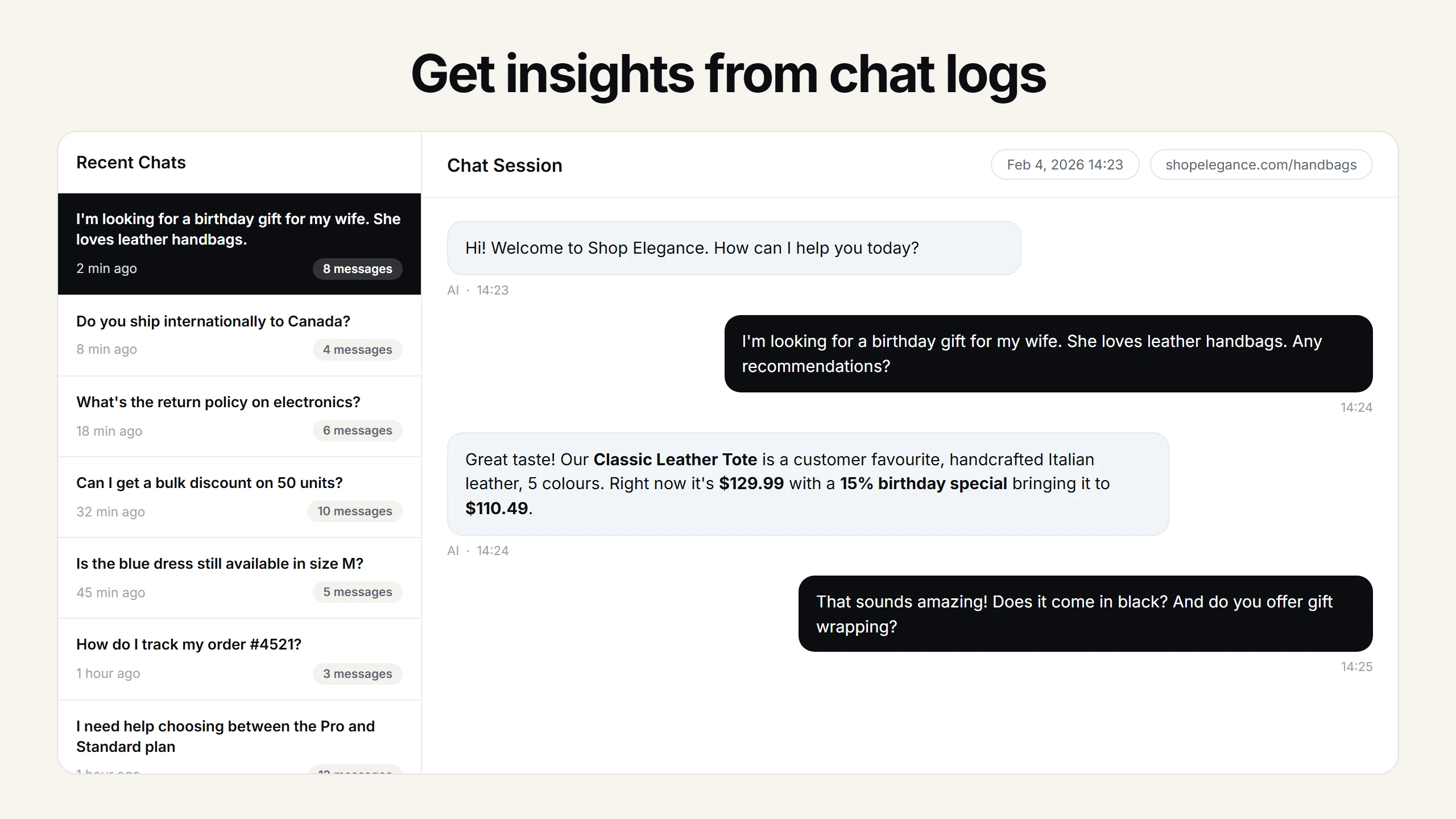
The diagnostic value is an underappreciated side effect. Every question the AI receives is a signal about where your onboarding material is falling short. If fifty new users per month ask some variation of "where do I find my login credentials after signing up," that is a gap in your welcome flow, not a support problem. Asyntai surfaces these patterns in conversation analytics — grouped by topic, sorted by frequency, filterable by time period. After a few onboarding cycles, the data becomes a precise roadmap for improving your documentation, restructuring your setup flow, or adding a missing step to your welcome sequence. The AI does not just answer questions; it quietly reveals which parts of your onboarding process generate the most confusion.
Custom instructions give you fine-grained control over how the assistant behaves during onboarding. You might instruct it to always recommend the getting-started checklist to users who seem to be on their first day. You might tell it to escalate any question about billing or refunds to a human immediately. You might ask it to keep answers concise during setup walkthroughs but go deeper when explaining course material. The assistant follows these rules consistently, which means every learner gets the same quality of onboarding guidance regardless of what time they sign up, which language they speak, or how busy your support team happens to be at that moment.
Scaling across multiple properties is built into the tier structure. A corporate training department running separate portals for different product lines, an education company offering distinct academies under separate brands, an agency managing onboarding for multiple clients — each site gets its own knowledge base, its own custom instructions, and its own assistant personality. Free plans cover one site, Starter covers two, Standard handles three, and Pro supports up to twenty. Each portal's onboarding assistant operates independently, drawing only from the content specific to that learning environment.
White-labeling matters for organizations where brand consistency during onboarding is non-negotiable. On Pro plans, the widget automatically carries your brand with no mention of Asyntai. On Standard, white-labeling is available by request — a quick email to [email protected] and the team configures it. For corporate training programs and branded academies, the assistant feels like a native part of the platform rather than a third-party add-on, which preserves the trust new users are building with your organization during their critical first interactions.
The economics are straightforward compared to the alternatives. A dedicated onboarding specialist costs tens of thousands per year and covers one timezone and one language. Asyntai's free tier handles 50 messages for validation. Starter at $39 per month covers 800 onboarding conversations. Standard at $139 handles 15,000. Pro at $449 scales to 50,000. For most learning platforms, even the Starter tier absorbs the majority of repetitive onboarding questions that would otherwise land in a support inbox, freeing human staff to focus on the complex cases — enrollment disputes, accessibility needs, curriculum counseling — where a personal touch actually changes outcomes.
There is a broader observation worth making about why AI-assisted onboarding works as well as it does, and it comes down to the psychology of the new user. People in the first hours of using a new platform are simultaneously the most curious and the most fragile. They want to explore, but they also want reassurance that they are doing things correctly. A silent platform feels indifferent. A help center search bar feels like homework. A conversational assistant that answers immediately and accurately feels like someone thought ahead and anticipated their needs. That feeling — of being guided rather than abandoned — is what separates onboarding that retains from onboarding that loses.
Getting started takes less time than most teams set aside for it. Sign up for free, paste the widget snippet into your LMS template (or install the AI chatbot for Moodle plugin if you run Moodle), point the AI at your help content, upload any private onboarding documents, write a few lines of custom instructions, preview with real learner questions, and publish. From that point on, every new user who arrives at your learning platform meets an assistant that already knows the curriculum, the policies, the deadlines, and the setup steps — and is ready to walk them through whatever they need, in whatever language they speak, at whatever hour they show up. The onboarding guide that never clocks out, never loses patience, and never forgets a prerequisite. See plans and pricing to choose the tier that fits your learner volume.