A custom AI chatbot for your website, answering from your content and governed by your rules
Most chatbots let you change the color. A custom AI chatbot for your website lets you change the mind — the knowledge it draws from, the instructions it follows, the voice it speaks in, and the boundaries it never crosses. Asyntai gives you that depth without writing a single line of code.
Build a custom AI chatbot from your own website content
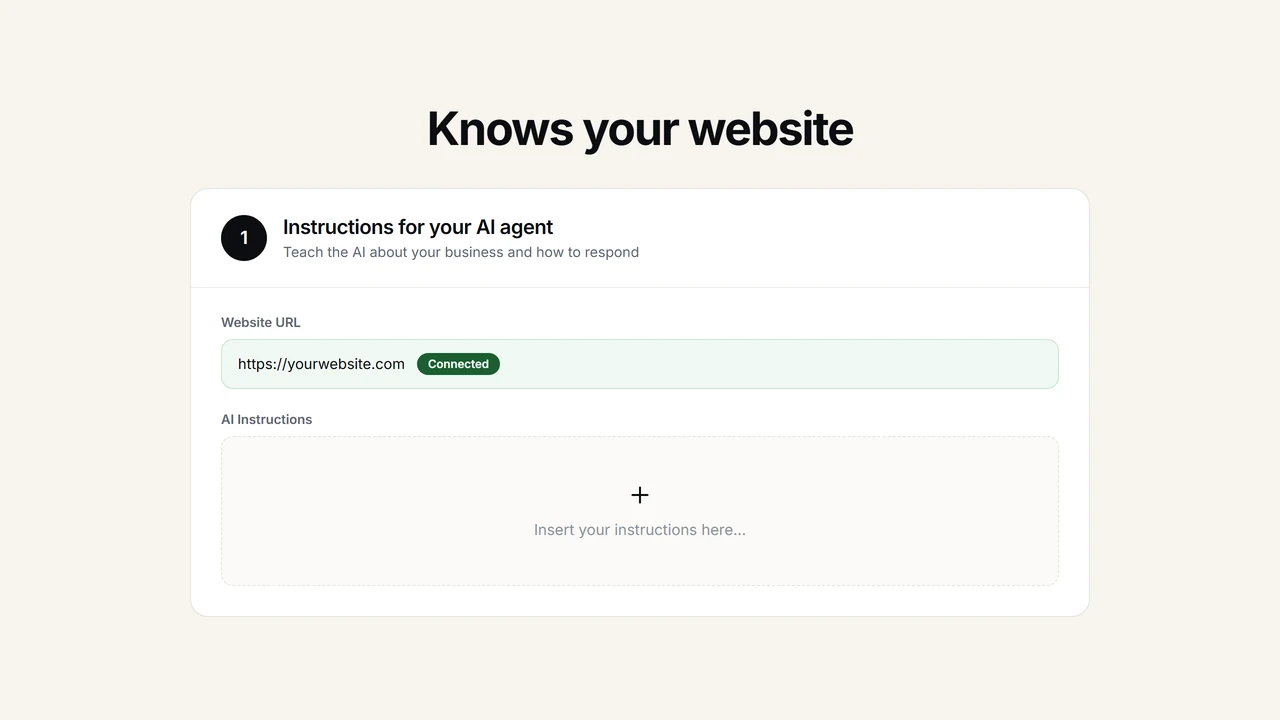
Enter your URL below and the AI will start learning from your pages immediately — then you shape everything else in the dashboard
Your own content and behavioral instructions are what make an AI chatbot genuinely custom
Swapping a color scheme does not make a chatbot custom — it makes it decorated. True customization starts with what the AI knows and how it behaves. Asyntai lets you control both: feed it your own content as the knowledge source, then write plain-English instructions that govern every reply it produces.
- Your site as the singular knowledge sourceThe chatbot ingests the URLs you specify — product pages, documentation, pricing tables, policy documents — and uses only that material when composing answers. Nothing from a shared model or a generic training corpus leaks into replies.
- Private documents for confidential materialUpload internal spec sheets, support playbooks, onboarding guides, and pricing matrices. The AI references them when a visitor's question calls for it, but the documents themselves stay out of any public index.
- Behavioral instructions written in natural languageDescribe what the AI should do and what it must avoid the same way you would brief a new team member: "always recommend the annual plan first," "never disclose competitor pricing," "ask for company size before suggesting a tier." Those instructions apply to every conversation, in every language.
Voice, tone, and conversational style are configurable — not fixed
Two websites can train the same AI on equally thorough documentation and still produce chatbots that feel entirely different, because voice is a separate dimension from knowledge. A custom AI chatbot for your website should sound like it belongs to your brand — formal, playful, technical, empathetic, terse — and Asyntai makes that a dashboard setting.
- Voice brief that shapes every responseWrite a paragraph describing the personality you want: "authoritative and concise, like a senior engineer explaining to a peer," or "warm and encouraging, like a patient teacher." The AI carries that register through every answer it generates.
- Vocabulary guardrails for brand alignmentTell the AI which words to prefer ("workspace" instead of "account," "member" instead of "user") and which to avoid ("cheap," "basic," "unfortunately"). It follows those lexical rules consistently regardless of conversation topic.
- Tone that holds across all 36 languagesThe voice brief is not English-only. When a visitor writes in Japanese, the chatbot generates a Japanese reply that carries the same personality traits — formality level, warmth, directness — that you configured in the brief. One set of instructions governs every language.
Deploy your custom AI chatbot with a single snippet
The installation mechanism is deliberately simple so the customization effort goes into the AI, not into the plumbing. A JavaScript tag in your page header is the only technical requirement — it works on WordPress, Shopify, Webflow, Squarespace, static HTML, and anything else that renders a web page.
- Sign up for an Asyntai account — the free plan lets you test with 50 messages per month — and grab the snippet from the settings panel.
- Paste the snippet inside the
<head>section of your website using your CMS header settings, a tag manager, or a direct template edit. - Supply the page URLs the AI should learn from and upload any private documents that should inform its answers.
- Open the customization dashboard, write your behavioral instructions and voice brief, rehearse a set of test questions, and go live.
<script src="https://asyntai.com/widget.js"
data-id="your-site-id" async>
</script>
</head>
# Your custom AI loads with your rules, voice, and knowledge on every page.
Custom AI chatbot for website — questions from people building one
The questions teams ask when they want more than a reskinned generic bot and need real AI customization.
What separates a "custom AI chatbot" from a regular chatbot with custom branding?
Branding customization changes what the chatbot looks like. AI customization changes what it knows, how it thinks, and what it is allowed to say. A custom AI chatbot for your website is trained exclusively on your content, follows behavioral instructions you author, speaks in a voice you define, and respects boundaries you set — the intelligence itself is shaped to your business, not just the paint job on top of it.
How do the behavioral instructions actually work under the hood?
You write instructions in plain English inside the Asyntai dashboard. The AI treats them as persistent rules that apply to every conversation. When a visitor asks a question, the model consults your own content for the answer and your instructions for how to deliver it — including what to emphasize, what to omit, when to escalate, and which tone to use. Instructions are additive: you can write twenty rules and the AI follows all of them simultaneously.
Can I make the AI refuse to discuss certain topics entirely?
Yes. Write an instruction like "never discuss competitor products by name," "decline any question about internal company revenue," or "do not speculate on features that have not been publicly announced." The AI treats those as hard boundaries and redirects the conversation when a visitor pushes into restricted territory — politely, using the tone you configured.
How is this different from the custom_chatbot_for_website page?
The custom chatbot page focuses on visual and surface-level customization — colors, avatars, welcome lines, positioning. This page focuses on customizing the AI layer specifically: what it has learned, how it reasons about your content, what instructions govern its behavior, and what voice it adopts. Both capabilities exist in Asyntai; the distinction is between styling the widget and shaping the intelligence behind it.
Does the voice customization carry through in languages other than English?
It does. The voice brief you write influences the AI's generation style across all 36 supported languages. A brief that says "use a formal, respectful register with minimal slang" produces formal German, formal Japanese, and formal Portuguese — not just formal English. The personality traits transfer across languages because they govern the generation style, not specific word choices.
Can different pages on my site trigger different AI behavior?
The behavioral instructions apply globally across your site, which ensures consistency. For page-specific variations — a pricing page that should emphasize the free trial, a documentation page that should stay technical — you can write conditional rules: "when the visitor is asking about pricing, always mention the free 50-message tier first" or "when the conversation involves API endpoints, use code-style formatting in responses." The AI interprets the context and applies the relevant rule.
Can logged-in users get a more personalized AI experience?
On Standard and Pro plans, your page populates window.Asyntai.userContext with whatever signed-in data you want the AI to reference — account name, plan tier, feature access, recent activity. The chatbot folds that context into every reply, so a Pro customer asking about a feature gets a different answer than a free-tier visitor asking the same question. The behavioral instructions can reference user context explicitly: "if the user is on the free plan, mention the upgrade path."
What does a custom AI chatbot cost on Asyntai?
The full customization surface — training, voice, behavioral instructions, visual styling, escalation rules — is available on every plan including free. The free tier covers 50 messages monthly with one site. Paid plans open at $39 per month for 800 messages and support multiple sites (2 on Starter, 3 on Standard, up to 10 on Pro). There are no per-seat charges, so your entire team accesses the dashboard and refines the AI configuration without affecting the bill.
What it means to truly customize an AI chatbot for your website
The phrase "custom chatbot" has been used so loosely in the market that it barely communicates anything specific. Pick a color, upload a logo, type a greeting line, and the vendor calls it custom. That is not customization — that is a template with a paint selector. A custom AI chatbot for your website is something materially different: it is an artificial intelligence whose knowledge, behavior, voice, and boundaries have been shaped to serve your specific business context. The distinction matters because the intelligence layer is what visitors actually interact with. Nobody cares what color the chat bubble is if the answers are wrong, generic, or off-brand. Customizing the AI is the part that produces measurable differences in answer quality, visitor satisfaction, and conversion.
Knowledge customization is the foundation. Every AI chatbot must draw its answers from somewhere, and the source determines the ceiling of usefulness. A chatbot grounded in a foundation model's general training data will confidently state your pricing, describe your products, and explain your policies — all incorrectly, because it is reciting approximations memorized from the open internet rather than reading your actual pages. A custom AI chatbot answering from your specific URLs and uploaded documents reverses that dynamic. It reads your product descriptions, your pricing tables, your technical documentation, your return policy, your onboarding guide, and your internal FAQ, then constructs every answer from that material. The difference is not subtle — it is the difference between a chatbot that sounds plausible and one that is actually correct.
Document uploads extend the knowledge surface beyond what is publicly crawlable. Support playbooks, internal pricing matrices, partner-only specification sheets, pre-release feature notes, HR policies for employee-facing bots — all of these can inform the AI without appearing in any search engine index. The training mechanism treats uploaded documents the same way it treats crawled pages: they become citable sources the AI references when a visitor's question calls for that material. For businesses with significant internal documentation that should influence the chatbot's answers but should never be linked publicly, this distinction between "indexed" and "published" is operationally important.
Behavioral instructions are where customization moves from what the AI knows to how the AI acts. Knowledge grounding prevents hallucination; behavioral instructions shape judgment. Consider the range of decisions a support conversation requires beyond just finding the right information: whether to recommend a product or stay neutral, whether to collect contact details proactively or wait until asked, when to suggest an upgrade versus when to solve the immediate problem, how to handle a complaint versus a feature request, whether to quote exact prices or direct the visitor to the pricing page, what disclaimers to attach to advice in regulated verticals. Each of those decisions can be encoded as a behavioral instruction in Asyntai — written in plain English, not in a scripting language or a flowchart tool. "When a visitor asks about enterprise pricing, collect their company name and headcount before quoting a number." "Never recommend a plan downgrade; always suggest speaking with the account team first." "If the visitor expresses frustration, acknowledge it before attempting a solution." The AI applies every active instruction simultaneously and consistently across all conversations.
Voice customization is the dimension that transforms a correct chatbot into one that feels like an extension of your team. Two chatbots can deliver the same factual content and still feel entirely different depending on how they deliver it. A fintech company wants crisp, precise language with zero hedging. A children's education platform wants warmth, encouragement, and simple vocabulary. A luxury hospitality brand wants understated elegance with careful phrasing. A developer tools company wants technical brevity with inline code references. Asyntai's voice customization works through a brief — a paragraph or two where you describe the personality, the register, the vocabulary preferences, and the stylistic traits you want the AI to embody. The brief governs every response the chatbot generates, functioning as a persistent style layer over the knowledge and behavioral layers beneath it.
The interplay between knowledge, behavior, and voice is what produces a chatbot that visitors experience as genuinely customized rather than merely branded. Knowledge ensures accuracy. Behavior ensures the right operational choices. Voice ensures the delivery matches the brand. When all three are configured thoughtfully, the chatbot reads as though a knowledgeable member of your team is answering — because functionally, your instructions defined what that team member knows, how it should act, and how it should sound. Visitors do not see three separate configuration layers; they see a single coherent personality that happens to be available at 3 AM on a Sunday in thirty-six languages.
Multilingual voice preservation is one of the technical achievements that separates a true custom AI chatbot from a translated FAQ widget. The voice brief you write does not merely apply to English responses — it governs generation style across every language the AI supports. A brief that specifies "formal, measured, avoids colloquialisms" produces formal Japanese, formal Arabic, and formal Portuguese. A brief that specifies "playful, uses sentence fragments, addresses the visitor by first name" produces that style in Korean, Dutch, and Thai. The AI does not translate a pre-written English response into other languages; it generates natively in the target language while applying the same personality constraints. This distinction matters because translation strips personality — it produces grammatically correct but tonally flat output. Native generation with voice constraints preserves the brand feel across markets.
Boundary setting is an underappreciated aspect of AI customization that experienced operators rank as critical. Without explicit boundaries, an AI chatbot will answer any question to the best of its ability — including questions about competitor products, internal financials, unreleased features, pricing for plans that do not exist, and opinions on topics your brand should not be associated with. Behavioral instructions in Asyntai let you draw those boundaries clearly: "do not discuss any competitor by name," "decline requests for financial projections," "if asked about features not documented in your content, say the feature is not currently available rather than speculating." Boundaries are rules the AI follows with the same consistency as positive instructions, and they prevent the category of embarrassing chatbot responses that tend to surface on social media when an AI confidently says something the company would never endorse.
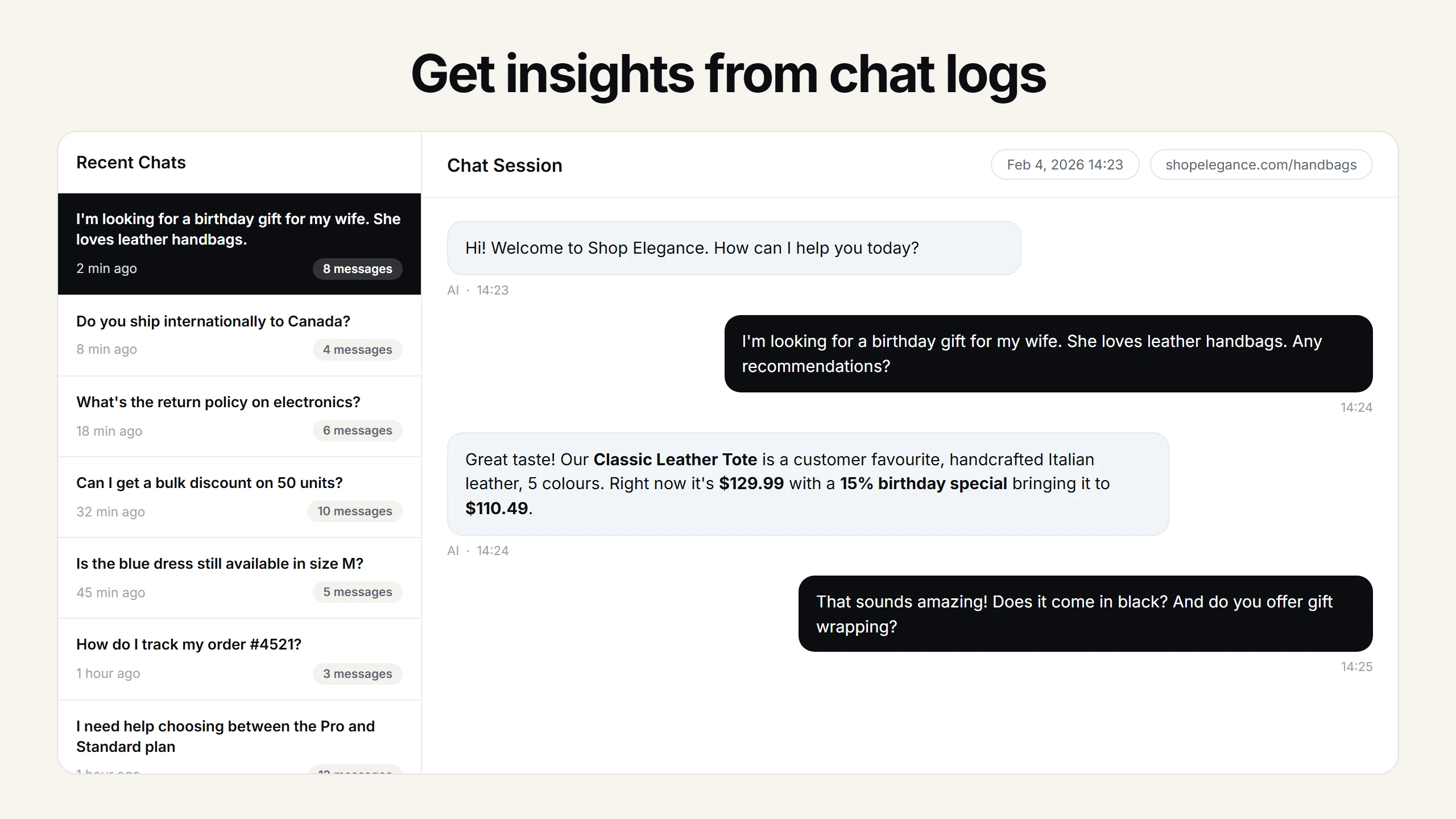
Iteration speed is what turns a decent custom AI chatbot into an excellent one over time. The initial configuration — your own content, instructions, voice brief — gets the chatbot to a publishable state. The real value accumulates in the weeks and months after launch, as conversation analytics reveal which questions come up most, which answers visitors accept versus reject, which topics trigger escalation, and where the chatbot's phrasing does not match what a human agent would say. Each of those observations becomes a refinement: a new instruction, an updated document, a tweaked voice guideline, an additional boundary. In Asyntai, these refinements take effect immediately — no retraining cycle, no deployment wait — which means the chatbot improves as fast as your team identifies opportunities. The custom AI chatbot three months after launch is materially better than the one on day one, and the gap keeps widening.
Logged-in visitor personalization adds a fourth customization axis on top of knowledge, behavior, and voice. On Standard and Pro plans, your website populates window.Asyntai.userContext with whatever authenticated-user data you choose to expose before the widget loads. The AI incorporates that data into its responses: an enterprise customer asking about a feature gets a reply that references their plan's capabilities specifically, while an anonymous visitor asking the same question gets the general overview. Behavioral instructions can reference user context explicitly — "if the visitor is on the free plan, mention that this feature requires an upgrade to Standard" — which means the customization extends beyond static personality into dynamic, per-visitor behavior. For SaaS products, membership sites, and account-driven businesses, this is the layer that makes the chatbot feel like a personal assistant rather than a public FAQ.
Multi-site deployment allows organizations running several web properties to maintain distinct custom AI chatbots per site. A software company might run one chatbot on its marketing site (answering from product positioning, configured to capture leads) and a different chatbot on its documentation portal (answering from technical docs, configured to answer developer questions in a terse, code-friendly style). Each site gets its own knowledge base, its own behavioral instructions, its own voice brief, and its own analytics — genuinely separate AI personalities under a single account. Plan tiers determine how many sites you can run: one on free, two on Starter, three on Standard, up to ten on Pro.
Pricing for the full AI customization surface is included on every Asyntai plan, including free. There is no premium tier for behavioral instructions, no add-on fee for voice customization, and no gated access to the training dashboard. The free tier limits volume to 50 messages per month and one website — enough to fully configure and test the custom AI chatbot before committing budget. Paid plans begin at $39 monthly for 800 messages. The customization depth is identical across tiers; only the volume and the number of sites scale. For teams accustomed to vendors that gate advanced AI features behind enterprise-priced tiers, this flat-access model means you can validate the full customization capability before spending a dollar.
The practical workflow for building a custom AI chatbot on Asyntai compresses into a focused session rather than a multi-week project. Register, paste the snippet into your site header, enter the URLs the AI should learn from, upload any private documents, open the customization dashboard, write the behavioral instructions that encode your business rules, compose the voice brief that defines the personality, set the boundaries that prevent off-brand responses, preview a dozen test conversations to verify the output, and publish. Refinement continues after launch as real conversations reveal adjustment opportunities. The entire surface — knowledge, behavior, voice, boundaries, visual styling — lives in one dashboard, editable by anyone on the team, with changes reflected in the live chatbot immediately. What used to require a conversational design agency and a six-figure budget is now a configuration exercise that a single product manager or marketing lead completes in an afternoon.