Conversational AI for sales: every visitor gets a knowledgeable salesperson the moment they land on your site
An AI sales assistant that reads your product pages, answers buyer questions in real time, recommends the right option, and captures qualified leads — around the clock, in 36 languages, without adding headcount.
Watch the AI sell from your own product pages
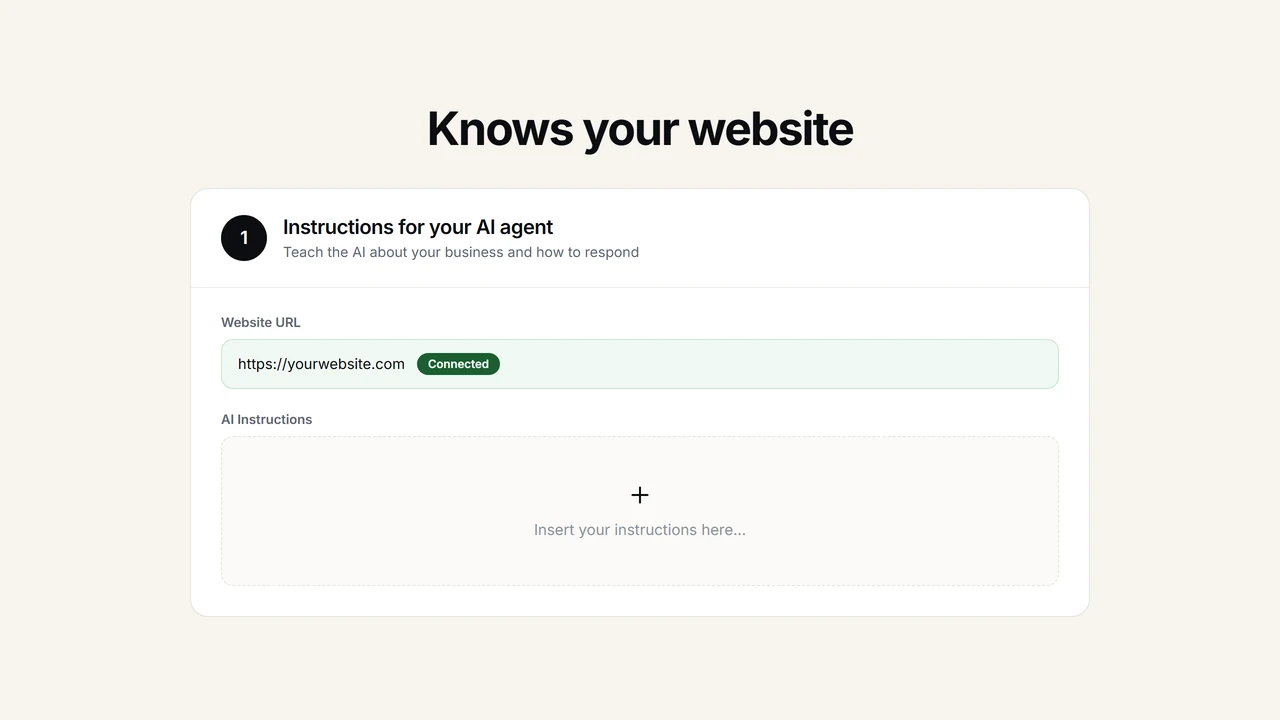
Drop your website URL below. The AI reads your product listings, pricing, FAQs, and policies — then handles buyer questions the way your best salesperson would.
Hundreds of visitors browse your site every day — and most leave without saying a word
There is a gap between someone arriving on your website and someone buying. In a physical store, a salesperson notices when a customer lingers at a display, picks up a product, puts it back, glances around for help. Online, that same hesitation is invisible. A visitor spends four minutes on your pricing page, scrolls between two product options three times, hovers over the "Add to Cart" button, and then closes the tab. You never know they were there. You never know what stopped them. Maybe they had a question about sizing. Maybe they wanted to know if the premium version was worth the upgrade. Maybe they needed confirmation that returns are free before committing. A contact form could have answered these questions — but nobody fills out a contact form when they are in buying mode. They want the answer now, in the flow, or they leave. Conversational AI fills this gap by placing a knowledgeable assistant on every page that engages visitors the moment they have a question. The AI reads your entire website — product descriptions, pricing tables, return policies, shipping information, comparison pages — and uses that content to answer buyer questions in natural dialogue. Visitors get instant, accurate responses without searching through your site. And every conversation that moves a hesitant browser closer to a purchase is revenue you would have lost to silence.
- Answer the question that is blocking the saleA shopper comparing two product tiers wants to know the difference between them. A visitor on your checkout page is unsure whether the warranty covers accidental damage. A B2B prospect needs to confirm that your software integrates with their existing tools before requesting a demo. The AI answers each of these questions instantly using your own website content — no wait, no ticket, no abandoned cart.
- Qualify leads before they reach your sales teamNot every visitor is ready to buy, and not every inquiry deserves a callback. The AI gathers context naturally during the conversation — budget range, company size, timeline, specific needs — and captures contact details so your sales team opens each lead with qualification data already attached. Cold form submissions become warm, contextualized opportunities.
- Sell after hours, on weekends, and across time zonesYour highest-intent traffic does not always arrive during business hours. A business owner evaluating software at 11 PM wants answers before their morning meeting. An international buyer in a different time zone browses your store on your Saturday. The AI engages every visitor with the same product knowledge and responsiveness regardless of when they arrive — and captures the lead if the sale needs human follow-up.
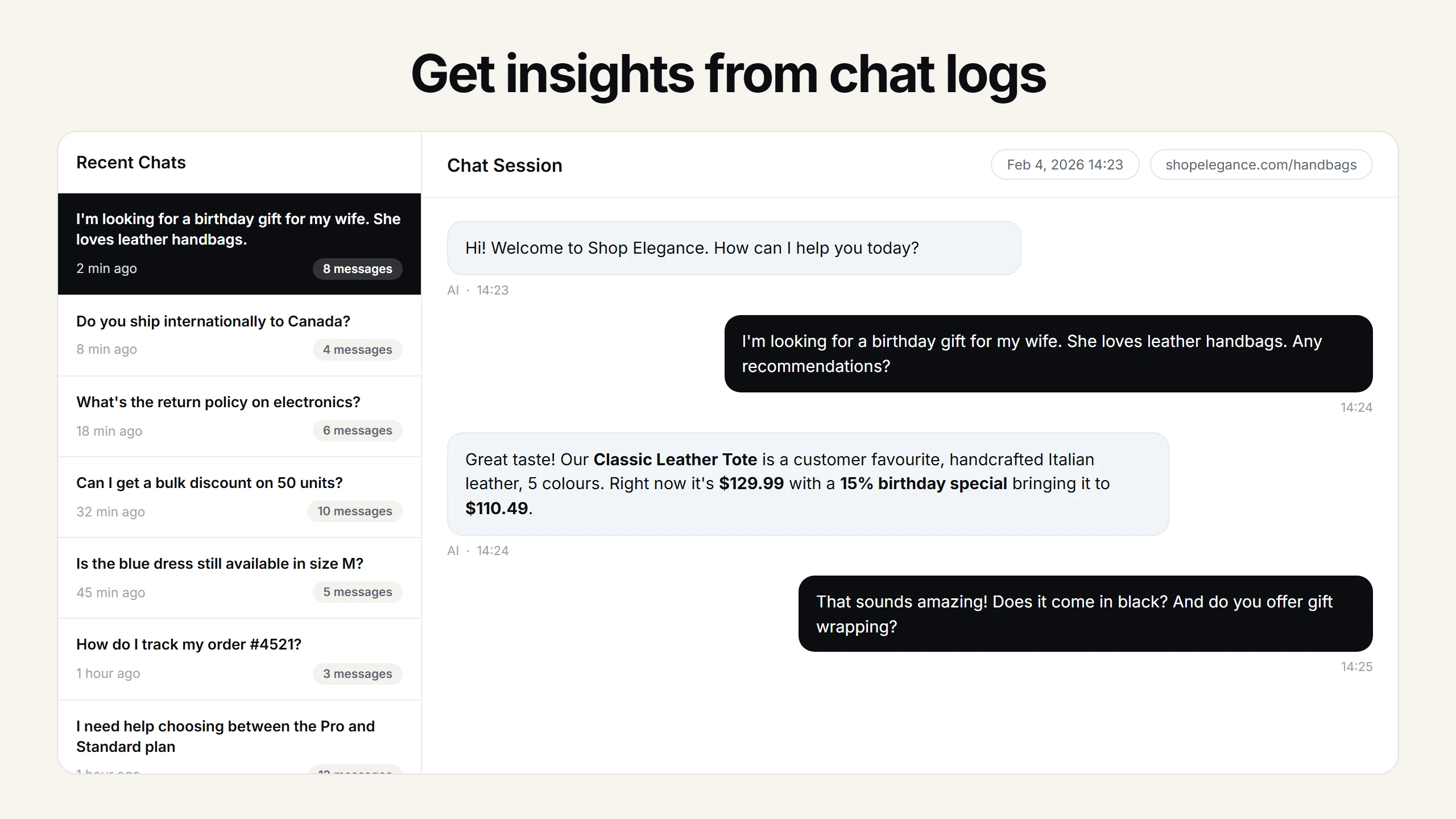
Connect your inventory, CRM, or product database and let the AI sell with live data
Answering from your website content handles most buyer questions — pricing, features, policies, specifications. But some sales conversations need real-time data. "Is this item in stock in my size?" "What is the lead time for a custom order?" "Can you check if my company already has an account?" Custom Tools — available on Standard ($139/month) and Pro ($449/month) plans — let the AI query your own systems mid-conversation to deliver answers that static content cannot.
- Real-time inventory and availability checksConnect a Custom Tool to your inventory system's API. When a shopper asks "do you have the Oslo sectional in charcoal grey?", the AI queries your stock database and answers with current availability, estimated delivery dates, and whether nearby locations carry it. No more "check back later" — the buyer gets the answer that closes the sale.
- Dynamic pricing and quote generationFor businesses with configurable products or volume pricing, the AI can pull calculated quotes from your pricing engine. A buyer asks "what would 500 units cost with custom packaging?" and the AI returns the per-unit price, bulk discount, and estimated production time — all from your own system, in seconds.
- Order status and account lookupsReturning customers often have questions that require account data: shipment tracking, subscription renewal dates, past order details. A Custom Tool connected to your CRM or order management system lets the AI answer these instantly, keeping existing customers engaged without consuming sales team bandwidth on support requests.
- Product recommendation from your full catalogWhen your catalog runs into hundreds or thousands of SKUs, visitors struggle to find the right product. The AI can query your product database based on what the visitor describes — "I need a waterproof jacket for hiking in cold weather, under $200" — and return specific product matches with links, prices, and key specs. It is like giving every visitor a personal shopper.
- Multilingual selling without multilingual staffInternational buyers arrive at your English-language site and expect to transact in their own language. The AI detects the visitor's language automatically and responds in kind — 36 languages supported. A French-speaking buyer browsing your product pages gets answers in French, with pricing, specifications, and purchase guidance delivered naturally. No translated site required, no multilingual sales hire needed.
Get conversational AI selling on your website
No developers, no CRM migration, no complex setup. Sign up, point the AI at your site, and paste one line of code. Your sales pipeline starts filling within the hour.
- Choose a plan at asyntai.com/pricing — the Free tier gives you 1 site and 50 messages to test with real buyer traffic. Starter ($39/month) handles 800 messages for a growing e-commerce store or SaaS site.
- Enter your website URL in the dashboard. The AI crawls up to 50 pages — product listings, pricing tables, feature comparisons, return policies, shipping information, FAQs — and builds its knowledge base from your existing content automatically.
- Customize the chat widget to match your brand. Set your company name, brand colors, logo, and opening message. Add supplementary content — product catalogs, specification sheets, size guides — as uploaded files for questions that go beyond what your website covers.
- Copy the embed script and paste it into your website. Works on Shopify, WordPress, Wix, Squarespace, custom-built sites, and 30+ other platforms. The AI goes live immediately and starts engaging buyers.
<script src="https://asyntai.com/widget.js"
data-id="your-site-id" async>
</script>
# One script. Engages, qualifies, and converts.
# Live on any platform in under 5 minutes.
Conversational AI for sales — FAQs
Common questions from sales teams and business owners evaluating conversational AI for their websites.
How does the AI know what to say about my products?
The AI reads your website — product pages, pricing tables, feature lists, FAQs, policies, blog posts — and uses that content to answer visitor questions. It does not guess or improvise. If a buyer asks about a specific product's weight, and that weight is listed on your product page, the AI provides it. If the information is not on your site, you can upload supplementary documents like spec sheets or catalogs. The AI answers using your content, not generic responses.
Will it actually help close sales, or just answer basic questions?
Both — and the line between them is thinner than most people think. A visitor who asks "what is the difference between the Standard and Pro plan?" is one good answer away from choosing. A shopper who asks "does this come in blue?" is one confirmation away from adding to cart. The AI provides the specific, instant answers that move hesitant browsers to buyers. For more complex sales, it captures qualified lead information — name, company, budget, timeline — so your sales team follows up with context instead of starting cold.
Can I control what the AI says and how it sells?
Yes. You write custom instructions in plain English that govern the AI's behavior. You can tell it to always recommend your premium product first, to offer a discount code when a visitor mentions a competitor, to ask for an email before discussing enterprise pricing, or to redirect warranty questions to your support page. These instructions apply to every conversation consistently — more reliably than training a human sales team to follow a script.
Does it work for B2B sales or only e-commerce?
Both. For e-commerce, the AI answers product questions, compares options, and guides buyers to checkout. For B2B, it qualifies leads by asking about company size, use case, and budget during the conversation, then captures contact details for your sales team. SaaS companies, agencies, manufacturers, and professional service firms use it alongside retail and DTC brands. The AI adapts based on the content on your website and the instructions you provide.
What happens when the AI cannot answer a question?
You define the fallback behavior. Common configurations include: collecting the visitor's name, email, and question for sales team follow-up; displaying your sales team's direct phone number or calendar booking link; or offering to connect them with a live representative during business hours. The AI captures the lead data regardless, so even unanswered questions generate an opportunity for your team to follow up.
Can the AI check inventory or pull live pricing?
Yes — with Custom Tools on the Standard ($139/month) and Pro ($449/month) plans. You connect your inventory system, CRM, or pricing engine through a REST API, and the AI queries it mid-conversation. A visitor asks "is this available in size 10?" and the AI checks your stock database in real time. You configure each tool through a form in your dashboard — no coding required on the Asyntai side.
How does it handle international buyers?
The AI detects each visitor's language automatically and responds in kind — 36 languages supported, included on every plan. A Japanese-speaking visitor browsing your English product pages gets answers in Japanese. A Spanish-speaking buyer asking about shipping to Mexico gets a response in Spanish. Your website content does not need to be translated — the AI reads the English content and delivers the response in the visitor's language.
What does it cost?
The Free tier gives you 1 site and 50 messages per month — enough to see how the AI handles real buyer conversations on your site. Starter is $39/month with 800 messages and 2 sites. Standard is $139/month with 15,000 messages, 3 sites, and Custom Tools for live data integrations. Pro is $449/month with 50,000 messages, 20 sites, Custom Tools, and white-label branding. All plans are month-to-month with no contracts.
How quickly can I get this running?
Most businesses have the AI live on their website within 15 minutes. You sign up, enter your URL (the AI reads your site automatically), customize the widget appearance, and paste the embed code. If you want to connect Custom Tools for inventory or CRM lookups, that takes additional setup time depending on your systems, but the conversational sales assistant works immediately using your website content while you configure those integrations.
Conversational AI for sales: the rep who never drops a lead
Every online business faces the same invisible problem: the gap between interest and action. A visitor arrives on your website. They found you through a search, clicked an ad, followed a referral link. They are interested — that much is certain, because nobody lands on a product page by accident. But interest is not action. Between "this looks good" and "I will buy this" lies a landscape of small doubts, unanswered questions, and friction points that a physical salesperson would resolve in thirty seconds. Does it come in the right size? Is the shipping fast enough? Will it integrate with the system they already use? Is the price competitive with the alternative they looked at yesterday? Each unanswered question is a tiny exit ramp, and your website — no matter how well designed — cannot predict which question each visitor will have. So they leave. Silently, without complaint, without a trace in your analytics beyond a bounce rate that ticks up by one.
The economics of this silence are staggering when you actually calculate them. Consider an e-commerce site with 10,000 monthly visitors and a 2% conversion rate. That is 200 buyers and 9,800 people who left without purchasing. Even if only 5% of those non-buyers had a question that, if answered, would have tipped them toward a sale, that is 490 recoverable transactions sitting on the table every month. A contact form does not solve this because people in buying mode do not want to submit a form and wait for a reply. A FAQ page does not solve it because visitors do not know which FAQ applies to their specific situation. Live chat with human agents could solve it, but the cost of staffing live chat during all hours — including evenings, weekends, and holidays when high-intent shoppers are browsing — puts it out of reach for most businesses. Conversational AI eliminates this tradeoff. The cost is fixed, the availability is constant, and the knowledge base scales with your website content.
What makes conversational AI different from a simple chatbot or an FAQ widget is the nature of the interaction. A traditional chatbot matches keywords to canned responses — if a visitor types something outside its decision tree, it fails visibly, which is worse than having no chat at all. Conversational AI reads your entire website, understands the relationships between products, pricing, policies, and features, and constructs answers to questions it has never been explicitly programmed to handle. A visitor on a furniture website asks "would the Marin sofa fit through a 30-inch doorway?" — the AI checks the product dimensions from your listing, notes that the sofa is 34 inches wide, and responds that it would not fit through that opening without removing the legs. That is not a canned answer. It is reasoning applied to your own product data, delivered in seconds.
Lead qualification is where conversational AI pays for itself most directly in B2B contexts. A software company's website might get 500 demo requests per month, but only 80 of those are from companies that match the ideal customer profile. The rest are students, competitors, companies too small for the product, or people who thought they were signing up for something else. Each unqualified lead consumes 15 to 30 minutes of a sales rep's time before it is disqualified. With conversational AI, the qualification happens during the initial website visit. The AI answers the visitor's questions about the product, then naturally gathers context: "What is your team size?" "Which tools are you currently using?" "What is your timeline for implementation?" By the time the visitor submits their contact information, the lead arrives in your CRM with enough data for a rep to decide in seconds whether it warrants a call. Your sales team spends their day on qualified opportunities instead of discovery calls that go nowhere.
Product comparison is another area where conversational AI dramatically outperforms static web pages. Your website might have a comparison table showing three product tiers side by side, but comparison tables present features — they do not explain which tier is right for a specific buyer. A visitor looking at that table thinks: "I need the reporting feature from the Pro tier, but I only have five team members, so the Standard tier's user limit is fine. Does Standard include any reporting at all, or do I have to go Pro?" That is not a question a comparison table answers. It is a question a salesperson answers. The AI reads your comparison page, your feature documentation, and your pricing page, then synthesizes an answer: "Standard includes basic reporting with weekly email summaries. Pro adds custom dashboards, real-time analytics, and API access to your data. Based on your team size of five, Standard would cover your user needs — the question is whether the advanced reporting in Pro justifies the price difference for your use case." That response moves the buyer forward. A comparison table leaves them stuck.
For e-commerce specifically, the AI handles the questions that product pages cannot anticipate. A clothing brand lists fabric composition, measurements, and care instructions — but a shopper wants to know "will this shrink in the dryer?" or "is this see-through in white?" A supplement company lists ingredients and dosages — but a buyer wants to know "can I take this with blood pressure medication?" (a question the AI should be instructed to redirect to their doctor, which you configure in custom instructions). An electronics retailer lists specifications — but a customer asks "will this monitor work with my 2019 MacBook Pro?" These are the questions that determine whether someone buys or bounces, and they are different for every visitor. The AI surfaces answers from your existing content — or, with Custom Tools on Standard and Pro plans, queries your product database — so each visitor gets the specific response their purchase decision depends on.
The after-hours dimension changes the revenue math fundamentally. Traditional sales operations accept that evenings, weekends, and holidays are dead time — the office is closed, so leads that arrive during those hours wait in an inbox until Monday. But buyer behavior does not follow business hours. A business owner researching software solutions does their evaluating at night after their own workday ends. A consumer deciding between two high-ticket purchases compares options on Sunday morning over coffee. An international buyer in a different hemisphere sends inquiries during what is your overnight. Each of these visitors is in active buying mode during hours when your sales team is offline. Conversational AI engages every one of them with the same product knowledge and responsiveness as a Tuesday afternoon, and captures their information when they are ready to take the next step — not 14 hours later when the moment has passed.
Cart abandonment — the perennial headache of online commerce — often traces back to an unanswered question at the critical moment. Studies consistently show that the majority of online shopping carts are abandoned before checkout. Price concerns, unexpected shipping costs, and a complicated checkout process account for some of this, but a significant share results from unresolved doubts. "Is this the right model for my needs?" "What if it does not fit — is the return process easy?" "I saw a similar product for less elsewhere — is this one actually better?" A conversational AI assistant positioned on product and checkout pages can intercept these doubts in real time. When a visitor lingers on the checkout page without completing the purchase, the AI can offer assistance: not in a pushy, pop-up way, but as a quiet availability indicator that says "I can answer questions about this product if you need anything." The visitors who engage are the ones with a specific doubt — and resolving that doubt is often all it takes to complete the sale.
Upselling and cross-selling happen naturally in conversation in ways that banner ads and "customers also bought" widgets cannot replicate. When a visitor asks the AI about a specific product, the AI — drawing on your full catalog content — can mention relevant additions: "The Summit jacket is a great choice for cold-weather hiking. Many customers also pick up the thermal base layer, which is designed to pair with it and is currently 20% off when purchased together." This is not an algorithm guessing from purchase data; it is a recommendation grounded in the actual product descriptions and relationships documented on your website. The AI does not recommend randomly — it recommends contextually, based on what the visitor has expressed interest in and what your content says about product compatibility.
For businesses with complex or configurable products, conversational AI acts as a guided selling tool. A visitor on a custom window blinds website does not know what to order — they know the window dimensions and that they want something that blocks light. The AI asks clarifying questions — room type, mounting preference, light control needs, color palette — and narrows the catalog to the three products that match, with pricing for their specific window size. A B2B buyer on an industrial supply site needs a specific valve fitting but does not know the part number — they describe the application, pipe diameter, and pressure rating, and the AI identifies the matching SKU. This guided selling process, which would otherwise require a phone call to a specialist, happens in a two-minute chat conversation on the website.
Trust signals — the subtle cues that make a buyer confident enough to enter their credit card — are amplified by conversational AI. When a visitor asks "is this site legitimate?" or "what happens if my order arrives damaged?" and receives an immediate, detailed answer referencing your actual return policy, that builds confidence in a way that a static policy page buried in your footer cannot. The conversation itself is a trust signal: a business that provides instant, knowledgeable responses feels more established, more professional, and more trustworthy than one that offers only a contact form. For smaller or newer brands without widespread name recognition, this perceived professionalism can be the difference between a sale and a lost visitor who decides to "go with the bigger brand just to be safe."
Custom instructions let you shape the AI's selling style to match your brand voice and sales strategy. You can instruct it to emphasize your satisfaction guarantee in every product conversation. You can tell it to always ask for the visitor's email before discussing custom pricing. You can configure it to recommend the mid-tier option first instead of the cheapest. You can set rules like "if a visitor mentions a competitor's product, acknowledge it and explain our three key differentiators." These instructions are written in plain English, and the AI follows them consistently across every conversation — more reliably than a sales team following a playbook, because the AI never forgets a step, never gets fatigued, and never improvises in ways that contradict your messaging.
The integration with your existing sales stack is straightforward. Every conversation and captured lead is available in your Asyntai dashboard. For businesses that want leads flowing directly into their CRM, Custom Tools on Standard and Pro plans allow the AI to push data to your systems via API — so a qualified lead captured at 2 AM appears in your Salesforce, HubSpot, or Pipedrive pipeline before your sales team arrives in the morning. The AI can also pull data from your CRM to personalize conversations: if a returning visitor's email matches an existing contact, the AI can greet them by name, reference their last purchase, and offer relevant follow-up recommendations.
Scalability is an inherent advantage over human sales teams. During a product launch, a flash sale, or a seasonal traffic spike, a human live-chat team is overwhelmed within minutes. Wait times climb, agents rush through conversations, quality drops, and potential buyers who cannot get through simply leave. Conversational AI handles ten conversations or ten thousand with identical response quality and zero wait time. A Black Friday traffic surge does not degrade the shopping experience — every visitor gets the same instant, knowledgeable assistance regardless of how many other people are on the site. This scalability alone justifies the investment for businesses with variable traffic patterns.
The cost structure makes this accessible to businesses at every stage. A solo entrepreneur launching their first Shopify store can start on the Free tier — one site, 50 messages per month, zero cost — and see how the AI handles real buyer conversations before committing any budget. A growing DTC brand doing $50K per month can run Starter at $39/month and handle 800 buyer interactions. A mid-market e-commerce operation can use Standard at $139/month for 15,000 messages and Custom Tools that connect to their inventory and CRM. An enterprise retailer with twenty regional sites can run Pro at $449/month with 50,000 messages, white-label branding, and full system integration. Every plan is month-to-month, no contracts, cancel anytime.
Ready to turn your website traffic into revenue? Start with the Free plan and watch the AI sell from your product pages — or go straight to Standard for Custom Tools and live data integrations.