Chat plugin for Shopify that does more than answer "where's my order?"
Most Shopify chat plugins are glorified contact forms. Asyntai is an AI chat plugin that reads your entire Shopify catalog, answers product questions in detail, shows Dynamic Product Cards with images, prices, and buy buttons inside the chat, and handles post-purchase inquiries like order tracking and returns through Custom Tools. Install it from the Shopify App Store — your catalog syncs automatically. No spreadsheets, no manual product uploads, no "please wait for an agent."
See the AI chat plugin working on your Shopify store
Enter your Shopify store URL and watch the AI answer product questions, show product cards, and handle real customer scenarios
Install from the App Store, catalog syncs automatically, product cards appear in the chat
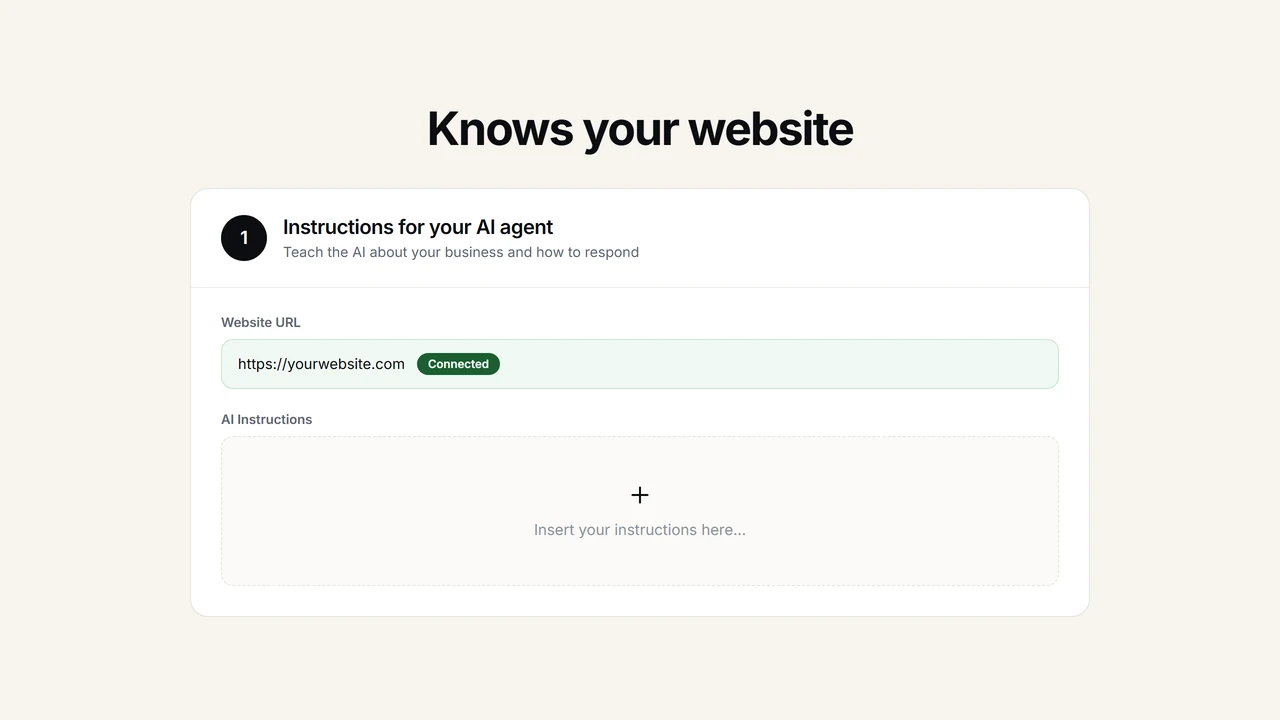
Asyntai is available as a native app on the Shopify App Store. Install it with one click and your product catalog syncs automatically — every product title, description, price, image, and variant flows into the AI's knowledge base without you uploading anything. When a visitor asks a product question, the AI searches your live catalog and responds with Dynamic Product Cards: visual cards showing the product image, current price, a short description, and a direct link to buy. Multiple matches display as a swipeable carousel. Your visitors go from question to product in seconds, inside the chat window, without navigating to a search results page.
- One-click Shopify App Store installFind Asyntai on the Shopify App Store and install it like any other Shopify app. No embed codes to paste, no theme files to edit, no liquid templates to modify. The chat widget appears on your storefront immediately. Uninstall is equally clean — one click removes everything.
- Automatic catalog syncYour Shopify product catalog — titles, descriptions, prices, images, variants, collections — syncs to the AI automatically. New products appear within hours. Price changes, stock updates, and product edits reflect without manual intervention. The AI always answers using your current catalog, not a stale copy from last week.
- Dynamic Product Cards in the conversationWhen the AI finds products that match a visitor's question, it renders them as rich visual cards inside the chat — product image, name, current price, short description, and a "View Product" button linking to your Shopify product page. Multiple results appear as a carousel. The visitor browses products without leaving the conversation.
Order tracking, returns, real-time data, escalation, and 36 languages — built in
A chat plugin that only answers product questions covers half the job. The other half is post-purchase support: "Where's my order?" "How do I return this?" "Can I change my shipping address?" Asyntai handles both sides through Custom Tools — configurable API connections that let the AI look up orders, check shipping status, initiate returns, and perform actions against your Shopify backend or any third-party system. Combine that with a Real-Time Data Feed for live inventory and pricing, automatic escalation to human agents when the AI can't resolve an issue, and native support for 36 languages — and you have a chat plugin that replaces your support inbox, not just supplements it.
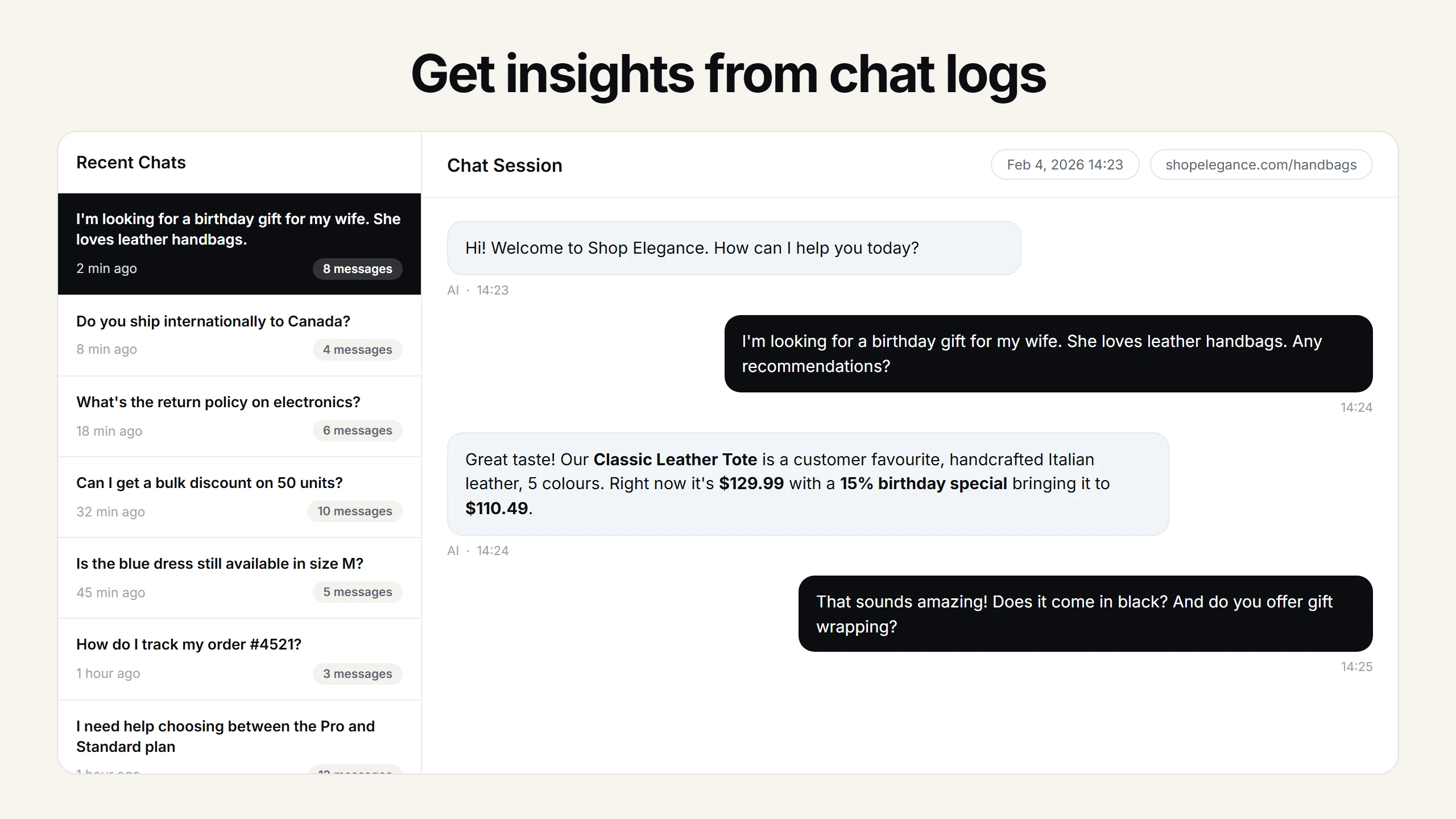
- Custom Tools for order tracking and actionsConnect your Shopify Admin API, shipping provider, or any REST endpoint as a Custom Tool. The AI calls these tools during conversations to look up order status, check tracking numbers, verify return eligibility, or perform any action your API supports. A customer asks "where's my order?" — the AI fetches the answer in real time, no human agent needed.
- Real-Time Data Feed keeps everything currentBeyond the automatic catalog sync, you can connect a Real-Time Data Feed — a URL returning your product data as JSON or CSV. The AI reads it on every query, so flash sale prices, inventory changes, and new arrivals are always accurate. Standard plan supports up to 200,000 characters; Real-Time Data Feed Max handles up to 10,000,000 characters for large catalogs.
- 36 languages, automatic escalationThe AI detects the visitor's language and responds in kind — across all 36 supported languages. A Japanese-speaking visitor browsing your English-language Shopify store gets answers in Japanese, with product cards showing your original product data. When the AI can't resolve an issue, it escalates to a human agent via email or your existing help desk, with the full conversation context included.
Add the AI chat plugin to your Shopify store in under 5 minutes
No developer needed. Install the Shopify app, your catalog syncs automatically, and the chat widget starts answering product questions immediately. Enable Dynamic Product Cards and Custom Tools from your dashboard whenever you're ready.
- Find Asyntai on the Shopify App Store and click Install. The app adds the chat widget to your storefront automatically — no theme editing required.
- Your Shopify product catalog syncs to the AI within hours. Every product, variant, price, image, and collection is indexed.
- Enable Dynamic Product Cards in your widget settings so the AI displays matching products as visual cards with images, prices, and buy buttons inside the chat.
- Optionally connect Custom Tools for order tracking, returns, and other post-purchase actions by pointing the AI at your Shopify Admin API or third-party endpoints.
<!-- Added automatically by the Shopify app -->
<script src="https://asyntai.com/widget.js"
data-id="your-store-id" async>
</script>
# The Shopify app handles the embed. You handle the products.
Chat plugin for Shopify — FAQs
Common questions from Shopify merchants evaluating AI chat plugins for their stores.
How does Asyntai differ from Shopify Inbox?
Shopify Inbox is a live chat tool — it connects your visitors to you (or your team) for manual, real-time conversations. When you're offline, visitors get a contact form. Asyntai is an AI chat plugin that answers autonomously, 24/7, without a human on the other end. The AI answers using your actual Shopify catalog — product descriptions, prices, availability — and displays matching products as Dynamic Product Cards with images and buy buttons inside the chat. It also handles post-purchase questions like order tracking and return eligibility through Custom Tools. Shopify Inbox requires someone to reply. Asyntai replies on its own, accurately, in seconds.
How does the AI get my Shopify product data?
When you install the Asyntai Shopify app, your product catalog syncs automatically. Every product title, description, price, image URL, variant, and collection is indexed by the AI without any manual uploads. The sync runs continuously — new products, price changes, and inventory updates flow through automatically. For merchants who want maximum data freshness, you can also connect a Real-Time Data Feed (a JSON or CSV URL) that the AI reads on every query, ensuring flash sale prices and stock levels are always current.
Can the AI track orders and handle returns?
Yes, through Custom Tools. You connect your Shopify Admin API (or any REST endpoint — shipping providers, returns platforms, CRM systems) as a tool the AI can call during conversations. When a customer asks "where's my order?" the AI calls your order lookup endpoint, retrieves the tracking information, and responds with the current status. You define what the AI can do — order lookups, return initiation, address changes, refund eligibility checks — and the AI uses those tools when relevant. Custom Tools are available on the Standard plan and above.
What do Dynamic Product Cards look like?
Dynamic Product Cards are visual cards that appear inside the chat conversation. Each card shows the product image (pulled from your Shopify catalog), the product name, the current price, a short description, and a "View Product" button that links directly to the product page on your Shopify store. When the AI finds multiple matching products, the cards display as a horizontal carousel the visitor can swipe through. They work on desktop and mobile and turn what would be a text-only answer into a visual shopping experience — the visitor sees the actual products, not just product names in a sentence.
Does it work with my Shopify theme?
Yes. The chat widget loads via a standalone JavaScript snippet that is independent of your Shopify theme. It works with Dawn, Prestige, Impulse, Debut, Brooklyn, and every other free or premium Shopify theme. It doesn't modify your theme files, doesn't conflict with other apps, and doesn't require any Liquid template editing. The Shopify app handles the installation automatically — the widget appears on your storefront the moment you install the app.
Does the AI support multiple languages?
Yes — 36 languages. The AI automatically detects the visitor's browser language and responds in that language. A French-speaking visitor browsing your English-language Shopify store gets answers in French, with product details (names, prices, images) pulled directly from your catalog data. You don't need to translate your product catalog or maintain separate storefronts. The AI handles the language layer; your Shopify catalog provides the product data. Supported languages include English, Spanish, French, German, Japanese, Korean, Chinese, Arabic, Portuguese, and 27 more.
How many products can the AI handle?
The automatic Shopify catalog sync handles stores of any size — the AI indexes your entire product catalog regardless of how many products you have. For the Real-Time Data Feed (which provides maximum data freshness), the Standard plan supports up to 200,000 characters of product data, which covers most small-to-medium catalogs. Real-Time Data Feed Max on the Pro plan supports up to 10,000,000 characters — enough for roughly 25,000 products with full descriptions. Between the catalog sync and the optional data feed, stores with thousands of SKUs are fully covered.
What plan do I need for my Shopify store?
The AI chat widget works on all plans, including Free, with answers drawn from your crawled Shopify store content. Dynamic Product Cards and the Real-Time Data Feed require the Standard plan ($139/month), which includes 15,000 messages per month. Custom Tools for order tracking and post-purchase actions are also Standard+. The Pro plan ($449/month) includes 50,000 messages per month and Real-Time Data Feed Max for large catalogs. Most Shopify stores start on Standard because that's where product cards and order tracking unlock.
What Shopify merchants actually need from a chat plugin — and why most fall short
Shopify makes it remarkably easy to launch an online store. Theme selection, product uploads, payment processing, shipping labels — the platform handles all of it with a polish that makes ecommerce accessible to anyone with inventory and ambition. But there's a gap in the Shopify experience that the platform itself hasn't fully addressed: what happens when a visitor has a question. Not a complaint that needs a support ticket, not a billing issue that needs an account lookup — just a question. "Does this jacket run large?" "What's the difference between the Pro and the Standard?" "Do you ship to Canada?" "I'm looking for a gift for someone who likes cooking, around $60." These are the questions that happen in physical stores a hundred times a day, answered by floor staff who know the products. In Shopify stores, these questions either go unanswered — and the visitor leaves — or they end up in an email inbox, answered hours later to a visitor who has already bought from a competitor.
The Shopify App Store is full of chat plugins that attempt to solve this. Shopify Inbox, Tidio, Gorgias, Re:amaze, LiveChat — the category is crowded. But the vast majority of these tools solve the wrong problem. They give you a way to talk to your visitors in real time. That's live chat: a human on one end, a visitor on the other, and a conversation that only happens when the human is available. For a solo founder running a Shopify store while also packing orders, managing inventory, and running ads, "being available for live chat" is a fantasy. The chat bubble sits on the storefront, the visitor clicks it, and they get a contact form — or worse, a "we'll get back to you" auto-reply that ensures they won't be back to get the reply. Live chat doesn't scale because it requires the one resource small merchants don't have: continuous human attention.
Rule-based chatbots were supposed to fix the scale problem. Map out the most common questions, write canned responses, build decision trees with buttons like "Shipping," "Returns," "Product Info." The visitor clicks through the tree until they find an answer or give up. These bots work for exactly three scenarios: the ones you anticipated. The moment a visitor asks something outside the decision tree — "which of your moisturizers is best for dry skin in winter?" — the bot deflects to a human agent or responds with a generic "I'm sorry, I didn't understand that." Rule-based bots fail because customer questions are not predictable enough to map in advance. Every new product, every new policy, every seasonal promotion creates questions that the bot wasn't programmed to handle. Maintaining the decision tree becomes a job in itself — and for most Shopify merchants, it's a job nobody does.
Asyntai takes a fundamentally different approach. Instead of scripts and decision trees, the AI answers using your actual Shopify store content. When you install the Asyntai app from the Shopify App Store, your product catalog syncs automatically — every product title, description, price, image, variant, collection, and tag flows into the AI's knowledge base. The AI also crawls your Shopify pages: your About page, your shipping policy, your FAQ, your size guides, your blog posts. Within hours of installation, the AI can answer questions about your products and policies with the same accuracy as a well-trained employee who has read everything on your website. Not because someone programmed those answers into a decision tree, but because the AI reads, understands, and reasons about your content in real time.
The difference becomes obvious the first time a visitor asks a question that a rule-based bot would fumble. "I have sensitive skin — which of your serums would be safest?" A scripted bot has no concept of "sensitive skin" or "safest" in relation to your product catalog. It would either deflect or show a generic product list. The AI reads the ingredient lists and descriptions across your serum products, identifies the ones labeled hypoallergenic or fragrance-free, and recommends them specifically — explaining why, using the information from your product descriptions. The answer isn't canned. It's generated from your catalog data, specific to the question, and contextually accurate. That's what it means for the AI to answer using your content: it doesn't memorize and repeat; it reads, reasons, and responds.
Dynamic Product Cards transform these conversational answers into a visual shopping experience. When the AI identifies products that match the visitor's question, it doesn't just name them in a sentence. It renders them as rich visual cards inside the chat window: product image, name, current price, a brief description, and a "View Product" button that links directly to the product page on your Shopify store. When there are multiple matches — "show me your running shoes under $100" — the cards appear as a horizontal carousel the visitor can swipe through. The effect is striking: the visitor goes from asking a question to browsing real products, visually, without ever leaving the chat. It's product discovery through conversation, not through a search bar.
The product data behind those cards stays current because of how the Shopify integration works. The automatic catalog sync means price changes, stock updates, variant additions, and new product launches flow through without any manual intervention. If you mark a product as out of stock at 2 PM, the AI stops recommending it at 2 PM. If you add a new collection at 9 AM, the AI starts answering questions about those products by the afternoon. For merchants who want even tighter data freshness — flash sales, real-time inventory on popular items — the Real-Time Data Feed provides an additional layer. Point Asyntai at a JSON or CSV URL that returns your current catalog data, and the AI reads it on every relevant query. Price change at 10 AM, accurate in the chat at 10:01 AM. The feed and the catalog sync work together: the sync provides broad product knowledge, the feed provides real-time precision.
But product questions are only one side of the Shopify merchant's support burden. The other side — often the larger side — is post-purchase support. "Where's my order?" "I need to return this." "Can I change the size I ordered?" "My package says delivered but I didn't receive it." These questions account for a disproportionate share of support volume and they all require data that lives outside the Shopify storefront: order status from your fulfillment system, tracking numbers from your shipping carrier, return eligibility from your return policy engine. A chat plugin that can only answer product questions handles the pre-purchase conversation and drops the post-purchase one entirely.
Custom Tools bridge that gap. They let you connect the AI to external APIs — your Shopify Admin API, your shipping provider's tracking API, your returns management platform, your CRM — so the AI can take action during conversations, not just answer from static content. When a customer asks "where's my order?" the AI doesn't say "please email [email protected]." It calls your order lookup endpoint with the customer's email, retrieves the tracking number and current status, and responds with the specifics: "Your order #4782 shipped on June 15th via USPS and is currently in transit. Here's your tracking number." The customer gets an immediate answer. You don't get an email to respond to. The interaction that would have taken 5 minutes of your time and 6 hours of the customer's patience takes seconds.
The versatility of Custom Tools goes beyond order tracking. Returns, exchanges, warranty checks, appointment scheduling, account lookups, loyalty point balances — any action that can be performed through an API can become a Custom Tool. A Shopify merchant selling subscription boxes could connect their subscription management API so the AI handles "skip next month" and "change my flavor" requests. A merchant selling electronics could connect their warranty database so the AI checks serial number coverage on the spot. Each tool you connect expands what the AI can do without expanding your support team. The chat plugin becomes not just a product expert but an operational agent — it doesn't just know about your store, it can do things in your store.
Language support might seem like a secondary concern for a Shopify merchant selling domestically, but the reality of ecommerce traffic tells a different story. Even stores targeting a single country receive visitors who browse in other languages — immigrant communities, tourists, international shoppers testing the waters before committing to a cross-border purchase. Asyntai supports 36 languages natively. The AI detects the visitor's browser language and responds accordingly. A Korean-speaking visitor on your English-language Shopify store gets answers in Korean, with product cards showing the same images, prices, and buy buttons as any other visitor. You don't need a multi-language Shopify setup, translated product descriptions, or separate storefronts. The AI handles the language; your catalog provides the products. For merchants with genuine international customer bases — or ambitions toward one — this eliminates an entire category of support friction.
Escalation matters because AI, no matter how capable, won't handle every conversation. A visitor might have a complaint that requires empathy and judgment. A question might fall outside what the AI knows. A customer might simply prefer talking to a person. Asyntai's escalation system handles these cases by routing the conversation to a human agent — via email, or through integration with your existing help desk. The critical detail is context: the escalation includes the full conversation history, so the human agent doesn't start from zero. They see what the visitor asked, what the AI answered, and where the conversation reached its limit. The AI handled the first 80% of the interaction; the human picks up the remaining 20% with full context, not a cold start.
For Shopify merchants specifically, the installation story is worth emphasizing because it addresses a real frustration. Most Shopify apps that require a code snippet ask you to edit your theme's Liquid templates — specifically theme.liquid — and paste a script tag in the right location. This is error-prone, theme-dependent, and intimidating for non-technical merchants. When you switch themes, you have to redo it. Asyntai's Shopify app handles the installation entirely through the app platform. Install the app, and the chat widget appears on your storefront. No theme editing, no Liquid code, no snippet placement. It works with Dawn, Prestige, Impulse, and every other Shopify theme — free or premium. This is not a trivial convenience. For the solo founder who chose Shopify specifically because they don't want to touch code, a chat plugin that requires code editing is a non-starter. Asyntai doesn't require it.
The economic case for an AI chat plugin on Shopify reduces to a simple observation: every unanswered question is a potential lost sale. A visitor asking "does this come in a larger size?" is ready to buy — they just need information. If the chat bubble connects them to a contact form that gets answered tomorrow, they buy from your competitor today. If a rule-based bot gives them a generic "please browse our size chart" response, they bounce. If the AI reads your product variants, finds that yes, XL is available in that color, and shows them the exact product card with a buy button — that's a conversion that would not have happened without the chat plugin. Multiply that by the number of product questions your store receives in a week — the ones you see in your inbox, plus the much larger number that visitors never bothered to ask because there was no good way to ask them — and the ROI calculates itself.
The chat plugin also surfaces customer intent data that most Shopify stores never capture. Every question a visitor asks in the chat reveals something about your catalog's gaps, your product descriptions' weaknesses, and your customers' priorities. If twenty visitors in a month ask "is this waterproof?" about a jacket whose product description doesn't mention water resistance, that's a signal to update the description. If visitors consistently ask for a product you don't carry, that's a signal to source it. The chat becomes a real-time feedback channel — not through surveys or review requests, but through the questions people naturally ask when they're considering a purchase. Most Shopify analytics tools tell you what visitors did. The chat tells you what they wanted.
Comparing Asyntai to the live chat and chatbot plugins in the Shopify App Store comes down to what you want the chat bubble to do. If you want a notification channel — "ping me when a visitor wants to talk" — live chat tools work. If you want a scripted FAQ bot that handles the same five questions — rule-based chatbots work, until they don't. If you want a chat plugin that understands your entire product catalog, shows visual product cards, tracks orders, handles returns, speaks 36 languages, and works 24/7 without a human on the other end — that's a different category of tool. The Shopify App Store labels them all "chat," but the range between a contact form with a chat bubble and an AI that reasons about your catalog is enormous.
Shopify merchants operate under a constraint that makes AI particularly valuable: they need to do everything themselves. A Shopify store is not a retailer with a support department. It's usually one person, or a small team, doing product sourcing, photography, copywriting, advertising, fulfillment, customer support, and strategic planning — simultaneously. Every support email answered is time not spent on growth. Every live chat session is time not spent on product development. An AI chat plugin doesn't eliminate support — it handles the routine fraction that doesn't need human judgment, which for most stores is the overwhelming majority. The merchant's time shifts from answering "what's the return policy?" for the 50th time to the work that actually grows the business.
The chat plugin category on Shopify is ripe for this shift because customer expectations have moved faster than the available tools. Visitors in 2026 have interacted with AI assistants on banking apps, airline sites, healthcare portals, and enterprise software. They expect the chat bubble on your Shopify store to actually help — not to connect them to a contact form, not to walk them through a button-driven script, but to understand their question and answer it. The stores that meet this expectation convert better, support cheaper, and build loyalty faster. The ones that don't are competing for the same customers with a worse experience. The chat plugin isn't a nice-to-have on Shopify stores anymore. It's the front door to your customer relationship — and the question is whether that door leads to an AI that knows your products, or a form that asks visitors to leave their email and wait.