AI search for WordPress that actually understands what your visitors want
Your WordPress search bar matches keywords. Asyntai's AI search understands intent. A visitor types "something warm for hiking under $100" and the AI searches your live product catalog, finds the right items, and shows them as visual product cards with images, prices, and buy buttons — right inside the chat widget. Not a search results page. A shopping conversation.
Watch the AI search your products in real time
Enter your WordPress or WooCommerce site URL and see how the AI finds and displays products from your content
Visitors describe what they want — the AI finds it and shows it
The default WordPress search matches keywords against post titles and content. That works for blog posts. It fails spectacularly for product discovery. When a visitor searches "lightweight rain jacket for spring hiking," keyword matching returns noise — or nothing. Asyntai's AI search reads the intent, searches your live product catalog through the Real-Time Data Feed, and returns matching products as Dynamic Product Cards: visual cards with product image, price, description, and a buy button. Multiple matches display as a swipeable carousel. The visitor goes from "I'm looking for..." to browsing real products in seconds, without ever leaving the chat.
- Natural language, not keyword gymnasticsVisitors describe what they need in their own words — "a gift for a runner under $50," "waterproof boots that look good in the office," "something like the Alpine Pro but cheaper." The AI understands the intent, not just individual words, and searches your catalog accordingly.
- Dynamic Product Cards in the chatWhen the AI finds matching products, it renders them as rich visual cards — product image, name, price, short description, and a direct buy/view button. Multiple results appear as a carousel the visitor can swipe through. Products are merchandised inside the conversation, not on a separate results page.
- Powered by your live catalogThe AI searches your Real-Time Data Feed — a URL (JSON, CSV, or API endpoint) that returns your current product data. Price changes, stock updates, and new arrivals reflect automatically. The AI always shows what you actually sell right now, not a stale index.
Live product data and a WordPress plugin that works with every theme
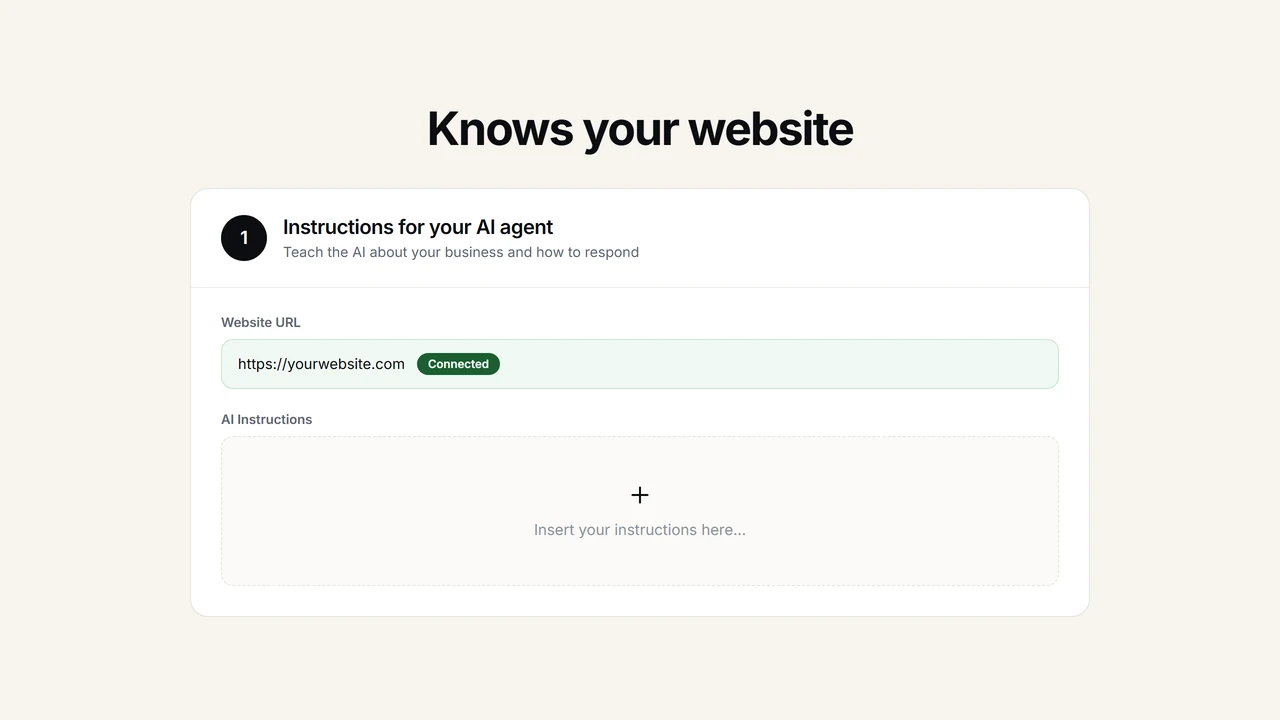
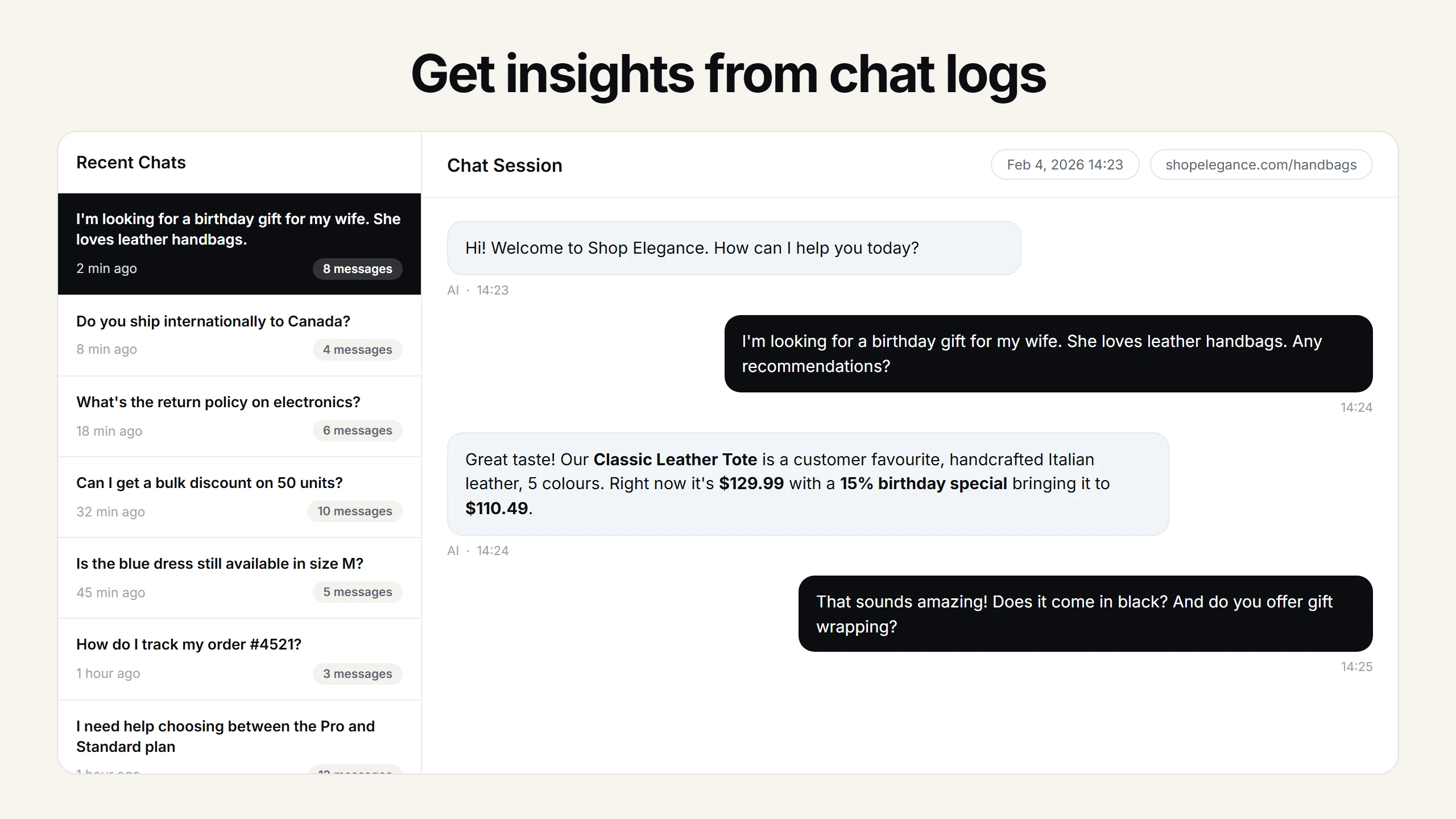
AI search is only as good as the data behind it. Asyntai's Real-Time Data Feed keeps the AI's product knowledge current — price and stock changes reflect immediately, new products appear within 24 hours, discontinued items stop showing up. And because the AI also crawls your WordPress pages, blog posts, and WooCommerce product pages, it can answer questions from your existing content too. Installation is a one-click WordPress plugin from your Asyntai dashboard — compatible with Elementor, Divi, Astra, GeneratePress, and every other theme.
- Real-Time Data Feed stays synchronizedPoint Asyntai at a URL that returns your product catalog (JSON, CSV, or any API endpoint). The AI indexes it automatically. When you change a price or mark an item out of stock, the feed reflects it immediately. New products appear within 24 hours. Standard plan supports up to 200,000 characters; Real-Time Data Feed Max handles up to 10,000,000 characters — roughly 25,000 products.
- Crawled content fills the gapsThe AI also crawls your WordPress pages, blog posts, WooCommerce product pages, and custom post types. So when a visitor asks a question that lives on your site — shipping policies, size guides, ingredient lists — the AI answers from your content. Data feed for products, crawled content for everything else.
- WordPress plugin, any themeInstall the official Asyntai plugin from your dashboard — one click, no code. It loads the chat widget on every page of your WordPress site. Works with Elementor, Divi, Astra, GeneratePress, Flavor, Flavor, and any other theme. WooCommerce is fully supported but not required.
Add AI search to your WordPress site in minutes
No developer needed. The WordPress plugin installs from your Asyntai dashboard, the data feed connects with a URL, and Dynamic Product Cards are enabled with a toggle. Your visitors get intelligent product search within minutes.
- Sign up at Asyntai, download the WordPress plugin from your dashboard, and activate it on your WordPress site.
- Let the AI crawl your site — it indexes your pages, posts, and WooCommerce products automatically.
- Connect a Real-Time Data Feed by pasting a URL that returns your product catalog (JSON or CSV). The AI indexes it within hours.
- Enable Dynamic Product Cards in your widget settings — the AI will render matching products as visual cards with images, prices, and buy buttons.
<!-- Installed automatically by the WordPress plugin -->
<script src="https://asyntai.com/widget.js"
data-id="your-site-id" async>
</script>
# Plugin handles the embed. You handle the products.
AI search for WordPress — FAQs
Common questions from WordPress store owners, WooCommerce merchants, and agencies evaluating AI-powered search.
How is this different from the default WordPress search?
The built-in WordPress search matches keywords against post titles and content fields. If a visitor searches "warm jacket for winter hiking," WordPress looks for posts containing those exact words — and usually returns irrelevant results or nothing. Asyntai's AI search understands intent. It reads the full query, figures out what the visitor actually wants (a warm, outdoor-suitable jacket), searches your product catalog, and returns matching items as visual product cards with images, prices, and buy buttons. It works through conversation, not a search box, which means the visitor can refine their request naturally — "something a bit cheaper" or "do you have that in red?"
Does it work with WooCommerce products?
Yes, in two ways. First, the AI crawls your WooCommerce product pages just like any other WordPress content — it reads product descriptions, specs, categories, and attributes. Second, you can connect a Real-Time Data Feed that exports your WooCommerce catalog as JSON or CSV — this gives the AI structured product data with current prices, stock levels, and images. When both sources are connected, the AI searches across your complete catalog and displays results as Dynamic Product Cards with accurate, real-time pricing and availability.
How does the AI get my product data?
Three sources work together. The AI automatically crawls your WordPress site — pages, posts, WooCommerce products, and custom post types. For structured product data with prices and images, you connect a Real-Time Data Feed: a URL (JSON, CSV, or API endpoint) that returns your current catalog. You can also upload files (PDFs, docs) to the knowledge base. The AI searches across all sources simultaneously and presents the best matches as product cards. Most WooCommerce stores already have a product export or REST API endpoint that works as a data feed.
How quickly do product changes (price, stock) update?
Price and stock changes in your Real-Time Data Feed reflect immediately — the AI reads the feed on each query, so it always has current data. New products added to the feed appear within 24 hours as the AI re-indexes. For crawled WooCommerce product pages, updates follow your crawl schedule (typically daily). The data feed is the fastest path for keeping product information current — which is why it's recommended for any store with frequently changing prices or inventory.
What do Dynamic Product Cards look like?
Dynamic Product Cards are visual cards that appear directly inside the chat conversation. Each card shows the product image, name, price, a short description, and a "View Product" button that links to the product page on your site. When the AI returns multiple matching products, they display as a horizontal carousel the visitor can swipe through. The cards are styled to match a clean, modern look and work on both desktop and mobile. They turn the chat from a text-only conversation into a visual product browsing experience.
How many products can it handle?
The Real-Time Data Feed on the Standard plan supports up to 200,000 characters of product data — enough for most small-to-medium catalogs. For larger stores, Real-Time Data Feed Max supports up to 10,000,000 characters, which handles roughly 25,000 products with full descriptions, prices, and image URLs. The AI also crawls your WooCommerce product pages with no hard product limit on crawled content. Between the data feed and crawled pages, stores with thousands of products are well within range.
Does it work with any WordPress theme?
Yes. The Asyntai WordPress plugin loads the chat widget via a small JavaScript snippet that works independently of your theme. It's been tested with Elementor, Divi, Astra, GeneratePress, OceanWP, Flavor, and dozens of others. It doesn't modify your theme files, doesn't conflict with page builders, and doesn't require any CSS customization. If your WordPress site loads in a browser, the plugin works.
What plan do I need?
The AI chat widget works on all plans — including Free — with knowledge base answers from your crawled content. Real-Time Data Feed and Dynamic Product Cards require the Standard plan ($139/month) or Pro plan ($449/month). Standard includes up to 15,000 messages/month and 200,000 characters of data feed. Pro includes 50,000 messages/month and access to Real-Time Data Feed Max (10,000,000 characters). Custom Tools for advanced actions like order lookups are also Standard+.
Why WordPress search fails at product discovery — and how conversational AI fixes it
WordPress powers over 40% of the web, and WooCommerce is the most popular ecommerce platform by install count. Yet the search experience on most WordPress stores is remarkably poor. The default search bar does keyword matching against post titles and content fields — technology that was adequate for finding blog posts in 2008 but falls apart when a visitor is trying to find a product they can picture but can't name. The disconnect between how people search ("something waterproof for fall hiking, not too bulky, under $150") and how WordPress search works (exact keyword matching against text fields) costs stores sales every day. Visitors who can't find what they're looking for don't file a complaint. They leave.
There are search plugins that improve on the default — Relevanssi, SearchWP, ElasticPress — and they do a better job of weighting results and searching custom fields. But they're still fundamentally keyword-matching tools with better algorithms. They still present results as a list of links on a search results page. They still require the visitor to know roughly what words to use. They can't understand "I'm looking for a gift for my dad who likes fishing" because that query isn't a keyword — it's a description of a need. Bridging the gap between what a visitor means and what products you sell requires a different kind of search entirely.
Asyntai's AI search for WordPress replaces that keyword-matching paradigm with conversational product discovery. Instead of a search box that returns a list of links, visitors interact with an AI-powered chat widget that understands natural language, searches your live product catalog, and displays matching products as Dynamic Product Cards — visual cards with product images, prices, descriptions, and buy buttons, right inside the chat window. The search happens through conversation, which means the visitor can refine, compare, and explore without retyping queries or bouncing between search results pages. It's the difference between searching and shopping.
The technology that makes this work is the Real-Time Data Feed. You provide Asyntai with a URL that returns your product catalog — a JSON feed, a CSV export, or a REST API endpoint. Most WooCommerce stores already have one of these available through WooCommerce's built-in REST API or a product export plugin. The AI indexes this feed and uses it as its primary source of product knowledge. When a visitor asks "do you have any running shoes for flat feet?", the AI searches the data feed — not just for the keywords "running shoes" and "flat feet," but for products whose descriptions, features, and categories match that intent. It might find products tagged with "stability," "arch support," or "motion control" even if the visitor didn't use those terms.
What separates this from a better search algorithm is what happens next. Instead of returning a list of links, the AI responds with Dynamic Product Cards — rich visual cards that display the product image, name, price, a short description, and a "View Product" button. When there are multiple matches, the cards appear as a swipeable carousel. The visitor sees the products right there in the conversation, compares them visually, and clicks through to the one they want. There's no search results page to wade through, no "page 2" that never gets visited, no back-button loop. The AI curates and presents, and the visitor browses within the chat.
Dynamic Product Cards work from any knowledge source that Asyntai has access to — not just the Real-Time Data Feed. If the AI finds a relevant product from your crawled WooCommerce pages, from an uploaded product catalog PDF, or from a connected Shopify integration, it can render it as a card. The visual format is the same regardless of where the data originated. This means even stores that haven't set up a data feed yet see product cards from their crawled product pages. The data feed adds real-time pricing and stock accuracy, but the visual experience starts working as soon as your site is crawled.
The Real-Time Data Feed is where accuracy and freshness converge. The AI reads the feed on each relevant query, which means price changes and stock updates reflect immediately. If you drop the price on a winter jacket from $180 to $129 for a flash sale, the next visitor who asks about winter jackets sees $129 on the product card — not the old price. If an item goes out of stock, it stops appearing in results. New products added to the feed are indexed within 24 hours. This is a fundamentally different model from search plugins that rely on periodic re-indexing and often serve stale data during sales events — precisely when accurate data matters most.
Capacity scales with catalog size. The Standard plan supports Real-Time Data Feeds up to 200,000 characters, which comfortably handles catalogs of a few hundred products with full descriptions, prices, and image URLs. For larger stores, Real-Time Data Feed Max extends that to 10,000,000 characters — roughly 25,000 products with complete data. Combined with crawled product pages (which have no character limit), even large WooCommerce catalogs are fully searchable. The AI doesn't slow down as the catalog grows because it's not doing keyword matching across a text index — it's reasoning about product relevance based on the visitor's intent.
The conversational format solves a problem that no search results page can: iterative refinement. When a visitor types "waterproof hiking boots" into a search bar and gets 40 results, they scroll, click, back-button, scroll, click, back-button. Each refinement starts from scratch. In a conversation with Asyntai's AI search, refinement is natural. "Do you have waterproof hiking boots?" shows product cards. "Something a bit lighter, for day hikes." The AI narrows the results. "What about that second one — is it available in size 11?" The AI checks the data feed. "Can you show me something similar but under $150?" The AI searches again with the new constraint. Each exchange builds on the last. The visitor doesn't restart the search — they steer it, like talking to a knowledgeable store clerk who remembers the whole conversation.
For WooCommerce stores specifically, the AI search provides advantages that generic search improvements can't. WooCommerce product data is often distributed across multiple fields — short description, long description, attributes (color, size, material), categories, tags, custom fields — and the default search only looks at title and main content. Even advanced search plugins need manual configuration to weight custom fields correctly. The AI sidesteps this entirely by understanding the product holistically. When the data feed includes all relevant attributes, the AI reasons about them together. "Blue cotton button-down shirt in medium" isn't a three-keyword query — it's a product description with color, material, style, and size, and the AI treats it as such.
The economic argument for conversational AI search comes down to product discovery rate. On most ecommerce sites, search users convert at 2-3x the rate of browsing users — because search indicates intent. But that conversion premium disappears when search returns poor results. A visitor who searches, gets irrelevant results, and leaves represents the most expensive kind of lost sale: a motivated buyer you failed to serve. AI search recovers those visitors by understanding what they actually want, even when they can't articulate it in keywords. Every product card shown to a visitor who would have bounced from a keyword search is incremental revenue that your store would otherwise never see.
Multilingual search extends the reach further. Asyntai supports 36 languages, which means a Spanish-speaking visitor can ask "busco una chaqueta impermeable para senderismo" and the AI searches the same English-language product data feed, finds matching products, and presents the cards with a response in Spanish. The product names, prices, and images on the cards come directly from the feed, while the conversational text around them — the AI's recommendation, comparison notes, follow-up question — is in the visitor's language. You don't need a multilingual catalog. The AI handles the language layer; the data feed handles the product layer.
Custom Tools extend the AI search beyond product discovery into post-search actions. Once a visitor finds the right product and clicks "View Product," the conversation doesn't have to end there. With Custom Tools, the AI can check real-time inventory for specific sizes or colors by calling your WooCommerce API. It can look up shipping estimates for the visitor's region. It can check whether a coupon code applies to a particular product. It can even initiate order lookups for returning customers — "I ordered this jacket last month, is the matching pants available in my size?" Each tool you connect adds another action the AI can take without the visitor navigating away from the chat. Search becomes the entry point to a full shopping conversation.
The WordPress plugin makes deployment straightforward for non-technical store owners. You download the plugin from your Asyntai dashboard (not from WordPress.org), upload it to your WordPress site via the Plugins page, and activate it. The plugin adds the Asyntai chat widget to every page. No code editing, no theme file modifications, no shortcodes. It works alongside any theme — Elementor, Divi, Astra, GeneratePress, and dozens of others have been tested. Page builders don't conflict because the widget loads asynchronously via a standalone script tag, independent of your theme's DOM structure.
The gap between what visitors expect from search in 2026 and what WordPress actually delivers is enormous. Visitors have been conditioned by Amazon, Google, and ChatGPT to expect that a search system will understand them — not just echo their words back as a keyword match. Every WordPress store with a basic search bar is leaving that gap open. Asyntai's AI search closes it — not by bolting a better algorithm onto the same search box, but by reimagining search as a conversation. The visitor describes what they want. The AI finds it. The products appear as visual cards with images and buy buttons. That's what AI search for WordPress looks like: a chat widget that doubles as the best product search experience on your site.
The stores that benefit most from AI search share a characteristic: they sell products that visitors describe in terms of need, occasion, or attribute rather than product name. Outdoor gear ("something warm for skiing"), fashion ("a dress for a summer wedding"), home decor ("minimalist desk lamp under $80"), specialty food ("gluten-free snacks for road trips"), beauty ("moisturizer for sensitive skin"). In every case, the visitor knows what they want but doesn't know what it's called in your catalog. Keyword search forces them to guess your vocabulary. Conversational AI search meets them where they are — with their words, their intent, their context — and translates that into the products you sell. That translation is where the revenue lives.
The traditional search bar isn't going away. Visitors who know exactly what they want — searching for a specific product name or SKU — will still use it. But for the larger group of visitors who are browsing, exploring, and looking for something they'll know when they see it, the AI search widget is a fundamentally better experience. It's not a replacement for the search bar. It's a new channel for product discovery that the search bar was never designed to handle. And it sits on every page of your site, ready to help the moment a visitor has a question that starts with "I'm looking for..." — which, if your analytics are any indication, is a moment that happens far more often than your current search logs suggest.