An AI search plugin that works on any website — not just the big platforms
Your site search matches keywords. Your visitors think in sentences. Asyntai bridges the gap with one JavaScript snippet. A visitor types "comfortable office chair under $400 with lumbar support" and the AI searches your product catalog, finds the right matches, and displays them as Dynamic Product Cards — complete with images, prices, and buy buttons — right inside the chat widget. Works on WordPress, Shopify, Wix, Squarespace, custom-built sites, and everything in between. No platform lock-in, no app store approval, no migration. Just paste the snippet and your content becomes AI-searchable.
See AI search working on your site
Enter your website URL — any platform — and watch the AI find and display products and content from your pages
One snippet install, auto-crawl, and search results your visitors actually want
Most site search plugins are tied to a single platform. They work on WordPress or Shopify, but not both — and never on a custom-built site. Asyntai's AI search plugin is a single JavaScript snippet that works everywhere. Paste it into your site's HTML, and the AI crawls your pages automatically — product listings, service pages, blog posts, FAQs, documentation. Within hours, visitors can search your entire site using natural language. The AI understands intent, not just keywords, and returns results as Dynamic Product Cards: visual cards with images, descriptions, prices, and action buttons displayed right inside the chat. No search results page. No keyword guessing. Visitors describe what they need, and the AI shows them what matches.
- Natural language search across all your contentVisitors search the way they think — "birthday gift for a 10-year-old who likes science," "quiet hotel near the beach with parking," "tutorial on setting up two-factor authentication." The AI reads the full query, understands the intent behind it, and searches your content to find the closest matches. No keyword tricks, no filter dropdowns, no boolean operators.
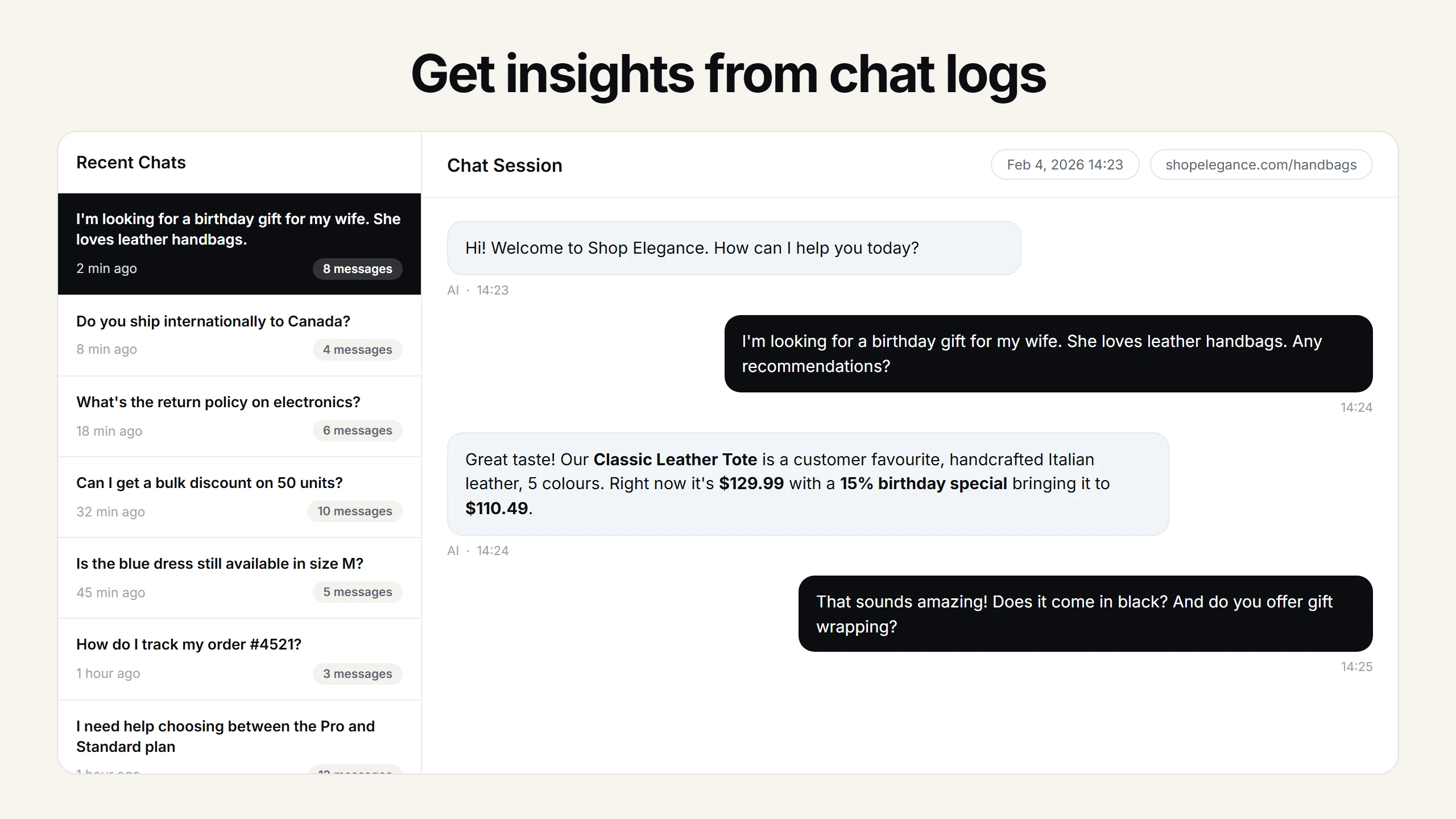
- Dynamic Product Cards in the conversationWhen the AI finds matching products or services, it renders them as rich visual cards — image, name, price or description, and a direct action button. Multiple results appear as a horizontal carousel the visitor can swipe through. The cards turn a text conversation into a visual browsing experience, keeping the visitor engaged without sending them to a separate search results page.
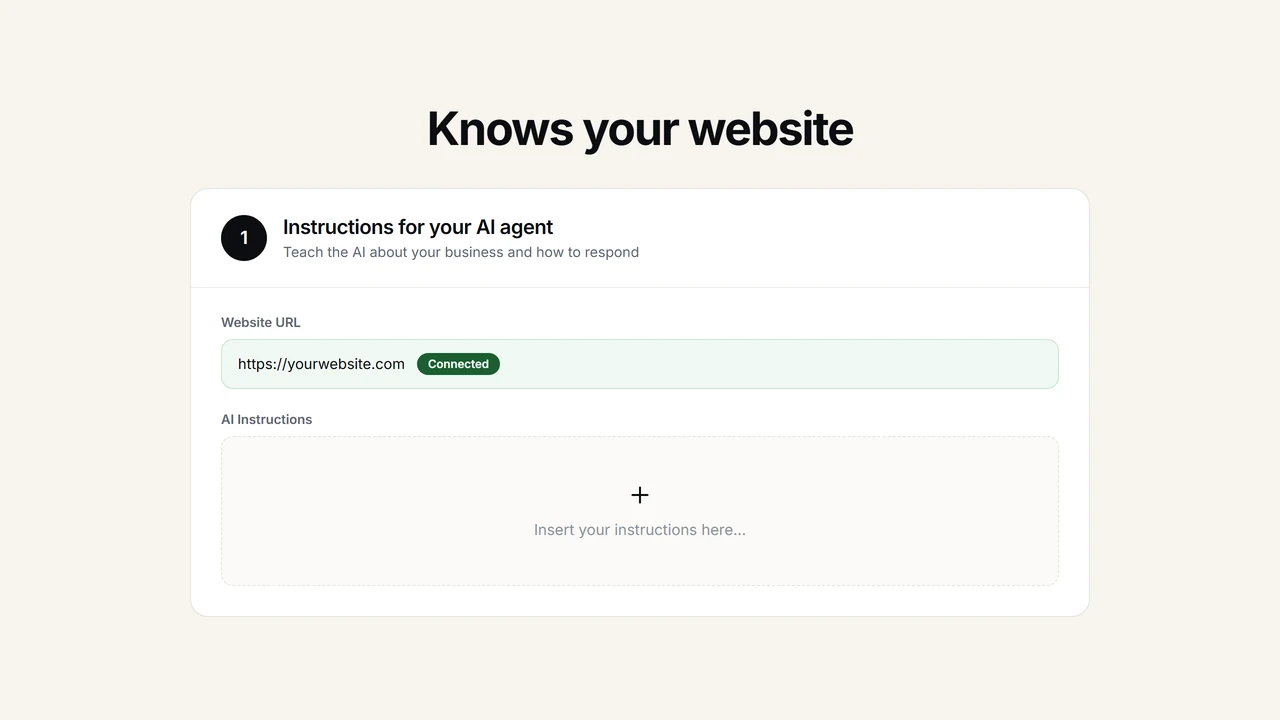
- Auto-crawl indexes your site automaticallyPoint Asyntai at your domain and it crawls your pages — product listings, service descriptions, blog articles, help docs, about pages. The AI builds a knowledge base from your existing content without any manual data entry. Re-crawls happen on schedule so new pages and updates are picked up automatically. Your site is the source of truth.
Real-time product data, Custom Tools for actions, and 36 languages out of the box
Crawled content gets the AI started, but live data makes it powerful. The Real-Time Data Feed connects the AI directly to your product catalog — a JSON feed, CSV export, or API endpoint that returns current prices, stock levels, and product details. Changes reflect immediately. New products appear within 24 hours. And with Custom Tools, the AI can go beyond search: it can check inventory, look up order status, calculate shipping, or call any API endpoint you expose. All of this works in 36 languages automatically — a visitor searching in Japanese gets results from your English catalog with the AI responding in Japanese. One snippet, any platform, every language.
- Real-Time Data Feed for live accuracyConnect a URL that returns your product catalog — JSON, CSV, or any API endpoint. The AI reads the feed on each query, so price changes, stock updates, and new arrivals are always current. Standard plan supports up to 200,000 characters of product data; Real-Time Data Feed Max handles up to 10,000,000 characters for catalogs with thousands of products.
- Custom Tools for post-search actionsSearch is the start, not the end. With Custom Tools, the AI can call your own API endpoints to check real-time inventory for specific sizes, look up shipping estimates, verify coupon codes, or retrieve order status for returning customers. Each tool you connect adds another action the AI can perform without the visitor leaving the chat.
- One snippet, every platform, 36 languagesThe AI search plugin is a single JavaScript snippet — no platform-specific app, no plugin marketplace, no server-side integration. It works on WordPress, Shopify, Wix, Squarespace, Webflow, BigCommerce, Magento, Ghost, Hugo, Jekyll, hand-coded HTML, or any site that renders in a browser. And it supports 36 languages natively, so visitors from any region can search and get responses in their own language.
Add AI search to your website in minutes
No developer needed. Copy one snippet into your site, let the AI crawl your content, and optionally connect a data feed for live product accuracy. Your visitors get intelligent, natural language search within minutes — regardless of what platform your site runs on.
- Sign up at Asyntai and copy the JavaScript snippet from your dashboard — it's one line of code.
- Paste the snippet into your website's HTML — in the header, footer, or through your platform's custom code injection (WordPress, Shopify, Wix, Squarespace all support this).
- Let the AI crawl your site — it indexes your pages, products, services, and content automatically within hours.
- Optionally connect a Real-Time Data Feed for live product data and enable Dynamic Product Cards to show visual search results.
<!-- Works on any website — paste before </body> -->
<script src="https://asyntai.com/widget.js"
data-id="your-site-id" async>
</script>
# One snippet. Any platform. AI-powered search.
AI search plugin — FAQs
Common questions from site owners, agencies, and developers evaluating an AI search plugin for their website.
What platforms does the AI search plugin work on?
Every platform that lets you add a JavaScript snippet to your pages. That includes WordPress, WooCommerce, Shopify, Wix, Squarespace, Webflow, BigCommerce, Magento, PrestaShop, OpenCart, Ghost, Hugo, Jekyll, Joomla, Drupal, and fully custom-built websites. The plugin loads asynchronously through a single script tag and doesn't depend on any server-side framework, CMS plugin system, or app store integration. If your site renders in a browser, the AI search plugin works on it. Agencies and freelancers use it across client sites on different platforms with the same Asyntai account.
How does it differ from the search bar my platform already provides?
Built-in search on most platforms — WordPress, Shopify, Wix — uses keyword matching. It takes the visitor's query, breaks it into individual words, and checks which pages contain those words. That works when the visitor knows the exact product name. It fails when they describe what they want in natural terms: "anniversary gift for someone who likes cooking," "warm but breathable running top for winter." Asyntai's AI search understands the full sentence, reasons about what the visitor means, and searches your product catalog and content for matches based on intent. Results appear as visual product cards inside the chat, not as a list of page links. It's a fundamentally different search experience.
How does the AI get my product and content data?
Two primary sources. First, the AI automatically crawls your website — it reads product pages, service descriptions, blog posts, FAQs, help articles, and any other public page. This happens automatically after you install the snippet. Second, you can connect a Real-Time Data Feed: a URL that returns your product catalog as JSON, CSV, or via an API endpoint. The data feed gives the AI structured product data with current prices, stock levels, and image URLs. You can also upload files like PDFs and documents to the knowledge base. The AI answers using your content from all sources combined.
Do I need a developer to install it?
No. Installation is copying a single script tag and pasting it into your site. On WordPress, you can paste it into the header using a plugin like Insert Headers and Footers, or use the Asyntai WordPress plugin. On Shopify, paste it into theme.liquid or use the Shopify app. On Wix, use the Custom Code section in site settings. On Squarespace, use Code Injection. On a custom site, paste it before the closing body tag. The whole process takes under five minutes on any platform. No API keys, no server configuration, no build step.
What do Dynamic Product Cards look like?
Dynamic Product Cards are visual cards that appear directly inside the chat conversation. Each card shows a product image, name, price, a short description, and an action button that links to the product page on your site. When the AI returns multiple matching products, the cards display as a horizontal carousel the visitor can swipe or scroll through. The cards work on both desktop and mobile, adapt to different screen sizes, and maintain a clean, modern appearance that fits alongside your existing site design. They transform the chat from a text-only exchange into a visual product discovery experience.
Does it work for non-ecommerce sites?
Yes. The AI search plugin works for any type of content. Service businesses use it to help visitors find the right service — "I need help with a leaking roof in Seattle" surfaces the relevant service page and contact details. Portfolio sites use it so visitors can discover projects by describing what they're looking for — "modern kitchen renovation with marble countertops." Documentation sites use it as a natural-language help tool — visitors ask questions instead of searching through a table of contents. SaaS companies use it for support deflection — the AI answers common questions from existing help articles. Ecommerce product cards are one use case, but the underlying capability is AI-powered content discovery across any site.
How many languages does it support?
Asyntai supports 36 languages. The AI can detect the visitor's language automatically and respond accordingly. A visitor searching in Spanish — "busco un regalo para un amigo que le gusta cocinar" — gets results from your English-language content with the AI's response in Spanish. Product card data (names, prices, images) comes directly from your catalog, while the conversational text is in the visitor's language. You don't need to maintain a multilingual catalog. The AI handles the language layer; your content stays in whatever language it's already in.
What plan do I need?
The AI chat widget with knowledge base answers from crawled content works on all plans, including Free. Real-Time Data Feed and Dynamic Product Cards require the Standard plan ($139/month) or Pro plan ($449/month). Standard includes up to 15,000 messages/month and 200,000 characters of data feed capacity. Pro includes 50,000 messages/month and Real-Time Data Feed Max (10,000,000 characters). Custom Tools for actions like order lookups and inventory checks are also Standard+. The Free plan with 50 messages/month is a full-featured way to test the AI search on your site before upgrading.
Why the standard search widget is the weakest link on most websites — and what AI search plugins actually change
Every website has a search function. Almost none of them work well. The search bar on a typical site — whether it's built on WordPress, Shopify, Wix, Squarespace, or a custom stack — does one thing: keyword matching. A visitor types words, the search engine checks which pages contain those words, and it returns a ranked list. This has been the model since the late 1990s, and it has barely evolved. The ranking algorithms have gotten more sophisticated, the indexing has gotten faster, but the fundamental interaction — type keywords, get links — hasn't changed. Meanwhile, how people search has changed dramatically. Visitors in 2026 don't think in keywords. They think in needs, questions, and descriptions. "Something for my sister's birthday under $50." "Which plan includes API access?" "Show me projects similar to the loft renovation in Brooklyn." These are real searches that real visitors type into real search bars, and they almost always return garbage — or nothing.
The gap between how people search and how search widgets work is where revenue disappears. Studies consistently show that visitors who use site search convert at 2-3x the rate of visitors who browse — because search signals intent. A visitor who searches is telling you what they want to buy. But that conversion premium evaporates when the search returns irrelevant results. A visitor who searches "lightweight stroller that folds small for travel," gets a page of tangentially related results, and leaves is the most expensive kind of lost sale: a motivated buyer who told you exactly what they wanted, and you failed to match it. Multiply that across hundreds of daily searches and the leak is substantial — invisible because your search analytics only track what was searched, not what wasn't found.
Platform-specific search plugins have tried to improve on this. Shopify has apps like Searchanise, Algolia, and Doofinder. WordPress has Relevanssi, SearchWP, and ElasticPress. Wix has its native site search. Each improves the ranking algorithm for its specific platform — better weighting of product attributes, faceted filtering, typo tolerance. These are genuine improvements. But they're still keyword-matching engines with better math. They still return a list of links on a search results page. They still require the visitor to translate their intent into keywords the search engine can process. And they only work on the platform they were built for. If you run sites across WordPress and Shopify, you need different search solutions for each, configured separately, with different feature sets and different price points. There's no unified search experience across platforms.
An AI search plugin changes the interaction model entirely. Instead of a search box that returns links, visitors interact with a conversational AI that understands natural language, searches your content and product catalog, and presents results visually — as Dynamic Product Cards with images, prices, and action buttons — right inside the chat. The search happens through conversation, which means it's iterative. "Do you have running shoes for flat feet?" shows product cards. "Something lighter, for indoor use." The AI narrows the results. "How does that compare to the CloudStep?" The AI provides a side-by-side. Each exchange builds on the previous one. The visitor refines their search by talking, not by retyping queries and clicking back.
What makes this work as a universal plugin — not tied to any single platform — is that the AI's knowledge comes from two sources that are platform-independent. The first is auto-crawl. You paste Asyntai's JavaScript snippet into your site, and the AI crawls your pages: product listings, service descriptions, blog posts, FAQ pages, documentation, landing pages. It reads what's publicly visible and builds a searchable knowledge base from it. This works the same way whether your site runs on WordPress, Shopify, Wix, Squarespace, Webflow, Magento, or static HTML. The crawler doesn't care what CMS generated the page. It reads the content, understands the structure, and indexes it for natural language search.
The second source is the Real-Time Data Feed — a URL you provide that returns your product catalog as structured data (JSON, CSV, or an API endpoint). This is where the AI gets current prices, stock levels, image URLs, and product attributes. The feed is platform-agnostic by design: any system that can export products as JSON or CSV works. WooCommerce has a REST API. Shopify has a product CSV export. BigCommerce, Magento, and PrestaShop all have export functions. Even a Google Sheet published as CSV works. The AI indexes the feed and uses it alongside crawled content to answer product searches with accurate, real-time data. When a visitor asks "do you have that in blue," the AI checks the feed — not a cached index from last week.
Dynamic Product Cards are the visual layer that turns search results into a browsing experience. When the AI finds products matching a visitor's query, it doesn't just list names and links. It renders each product as a visual card inside the chat: product image, name, price, a short description, and an action button. Multiple matches display as a horizontal carousel the visitor can swipe through. The cards make the chat feel like a curated product display rather than a text exchange. For ecommerce sites, the cards show prices and "View Product" buttons. For service businesses, they can show service descriptions and "Learn More" buttons. For portfolio sites, project images and "View Project" links. The card format adapts to whatever content the AI surfaces.
The conversational format solves a usability problem that even the best search results page cannot: contextual refinement. On a traditional search results page, every new search starts from scratch. The visitor types a query, reviews results, goes back, types a different query, reviews again. There's no memory between searches, no building on previous context. In a conversation with the AI search plugin, refinement is natural and cumulative. "I'm looking for a winter jacket." The AI shows options. "Something warmer, for below-zero temps." The AI narrows down. "Do you have the Expedition Parka in large?" The AI checks stock. "What's the return policy on outerwear?" The AI answers from the site's FAQ page. One conversation, four different types of queries, each building on the last. No search bar could handle that sequence because search bars don't have memory.
For site owners who operate across multiple platforms, the single-snippet model eliminates fragmentation. An agency that manages client sites on WordPress, Shopify, and Squarespace doesn't need to learn three different search plugins, maintain three different configurations, or pay for three different subscriptions. One Asyntai account, one snippet per site, and the same AI search experience everywhere. The configuration — knowledge base sources, data feeds, Custom Tools, widget appearance — is managed from the Asyntai dashboard, not from within each platform's admin panel. This is especially valuable for businesses that run a main site on one platform and a blog or documentation site on another. The AI search works across both, using content from all crawled sources.
Custom Tools extend the AI search plugin beyond discovery into action. Once a visitor finds what they're looking for, the AI can do more than link to a product page. With Custom Tools, it can call your own API endpoints: check real-time inventory for a specific size, calculate shipping costs to a given postal code, look up an order status, verify whether a promotional code applies. Each tool is an HTTP endpoint you configure in the Asyntai dashboard — the AI calls it during the conversation when the visitor's question requires it. This turns the search widget into a full shopping assistant or support agent, capable of answering questions that require live data from your backend. And because Custom Tools use standard HTTP, they work regardless of your platform — any system that can expose an API endpoint can power a Custom Tool.
Language support is built in, not bolted on. The AI search plugin supports 36 languages natively. It detects the visitor's language — from browser settings, from the page language, or from the language of their query — and responds accordingly. A German-speaking visitor asks "Gibt es eine leichte Regenjacke unter 100 Euro?" and the AI searches your English-language product catalog, finds matching lightweight rain jackets under the equivalent price, and responds in German. The product cards show data from your feed (product names, prices in your currency, images), while the AI's conversational text is in German. You don't need to maintain a translated catalog. You don't need a multilingual search plugin. The AI handles the language mapping automatically, which means your single-language product catalog is instantly searchable by visitors in 36 languages.
The question of whether an AI search plugin is worth the investment comes down to a simple ratio: how many visitors search your site, and how many of them find what they're looking for? Most site analytics tools track the first number but not the second. You can see that 15% of your visitors use search, but you can't easily see how many of them found a relevant result. The "zero results" metric is a start, but it misses the more common failure: searches that return results, just not relevant ones. A visitor who searches "gift for someone who likes coffee" and gets a page of loosely related results might click on one, realize it's not right, and leave. That search "worked" by the platform's metrics — it returned results and generated a click — but it failed the visitor. AI search doesn't just reduce zero-result searches. It increases the quality of every search result by understanding what the visitor actually means.
Installation complexity is the most common objection to adding a new search solution, and it's the objection that matters least here. The AI search plugin is a single script tag — fewer than 100 characters of code. You paste it into your site's HTML. On WordPress, that means dropping it into a header/footer plugin or using the Asyntai WordPress plugin. On Shopify, it goes into theme.liquid or through the Asyntai Shopify app. On Wix, it's the Custom Code section. On Squarespace, Code Injection. On a custom site, paste it before the closing body tag. There's no package to install, no build step to run, no API key to configure on the server side, no database table to create. The snippet loads asynchronously, so it doesn't affect page load speed. It doesn't conflict with existing search functionality — the AI chat widget sits alongside your current search bar, giving visitors a second, more capable search path.
The difference between AI search and traditional search becomes most visible with ambiguous or complex queries — which are exactly the queries that indicate the highest purchase intent. "Something for my living room that ties together gray furniture and warm wood tones." "A laptop for my daughter starting college, needs to run design software." "Waterproof speaker that sounds decent, not too big, for camping." These are real purchasing decisions expressed as natural language. No keyword search can handle them because they're not keyword queries — they're descriptions of needs that require reasoning to match against a product catalog. The AI reads the description, infers the relevant attributes (color compatibility, software requirements, size and durability), and searches the catalog for products that match those inferred criteria. Then it presents the matches as visual cards, so the visitor can evaluate them immediately.
Content-rich sites benefit from AI search in ways that ecommerce stores might not immediately recognize. A law firm with 200 articles about different legal topics can give visitors an AI search that answers "do I need a permit to build a deck in Ontario?" by finding and summarizing the relevant article. A university with thousands of program pages can help prospective students who search "master's program in data science with co-op" find the right program without navigating a complex directory. A recipe site can handle "quick weeknight dinner with chicken and whatever's in a basic pantry" better than any category filter. In each case, the AI search plugin doesn't replace the existing site navigation — it augments it with a natural language path that works especially well for visitors who know what they want but don't know where to find it on your site.
The economics of site search have always been lopsided. Visitors who search are your highest-intent audience, yet most sites spend their design and development budget on navigation, landing pages, and checkout flows. The search function gets a default text input and whatever results the platform generates. An AI search plugin rebalances that equation by giving your highest-intent visitors a search experience that matches their intent level. They're ready to buy or engage — and now the search actually helps them get there. For the cost of a Standard plan, every search on your site becomes a conversation where the AI understands the query, searches your live catalog, shows visual results, and follows up. It's not a better search bar. It's a different kind of search — one that works the way your visitors already think.
The sites that see the most impact from AI search share a common trait: their visitors describe needs rather than products. Ecommerce stores where shoppers say "something comfortable for standing all day at work" instead of searching for a specific brand and model. Service businesses where clients describe situations — "I think my furnace is making a weird noise, it's about 15 years old." Educational platforms where learners search by goal — "learn Python for data analysis, I know some SQL already." Real estate sites where buyers search by lifestyle — "family-friendly neighborhood near good schools, under $500K." In every case, the visitor's query is rich with intent that keyword matching throws away. The AI search plugin captures that intent, reasons about it, and delivers results that match what the visitor actually means. That translation — from visitor intent to relevant content — is where the value lives, and it works the same way regardless of what platform your site is built on.