AI search for enterprise — one platform, every brand, every site
Your enterprise runs multiple sites across brands, regions, and departments. Asyntai deploys AI-powered search across all of them from a single account. Each site gets its own knowledge base, its own data feeds, and its own search scope — visitors on Brand A only see Brand A results. Centralized analytics let you see search patterns across the entire organization. No per-seat licensing, no six-month implementation. Deploy to your first site this week and roll out across the organization at your own pace.
See how AI search works on your enterprise site
Enter any of your organization's site URLs and see how the AI finds and displays content from that specific site
Every brand gets its own search — visitors never see the wrong results
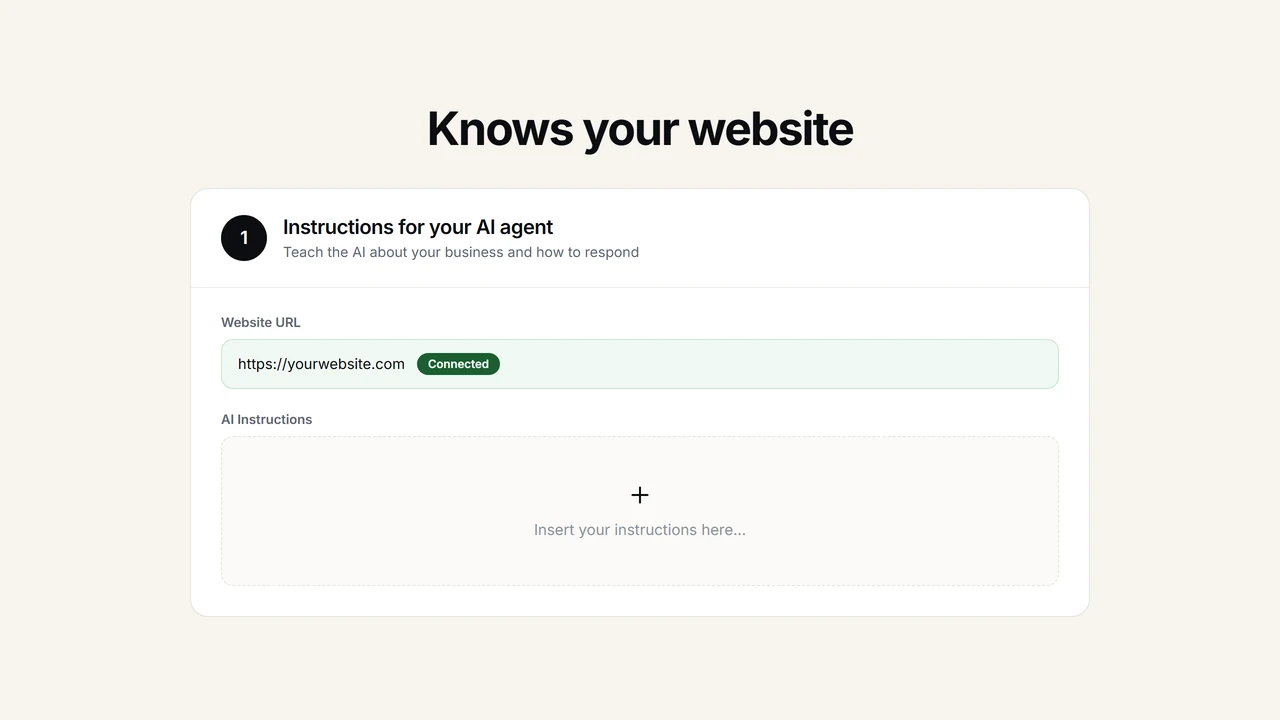
Enterprise search platforms often index everything into one giant pool, then try to filter results by site after the fact. That creates leakage — a visitor on your consumer electronics site seeing results from your industrial supply catalog, or an internal HR query surfacing customer-facing product pages. Asyntai takes the opposite approach. Each site in your account has its own knowledge base, its own Real-Time Data Feed, and its own search scope. The AI on Site A searches only Site A content. The AI on Site B searches only Site B content. No cross-contamination, no complex access rules, no leakage. The Pro plan supports up to 20 sites, each independently configured, all managed from one dashboard.
- Isolated knowledge bases per siteEach site gets its own crawled content, its own uploaded documents, and its own data feed. A visitor interacting with the AI on your luxury fashion brand sees only that brand's products, lookbooks, and size guides — never inventory from your industrial supply division. Isolation is structural, not filter-based, so there is no configuration to maintain and no risk of cross-site leakage.
- Independent Real-Time Data FeedsEach site connects its own data sources — product catalogs, knowledge articles, inventory systems, support documentation. One site might feed 5,000 consumer electronics products via JSON. Another might feed 200 industrial pumps via CSV. A third might not need a data feed at all, relying entirely on crawled content from an internal knowledge portal. Each feed updates independently on its own schedule.
- Dynamic Product Cards across every siteWhen the AI finds matching products or resources, it displays them as visual cards with images, descriptions, pricing, and action buttons — regardless of which site the visitor is on. The card format adapts to the content: product cards for ecommerce sites, article cards for knowledge bases, resource cards for internal portals. The same rich visual experience, deployed consistently across your organization.
Centralized analytics, Custom Tools per site, and 36 languages out of the box
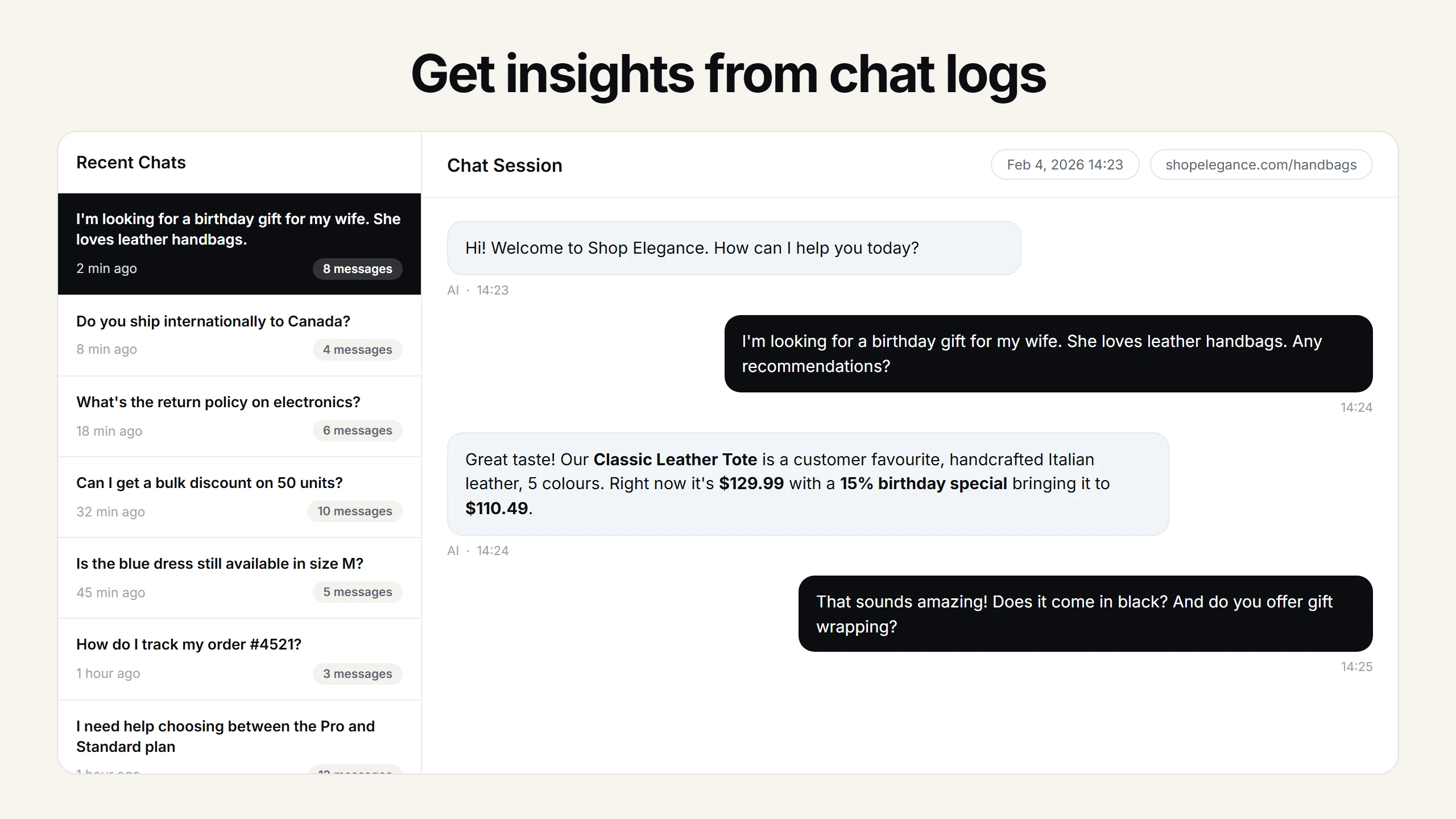
Managing AI search across an enterprise is not just about deploying widgets — it is about visibility, control, and adaptability. Asyntai's dashboard gives you a single view of search activity across all sites: what visitors are searching for, which queries lead to conversions, where content gaps exist. Custom Tools let each site connect its own backend APIs — order lookups for ecommerce, ticket creation for support, booking systems for services — so the AI does not just search but acts. And with 36 languages supported natively, global enterprises deploy once and serve every market without maintaining separate language-specific search configurations.
- Centralized analytics across all sitesSee search volume, popular queries, content gaps, and conversation outcomes across your entire organization from one dashboard. Identify which brands get the most search traffic, which queries go unanswered, and where visitors drop off. Export data via the API for integration with your existing BI tools. No need to check each site separately — the dashboard aggregates and segments automatically.
- Custom Tools per siteEach site can connect its own API integrations for post-search actions. Your ecommerce brand might connect order lookup and return initiation. Your B2B division might connect inventory availability and quote requests. Your HR portal might connect ticket creation and benefits lookup. Each site's Custom Tools are independent — the consumer-facing AI never sees the internal HR endpoints, and vice versa.
- 36 languages, zero translation overheadA visitor in Tokyo asks a question in Japanese. The AI searches the same English-language data feed and responds in Japanese, with product cards showing the original product names and prices. A visitor in Berlin asks in German. Same data, German conversation. You do not need multilingual content — the AI handles the language layer while the data feed handles the product and content layer. Deploy one configuration, serve every market.
Deploy AI search across your enterprise in days, not months
Traditional enterprise search platforms require months of integration, custom connectors, and professional services. Asyntai deploys to your first site in minutes and scales across your organization at your own pace. Each site gets a single script tag — that is the entire installation.
- Sign up for Asyntai Pro and create your first site. Each site gets its own widget ID, knowledge base, and configuration.
- Add the script tag to each site — one line of JavaScript per site. Works with any CMS, any framework, any static site. Your development team can deploy across all sites in a single sprint.
- Connect Real-Time Data Feeds for each site — product catalogs, knowledge articles, inventory data. Each site points to its own data source via URL (JSON, CSV, or API endpoint).
- Configure Custom Tools per site if needed — connect each site's backend APIs so the AI can perform actions like order lookups, ticket creation, or booking confirmations.
<!-- Each site gets its own widget ID -->
<!-- Site 1: Consumer Electronics -->
<script src="https://asyntai.com/widget.js"
data-id="site-electronics-id" async>
</script>
<!-- Site 2: Industrial Supply -->
<script src="https://asyntai.com/widget.js"
data-id="site-industrial-id" async>
</script>
# Same script, different IDs. Each site searches its own content.
AI search for enterprise — FAQs
Common questions from enterprise buyers, IT teams, and procurement leads evaluating multi-site AI search.
How does brand isolation work? Can visitors on one site see content from another?
No. Each site in your Asyntai account has its own knowledge base, its own data feed, and its own search scope. The AI widget deployed on Site A only has access to Site A's content — it physically cannot search Site B's data because it is a separate knowledge base with a separate widget ID. This is not a filter on top of a shared index. Each site is structurally independent. A visitor on your luxury fashion brand will never see results from your industrial supply catalog, and an employee searching your internal HR portal will never surface customer-facing product data. There is no configuration to maintain for this isolation — it is how the architecture works by default.
How long does deployment take across multiple sites?
Each site takes minutes to deploy — you add a single script tag to the page, connect a data feed URL, and the AI starts crawling and indexing. Most enterprises deploy their first site same-day and roll out across additional sites over one to two weeks. The limiting factor is usually internal approval processes, not technical work. There is no professional services engagement, no custom connector development, and no staging environment required. Your development team adds one line of JavaScript per site. Compare that to traditional enterprise search platforms that require three to six months of integration work, custom crawlers, and dedicated project management.
What security and data handling practices does Asyntai follow?
All data is encrypted in transit (TLS 1.2+) and at rest. Each site's knowledge base is logically isolated — there is no shared index across sites. Data feeds are fetched over HTTPS and processed in isolated environments. Conversation logs are stored per-site and accessible only to account administrators. Asyntai does not use your data to train models. The AI answers using your content at query time through retrieval, not by incorporating your data into its weights. You can delete any site's data at any time, and deletion is permanent. For enterprises with specific compliance requirements, contact us to discuss your needs.
Does Asyntai support SSO or team access controls?
The Pro plan includes team access so multiple administrators can manage the account. Each team member can access the dashboard, configure sites, view analytics, and manage knowledge bases. For SSO integration with your enterprise identity provider, contact our team to discuss your requirements — we work with enterprises on authentication configurations that fit their existing infrastructure.
Where is data stored? Can we choose the data residency region?
Asyntai's infrastructure is hosted on major cloud providers with data centers in multiple regions. For standard accounts, data is stored in the region closest to your primary deployment. For enterprises with specific data residency requirements — such as EU-only storage for GDPR compliance or specific country restrictions — contact us to discuss available options. We understand that data residency is often a procurement requirement, not a preference, and we work with enterprise customers to meet their specific needs.
What analytics are available across sites?
The dashboard shows search activity across all your sites from a single view. You see total conversations, popular search queries, content gaps (questions the AI could not answer), and conversation outcomes — all segmentable by site, date range, and language. You can identify which brands generate the most search traffic, which topics have knowledge gaps, and where visitors are dropping off. Conversation logs are searchable and exportable. The API provides programmatic access to analytics data for integration with your existing BI tools, data warehouses, or reporting dashboards.
What does the Pro plan cost for enterprise deployments?
The Pro plan is $449 per month and includes up to 20 sites, 50,000 messages per month, Real-Time Data Feed Max (up to 10,000,000 characters per feed), Custom Tools, API access, team access, and priority support. Each site gets its own knowledge base, data feed, and widget configuration. For organizations that need more than 20 sites or 50,000 messages per month, contact us for custom enterprise pricing. There is no per-seat fee, no per-query fee, and no implementation cost.
Does Asyntai help with regulatory compliance (GDPR, SOC 2, HIPAA)?
Asyntai is designed with privacy and compliance in mind. The AI does not store personal visitor data beyond conversation logs, which are accessible only to your administrators and can be deleted at any time. For GDPR, the AI operates as a data processor under your control — it processes visitor queries using your content and does not retain data for its own purposes. Cookie consent and privacy notice integration work with your existing consent management platform. For enterprises with SOC 2, HIPAA, or other specific compliance frameworks, contact us to discuss your requirements and review our current certifications and data handling documentation.
Why enterprise search is broken — and why multi-site AI search fixes it without a six-month project
Enterprise organizations do not have one website. They have ten. Twenty. Sometimes fifty. A consumer electronics brand with its own storefront. A B2B industrial division with a product catalog and spec sheets. A corporate HR portal with benefits documentation and policy guides. A luxury fashion label with lookbooks and boutique locations. A financial services arm with product comparisons and compliance documents. Each site serves a different audience, sells different products or services, and operates with different content — often managed by different teams in different countries. And every single one of them needs search that actually works.
The enterprise search market has traditionally offered two options, both inadequate. Option one: each site gets its own standalone search tool — Algolia here, Elasticsearch there, a WordPress plugin on a third site. The result is fragmented infrastructure, inconsistent search quality, no unified analytics, and a different vendor relationship for every property. The VP of Digital has no single view of what customers and employees are searching for across the organization. Option two: a unified enterprise search platform — Coveo, Lucidworks, SearchStax — that indexes everything into one giant pool and tries to scope results by site at query time. These platforms cost six figures, take three to six months to implement, require dedicated connector development, and still fundamentally do keyword matching behind a more sophisticated ranking algorithm. And they create a new problem: leakage. When everything lives in one index, the barrier between your consumer-facing content and your internal HR documents is a filter — not a wall.
Asyntai takes a third approach. Each site in your account is a fully independent AI search instance — its own knowledge base, its own data feeds, its own widget, its own Custom Tools. A visitor on your consumer electronics site interacts with an AI that knows only about consumer electronics. An employee on your HR portal interacts with an AI that knows only about HR policies, benefits, and internal processes. There is no shared index to filter. There is no cross-site contamination to prevent. The isolation is architectural, not configurational. And because each site is independently configured, different teams can manage their own content without coordinating with a central search team or waiting in a queue for connector development.
The AI search on each site works through conversation, not a search box. A visitor on your electronics site types "I need a 4K monitor for video editing, something color-accurate around $800." The AI does not do keyword matching against product titles. It understands the intent — a color-accurate 4K monitor suitable for professional video editing at a specific price point — searches that site's Real-Time Data Feed for matching products, and presents them as Dynamic Product Cards: visual cards with product images, prices, key specs, and a direct link to the product page. If the visitor says "something a bit larger, maybe 32 inches," the AI refines the results within the same conversation. No new search query. No results page. No back-button loop. It is the difference between a search engine and a knowledgeable sales associate who knows your entire catalog.
The Real-Time Data Feed is what makes the product search accurate and current. Each site connects its own data source — a URL that returns the product catalog, knowledge base, or content repository in JSON, CSV, or via API endpoint. The AI indexes each feed independently. When a price changes in the electronics catalog, the next visitor sees the updated price on the product card. When a new product launches, it appears in search results within 24 hours. When an item goes out of stock, it stops showing up. Each site's feed operates on its own update cycle. The electronics catalog might refresh hourly while the industrial supply feed refreshes daily — each one configured for its own operational rhythm. Standard plan feeds support up to 200,000 characters. Real-Time Data Feed Max, available on the Pro plan, handles up to 10,000,000 characters per feed — enough for roughly 25,000 products with full descriptions, specifications, images, and pricing.
Dynamic Product Cards transform the search experience from text-based results to visual merchandising inside the conversation. Each card renders a product image, name, price, a short description, and an action button — "View Product," "Request Quote," "Read Article," or whatever label fits the content type. Multiple matching results appear as a horizontal carousel the visitor can swipe through. The format works identically whether the content is a consumer product, an industrial component, a knowledge article, or a policy document. The visual presentation is consistent across all sites in your organization, which means visitors get a familiar, polished experience regardless of which brand or department they are interacting with.
Custom Tools extend each site's AI from search into action. On your ecommerce sites, Custom Tools might connect to order lookup, shipping status, and return initiation APIs. On your B2B industrial site, Custom Tools might connect to real-time inventory availability, quote generation, and distributor locator endpoints. On your HR portal, Custom Tools might connect to benefits enrollment, PTO balance lookup, and IT ticket creation systems. Each site's Custom Tools are completely independent — the consumer-facing AI never sees the HR endpoints, and the HR AI never sees the ecommerce order system. A visitor searching for products can, in the same conversation, find the right item, check availability in their region, and request a quote — all without leaving the chat widget. That is not search. That is a complete self-service interaction powered by search as the entry point.
Multilingual search is where the enterprise architecture shows its most practical advantage. Asyntai supports 36 languages natively. A visitor in Japan asks a question in Japanese on your electronics site. The AI searches the English-language product data feed, finds matching products, and responds in Japanese — the product cards show the original product names and prices from the feed, while the conversational text around them is in Japanese. A visitor in Brazil asks in Portuguese on the same site. Same data feed, Portuguese response. You do not need to maintain 36 translations of your product catalog. The AI handles the language layer; the data feed handles the product layer. For a global enterprise with sites serving dozens of markets, this eliminates the need for language-specific search configurations, translated search indexes, or region-specific search tuning. One data feed per site, 36 languages automatically.
Centralized analytics give the enterprise something that fragmented search tools never could: a unified view of what people are searching for across the entire organization. The dashboard shows total conversations, popular queries, content gaps, and outcomes — segmentable by site, date range, and language. A product marketing team can see that visitors across three regional sites are all searching for a product category you do not carry yet. A content team can see that a specific policy question comes up hundreds of times per month on the HR portal and the answer is buried in a 40-page PDF. A customer experience team can see which brands have the highest search-to-purchase conversion and what those sites are doing differently. The API provides programmatic access to all analytics data, so you can pipe it into your existing BI tools, data warehouses, or executive dashboards. This is intelligence, not just metrics.
The deployment model is where Asyntai diverges most sharply from traditional enterprise search. Conventional platforms require a procurement cycle, a professional services engagement, connector development for each content source, a staging environment, UAT testing, and a phased rollout — typically three to six months from contract to production. Asyntai deploys to your first site in minutes. You sign up, create a site, add a script tag, connect a data feed, and the AI starts crawling and indexing. Your second site takes the same amount of time. Your tenth site takes the same amount of time. There is no professional services engagement. There is no custom connector to develop — if your data is accessible via URL (JSON, CSV, or API), it works. There is no staging environment required — the widget is a single JavaScript tag that loads asynchronously and does not interfere with your site's functionality. Most enterprises deploy their first site same-day, validate the experience over a week, and then roll out across additional sites at their own pace.
The total cost comparison is stark. A traditional enterprise search platform runs $50,000 to $200,000 per year in licensing, plus $50,000 to $150,000 in implementation services, plus ongoing maintenance and connector development costs. Asyntai's Pro plan is $449 per month — $3,588 per year — for up to 20 sites, 50,000 messages per month, Real-Time Data Feed Max on every site, Custom Tools, API access, and team access. For organizations that need more than 20 sites or higher message volumes, custom enterprise pricing is available. But the point is that AI-powered conversational search across your entire organization does not require an enterprise budget anymore. It requires a credit card and an afternoon.
Security and data isolation are non-negotiable for enterprise deployments, and Asyntai's multi-site architecture handles both by design. Each site's knowledge base is logically isolated — there is no shared index, no cross-site query capability, and no administrative backdoor that lets one site's content appear in another site's results. Data feeds are fetched over HTTPS and processed in isolated environments. Conversation logs are stored per-site and accessible only to account administrators. The AI answers using your content through retrieval at query time — it does not incorporate your data into model weights or use your content to improve its general capabilities. You can delete any site's data at any time, and deletion is permanent. For enterprises with specific compliance requirements — GDPR data residency, SOC 2, industry-specific regulations — Asyntai works with you to meet those requirements.
Team access on the Pro plan means you are not dependent on a single administrator. Multiple team members can manage the account, configure sites, view analytics, update knowledge bases, and monitor conversation logs. Different team members can be responsible for different sites — the brand manager for the fashion label manages that site's knowledge base and AI instructions, while the IT team manages the industrial supply site's data feed integrations. There is no need for a centralized search team that becomes a bottleneck. Each team operates independently on their site while the centralized dashboard provides organizational visibility.
The API opens up programmatic access to everything — site management, analytics, conversation data, and widget configuration. Enterprises use the API to integrate Asyntai data into their existing tooling: pushing analytics into Snowflake or BigQuery, triggering alerts in Slack when content gaps are detected, automating knowledge base updates when new content is published in the CMS. The API turns Asyntai from a standalone search tool into a component of your enterprise infrastructure that communicates with everything else.
Consider the deployment across a hypothetical mid-market enterprise with five digital properties. Site one: a direct-to-consumer electronics store with 3,000 products, needing product search with real-time pricing and order status lookups. Site two: a B2B industrial supply catalog with 8,000 SKUs, needing spec sheet search and quote request functionality. Site three: a corporate website with investor relations, press releases, and career listings. Site four: an internal employee portal with HR policies, benefits documentation, and IT knowledge base articles. Site five: a customer support knowledge base serving post-purchase questions across all product lines. With a traditional enterprise search platform, this deployment involves five different content connectors, a multi-month implementation project, and ongoing tuning of relevance models across five very different content types. With Asyntai, it is five sites in one Pro account, five data feeds (each a URL pointing to the right data source), five script tags, and five sets of Custom Tools. Total implementation time: days, not months. Total cost: $449 per month, not $150,000 per year.
The question enterprise buyers should ask is not "can this AI search platform handle our scale?" — the question is "why are we still spending six figures and six months on search infrastructure that does keyword matching with better ranking?" The technology has shifted. AI-powered search that understands natural language, reasons about intent, presents results visually, and takes action through API integrations is available at a fraction of the cost and a fraction of the deployment time. Asyntai's multi-site architecture means it scales to enterprise needs without enterprise complexity. Each site is independent. Each knowledge base is isolated. Each data feed updates on its own schedule. The dashboard unifies the view. And the AI on every site understands what visitors are actually looking for — which is more than any keyword-matching platform will ever do, regardless of how much you pay for it.
The enterprise search market is overdue for the same disruption that hit every other category of enterprise software: a product that works better, deploys faster, and costs less than the incumbent. Asyntai is that product for AI-powered search. Not because it replaces every function of a Coveo or Lucidworks — those platforms do things Asyntai does not, like federated search across internal databases and deep CRM integrations. But for the use case that matters most — helping visitors and employees find what they are looking for across your digital properties — Asyntai delivers a better experience in days instead of months, at thousands instead of hundreds of thousands. And it does it through conversation, which is how people actually want to search when the technology lets them.