AI assistant for business that actually knows your business
Asyntai offers an AI assistant that answers from your business site — learns your services, pricing, case studies, and policies in minutes, then handles prospect and customer questions around the clock, in 36 languages.
Try the AI assistant on your business site
Paste your website URL and see how the assistant would actually answer your prospects and customers
Not a generic chatbot. Reads your actual content.
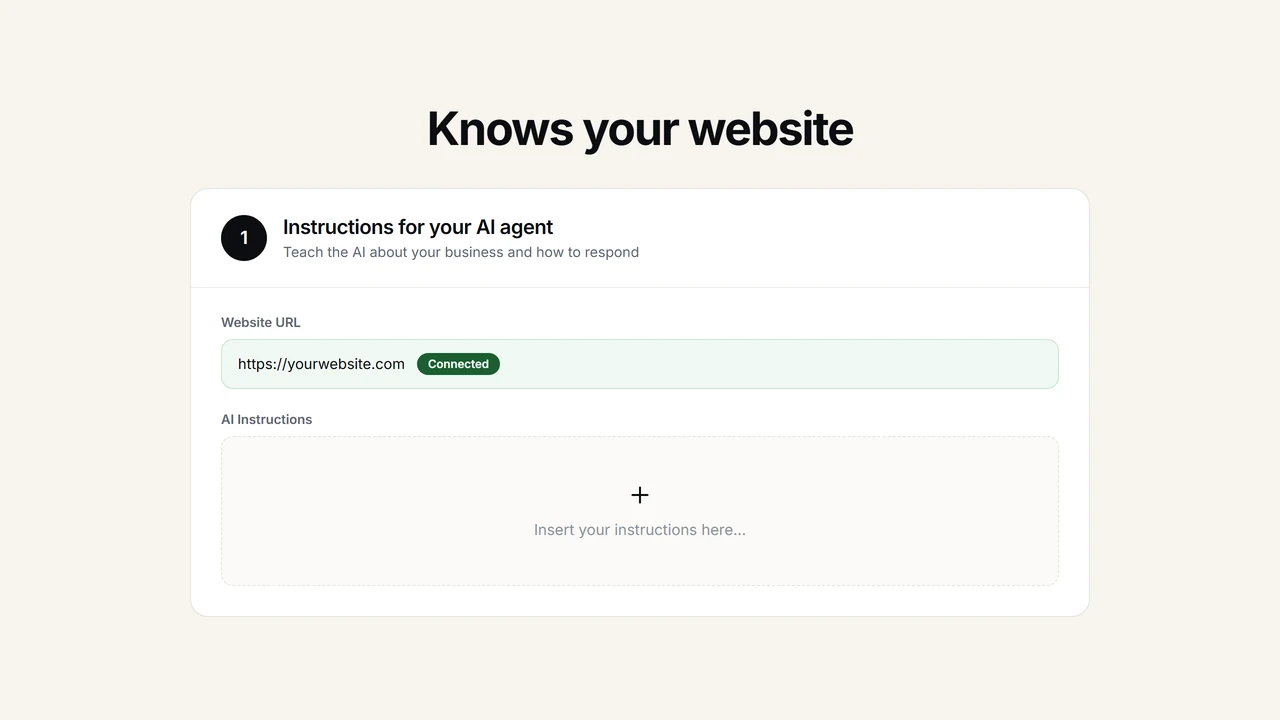
A useful AI assistant for business has to know the business. Asyntai crawls your website, absorbs your services, pricing, case studies, and policies, and turns all of that into a single knowledge base — so every answer is grounded in what you actually sell, not in generic AI-speak.
- Auto-crawls your public siteServices pages, pricing, about, blog posts, FAQs — anything published becomes part of the assistant's working context.
- Upload private documentsPricing sheets, proposal templates, onboarding guides, internal FAQs — add them as PDFs or paste the text directly.
- Speak in your voicePlain-English custom instructions set tone, escalation rules, and how to handle edge cases. "Always offer a consultation when asked about pricing." The assistant follows it.
Qualifies leads before they ever hit your inbox
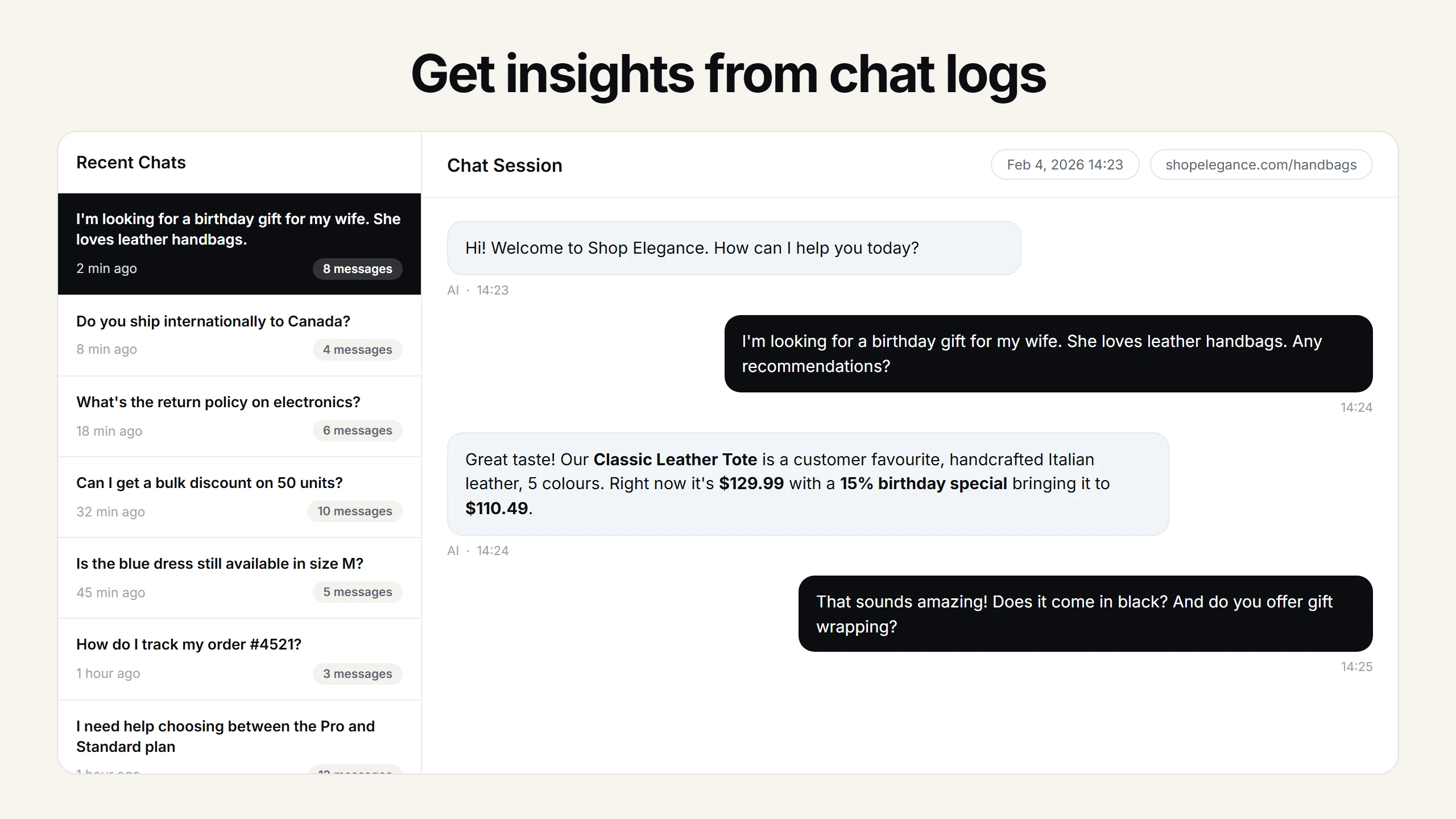
An AI assistant for business is only as valuable as the business it generates. Asyntai captures contact details mid-conversation, tags them with full context, and sends them straight to your dashboard — and optionally to your inbox — while the prospect is still warm.
- Smart lead capture in conversationsThe assistant can ask for an email or phone number when a prospect seems ready. Leads land in your Asyntai dashboard, with real-time email notifications if you want them.
- Qualifies before your team sees itEvery lead arrives with the full chat transcript — what they asked, what was answered, what they're actually looking for.
- Conversation analyticsSee which questions come up most, which pages generate the most interest, and where your site is silently losing potential business.
Install in minutes. No tech project.
Adding an AI assistant for business usually sounds like a weeks-long implementation. It isn't. Paste one JavaScript snippet into your website's <head> — WordPress, Webflow, Squarespace, custom site, all work the same way — and the assistant is live.
- Sign up for a free Asyntai account and copy your personal snippet.
- Paste it into your site's
<head>— via your CMS header settings, a header plugin, or directly in the template. - Point the assistant at your site URL and let it crawl your content.
- Test a few conversations, tweak the welcome message, go live.
<script src="https://asyntai.com/widget.js"
data-id="your-site-id" async>
</script>
</head>
# Setup done. No dev team required.
AI assistant for business — FAQs
What founders and small teams usually ask before switching on.
How is this different from just using ChatGPT?
ChatGPT is a general-purpose model that knows nothing about your business by default. Asyntai has the AI answer from your own site, documents, and custom instructions — so the answers reflect your services, pricing, case studies, and policies, not the generic internet. It's also embedded directly on your site as a live assistant, rather than a separate tool your prospects would have to visit.
What kinds of business sites is this for?
Service businesses, consultants, agencies, coaches, professional services, SaaS landing pages, local businesses, ecommerce stores — anywhere a prospect or customer might arrive with a question. The assistant works the same way regardless of what your business sells.
How long does setup actually take?
Most businesses get live in under half an hour. That includes pasting the snippet, pointing the AI at your URL, uploading a couple of PDFs if needed, writing a few custom instructions, and testing a handful of conversations. There's no implementation project and no external developer required.
Can the assistant handle questions in other languages?
Yes. The widget UI is available in 36 languages, and the AI detects the visitor's language directly from their first message — so a French prospect gets a French reply, a German prospect gets German, without any extra configuration on your side.
Can it access my customer data to give personalized answers?
Yes, through the User Context feature on Standard and Pro plans. Your site passes logged-in customer data — name, account details, order history, whatever you choose — into a JavaScript object before the widget loads. The AI uses that context to answer personalized questions without needing any API integration.
What happens if I run out of messages?
The assistant pauses new replies until the next billing cycle or until you upgrade. Email warnings arrive before you actually hit the cap, so a traffic spike doesn't silently cut off your chat.
Can I use it on more than one business site?
Yes on paid plans. Free: 1 site, Starter: 2, Standard: 3, Pro: up to 10. Each site gets its own separately indexed AI assistant, which matters if you run multiple ventures or manage sites for clients.
Where do captured leads actually go?
Leads land in your Asyntai dashboard, with the full conversation transcript attached. If you turn on email notifications, the same transcript also lands in your inbox in real time — so you can follow up through whatever email or CRM workflow you already use.
AI assistant for business — the honest guide
Ask any small business owner where their hours actually go, and the answer is almost always the same: repeating themselves. The same pricing question from a prospect every morning. The same "do you work with startups" email every afternoon. The same "what's included in your package" question from a potential client who almost certainly could have found the answer on the services page if they had scrolled. A well-built AI assistant for business exists to remove this category of work, not by pretending to replace you, but by handling the top of the funnel so your actual attention ends up on the conversations that matter.
The phrase "AI assistant for business" is doing a lot of heavy lifting in the market right now. It gets attached to everything from generic ChatGPT wrappers to narrow scheduling bots to enterprise-scale automation suites. What most small and mid-sized businesses actually need sits in a specific slot: an assistant that lives directly on the company website, knows the business well enough to answer prospects and customers, qualifies leads while interest is warm, and doesn't require a consultant to set up. Anything simpler than that is a novelty. Anything more complex belongs to larger operations with dedicated ops teams.
Training is where most AI assistants for business go wrong. They either launch with zero context — offering generic, suspicious-sounding replies — or require weeks of manual Q&A curation before they answer anything useful. Asyntai avoids both failure modes by pulling directly from your own content. You enter your website URL and the AI crawls your public pages: services, pricing, case studies, about, FAQs, blog posts. Anything already written on your site becomes part of the assistant's working memory. For content that isn't public — proposal templates, partner pricing, internal how-to documents, client onboarding checklists — you upload as PDFs or paste as text. The assistant treats all of it as one knowledge base, and adjusts as you update it.
Voice matters in business communication in a way it doesn't for consumer chatbots. A law firm assistant should not sound like a retail concierge. A B2B SaaS assistant shouldn't open every reply with an exclamation mark. Asyntai uses plain-English custom instructions to set tone and behavior — "always suggest a 15-minute consultation when pricing questions come up", "never commit to a project timeline without gathering scope first", "link to the case studies page whenever a prospect mentions similar use cases". These instructions apply to every conversation in every language. The assistant doesn't drift over time; it stays consistently on-brand.
One of the least-discussed advantages of having an AI assistant for business on your site is time-of-day coverage. Your prospects don't conveniently email during business hours. They land on your services page at 11 PM after putting kids to bed, or at 6 AM before a meeting starts, or on Sunday afternoon while weighing options. If there's no way for them to get their question answered right then, most of them will close the tab and forget to come back. A live assistant that answers instantly — at any hour, in any language — recovers a meaningful fraction of the prospects who would otherwise evaporate between Friday afternoon and Monday morning.
For businesses whose prospects and customers span multiple countries — and with any amount of SEO reach, most businesses do — multilingual handling stops being optional. A German prospect who types a question in German and gets an English reply either translates in their head, hits translate in the browser, or gives up. The Asyntai widget UI supports 36 languages and the AI detects the visitor's language from their message directly. A French prospect gets French. A Japanese visitor gets Japanese. A Portuguese customer gets Portuguese. All from the same install, no translation plugin, no duplicate configuration. Businesses that serve regional or global audiences see the return on this faster than almost any other feature.
Customer-specific answers — the ones where the assistant needs to know who it's talking to — are handled through a feature called User Context, available on Standard and Pro plans. Your website passes logged-in customer data into a small JavaScript object before the widget loads: name, account tier, order status, relevant preferences, whatever you want the assistant to have. The AI uses that context for personalized responses without needing any backend API integration. A returning customer asking "where is my order" or "when does my subscription renew" gets a specific, accurate answer because your site pushed the data in. Nothing is pulled; you control exactly what the assistant sees.
Most businesses underestimate how many potential leads leave their site unannounced every week. They didn't submit the contact form because it asked for a phone number they didn't want to share. They didn't email because the website didn't feel fully trustworthy yet. They didn't book a call because the calendar flow asked for four pieces of info they didn't have handy. The AI assistant for business catches those lost intents. During any conversation, it can ask for an email — or phone number, or both — and every captured lead lands in your Asyntai dashboard with the full conversation attached. Turn on email notifications and the same transcript arrives in your inbox in real time. You're not getting an anonymous form submission; you're getting a contact with context about what they actually wanted.
What visitors ask the assistant doubles as a live diagnostic of your website's gaps. If twenty prospects this week asked how long your typical engagement runs, your services page needs a timeline section. If potential clients keep asking whether you work with specific industries, your about or case-studies page needs clearer positioning. If the same three questions keep surfacing after a particular blog post, that post needs a sharper conclusion or its own FAQ. Conversation analytics in the dashboard make the patterns visible. Over time, the AI assistant for business isn't only answering inbound questions — it's quietly telling you which parts of your site are leaking interest and which parts are doing the work.
Pricing is designed so the assistant is viable whether you're a solo founder or a mid-sized operation. The free tier includes 50 messages per month, enough to test the idea on a new site or a small services business. Paid plans begin at $39 per month for 800 messages — which handles typical B2B traffic with room to spare — and scale up from there for higher-volume sites. Plans also scale in the number of sites you can connect: free supports one, Starter two, Standard three, Pro up to ten. That last tier matters for consultants and agencies running multiple client sites, or for founders operating a portfolio of ventures. When usage gets close to the monthly cap, email warnings arrive before the assistant actually pauses, so a sudden surge of traffic from a podcast mention or a viral post doesn't silently cut off your chat.
Certain business categories see outsized return from an AI assistant. Consultants and agencies book more discovery calls because the assistant handles the "is this right for my situation" objections that normally stall prospects on the services page. Coaches and course creators reduce pre-enrollment friction by answering "how does this work" questions in real time. Accountants, lawyers, and other professional services qualify leads by scope before a human ever picks up the phone. SaaS businesses running WordPress or Webflow marketing sites convert more free-trial signups by answering the pricing and feature questions that would otherwise delay decision-making. Local businesses — dentists, fitness studios, salons — capture after-hours inquiries that would otherwise go to voicemail. The common pattern across all of these: the assistant handles the questions that keep coming back, so the business owner doesn't have to.
There's a legitimate question about where human judgment still belongs. The AI assistant for business is strong at answering questions grounded in your content, qualifying prospects, routing complex inquiries, and capturing leads with context. It's deliberately narrow on the things that require human empathy or real judgment — sensitive negotiations, genuine complaints, custom quotes that depend on subjective sizing. For those, the assistant can escalate cleanly, capture the contact details, and hand the conversation to your existing email or CRM workflow. The goal isn't to remove humans from the business. It's to remove repetition from their day so the meaningful conversations actually get proper attention.
Installing an AI assistant for business used to be a weeks-long implementation project involving developers, integration reviews, and a prompt-engineering phase. It isn't anymore. Paste one snippet into your site's header. Let the AI crawl your content while you make coffee. Upload anything internal that isn't on the public site. Write two or three custom instructions in plain English. Test a handful of conversations. Go live. From there, the assistant quietly works in the background — answering the questions that would have been repeated emails, capturing the leads that would have slipped away, and showing you which parts of your site need sharpening. For any business spending too much time repeating themselves, this is one of the highest-leverage thirty minutes they'll spend this quarter.