An AI agent built for WordPress — installs in one click, answers from your content
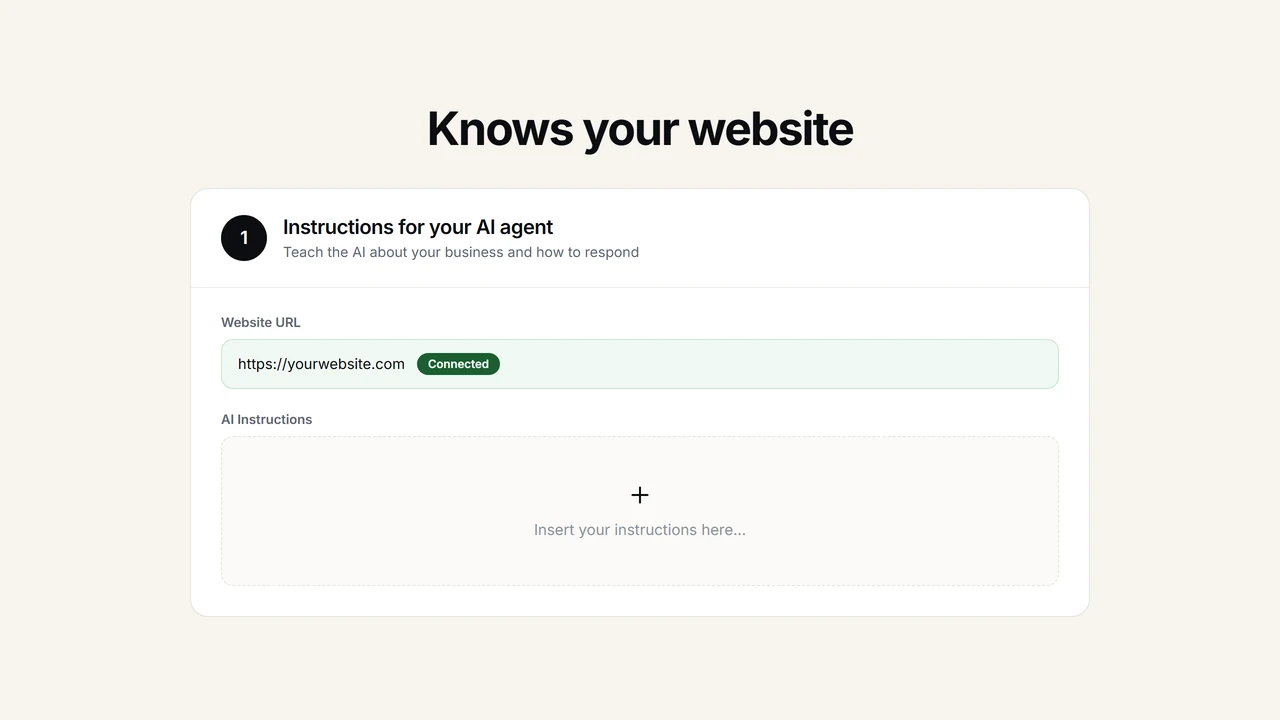
Asyntai's WordPress plugin adds a full AI agent to your site in minutes. It crawls your pages, posts, WooCommerce products, and custom post types, then answers visitor questions using your actual content. Need it to do more? Connect Custom Tools for order lookups, appointment booking, lead capture, and anything else your APIs support. Works with every theme. No code editing required.
See the AI agent answer questions from a WordPress site
Enter your WordPress site URL and watch the AI agent answer real visitor questions using your actual pages and products
One plugin, full AI agent — on any WordPress site
Asyntai's official WordPress plugin is available directly from your Asyntai dashboard. Download it, upload it to your WordPress admin, activate, and paste your site ID. The agent immediately begins crawling your pages, posts, WooCommerce products, and custom post types to build its knowledge base. No theme files edited, no PHP written, no shortcodes configured. It works with every WordPress theme — developer themes, page builder themes, starter themes, custom builds — because the plugin operates independently of your theme's template structure.
- Crawls everything WordPress publishesPages, posts, WooCommerce products, custom post types, category descriptions, tag archives — anything with a public URL gets indexed into the agent's knowledge base automatically.
- Works with any theme and any page builderElementor, Divi, WPBakery, Beaver Builder, Gutenberg blocks, classic editor, GeneratePress, Astra, Kadence — the plugin is theme-agnostic. Your layout choices don't affect the agent.
- WooCommerce-ready out of the boxThe agent understands product pages — names, descriptions, prices, variations, categories. Visitors ask "do you have this in blue?" or "what's the price of the large size?" and get real answers from your actual product data.
Custom Tools turn your WordPress agent into a system that takes action
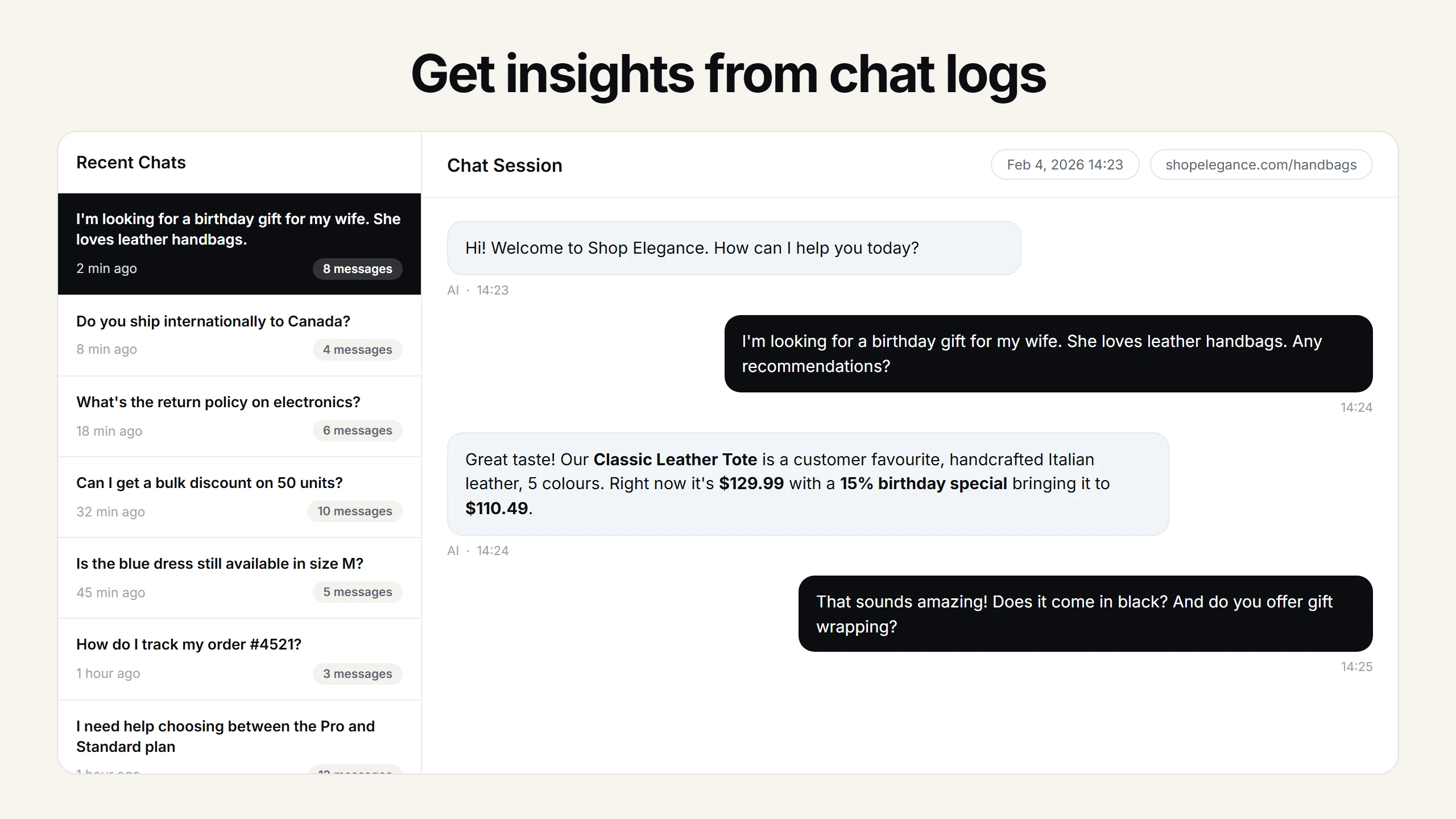
Most WordPress chat plugins repeat your FAQ. Asyntai's agent goes further with Custom Tools — it calls your own APIs mid-conversation to look up WooCommerce orders, check appointment availability, capture lead information, and push data to your CRM. The agent doesn't just answer questions. It resolves them by connecting to the systems your business already runs.
- WooCommerce order lookups in the chatConnect your WooCommerce REST API as a Custom Tool. When a customer asks "where is my order #4821?", the agent extracts the order number, calls your endpoint, and replies with the tracking status, carrier, and estimated delivery — no human involved.
- Appointment booking and availability checksIf you run a service business on WordPress — coaching, consulting, healthcare, salons — connect your booking system's API. The agent checks available slots and walks the visitor through scheduling without leaving the chat.
- Lead capture and CRM integrationDefine a Custom Tool that pushes visitor details to your CRM, email list, or Google Sheet. The agent collects name, email, and requirements through natural conversation — no static form, no friction, no pop-up the visitor has to hunt for.
Add the AI agent to your WordPress site in minutes
The Asyntai WordPress plugin is available from your Asyntai dashboard — download, upload to WordPress, activate, and paste your site ID. No code, no theme editing, no developer needed.
- Sign up at Asyntai and download the official WordPress plugin from your dashboard.
- In your WordPress admin, go to Plugins > Add New > Upload Plugin, upload the zip file, and activate.
- Enter your Asyntai site ID in the plugin settings — the agent widget appears on your site immediately.
- The agent crawls your pages, posts, and WooCommerce products. Within minutes, it answers visitor questions using your real content.
// No code editing required — but if you
// prefer manual install, add to header.php:
<script src="https://asyntai.com/widget.js"
data-id="your-site-id" async>
</script>
// Plugin handles this automatically.
AI agent for WordPress — FAQs
Common questions from WordPress site owners, WooCommerce store operators, and agencies evaluating AI agents for their WordPress sites.
How do I install the Asyntai plugin on WordPress?
Sign up for an Asyntai account and download the official WordPress plugin from your dashboard. In your WordPress admin, go to Plugins, click Add New, then Upload Plugin, and select the zip file. Activate the plugin, enter your Asyntai site ID in the settings page, and the AI agent widget appears on your site immediately. The entire process takes about two minutes and requires no coding or theme editing.
Does the plugin work with my WordPress theme?
Yes. The Asyntai plugin is completely theme-agnostic. It works with developer themes like GeneratePress, Astra, and Kadence, page builder themes from Elementor, Divi, and Beaver Builder, default WordPress themes, and fully custom themes. The plugin loads independently of your theme's template files, so your design, layout, and customizations are unaffected. If WordPress runs it, the plugin works on it.
Does the AI agent work with WooCommerce?
Yes, and it goes beyond basic product Q&A. The agent automatically crawls your WooCommerce product pages — names, descriptions, prices, variations, categories — and answers visitor questions from that data. With Custom Tools on Standard and Pro plans, you can also connect the WooCommerce REST API for live order lookups, inventory checks, and return processing directly in the chat.
Does it work with page builders like Elementor and Divi?
Yes. The agent crawls the rendered HTML of your pages, not your editor's internal data format. Whether you build pages with Elementor, Divi, WPBakery, Beaver Builder, Gutenberg blocks, or the classic editor, the agent sees the same content your visitors see. Your choice of page builder has no effect on the agent's ability to understand and answer from your content.
Will the plugin slow down my WordPress site?
No. The plugin adds a single lightweight script tag that loads asynchronously — it does not block page rendering or affect your Core Web Vitals. The script is served from Asyntai's CDN, so it adds no load to your WordPress server. It has been tested with common caching plugins (WP Super Cache, W3 Total Cache, LiteSpeed Cache, WP Rocket) and performance optimization tools without conflicts.
Does the agent work on WordPress multisite installations?
Yes. You can install the plugin on individual sites within a multisite network, each with its own Asyntai site ID and separate knowledge base. Each site's agent crawls only that site's content and operates independently. This is useful for agencies or organizations running multiple WordPress sites under one network — each site gets its own AI agent with its own knowledge.
Can the agent handle questions about custom post types?
Yes. The agent crawls any content with a public URL on your WordPress site, including custom post types. Whether you use custom post types for portfolio items, events, team members, case studies, recipes, or listings — if they have front-end pages, the agent indexes them and answers questions about their content. No additional configuration is needed beyond having those pages publicly accessible.
Is the plugin available on WordPress.org?
The Asyntai WordPress plugin is distributed through your Asyntai dashboard, not through the WordPress.org plugin directory. When you sign up and log in to your dashboard, you can download the latest version of the plugin as a zip file and upload it to your WordPress admin. This ensures you always get the most current version with the latest features and improvements.
Why your WordPress site needs an AI agent — not another chatbot plugin
WordPress powers over 40% of the web. It runs personal blogs, corporate sites, WooCommerce stores doing seven figures in revenue, membership platforms, learning management systems, booking sites, directories, and everything in between. The ecosystem is massive, and the plugin directory reflects it — there are dozens of chatbot plugins available, each promising to "add AI" to your site. Most of them do roughly the same thing: they connect to a language model, maybe read your FAQ page, and produce scripted answers to a narrow set of questions. When a visitor asks something specific — "is this product available in my size?", "where is my order?", "can I book a consultation for Thursday?" — the chatbot stalls. It tells the visitor to check another page, fill out a form, or email support. The conversation ends exactly where it should have been resolved.
The gap between a chatbot plugin and an AI agent is the gap between answering and doing. A chatbot reads static content and repeats it. An AI agent reads your entire site — every page, every post, every product — understands the content in context, and can take action through API calls when a visitor's question requires live data. That difference matters on WordPress more than anywhere else, because WordPress sites tend to be content-rich environments where visitors arrive with highly specific questions. A WooCommerce store has hundreds of products with variations. A service business has detailed service pages, pricing breakdowns, and scheduling requirements. A membership site has tiers, features, and access rules. The visitor who lands on these sites doesn't want a chatbot that recites your homepage tagline. They want answers about the specific thing they're looking at.
Asyntai's approach to WordPress starts with a dedicated plugin. Not a JavaScript snippet you paste into your header (though that works too, if you prefer it). An actual WordPress plugin that you download from your Asyntai dashboard, upload through your WordPress admin panel, and activate with one click. You enter your Asyntai site ID in the plugin settings, and the agent widget appears on your site. No theme files edited. No functions.php modified. No shortcodes placed in content areas. The plugin handles everything — loading the widget, ensuring compatibility with your theme, and staying out of the way of your other plugins and caching layers.
Theme compatibility is a real concern with WordPress plugins, and it's one that the Asyntai plugin addresses by design. The widget operates as an overlay — it doesn't inject itself into your theme's DOM structure, doesn't depend on your theme's CSS framework, and doesn't conflict with your header, footer, or sidebar templates. Whether you're using a developer theme like GeneratePress or Astra, a page builder theme from Elementor or Divi, a starter theme you've customized heavily, or a fully bespoke theme built from scratch, the plugin works identically. This matters because WordPress site owners choose their themes for specific design and performance reasons, and a chat plugin that breaks the layout or introduces CSS conflicts is a non-starter.
Page builder compatibility follows from the same principle. The agent doesn't care how you built your pages — it crawls the rendered HTML, the same content that Google sees and that your visitors read. Elementor widgets, Divi modules, WPBakery rows, Gutenberg blocks, ACF fields rendered by custom templates — all of it becomes crawlable content that the agent learns from. You don't need to configure which content to include or exclude. If it has a public URL and produces HTML, the agent indexes it. This is a meaningful advantage over chatbot plugins that require you to manually enter Q&A pairs or upload a knowledge base file. Your WordPress site already is the knowledge base. The agent reads it directly.
For WooCommerce stores, the crawling goes deeper. Product pages aren't just text — they contain structured data: product names, descriptions, prices, variations (size, color, material), categories, tags, and availability signals. The agent parses all of this and uses it to answer product-specific questions. A visitor browsing your store asks "do you carry this jacket in a medium?" or "what's the difference between the premium and standard version?" — and the agent answers from your actual product data, not a generic response. This is where WordPress chatbot plugins typically fail. They might connect to a language model, but they don't deeply understand WooCommerce's product structure. They treat a product page like any other page of text, missing the structured relationships between variations, categories, and pricing that make product questions answerable.
But answering product questions from crawled data — while valuable — is still what a sophisticated chatbot does. What makes Asyntai an agent is Custom Tools. Custom Tools let the AI call your own API endpoints during a conversation. The visitor asks a question, the AI determines that live data is needed, extracts the relevant parameters from the conversation, calls your endpoint, receives the response, and composes a natural-language answer — all within the same chat, in seconds. This is the difference between "you can check your order status in your account" and "your order #4821 shipped yesterday via USPS, tracking number 9400111899223846752319, estimated arrival June 24th." The first is a chatbot deflection. The second is an agent resolution.
The WooCommerce REST API is a natural fit for Custom Tools. WooCommerce ships with a full REST API out of the box — orders, products, customers, shipping, coupons — all accessible via authenticated HTTP endpoints. You can connect the orders endpoint as a Custom Tool so the agent looks up order status when a customer provides their order number. You can connect the products endpoint for real-time inventory checks. You can connect the customers endpoint so the agent retrieves account details for logged-in visitors. Each tool is configured in your Asyntai dashboard: name it, describe when the AI should use it, paste the WooCommerce REST API URL with your consumer key and secret, and define the parameters. No custom PHP code. No plugin development. No WooCommerce hooks or filters. You're connecting an existing API to an AI agent through a dashboard form.
Custom Tools extend well beyond WooCommerce. WordPress sites run every kind of business, and each business has its own systems. A clinic using WordPress with a booking plugin might connect their scheduling API so the agent checks appointment availability and walks visitors through booking. A law firm might connect a lead qualification endpoint that captures the visitor's name, case type, and preferred contact method, then pushes it to their CRM. A real estate site might connect their MLS feed API so the agent answers questions about specific listings — square footage, school district, days on market. An education platform might connect their course enrollment API so the agent checks seat availability and registration deadlines. The power of Custom Tools is that they're generic. If your business runs on an API — and in 2026, most do — the agent can call it.
Lead capture through Custom Tools deserves special attention because it addresses one of the most persistent problems WordPress site owners face: contact form abandonment. The standard WordPress approach is a contact form — Contact Form 7, WPForms, Gravity Forms — placed on a dedicated "Contact Us" page. The visitor has to find the page, fill in the fields, guess what to write in the message box, and hope someone responds. Conversion rates on contact forms are typically 1-3% of page visitors. An AI agent that captures lead information through conversation changes the dynamic entirely. The visitor starts chatting because they have a question. The agent answers it, building trust. At the natural moment — "would you like us to send you a quote?" or "I can have someone follow up with more details, what's the best email?" — the agent captures the information and pushes it to your CRM or email tool via a Custom Tool. No form. No separate page. No friction. The lead capture happens where the visitor already is: in a conversation.
WordPress multisite installations work with the Asyntai plugin without modification. Each site in the network gets its own plugin activation and its own Asyntai site ID. The agent on each site crawls only that site's content and operates independently — a visitor on Site A talks to an agent answering using Site A's pages and products, not Site B's. This is particularly relevant for agencies managing multiple client sites on a single WordPress multisite network, and for organizations running region-specific or brand-specific sites under one WordPress installation. Each site gets a purpose-built AI agent without cross-contamination of knowledge bases.
Performance is a non-negotiable concern for WordPress site owners, especially those who have invested in Core Web Vitals optimization, caching plugins, and CDN configurations. The Asyntai plugin adds a single async script tag to your site. Async means the browser loads your page first — HTML, CSS, above-the-fold images, everything that determines your Largest Contentful Paint and First Input Delay scores — and then loads the agent widget script afterward, without blocking. The script itself is served from Asyntai's CDN, not from your WordPress server, so your hosting resources and server response time are unaffected. The plugin has been tested alongside WP Super Cache, W3 Total Cache, LiteSpeed Cache, WP Rocket, Autoptimize, and Cloudflare without conflicts. If your WordPress site is already fast, adding the agent keeps it fast.
The agent's multilingual capability matters for WordPress sites that serve international audiences. WordPress itself has robust internationalization support — language switchers, WPML, Polylang, TranslatePress — and many WordPress sites serve visitors in multiple languages. The Asyntai agent supports 36 languages natively. It detects the visitor's language preference and responds accordingly, regardless of what language your content was written in. A German visitor on your English WooCommerce store asks "Haben Sie dieses Produkt auf Lager?" and the agent answers in German using product data from your English product pages. When Custom Tools are involved, the translation layer is even more valuable: the agent calls your English-language API, receives English data, and composes the response in the visitor's language. Your endpoints don't need to be multilingual. The agent handles the translation.
WordPress sites accumulate content over years — blog posts, landing pages, documentation, archived products, event pages, knowledge base articles. Most chatbot plugins struggle with this volume because they rely on manual Q&A entry or limited file uploads. The Asyntai agent crawls your entire site and builds its knowledge base from everything it finds. A five-year-old blog post about a niche topic? Indexed. A deep product category page with 200 items? Crawled. A documentation section with 50 how-to articles? All in the knowledge base. When a visitor asks a question, the agent searches across this entire corpus and pulls the most relevant information — even if it's from a page the visitor would never find through your site navigation. This turns your existing content library into a competitive advantage rather than a pile of forgotten pages.
The typical WordPress site owner's journey with chatbot plugins follows a predictable arc. They install a free chatbot plugin, set up a few Q&A pairs, realize visitors ask questions the Q&A doesn't cover, try to keep up by manually adding answers, fall behind, and either abandon the chatbot or accept that it deflects most questions to email. The AI agent approach breaks this cycle because the knowledge base is self-building. You don't write Q&A pairs. You publish content on your WordPress site — which you were going to do anyway — and the agent automatically incorporates it. Add a new product to WooCommerce? The agent can answer questions about it after the next crawl. Publish a new blog post about your shipping policy? The agent uses it to answer shipping questions. Update your pricing page? The agent's answers reflect the new pricing. Your WordPress site and your AI agent stay in sync because the site is the source of truth.
Security and data handling matter to WordPress site owners who have been conditioned by plugin vulnerabilities and data breach headlines. The Asyntai plugin doesn't store any data in your WordPress database. It doesn't create custom database tables, doesn't log conversations on your server, and doesn't process any visitor data through your WordPress hosting. All conversations happen between the visitor's browser and Asyntai's infrastructure. Your WordPress server's role is limited to loading the widget script — the same role it plays when you embed a YouTube video or a Google Map. This architecture means the plugin doesn't expand your WordPress site's attack surface, doesn't add database queries to your page loads, and doesn't require you to manage conversation data under your existing WordPress backup and GDPR workflows. Conversation data is managed in your Asyntai dashboard, separate from your WordPress admin.
For WordPress developers and agencies, the Asyntai plugin presents a practical client offering. Instead of building a custom chatbot solution for each client — selecting an AI provider, writing integration code, managing API keys, building a conversation UI, handling mobile responsiveness — you install the Asyntai plugin, enter the client's site ID, and the agent is live. Custom Tools let you connect the client's specific systems without custom development. A WooCommerce client gets order lookups. A booking client gets appointment scheduling. A lead generation client gets CRM-connected lead capture. Each client's agent is answering using their specific content and connected to their specific APIs. For an agency, this means offering "AI agent for your website" as a service with minimal per-client engineering — the platform handles the AI, the crawling, the conversation UI, the multilingual support, and the tool execution.
The economics of running an AI agent on WordPress come down to resolution rate — what percentage of visitor questions does the agent handle without human intervention? A knowledge-base-only chatbot on a typical WordPress site resolves maybe 40-50% of incoming questions. The rest are either too specific ("is this in stock?"), too personal ("where is my order?"), or too action-oriented ("can I book for Thursday?") for a static-knowledge chatbot to handle. Adding Custom Tools pushes that resolution rate into the 70-85% range because those specific, personal, action-oriented questions are exactly what Custom Tools address. Each resolved question is one that doesn't become a support email, a missed phone call, or a visitor who leaves without converting. On Asyntai's pricing — starting at $39/month for 800 messages — that's a fraction of what a part-time support person costs, running 24/7, in 36 languages, on every page of your WordPress site.
The WordPress plugin ecosystem has conditioned site owners to expect a specific installation experience: download, upload, activate, configure one or two settings, done. The Asyntai plugin follows this convention exactly. There's no OAuth flow, no webhook configuration, no API key generation in your WordPress dashboard. You download the plugin zip from your Asyntai dashboard, upload it in WordPress admin, activate it, paste your site ID, and the agent is live on your next page load. If you want to go further — adding Custom Tools, configuring escalation rules, customizing the agent's appearance and behavior — all of that happens in your Asyntai dashboard, not in WordPress admin. The plugin's job is to put the agent on your site. The dashboard's job is to make the agent smart.
The fundamental question for WordPress site owners evaluating AI chat plugins is whether you want a widget that talks or an agent that works. A widget that talks repeats your FAQ, deflects hard questions, and adds a chat bubble that visitors learn to ignore. An agent that works reads your entire site, understands your products and services, answers specific questions from real data, calls your APIs to look up orders and check availability, captures leads through conversation, and resolves the majority of visitor questions without human intervention. The Asyntai WordPress plugin puts that agent on your site with the same effort it takes to install any other WordPress plugin. The difference is what happens after you click activate.