An AI agent for small business that never clocks out
You started your business to do what you love — not to answer the same ten questions at 11 PM. Asyntai gives your small business an AI agent that handles customer inquiries from your own content, captures leads while you sleep, and grows with you from free to full automation. Five minutes to set up, zero technical skills required.
Watch the AI agent answer questions from your site
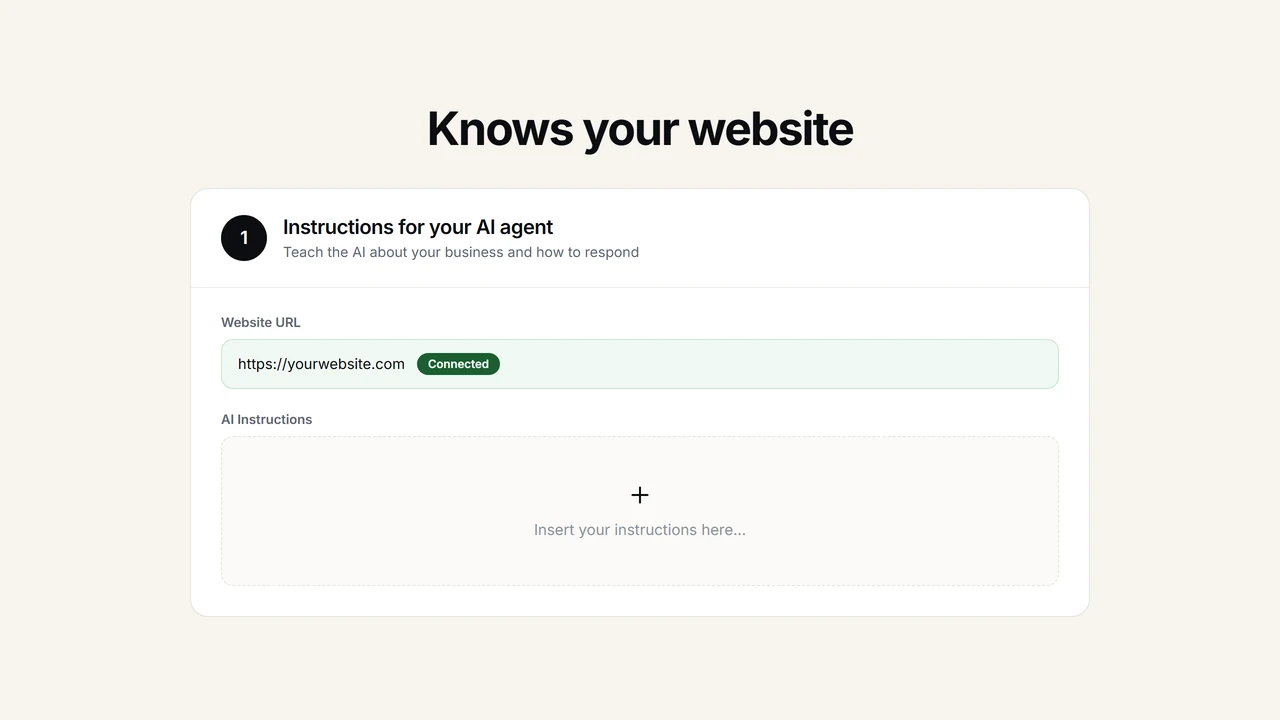
Paste your business website and see how the AI agent responds to real customer questions using your actual content
Your best employee works nights, weekends, and holidays
Most small businesses lose customers between 6 PM and 9 AM — not because the product is wrong, but because nobody is there to answer. An AI agent for small business changes that equation entirely. Asyntai crawls your website, learns your content, and answers customer questions accurately around the clock. Every inquiry gets a response in seconds, whether it arrives at noon or midnight on a Saturday.
- Answers from your own contentThe AI crawls your site and learns your services, pricing, policies, and FAQs. When a customer asks a question, they get an answer grounded in what you actually offer — not a generic template response.
- Captures leads you would have missedA visitor lands on your site at 10 PM, ready to buy. Without the agent, they bounce. With it, they get answers, stay engaged, and leave their contact info. You wake up to a warm lead instead of an empty inbox.
- Handles the repetitive so you can focusHours, pricing, service areas, booking steps, product availability — the questions that eat two hours of your day get answered automatically, freeing you to do the work that actually grows revenue.
Start with FAQ answers, scale to full automation
Most small businesses start simple — let the AI answer common questions from your website content. But as your business grows, so does the agent. Connect Custom Tools to let the AI look up orders, check appointment availability, or pull account details from your systems. Add User Context so it knows who the visitor is. Turn on multilingual support when you expand to new markets. The agent scales with your business, not ahead of it.
- Custom Tools for live dataWhen customers need specific answers — order status, booking availability, account details — the AI calls your API endpoints mid-conversation and responds with real data. No more "please email us and we will get back to you."
- User Context for personal touchPass visitor details like name, membership tier, or purchase history into the widget. The AI uses that context to give personalized answers — the kind of service that used to require a dedicated account manager.
- 36 languages, one agentA customer writes in Spanish, the AI responds in Spanish — using your English website content as the source. No translated FAQ pages, no bilingual staff. One agent serves every language your customers speak.
Live on your site in under five minutes
You do not need a developer, a technical background, or a free afternoon. Copy one snippet, paste it into your site, and the AI agent starts learning your content. Most small business owners have it running before their coffee gets cold.
- Sign up free at Asyntai — no credit card, no commitment.
- Copy the one-line snippet from your dashboard and paste it into your website's
<head>tag. - The AI crawls your site and builds its knowledge base from your pages, FAQs, and product info.
- Your AI agent is live — answering customer questions from your actual content, around the clock.
<script src="https://asyntai.com/widget.js"
data-id="your-site-id" async>
</script>
</head>
# One snippet. Your AI agent is live.
AI agent for small business — FAQs
Straight answers to the questions small business owners ask before adding an AI agent to their site.
How much does this cost for a small business?
Asyntai has a free plan that includes 50 messages per month — enough to test it with real customers and see the value before spending anything. When you are ready to scale, paid plans start at $39/month for 800 messages. There are no setup fees, no per-seat charges, and no annual contracts required. You can upgrade, downgrade, or cancel at any time.
How long does setup actually take?
Most small business owners have the AI agent live on their site within five minutes. You sign up, copy one snippet of code, paste it into your website, and the AI starts crawling your pages. If you use WordPress, Shopify, Wix, Squarespace, or any platform that lets you add a script tag, you can do this yourself without a developer. There is nothing to configure before it starts working.
Do I need technical skills or coding knowledge?
No. The setup is copy-paste. The dashboard is point-and-click. The AI learns your content by reading your website — you do not train it, program it, or write rules for it. If you can manage your own website, you can run an AI agent. Thousands of non-technical business owners use Asyntai today.
What kinds of questions can the AI agent handle?
Anything that can be answered from your website content. Pricing questions, service descriptions, business hours, location and coverage areas, product details, return policies, booking procedures, company background — if the answer is on your site, the AI will find it and respond accurately. For questions that go beyond your content, the AI can be configured to capture the visitor's contact info and escalate to you.
Will the AI give wrong answers or make things up?
Asyntai answers strictly from your content. It does not invent information or pull answers from the general internet. If a customer asks something your site does not cover, the agent says so honestly and offers to connect them with you directly. You can also add custom instructions — specific guidelines about what to say, what not to say, and when to escalate — to keep every response on brand.
Can the AI agent actually do things, or does it just answer questions?
It starts by answering questions from your content, which is already a huge time saver. But with Custom Tools (available on Standard and Pro plans), the AI can also call your systems mid-conversation — check appointment availability, look up order status, pull account details, or trigger actions in your backend. It goes from answering "do you offer Saturday appointments?" to actually checking your calendar and saying "yes, 2 PM and 4 PM are open this Saturday."
What happens when the AI cannot answer a question?
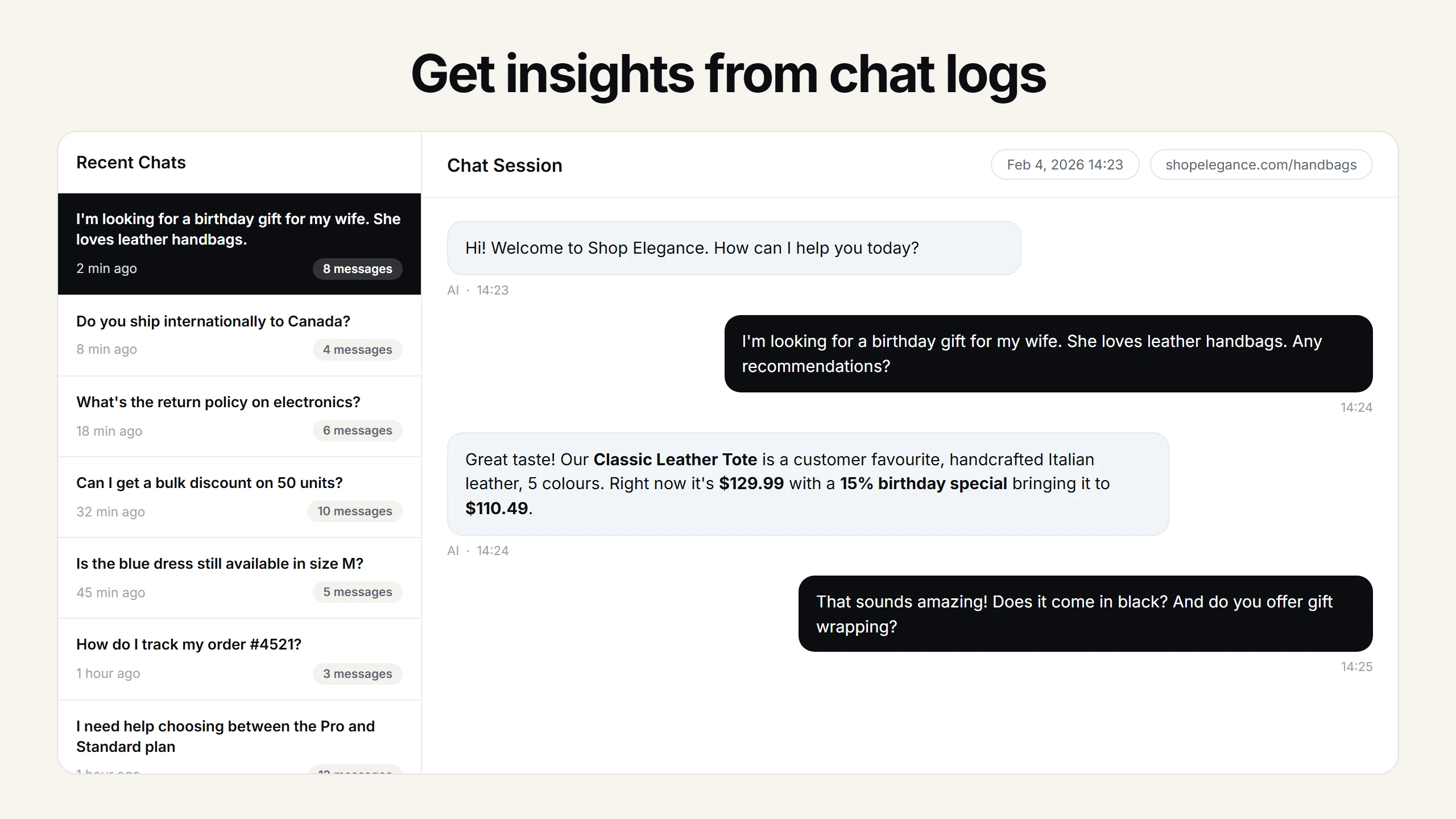
You control exactly what happens. The default behavior is to let the customer know the agent cannot help with that specific request and offer to connect them with a person. You can customize this — collect an email address, offer a phone number, submit a form, or route to a specific team member. Every escalated conversation is logged in your dashboard with the full transcript so you can follow up quickly.
Can one person manage this, or do I need a team?
One person can manage it completely. That is the whole point. The AI agent handles the volume — answering dozens or hundreds of customer conversations per month — while you review the dashboard, adjust settings when needed, and focus on conversations that genuinely require your personal attention. There are no workflows to maintain, no scripts to update, no tickets to triage. The agent does the heavy lifting.
Why small businesses need an AI agent — and why it is finally practical to have one
Running a small business means wearing every hat. You are the salesperson, the support team, the operations manager, and the person who locks up at night. When a customer has a question at 3 PM, you answer it between tasks. When a lead fills out your contact form at 9 PM, you see it the next morning — if you remember to check. When someone visits your website on a Sunday afternoon, reads your services page, has a question about pricing, and finds no way to get an immediate answer, they leave. You never know they were there. That invisible loss — the customer who was ready but had no one to talk to — is the most expensive problem small businesses do not measure.
Large companies solve this with headcount. They hire support teams, staff live chat desks, run shift rotations, and maintain knowledge bases with dedicated content managers. A mid-size ecommerce company might spend $4,000 to $6,000 per month on a single full-time support agent — salary, benefits, tools, training. A small business cannot absorb that cost. So the owner answers questions personally, replies get slower as the business grows, evenings and weekends go uncovered, and the gap between "what customers expect" and "what the business can deliver" widens quietly until it shows up as lost sales and bad reviews.
An AI agent for small business closes that gap. Not by replacing the owner — nobody replaces the person who built the thing — but by handling the volume that the owner cannot physically cover alone. The repetitive questions, the after-hours inquiries, the "do you serve my area?" and "what are your hours?" and "how much does this cost?" messages that add up to hours of work every week. The AI agent answers them instantly, accurately, around the clock, using the business's own content as its source. The owner stops being a human FAQ and starts spending that time on work that grows revenue.
The economics are not subtle. A small business owner who spends two hours per day answering routine customer questions is spending roughly 500 hours per year on work that an AI agent handles in seconds. Value that time at even $30 per hour — modest for a business owner — and that is $15,000 per year in opportunity cost. An AI agent that costs $39 per month recovers that time for $468 per year. The math is not close. But the real value is not the hourly savings. It is the customers who get answers at 10 PM instead of waiting until morning, the leads who engage instead of bouncing, and the owner who sleeps through the night without checking their phone.
The reason AI agents for small business are practical now — rather than five years ago — is that the underlying technology crossed a threshold. Earlier chatbots required you to write rules, build decision trees, anticipate every possible question, and manually program responses. That was a project, not a tool. A small business owner does not have time to build a project. Modern AI agents work differently. They read your website, understand the content semantically, and answer questions in natural language without pre-programmed responses. You do not write scripts. You do not create flowcharts. You paste a snippet on your site and the AI figures out the rest. The setup time went from weeks to minutes, and the maintenance time went from hours per week to nearly zero.
Consider a local plumbing company. Their website lists services — drain cleaning, water heater repair, emergency calls, bathroom remodeling. It lists their service area — three counties in the metro region. It has a pricing page with ranges and a page about their team. Without an AI agent, a homeowner who visits the site at 8 PM with a leaking pipe sees the phone number, calls, gets voicemail, and calls the next plumber on Google. With an AI agent, they get an immediate response: "Yes, we handle emergency leak repair. We serve your county and our emergency rate starts at $150 for the first hour. Would you like to schedule a visit or speak with someone directly?" That response came from the content already on the website. Nobody programmed it. The AI read the services page, the pricing page, and the service area page, and composed an answer. The plumber wakes up to a booked job instead of a missed call.
Small ecommerce stores face a different version of the same problem. A customer browsing at midnight wants to know if an item ships to their country, whether it comes in a different size, or what the return policy is. These answers are on the site — buried in a footer link or a FAQ page the customer did not find. The AI agent surfaces that information instantly in conversation, right on the page where the customer is already shopping. No hunting through help pages, no "contact us" forms, no waiting. The answer appears in seconds, and the customer completes the purchase instead of abandoning the cart. For a store doing $10,000 per month in revenue, recovering even two or three abandoned carts per week changes the trajectory of the business.
Consultants and professional service providers — accountants, lawyers, marketing agencies, coaches, therapists — have a subtler version of the problem. Their highest-value activity is delivering the service, not answering intake questions. Every minute spent explaining "what does a session cost?" or "do you work with businesses in my industry?" or "what is the process for getting started?" is a minute not spent on billable client work. An AI agent handles the qualification layer: it answers common questions from the website, explains the process, and collects contact information from interested prospects. The consultant opens their dashboard and sees a list of pre-qualified leads with full conversation transcripts — not a pile of generic contact form submissions with no context.
Agencies and freelancers who serve multiple clients discover another dimension of value. A web design agency with twenty client sites can deploy an AI agent on each one, customized to that client's content and branding. Each agent answers that client's customer questions independently. The agency does not need to staff a support team for their clients' sites. The AI agent becomes part of the service offering — "we build your website and it comes with an AI assistant that answers your customers' questions 24/7." That is a genuine competitive advantage in a market where most agencies deliver a site and walk away.
The starting point for most small businesses is simple: let the AI answer questions from your website content. That alone handles a surprising volume. Asyntai crawls your site, indexes your pages, and builds a knowledge base that the AI references when answering questions. When a customer asks about pricing, the AI pulls from your pricing page. When they ask about your return policy, it pulls from your terms page. When they ask a question your site does not cover, the AI says so honestly and offers to connect them with you. There are no hallucinations, no made-up answers, no risk of the AI promising something your business does not offer. It answers from your content or it escalates. You control the boundaries.
What separates Asyntai from the simpler chatbot tools is what happens after the FAQ stage. As your business grows, your needs become more specific. A customer does not just want to know if you offer Saturday appointments — they want to know if 2 PM this Saturday is available. They do not just want your return policy — they want to know if their specific order is still within the return window. They do not want to hear "check your email for tracking information" — they want the tracking number right now. These questions require live data from your systems, not static content from your website.
That is where Custom Tools come in. Available on Standard and Pro plans, Custom Tools let the AI agent call your API endpoints during a conversation. You define a tool in your dashboard — a name, a description of when to use it, and your endpoint URL. When a customer asks a matching question, the AI extracts the relevant information from the conversation (an order number, a date, an email address), calls your endpoint, gets the response, and answers the customer with real data. A booking system with an availability API becomes a tool the AI can check. An order management system with a status endpoint becomes a tool the AI can query. You do not build integrations. You point the AI at endpoints that already exist.
A small gym or fitness studio provides a concrete example of the growth path. Stage one: the AI agent answers questions from the website — class schedules, membership pricing, location details, trainer bios. That handles the majority of inquiries and frees the front desk from answering the phone during peak hours. Stage two: the owner connects a booking API as a Custom Tool. Now the AI does not just tell customers the class schedule — it checks real-time availability and tells them whether the 6 PM yoga class on Thursday has spots open. Stage three: the owner adds User Context so the AI recognizes logged-in members by name and membership tier, and can reference their booking history. The AI went from FAQ bot to virtual front desk in three steps, each one adding capability without adding complexity. And the owner still manages everything from a single dashboard.
The multilingual capability matters more than most small business owners initially expect. A restaurant in a tourist district, a vacation rental in a coastal town, an online store that ships internationally — all of these businesses encounter customers who speak languages the owner does not. Without the AI agent, those customers either struggle through the experience in a language they are not comfortable with, or they leave. With the AI agent, a question asked in Portuguese gets answered in Portuguese. A question asked in Japanese gets answered in Japanese. The source content is your English website. The AI handles the translation. You do not maintain translated FAQ pages or hire multilingual staff. One agent, 36 languages, and every customer feels understood.
Lead qualification is a feature that small business owners discover after installation rather than before. The AI agent does not just answer questions — it engages visitors in conversation, uncovers their needs, and captures contact information. A visitor who would have read your homepage and left instead has a conversation: "Do you offer commercial cleaning?" "Yes, we serve commercial properties including offices, retail spaces, and medical facilities. Our commercial packages start at $500 per month depending on square footage. Would you like to schedule a walkthrough?" "Yes, can someone come by Thursday?" "I would be happy to arrange that. Could you share your name, email, and the address of the property?" That interaction happened at 9 PM. The cleaning company owner wakes up to a qualified commercial lead with contact info, property type, and stated interest — all captured in a conversation transcript. No form fill. No phone tag. No missed opportunity.
The operational simplicity of running an AI agent on Asyntai is worth emphasizing because it is the reason small business owners actually use it, as opposed to the enterprise tools they sign up for and never configure. There is no onboarding call. There is no implementation timeline. There is no training period. You sign up, paste a snippet, and the agent is live. The dashboard shows you every conversation, every question customers asked, and every answer the AI gave. You can update your site content and the AI re-crawls it automatically. You can write custom instructions — "always recommend our premium package first" or "never discuss competitor pricing" — and the AI follows them across every conversation. If something is not working the way you want, you adjust a setting, not a codebase.
Small businesses that hesitate usually have one of two concerns: "what if it says something wrong?" and "what if customers hate talking to a bot?" Both concerns dissolve with experience. The AI answers from your content, so the accuracy is bounded by what your website says. If your pricing page says "$99 per session," the AI says "$99 per session." It does not guess, extrapolate, or improvise. And customer behavior data consistently shows that visitors prefer an instant AI response over waiting hours or days for a human reply — especially for straightforward questions. The choice is not "AI agent versus a friendly human available instantly." The choice is "AI agent versus no response until tomorrow morning." Framed that way, the AI wins every time.
The cost structure of an AI agent deserves comparison to the alternatives small businesses actually use. A part-time support person costs $1,500 to $2,500 per month and covers maybe 30 hours per week. A virtual assistant costs $500 to $1,500 per month and handles tasks asynchronously with response times measured in hours. A live chat service costs $300 to $800 per month and covers business hours in one time zone. An answering service costs $200 to $500 per month and takes messages without answering questions. Asyntai's Starter plan costs $39 per month, covers all 168 hours per week, answers questions accurately from your content in 36 languages, captures leads, and logs every conversation for your review. At higher tiers, it calls your APIs and resolves issues autonomously. Per dollar spent, nothing else comes close.
The free plan exists because Asyntai wants small businesses to validate the value before committing money. 50 messages per month is enough for a low-traffic site to run the agent for weeks and see real conversations. You see what customers ask. You see how the AI responds. You see the leads it captures and the questions it handles while you are asleep. When the volume grows past 50 messages — because the agent is working and customers are engaging — upgrading to the $39 Starter plan is an obvious decision because you have already seen the return.
There is a compounding effect that small business owners notice after a few weeks. The AI agent does not just answer questions — it reveals what customers actually want to know. Your dashboard shows the most common questions, and many of them surprise you. You thought customers cared about pricing, but they are asking about turnaround time. You thought your service area was clear, but people keep asking if you cover a specific neighborhood. You thought your FAQ page was comprehensive, but customers keep asking about a topic you never addressed. That insight is worth more than the time savings alone, because it tells you exactly where your website, your marketing, and your service offering have gaps. You improve your business based on what customers actually ask, not what you assumed they would ask.
The small businesses getting the most value from AI agents today share a few traits. They have a website with real content — service descriptions, pricing information, policies, product details. They receive customer inquiries that are repetitive and answerable from that content. They value their own time and recognize that answering the same ten questions is not a good use of it. And they want to capture after-hours opportunities instead of hoping customers come back during business hours. If that describes your situation, an AI agent is not a nice-to-have. It is the most cost-effective operational improvement available to a small business today.
Deploying an AI agent for your small business is not an IT project, a strategic initiative, or a digital transformation. It is a five-minute setup that gives you a tireless team member who knows your business, speaks your customers' language, and never takes a day off. Start with the free plan. See what your customers ask. Watch the agent handle it. Then decide if $39 per month is worth getting your evenings back. For most small business owners, the answer is obvious before the first week is over.