White label software to resell: an AI chatbot business you can start this week
Subscribe, add your first client's website, and the AI builds a knowledge base from their content automatically. Break even at three clients — every client after that is nearly pure margin. No development, no hosting, no engineering team.
See the white label software in action before you resell it
Drop in any website URL — a client's site, a prospect's site, your own — and watch the AI build a knowledge base and start answering questions. This is what your clients will experience under your brand.
Break even at three clients — profit on every one after that
The economics of reselling white label software come down to a simple ratio: your fixed cost versus what you charge per client. A Pro plan subscription is $449/month and covers up to 20 client sites with 50,000 total messages. If you price your AI chatbot service at $150 per client per month, three clients cover your subscription and the fourth is almost entirely margin. At $200 per client, two and a half clients get you to break-even. At $300, you are profitable before client number two finishes onboarding. There is no revenue share, no per-client fee, and no commission flowing back to the platform. The gap between $449 and what you collect is yours to keep, every single month.
- $449/month covers 20 clients — your per-seat cost drops as you growAt one client your cost is $449 per seat. At five it is $90. At ten it is $45. At the full twenty it falls to roughly $22 per client per month. The subscription is flat regardless of how many of your 20 slots you fill, so every new client dramatically improves your margin without increasing your expenses.
- No revenue share, no hidden platform feesYou bill your clients directly through your own invoicing — Stripe, PayPal, bank transfer, whatever you prefer. There is no percentage going back to the platform, no transaction fee on your resale revenue, and no minimum sales target to meet. The full difference between your subscription and your client revenue is gross profit.
- Fixed cost, variable revenue — the margin only improvesYour cost stays at $449 whether you have 2 clients or 20. Each new client adds $150-$300 in monthly revenue with zero additional cost on the platform side. At 10 clients charging $200 each, you collect $2,000 against $449 in cost — a 78% gross margin. At 20 clients, gross margin exceeds 85%.
A growth path that compounds every month
Scaling white label software to resell is not the same as scaling a services business. You do not need to hire when you add a client. You do not need more office space, more software licenses, or more infrastructure. Each new client is twenty minutes of setup — add the website, configure the widget branding, let the AI crawl their content, paste the embed script — and then recurring monthly revenue with minimal ongoing work. The AI updates its knowledge automatically as your client's website changes, so maintenance is close to zero. Start with one or two clients while you learn the product. Add three to five more once you have a pitch that converts. Fill the remaining slots as referrals come in. Twenty clients on a single Pro plan is not a ceiling — agencies that outgrow it move to a Custom Pro plan with higher limits.
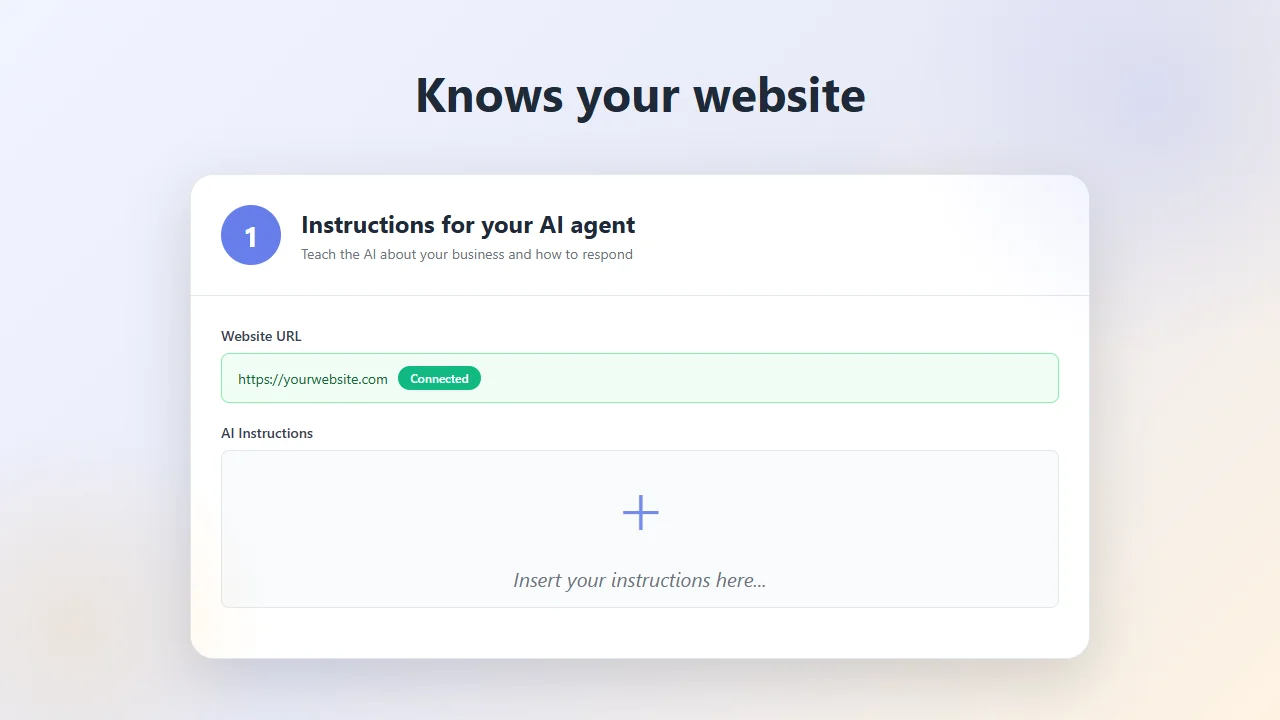
- Twenty minutes per client setup — no development requiredAdding a new client means entering their domain, choosing widget colors and your branding, waiting for the AI to crawl their site, and pasting one line of JavaScript. There is no coding, no API integration, and no design work. If the client wants extra content in their knowledge base — PDFs, product sheets, internal docs — you upload those files and the AI incorporates them.
- Each client is isolated — zero risk of cross-contaminationEvery one of your 20 sites has its own knowledge base, widget configuration, AI instructions, conversation history, and analytics. The veterinary clinic's patient information never surfaces in the restaurant's chatbot. The accounting firm's tax guidance stays separate from the gym's class schedule. Full isolation, managed from one dashboard.
- 50,000 messages shared across all clientsThe message pool is shared, which works in your favor. Quiet clients (a small law office with 200 chats per month) offset busy ones (a retail store with 2,000). Most small businesses use 300-800 messages per month, meaning 20 typical clients consume 6,000-16,000 messages — well within the 50,000 allocation.
- Custom Pro plan when you outgrow 20 sitesHitting 20 clients is a milestone, not a wall. The Custom Pro plan extends your site count and message limits to match your agency's growth, so the business model scales past the initial Pro plan cap.
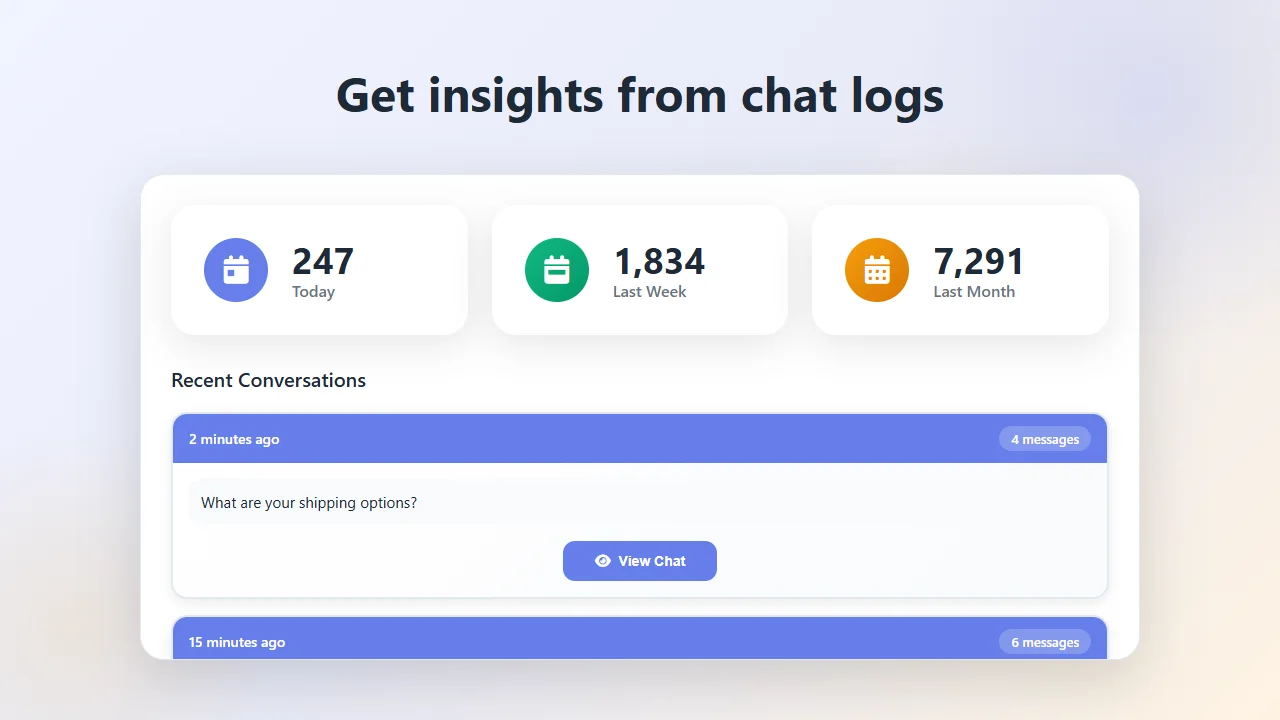
- Embed a client dashboard on your own siteGive each client access to a white-labeled dashboard with three tabs — Conversations, Analytics, and Leads with CSV export. Embed it on your own website via a JS snippet. It carries your logo, brand name, and primary color. Password protection and domain restrictions keep each client's data private. Your clients manage their chatbot data through your brand, not ours.
Get your first resale client live in under an hour
You do not need a development team, a hosting provider, or weeks of integration. From signing up to sending your first client invoice — here is the path.
- Subscribe to the Pro plan at asyntai.com/pricing — $449/month gets you white-label branding removal, 20 client sites, and 50,000 messages. You are ready to resell immediately.
- Add your first client's website domain in the dashboard. Set your agency name, logo, and brand colors on the widget so the chatbot appears as your product, not anyone else's.
- The AI automatically crawls your client's site and builds a knowledge base from their pages, products, services, and FAQs. Upload any additional documents the client provides — the AI absorbs those too.
- Copy the one-line embed script, paste it into the client's website, and the branded chatbot goes live — answering visitor questions using the client's own content, under your brand, around the clock.
<!-- Client sees your name. Visitors see your name. -->
<script src="https://asyntai.com/widget.js"
data-id="client-website-id" async>
</script>
# One script tag. White-labeled. Live.
# Bill the client and keep the margin.
How reselling works
From signing up to billing your first client — four simple steps.
Choose a plan
Subscribe to a plan that fits how many client websites you need. Pro is the most popular for resellers — white-label plus up to 20 websites.
View plans →Add a client website
Each website you add under your account is one client's chatbot. Add up to the number your plan allows.
Go to your dashboard →Set up the chatbot
Add the client's content, customize the widget to their brand, and install it on their site. You can also give the client read-only access to their chat logs, analytics and leads on your own website.
Setup guide →Resell at your price
Charge your client whatever you like. You own the relationship and bill them directly — the margin is yours, every month.
Reseller Resources
Everything you need to get started, answer client questions, and see the dashboard in action
Reseller Guide
Step-by-step walkthrough: white-label branding, the embeddable client dashboard, and how to get your first client live.
Read the guideReseller FAQ
Pricing, margins, billing, white-label details, platform compatibility, and everything else partners ask before starting.
View FAQClient Dashboard Demo
See the embeddable white-label dashboard with sample data — conversations, analytics, and leads under your brand.
See the demoWhite label software to resell — reseller FAQs
The most common questions from agencies, freelancers, and entrepreneurs evaluating this AI chatbot as white label software to resell.
How many clients do I need to break even?
It depends on what you charge. The Pro plan is $449/month and supports 20 sites. If you charge $150 per client per month, you break even at 3 clients ($450 revenue vs. $449 cost). At $200 per client, you break even between 2 and 3 clients. At $300 per client, you are profitable with just 2 clients. Every client beyond break-even is nearly pure margin because the subscription cost does not increase as you add more sites up to 20.
How do I bill my clients?
However you like. You invoice your clients directly using your own billing method — Stripe, PayPal, bank transfer, or any invoicing tool you already use. There is no payment gateway tied to the platform. Asyntai charges you a flat monthly subscription. What you charge your clients, and how you collect that payment, is entirely your business. There is no revenue share and no commission of any kind.
Can clients see who provides the underlying platform?
No. On the Pro plan, all Asyntai branding is removed — including the "Powered by Asyntai" badge on the chat widget. The widget displays your name, logo, and colors. The embeddable client dashboard carries your branding. Your clients and their website visitors never see the name of the platform behind it. If you are on the Standard plan ($139/month, 3 sites) and want white-label branding, you can email [email protected] for manual activation.
What happens if I get more than 20 clients?
The Pro plan supports up to 20 sites. When you grow beyond 20 clients, you move to a Custom Pro plan with higher site and message limits tailored to your volume. There is no gap — you reach out, we configure higher limits, and you keep adding clients. Outgrowing 20 sites is a sign the business model is working, and the platform scales with you.
How much time does it take to manage 20 clients?
Very little ongoing time. The initial setup per client takes about twenty minutes — adding the site, configuring branding, letting the AI crawl content, and embedding the script. After that, the AI updates its knowledge automatically as the client's website content changes. You do not need to manually refresh knowledge bases. Occasional tasks include uploading new documents a client provides, tweaking AI behavior instructions, or reviewing conversation logs. Most resellers spend under two hours per week managing a full roster of 20 clients.
Can I start small and scale up later?
Yes. You can begin with the Starter plan at $39/month (2 sites, 2,500 messages) to test with a couple of clients, or the Standard plan at $139/month (3 sites, 15,000 messages) for a small portfolio. When you are ready to go full white-label and scale beyond 3 clients, upgrade to Pro. Your existing client setups, knowledge bases, and configurations carry over — nothing needs to be rebuilt.
What verticals work best for reselling AI chatbots?
Any business with a website and visitor questions is a candidate. The strongest verticals include professional services (dental, legal, accounting), ecommerce and retail, hospitality (restaurants, hotels), fitness and wellness (gyms, spas), education (tutoring centers, schools), automotive (repair shops, dealerships), and healthcare (clinics, veterinary practices). The AI builds its knowledge base from whatever content is on the client's website, so it adapts to any vertical without custom development.
What if a competitor is already selling AI chatbots in my area?
White-label means the product carries your brand, not a commodity brand that every competitor shares. Your competitor's chatbot and your chatbot may run on different platforms, but the client sees your name, your logo, and your service. Differentiation comes from your relationship, your vertical expertise, your bundling with other services, and your support — not from the underlying technology. Most local markets have room for multiple providers because the total addressable market of businesses that could benefit from AI chat is vast and adoption is still early.
Is there an alternative to reselling if I just want to refer customers?
Yes. The affiliate program pays a 20% recurring commission on every customer you refer using a tracking link. If a referral signs up for the Pro plan at $449/month, you earn $89.80 every month for up to 12 months — without managing their setup, support, or billing. Some people combine both models: white-label reselling for clients they manage directly, and affiliate referrals for businesses they do not want to support. The two approaches complement each other.
The complete guide to reselling white label AI chatbot software
Reselling software is fundamentally different from reselling services. When you resell a service — web design, SEO, social media management — your revenue is tied to your time. Every new client needs hours of ongoing work, and your income scales linearly with your labor until you hit a wall. When you resell software, the economics flip. The product does the work. You set it up once, the client pays monthly, and the software delivers value around the clock without additional input from you. White label AI chatbot software sits at the intersection of these two models: it is software that you resell, but because it carries your brand and you control the client relationship, it feels like a service to your clients. They see you as the provider. The technology runs invisibly behind the scenes. Your margin is the difference between what you charge and your flat subscription cost, and that margin grows with every client you add.
The break-even math for reselling this particular white label software is worth walking through at multiple price points because it shows how quickly the business becomes profitable. The Pro plan is $449 per month and includes 20 client sites and 50,000 messages. At a resale price of $99 per client per month — which is conservative for an AI chatbot that answers questions, captures leads, and works around the clock — five clients cover your cost ($495 revenue vs. $449 expense) and clients six through twenty are nearly pure profit. At $149 per client, you hit break-even at the third client. At $199, two and a half clients pay for the subscription. At $249, two clients cover it. And at $299, which is entirely reasonable for a white-labeled AI chatbot service, you are profitable before the second client's first month closes. The subscription price does not change regardless of how many of the 20 slots you fill. Client number twenty costs you nothing more than client number one.
Let us map out what the revenue looks like at full capacity. Twenty clients at $149 each is $2,980 in monthly revenue against $449 in cost — $2,531 in gross margin. Twenty clients at $199 each is $3,980 minus $449, leaving $3,531. Twenty clients at $249 generates $4,980, and at $299 the number is $5,980. Annually, that ranges from roughly $30,000 to $72,000 in gross margin from a single subscription. These are not projections based on best-case scenarios. They are arithmetic. The subscription is $449. You pick the price. You multiply by the number of clients. You subtract $449. What remains is yours. No revenue share chips away at it. No per-message fee accrues. No commission slides back to the platform. The gap between your subscription and your client revenue is gross profit, and it compounds every month as you add clients.
The path from zero clients to twenty is not a sprint — it is a staircase, and each step gets easier. Your first client is the hardest because you are learning the product, refining your pitch, and building your first case study. Pick someone you already know: an existing client, a business in your network, a friend who runs a company with a website. Set up their chatbot, show them the demo with their actual content, and let the AI's ability to answer questions from their own website sell itself. Once that first client is live and happy, you have a reference, a screenshot, and a story. The second and third clients come from that credibility. By client five, you likely have a repeatable process: a pitch deck, a standard onboarding flow, and enough experience to handle objections confidently. Clients six through ten often arrive through referrals from your existing roster. Ten through twenty is where you can start prospecting more aggressively because the business is already profitable and the margin on each new client is close to 100%.
The setup process for each client is identical, regardless of industry, and takes about twenty minutes. You log into your dashboard, add the client's website domain, configure the chat widget with your agency's branding — name in the header, your logo, your color scheme — and let the AI crawl the site. The crawler reads every page: services, products, pricing, FAQs, blog posts, team bios, contact information. Within hours, the AI has built a knowledge base from that content and can answer visitor questions accurately. You copy the embed script — one line of JavaScript — and paste it into the client's site. The chatbot appears, branded with your name, ready to go. If the client has supplemental materials — product PDFs, policy documents, training manuals — you upload those to the knowledge base and the AI weaves them into its responses alongside the crawled content. There is no coding. No API configuration. No design mockups. Twenty minutes from start to a live, branded, functioning AI chatbot.
One question that stops people from starting is whether AI chatbots work for their clients' industries. The answer is broad: any business with a website and visitors who have questions benefits from an AI chatbot. Consider the range of verticals a single reseller can serve. A veterinary clinic's chatbot answers questions about vaccination schedules, boarding policies, emergency hours, and which species the practice treats. A gym's chatbot handles class schedules, membership pricing, personal training availability, and facility hours. A restaurant's chatbot covers the menu, dietary accommodations, reservation options, and private event policies. An auto repair shop's chatbot explains services offered, provides hours, describes the intake process, and answers questions about warranties. A tutoring center's chatbot walks parents through subject availability, tutor qualifications, pricing, and scheduling. Each of these chatbots is built from the content on that business's own website, configured independently, and branded with your agency's identity. You are not building five different products. You are configuring the same white label software five different ways.
The white label element deserves specific attention because it is the feature that makes reselling viable. Without white labeling, you are just referring people to someone else's product. With it, you are the product. On the Pro plan, the "Powered by Asyntai" badge disappears entirely from the chat widget. Your name appears in the header. Your logo loads in the widget. Your colors define the visual identity. When a visitor on your client's website interacts with the chatbot, they see your brand — or the client's brand, if you configure it that way. The embeddable client dashboard deepens this further: three tabs (Conversations, Analytics, Leads with CSV export) embedded on your own website via a JS snippet, displaying your logo, brand name, and primary color. Password protection and domain restrictions keep each client's data private. Your client logs in, sees your brand, reviews their chatbot's performance, and has no reason to look behind the curtain. Standard plan users who want white-label activation can email [email protected] for manual setup.
Reselling white label software avoids the single biggest problem with building your own AI chatbot product: engineering. To build a comparable chatbot platform from scratch, you would need a conversational AI engine, a knowledge base ingestion pipeline (web crawler, document parser, chunker, embedder, vector store), a chat widget with desktop and mobile support, multi-tenant architecture for client isolation, an analytics dashboard, lead capture functionality, multilingual support across 36 languages with auto-detection, and the infrastructure to host and scale all of it. The engineering team alone would cost more per month than several years of Pro plan subscriptions. And that is before you debug edge cases, handle uptime, manage model updates, and deal with the thousand small problems that surface when real users interact with real AI in real businesses. White label software to resell skips all of that. You inherit a mature, working product and spend your time on what actually generates revenue: selling, onboarding, and retaining clients.
The messaging limits on the Pro plan — 50,000 messages per month — are shared across all your client sites, and this pooling works in your favor as a reseller. Most small business chatbots handle between 200 and 1,000 conversations per month, depending on the website's traffic and the nature of the business. A low-traffic professional services site might see 150-300 chatbot conversations monthly. A moderate-traffic ecommerce store might see 600-1,200. When you pool 20 clients, the quiet ones subsidize the busy ones. If your average client uses 1,500 messages per month, your total consumption across 20 clients is 30,000 — well within the 50,000 allocation. Even with a mix of some high-traffic clients, the shared pool gives you headroom. Agencies whose client base consistently pushes above 50,000 total messages move to the Custom Pro plan for higher limits.
Custom Tools add a layer of value that lets you charge premium prices. Available on Standard and Pro plans, Custom Tools allow the AI to call your client's own API endpoints during a conversation — performing real actions, not just answering questions. For a restaurant client, the chatbot can check table availability and take reservation details. For an ecommerce client, it can look up order status, find tracking numbers, and initiate return requests. For a clinic, it can check appointment openings and collect intake information. Each client's Custom Tools are configured independently, so the restaurant bot does not share functionality with the ecommerce bot. When you offer this to a client, you are not selling a simple Q&A widget — you are selling an AI assistant that does things. That distinction supports $200-$400 monthly pricing far more easily than a chatbot that only answers questions. And because you configure the tools, you become the expert your client relies on, deepening the relationship and raising the switching cost.
Language support extends your addressable market beyond English-speaking businesses. The AI supports 36 languages and auto-detects the visitor's language, responding naturally in whatever language the question arrives in. A Spanish-language visitor gets Spanish answers. A Japanese visitor gets Japanese. The knowledge base content does not need to be translated — the AI handles the language layer from whatever content is available. For resellers, this opens up entire markets: you can serve businesses with multilingual customer bases, businesses operating in non-English markets, and businesses targeting international audiences. A single chatbot on a single client site handles all 36 languages without additional configuration or cost. If you operate in a multilingual region — South Florida, Montreal, the EU — this feature alone can differentiate your offering from competitors who are limited to English.
The comparison between reselling and the affiliate model is worth understanding because both generate income, but they serve different situations. As a reseller with white label software, you own the client relationship, set your own prices, brand everything with your identity, and keep the full margin above your subscription cost. The revenue per client is higher, but you handle setup, onboarding, and any client questions. As an affiliate, you refer customers to Asyntai using a tracking link and earn a 20% recurring commission on their subscription — $89.80 per month for a Pro plan referral, for instance — without managing anything. The customer deals directly with Asyntai. The affiliate approach is passive income; reselling is active margin. Plenty of agencies use both: white-label for their managed client roster (higher revenue, full control) and affiliate links for businesses they encounter but do not want to manage (effortless recurring commissions). The two models coexist without conflict.
Client retention in a software reselling model is structurally different from client retention in a services model. In services, clients leave when they find a cheaper provider or decide to bring the work in-house. With white label AI chatbot software, the switching cost rises over time. After the first month, the chatbot has conversations the client can review. After three months, the knowledge base has been refined with uploaded documents, adjusted AI instructions, and tuned response styles. After six months, the chatbot is deeply integrated into the client's workflow — handling visitor questions, capturing leads, routing inquiries. Moving to a different provider means abandoning all of that accumulated configuration and starting over. This natural retention dynamic means your monthly recurring revenue becomes more stable over time, not less. Churn rates for well-configured AI chatbots tend to be low because the product gets better the longer it runs, and rebuilding from scratch with a competitor feels like going backward.
The operational reality of managing a portfolio of 20 chatbot clients is lighter than most people expect. The AI updates its knowledge base automatically as client websites change — new blog posts, updated product listings, revised hours. You do not need to manually refresh anything. Conversation logs are available in the dashboard, so you can spot-check quality when you want, but the AI handles day-to-day interactions without intervention. The most common ongoing tasks are uploading supplementary documents when a client provides them, tweaking AI instructions to adjust tone or add new response guidelines, and occasionally reviewing conversation logs to ensure quality. Most resellers report spending one to two hours per week managing their entire client roster. That is a few minutes per client per week in exchange for $150 to $300 per client per month in revenue.
Platform compatibility is a non-issue for resellers because the embed method is a single line of JavaScript that works on any website. WordPress, Shopify, Wix, Squarespace, Webflow, Magento, Joomla, Drupal, OpenCart, BigCommerce — the script works on all of them. There are also dedicated plugins for over 30 platforms that simplify the installation further. Your client's tech stack does not limit your ability to deploy the chatbot. A reseller serving a mixed portfolio — a WordPress dental practice, a Shopify ecommerce store, a Squarespace restaurant — uses the same product and the same deployment process for all of them. No platform-specific customization needed, no compatibility testing, no conditional logic. One product, one embed, every platform.
If you are evaluating white label software to resell, the decision ultimately comes down to whether the economics make sense for your situation and whether you have access to businesses that would benefit from an AI chatbot. The economics, as laid out above, are clear: the Pro plan at $449/month supports 20 clients, and profitability starts at client two or three depending on your pricing. The market question answers itself when you consider that every business with a website has visitors who leave without buying because their question went unanswered. An AI chatbot that answers using the business's own content solves that problem visibly and measurably. You do not need to sell the concept of AI — businesses already understand they need it. You need to be the one who delivers it under your brand, at your price, before someone else does. For questions about reselling, custom limits, or your use case, reach out at [email protected] — we respond within 24 hours.