White label software as a service: launch your own AI chatbot SaaS without writing code
Skip the year of engineering. Take a fully hosted AI chatbot platform, strip the branding, and launch it as your own SaaS product. You set the pricing, handle client relationships, and collect recurring revenue every month.
Experience the SaaS product you will resell
Enter any website URL to see the AI build a knowledge base and start answering questions — this is the exact product your clients will use, running under your brand
Hosted infrastructure, managed AI, and automatic updates from day one
Most people who want to sell a SaaS product face the same wall: they need a development team, cloud infrastructure, ongoing maintenance, and months before anything is ready for a paying customer. White label software as a service eliminates all of that. You get a production-grade AI chatbot platform that is already built, already hosted, and already serving customers — you just rebrand it. The servers, the AI models, the database, the CDN, the uptime monitoring — all handled. When new features ship or security patches roll out, they appear in your product automatically. You never touch a server, never deploy code, never wake up to an alert at 3 AM. Your job is to sell and support your clients. Everything under the hood is managed for you.
- Zero infrastructure to manageThe entire platform runs on managed infrastructure — servers, databases, CDN, SSL, uptime monitoring. You do not provision anything, patch anything, or scale anything. When your tenth client signs up, the system handles the load the same way it handled your first. There are no DevOps tasks, no server bills, no scaling decisions to make.
- Automatic feature updates and security patchesEvery improvement to the AI, every new widget option, every security patch ships to your white-labeled product automatically. You wake up to a better product than the one you went to sleep with. Your clients benefit from continuous development without you hiring a single engineer or managing a single sprint.
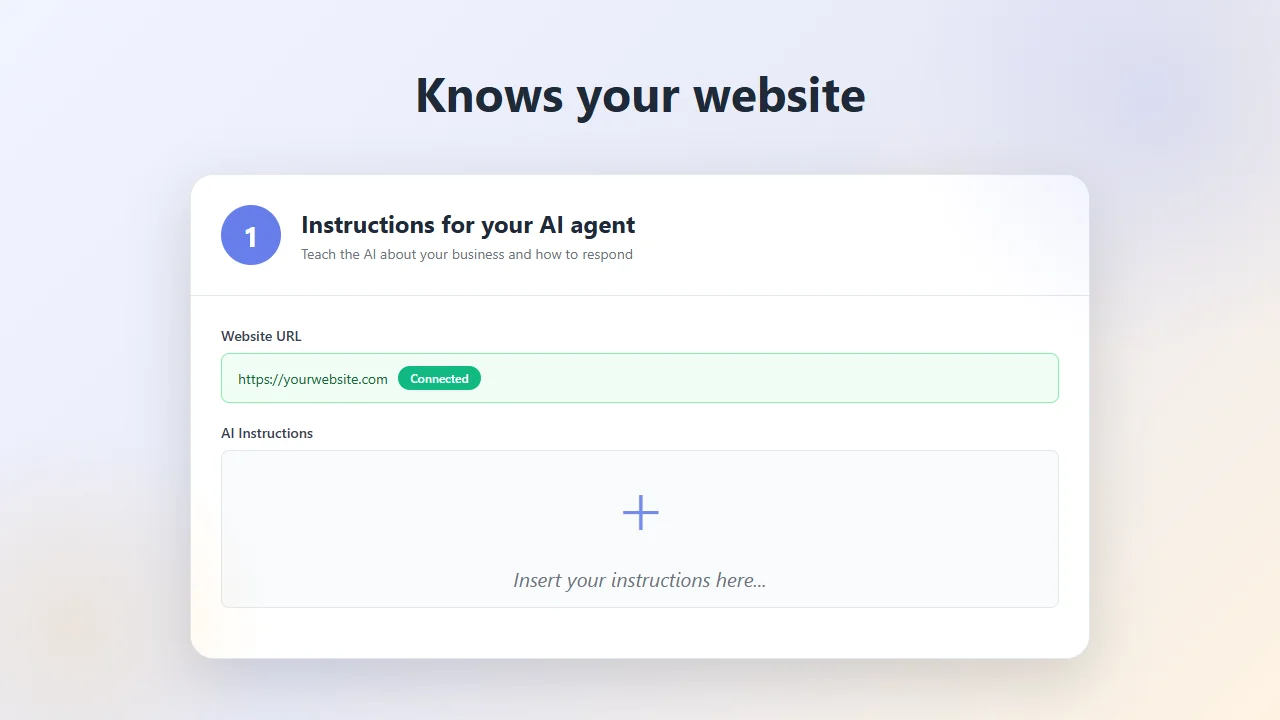
- Enterprise-grade AI with no model managementThe AI that powers your SaaS product answers using each client's own website content and uploaded documents. It supports 36 languages with automatic detection. You never fine-tune a model, manage embeddings, or worry about context windows. The knowledge base builds itself when you add a client's URL, and updates as their content changes.
Recurring revenue that compounds every month you add a client
SaaS economics are simple: acquire a client once, collect revenue every month they stay. The white label software as a service model hands you a product with built-in retention — once a client's chatbot is live and answering visitor questions using their own content, switching costs are high and the value is visible daily. Your cost base is fixed: the Pro plan at $449/month covers up to 20 client sites with 50,000 messages. Everything you charge above that is margin. There is no revenue share with anyone, no percentage flowing upstream, no minimum commitments. The gap between your subscription cost and your total client billings is your gross profit — and it widens with every new client you onboard.
- Fixed cost, variable revenue — classic SaaS leverageYour Pro subscription costs $449/month regardless of whether you have 1 client or 20. Each client you add increases your revenue without increasing your cost. At 10 clients paying $200/month each, your MRR is $2,000 against $449 in cost — $1,551 in monthly profit. At 20 clients, revenue doubles to $4,000 while cost stays flat.
- Natural retention from accumulated valueEach client's chatbot gets better over time as the knowledge base is refined, AI instructions are tuned, and response patterns improve based on real conversations. Three months of accumulated configuration and optimization is not something a client walks away from lightly. This organic stickiness drives low churn without you building any retention features.
- No revenue share — keep 100% above your subscriptionThere is no commission, no platform fee per client, no percentage of your billings going to anyone. You pay your Pro subscription. Everything you collect from clients above that number is yours. If you charge $250/month per client and have 15 clients, your revenue is $3,750 and your cost is $449. The $3,301 difference is entirely your profit.
- Multiple pricing tiers for your own SaaSBecause each client site has independent configuration, you can create your own tiered pricing. Offer a basic package with standard widget branding and the knowledge base. Offer a premium package that includes Custom Tools (API integrations for order lookups, appointment booking, account management), the Real-Time Data Feed for live product catalogs, and the embeddable client dashboard. Same underlying platform, different packaging, different price points.
- Scale beyond 20 with Custom ProWhen your SaaS business outgrows 20 sites or 50,000 messages per month, the Custom Pro plan extends your limits. Higher site counts, higher message volumes — scaled to match your growth without changing the white-label setup your clients already know.
Launch your SaaS product in an afternoon
No development sprint. No infrastructure provisioning. From zero to a white-labeled, revenue-ready AI chatbot SaaS — four steps, one afternoon.
- Subscribe to the Pro plan at asyntai.com/pricing — $449/month gives you white-label branding removal, 20 client sites, and 50,000 messages per month for your entire SaaS operation.
- Configure your SaaS brand identity — set your product name, logo, and color scheme in the dashboard. This branding appears on every client's chat widget and on the embeddable client dashboard.
- Onboard your first client: add their website URL, let the AI crawl their content to build a knowledge base automatically, and customize the widget appearance to match their site design.
- Copy the one-line embed script and install it on your client's website — the AI chatbot goes live immediately, answering visitor questions using that client's own content, under your SaaS brand.
<!-- Zero engineering, full white-label -->
<script src="https://asyntai.com/widget.js"
data-id="client-site-id" async>
</script>
# One line of code. Your brand on the widget.
# A complete SaaS product, live in minutes.
How reselling works
From signing up to billing your first client — four simple steps.
Choose a plan
Subscribe to a plan that fits how many client websites you need. Pro is the most popular for resellers — white-label plus up to 20 websites.
View plans →Add a client website
Each website you add under your account is one client's chatbot. Add up to the number your plan allows.
Go to your dashboard →Set up the chatbot
Add the client's content, customize the widget to their brand, and install it on their site. You can also give the client read-only access to their chat logs, analytics and leads on your own website.
Setup guide →Resell at your price
Charge your client whatever you like. You own the relationship and bill them directly — the margin is yours, every month.
Reseller Resources
Everything you need to get started, answer client questions, and see the dashboard in action
Reseller Guide
Step-by-step walkthrough: white-label branding, the embeddable client dashboard, and how to get your first client live.
Read the guideReseller FAQ
Pricing, margins, billing, white-label details, platform compatibility, and everything else partners ask before starting.
View FAQClient Dashboard Demo
See the embeddable white-label dashboard with sample data — conversations, analytics, and leads under your brand.
See the demoWhite label software as a service — FAQs
Questions from entrepreneurs, agencies, and SaaS founders evaluating white-label AI chatbot reselling as a business model.
Do I need any technical skills to run this as a SaaS business?
No. The entire technical stack — hosting, AI models, databases, security, updates — is managed for you. Setting up a client takes about twenty minutes and involves no code: you add their website URL, configure the widget branding (name, logo, colors), and paste a one-line embed script onto their site. The AI crawls the client's website and builds a knowledge base automatically. If you can use a web dashboard and copy-paste a line of HTML, you have all the technical skills required. The platform handles everything else behind the scenes.
Who handles hosting, uptime, and server maintenance?
All infrastructure is fully managed. You do not provision servers, configure databases, monitor uptime, or apply security patches. The platform runs on production-grade infrastructure with redundancy and monitoring built in. When your client base grows from 2 to 20, you do not need to scale anything — the infrastructure handles the load automatically. Your role is selling and supporting clients, not managing servers. There are no AWS bills, no DevOps tasks, and no 3 AM alerts.
What happens when new features are released?
New features, improvements, and security patches are deployed automatically to the platform. Because you are reselling a hosted SaaS product, every update applies to your white-labeled version without any action on your part. Your clients get access to new capabilities as soon as they ship. You do not manage deployments, run migrations, or coordinate release schedules. The product you resold last month is better today than when you sold it — and that improvement happened without you lifting a finger.
How does the pricing math work for a SaaS business?
The Pro plan costs $449/month and supports up to 20 client sites with 50,000 messages. Your cost per client at full capacity is approximately $22/month. You set your own prices — $99, $199, $349/month per client, whatever your market supports. At 10 clients paying $199/month, your MRR is $1,990 against $449 in cost, giving you $1,541 in monthly gross profit. At 20 clients at the same rate, MRR hits $3,980 with the same $449 cost. There is no revenue share, no per-client fee, and no percentage going upstream.
Can I create my own pricing tiers for my SaaS product?
Yes. Because each client site has independent configuration, you can package the features however you want. Offer a basic tier with the AI chatbot and knowledge base. Offer a premium tier that adds the embeddable client dashboard (Conversations, Analytics, Leads with CSV export), Custom Tools for API integrations, and the Real-Time Data Feed for live product catalogs. You control what each client gets access to by configuring their site settings. The packaging and pricing strategy is entirely yours to design.
What does white-label branding actually remove?
On the Pro plan, white-label branding removes the "Powered by Asyntai" badge from the chat widget entirely. Your product name appears in the chat header. Your logo displays in the widget. Your brand colors are used throughout. The embeddable client dashboard — where your clients view conversations, analytics, and leads — carries your logo, brand name, and primary color. Your clients and their website visitors never see any third-party branding. Standard plan users who want white-label can email [email protected] for manual activation.
What if I outgrow 20 clients or 50,000 messages?
The Custom Pro plan extends both site and message limits beyond what the standard Pro plan offers. When your SaaS business scales past 20 clients or your collective message volume exceeds 50,000 per month, you move to a Custom Pro configuration with higher limits tailored to your growth. The white-label branding, client isolation, and everything else stays the same — you just get more capacity.
Is there a contract or minimum commitment?
No. The Pro plan is a monthly subscription with no contract, no minimum commitment period, and no cancellation penalty. You can start this month, onboard clients, and if for any reason you decide to stop, you cancel. There are no annual lock-ins required, though the flexibility to go month-to-month means you can test the business model with minimal risk before committing to scaling.
Can I use the affiliate program alongside my SaaS business?
Yes. The affiliate program and the white-label reselling model are complementary. For clients you want to manage directly — with your branding, your pricing, your support — use the white-label model. For people you encounter who need an AI chatbot but do not want managed service, send them an affiliate link. The affiliate program pays a 20% recurring commission on their subscription for up to 12 months per referral. A referral who signs up for Pro earns you $89.80 per month with zero ongoing work. Many SaaS operators use both channels simultaneously.
Why white label software as a service is the fastest path to recurring SaaS revenue
The dream of running a SaaS business has a well-documented obstacle: you have to build the product first. The typical SaaS founder spends six to eighteen months assembling a development team, writing code, setting up infrastructure, navigating beta testing, and burning through savings — all before earning a single dollar in recurring revenue. White label software as a service changes the sequence entirely. Instead of building, you take an existing product that already works, already has customers, and already handles the technical complexity, then rebrand it as your own. The AI chatbot you resell answers using each client's website content, supports 36 languages with automatic detection, works on any website platform, captures leads, tracks analytics, and comes with a client dashboard you can embed on your own site. The product is built. The only thing left is to sell it.
The distinction between white labeling and simply being a referral partner matters enormously. A referral partner sends leads and earns a commission. A white-label SaaS operator owns the entire client experience: the branding, the pricing, the onboarding, the ongoing relationship. When you operate white label software as a service, your client sees your name in the chat header, your logo in the widget, your colors on every surface. The embeddable client dashboard — where clients review conversations, check analytics, and export leads as CSV — carries your brand identity. There is no "Powered by" badge, no third-party footer, no link to someone else's website. You invoice the client, you provide the support, you set the terms. The economics follow the ownership: instead of earning a 20% commission on someone else's subscription, you keep 100% of the margin between your Pro plan cost and whatever you charge your clients.
Understanding the cost structure is fundamental to evaluating this as a SaaS business. The Pro plan costs $449 per month and includes white-label branding removal, up to 20 client sites, and 50,000 messages across all sites. This is your cost of goods sold. Everything above it is gross margin. If you onboard five clients at $200 per month each, your revenue is $1,000 and your cost is $449 — a 55% gross margin. At ten clients, revenue rises to $2,000 while cost remains $449 — now 78% gross margin. At twenty clients, revenue is $4,000 against the same $449 — 89% gross margin. The economics improve with every additional client because your cost base is entirely fixed. This is the exact leverage that makes SaaS businesses attractive to operate and attractive to acquirers: fixed costs, growing revenue, and margins that expand with scale.
Monthly recurring revenue is the metric that defines a SaaS business, and the white-label model generates it naturally. Each client you onboard becomes a monthly subscriber to your service. They pay you every month for the AI chatbot that runs on their website, answers their visitors' questions, and captures leads. Unlike project-based revenue — where you finish the work, send the final invoice, and start looking for the next engagement — subscription revenue accumulates. Client number three does not replace client number two; it stacks on top. Your MRR grows with each onboarding and only decreases if a client cancels. And cancellation rates in AI chatbot services tend to be low because the product delivers visible, daily value: questions answered, visitors engaged, leads captured, support hours saved. A client who watches their chatbot handle fifty visitor conversations in a week does not cancel the next month.
The operational reality of managing a white-label SaaS differs from managing a traditional SaaS in one critical way: you are not responsible for product development, infrastructure, or AI model performance. When you run a conventional SaaS, a significant portion of your budget and mental energy goes to engineering — fixing bugs, shipping features, scaling infrastructure, managing deployments, patching security vulnerabilities. In the white-label model, all of that happens upstream, automatically. The AI improves, the widget gains new features, security patches deploy — and your product gets better without any work from you. Your operational responsibilities narrow to three things: selling clients on the value, onboarding them (about twenty minutes per client), and providing front-line support. For most clients, support means adjusting AI instructions, adding documents to the knowledge base, or tweaking widget styling — tasks that take minutes, not hours.
Client onboarding in this model is fast enough that it does not require a dedicated team. You add the client's website URL in your dashboard. The AI crawls their site — reading pages, blog posts, product listings, FAQs, and any other published content — and builds a knowledge base automatically. You configure the widget: your product name in the header, the client's preferred colors, a custom welcome message. If the client has documents that are not on their website — PDFs, policy manuals, product catalogs, internal guides — you upload those to the knowledge base alongside the crawled content. Then you copy the embed script, a single line of JavaScript, and paste it into the client's website. The chatbot appears, branded under your SaaS product name, answering visitor questions using that specific client's content. The entire process from signup to live takes about twenty minutes, and none of it requires development skills or technical infrastructure. You can onboard a new client between meetings.
Building your own pricing tiers is where the white-label model starts to feel like running a real SaaS company. Because each client site has independent configuration, you control which features each client gets access to. A basic tier might include the AI chatbot with knowledge base and widget branding. A professional tier might add the embeddable client dashboard — giving your client direct access to conversation transcripts, analytics, and lead data with CSV export under your branding. An enterprise tier might include Custom Tools, which let the AI call the client's own API endpoints during conversations to check order status, book appointments, or look up account details. You can also differentiate on the Real-Time Data Feed: Standard plan capacity is 200,000 characters, while Pro supports up to 10,000,000 characters — enough for large product catalogs. The underlying platform is the same for every client, but your packaging determines the perceived value and the price you charge.
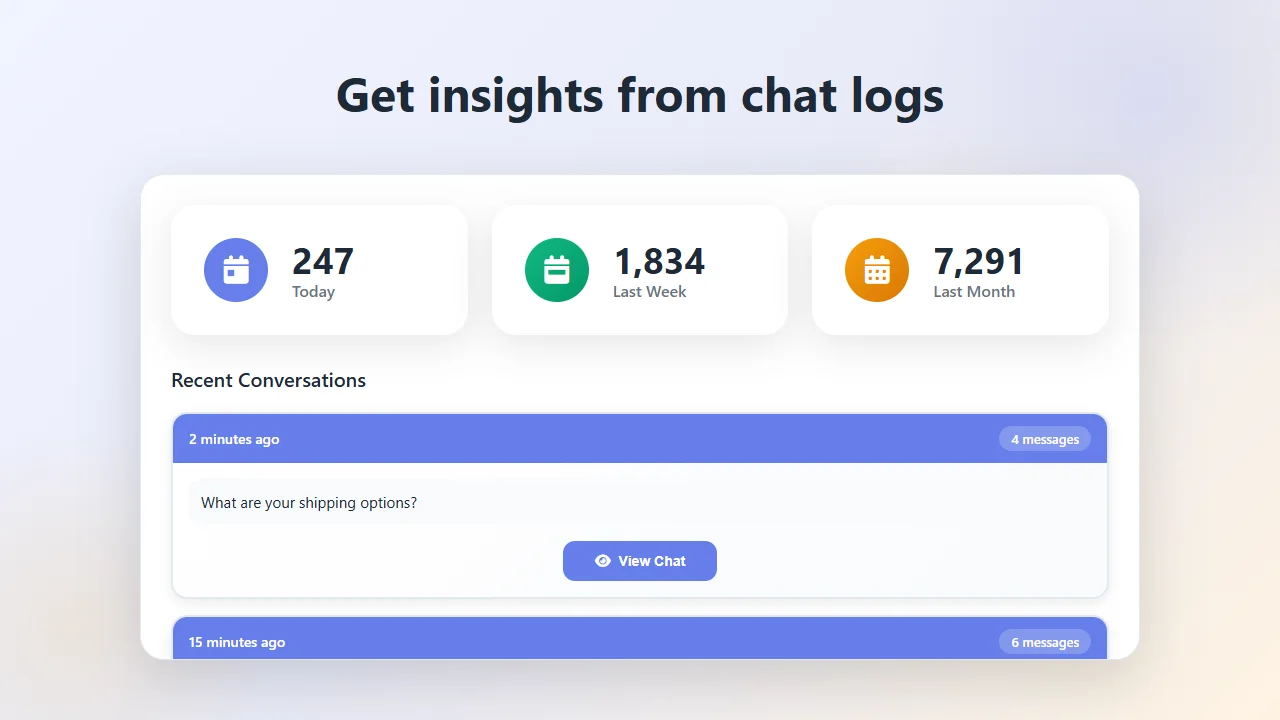
The client dashboard deserves particular attention because it is what transforms your offering from a simple chatbot installation into a genuine software-as-a-service experience. The dashboard has three tabs: Conversations, where clients read full chat transcripts with visitor details; Analytics, where they track message volume, response metrics, and usage trends; and Leads, where they view captured contact information and export it as a CSV for their CRM. You embed this dashboard on your own website using a JS snippet. It displays your logo, your brand name, and your primary color. You can set password protection and restrict access by domain for each client's token. When your client logs in, they see a professional analytics interface under your brand name — the kind of dashboard they would expect from any SaaS product. It is not an add-on. It is the experience that justifies the monthly subscription.
Language coverage determines how large your addressable market can grow. The AI supports 36 languages and auto-detects the visitor's language in real time. If your German client's visitor types a question in German, the response comes in German. If your Japanese client's visitor asks in Japanese, the AI replies in Japanese. The knowledge base content can be in any language, and the AI handles the language matching automatically. This means your white-label SaaS is not limited to English-speaking markets. An agency in Europe can sell to clients in France, Germany, Spain, and Italy without configuring separate language versions. A digital marketing firm in Southeast Asia can serve clients in Thailand, Indonesia, and Vietnam with the same product. Every additional language you can sell into is a larger addressable market with the same product and the same cost base.
Platform compatibility is another concern that the white-label model resolves before it becomes a problem. The embed script works on any website that supports custom HTML — which covers WordPress, Shopify, Wix, Squarespace, Webflow, Magento, Joomla, Drupal, and essentially every other website platform in use today. There are official plugins for over 30 platforms that simplify the installation process. Your clients do not need to be on a specific platform for your SaaS product to work. Whether they built their site on WordPress, have a Shopify store, or use a custom-built website, the chatbot installs the same way and works the same way. This eliminates a common SaaS limitation: your product is not locked to a single ecosystem, so your sales pipeline does not narrow based on what technology your prospects use.
Custom Tools open a second revenue axis for your SaaS business. Available on Standard and Pro plans, Custom Tools let the AI chatbot call your client's own API endpoints during a conversation. For an ecommerce client, the bot checks order status, retrieves shipping tracking, and processes return requests — all within the chat window. For a healthcare clinic, the bot checks appointment availability and books slots. For a SaaS company, the bot looks up user accounts and handles password resets. Each client's tools are configured independently, so you can offer different capabilities based on the client's needs and their available APIs. From a pricing standpoint, Custom Tools are a natural upgrade tier: basic clients get the chatbot with knowledge base, premium clients get the chatbot plus live API integrations that perform real actions. The value difference justifies a significant price gap between tiers.
Comparing the build-versus-buy decision in concrete terms clarifies why white label software as a service is the rational choice for most SaaS entrepreneurs. Building a comparable AI chatbot product from scratch requires: a conversational AI engine with retrieval-augmented generation (budget six months of AI engineering and ongoing model costs), a web crawler and document parser for knowledge base ingestion, a chat widget with responsive design and accessibility support, a multi-tenant architecture with client isolation, a client-facing analytics dashboard, multilingual support across 36 languages, and infrastructure to keep everything running reliably at scale. The engineering cost runs into hundreds of thousands of dollars and twelve to eighteen months of development before you can serve a single paying client. The white-label approach delivers the finished product for $449 per month, with your first client potentially onboarded the same afternoon you sign up. The build path makes sense if you have venture funding and a two-year runway. The white-label path makes sense if you want revenue this month.
Customer lifetime value in the AI chatbot space tends to be strong because the product becomes more valuable the longer a client uses it. When you first deploy a chatbot for a client, it answers questions based on their website content. Over time, the knowledge base gets refined — additional documents are uploaded, AI instructions are adjusted, response style is tuned based on conversation data. After three months, the chatbot knows the client's business intimately. After six months, it handles edge cases that would have stumped it on day one. This accumulated intelligence creates natural retention: a client with a finely tuned chatbot does not want to start over with a new vendor. High lifetime value combined with low churn is the formula that makes SaaS businesses durable. In the white-label model, you benefit from this retention dynamic without having built the technology that creates it.
The hybrid model — white-label for managed clients, affiliate for unmanaged referrals — deserves consideration as a revenue strategy. The affiliate program pays a 20% recurring commission on any subscription purchased through your tracking link. A customer who signs up for a Pro plan through your affiliate link earns you $89.80 per month, every month, with no setup work, no support obligation, and no client management. If you encounter a prospect who wants an AI chatbot but does not want managed service, the affiliate link captures that revenue without adding to your support workload. Some SaaS operators generate a secondary income stream from affiliate referrals that covers a meaningful portion of their Pro subscription cost, effectively reducing their cost basis and improving margins on their white-label business.
Scaling past the initial 20-client capacity is a planned path, not a hard ceiling. The Custom Pro plan extends both site limits and message volumes beyond the standard Pro tier. When your SaaS business hits 20 clients and starts running into capacity constraints, you move to Custom Pro with limits tailored to your specific growth profile. The transition is seamless — your existing clients, their knowledge bases, their widget configurations, and their conversation histories carry over. You do not rebuild anything, migrate anything, or re-onboard anyone. The white-label branding, the client dashboard, the Custom Tools — everything stays the same. You just get more room to grow. For SaaS businesses with ambitions beyond 20 clients, the path from startup to scale is uninterrupted.
Ready to launch your own AI chatbot SaaS? Reach out at [email protected] — we respond within 24 hours.