White label ecommerce software: an AI shopping assistant you brand as your own
Not a storefront. Not a cart. An AI chatbot that sits on your clients' online stores and helps shoppers find products, answers order questions, and handles shipping inquiries — under your brand, around the clock.
See the AI shopping assistant on any ecommerce site
Paste an online store URL below and watch the AI learn the products, policies, and content — then picture this running under your brand on every client's store
Product knowledge, order support, and shipping answers — all under your name
Asyntai is not an ecommerce platform. It is an AI chatbot that sits on ecommerce sites and helps shoppers get answers. It reads product pages, shipping policies, and return rules, then uses that content to respond to visitor questions instantly. On the Pro plan, the "Powered by Asyntai" badge is gone entirely. The widget header shows your company name. Your logo appears in the chat window. Your colors run through every surface. Your client's shoppers interact with what looks like your proprietary AI shopping assistant — no third-party footprint visible anywhere. Standard plan users who want the same branding removal can email [email protected] for manual activation.
- Product discovery through conversationShoppers type what they are looking for — "running shoes for wide feet under $120" — and the AI searches the store's catalog and responds with matching products, prices, and availability. No category navigation. No filter menus. Just a natural conversation that leads to the right product.
- Real-Time Data Feed for live catalog accessConnect the AI to a product feed URL that returns current inventory in JSON or CSV format. Prices, stock levels, new arrivals, and discontinued items update automatically. Pro plan clients get up to 10,000,000 characters of feed capacity — enough for thousands of SKUs.
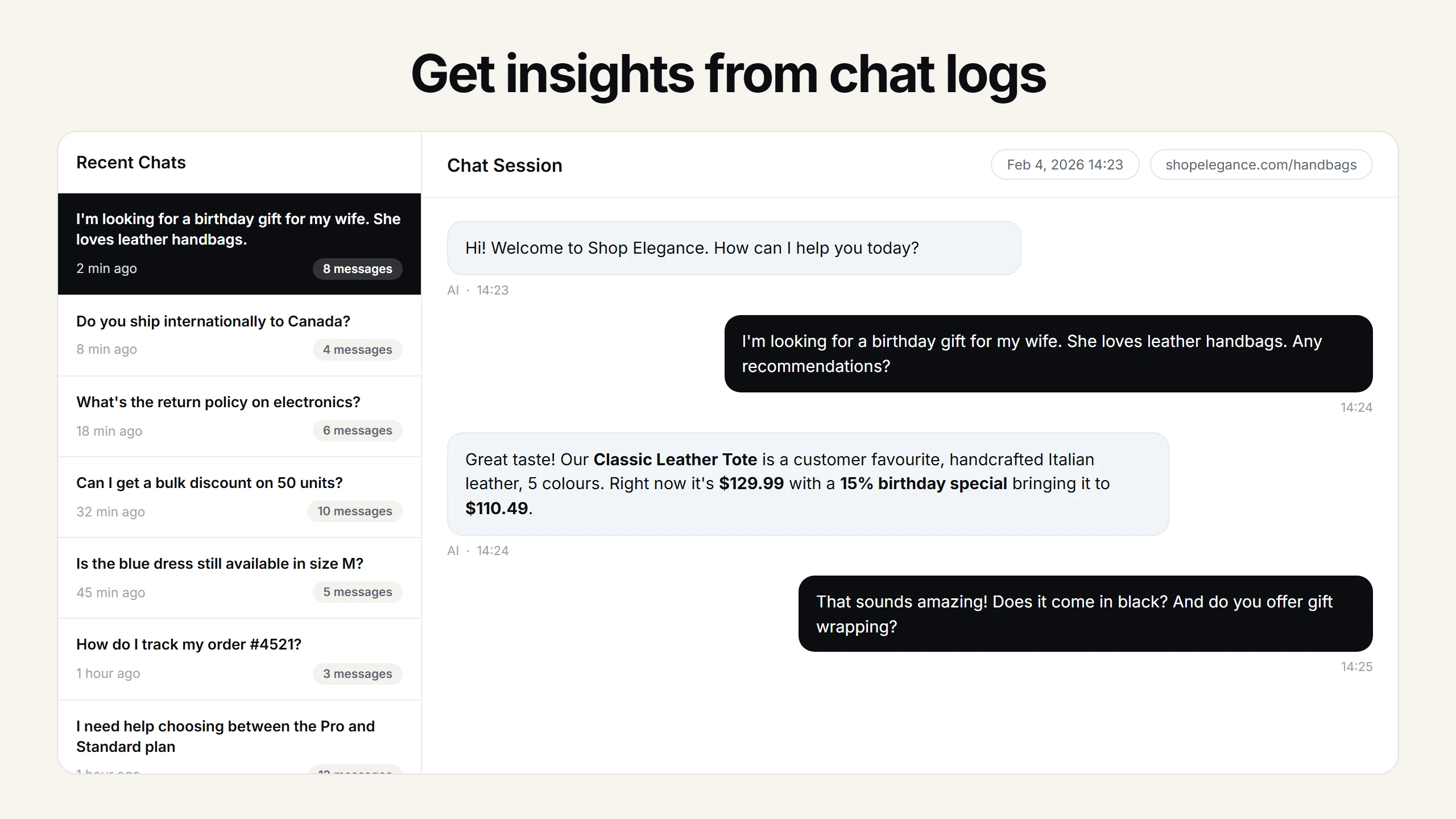
- White-labeled client dashboard with sales contextEach ecommerce client gets a branded dashboard with Conversations (every chat transcript showing what shoppers asked), Analytics (message volume and engagement metrics), and Leads (shopper contact info with CSV export). Your logo, your brand, your domain.
One subscription covers AI shopping assistants for twenty online stores
The Pro plan is $449/month for up to 20 client sites and 50,000 messages. At capacity, your cost per ecommerce client is roughly $22. Charge $200 or $300 per month for an "AI shopping assistant" — a fraction of what a part-time support agent costs — and every dollar goes to you. No revenue share, no commission, no per-store fees. For agencies managing more than 20 ecommerce clients, the Custom Pro plan raises both limits.
- $449/month covers 20 ecommerce clientsAt 15 clients paying you $250 each, your monthly revenue is $3,750 against a $449 cost — $3,301 in margin. The subscription cost is flat. Every additional store you bring on increases your margin without increasing your expenses.
- Order status via Custom ToolsOn Standard and Pro plans, the AI can call the store's order API mid-conversation — pulling tracking numbers, delivery estimates, and return status in real time. The shopper asks "where is my order?" and gets the answer in seconds, without waiting for a human.
- Isolated environments per storeThe fashion boutique's catalog never appears in the electronics retailer's responses. Each store has its own knowledge base, product feed, widget branding, AI instructions, conversation history, and lead data. Twenty sealed compartments under one account.
- 36 languages for global ecommerceThe AI auto-detects the shopper's language and responds in kind. French, German, Japanese, Arabic — no separate widget instances, no multilingual staff. One deployment handles international shoppers on all 36 supported languages.
- Works on every ecommerce platformShopify, WooCommerce, Magento, BigCommerce, OpenCart, PrestaShop, Wix, Squarespace — plugins for over 30 platforms. One line of JavaScript for any custom-built store. You never turn away a client because of their platform.
Set up an AI shopping assistant for your first ecommerce client
No developers. No API integration. From signup to a branded chatbot answering product questions on your client's online store — four steps, about twenty minutes.
- Subscribe to the Pro plan at asyntai.com/pricing — you get branding removal, 20 client sites, and 50,000 messages per month.
- Add your ecommerce client's domain, brand the widget with your name, logo, and colors, and optionally connect their product data feed for real-time catalog access.
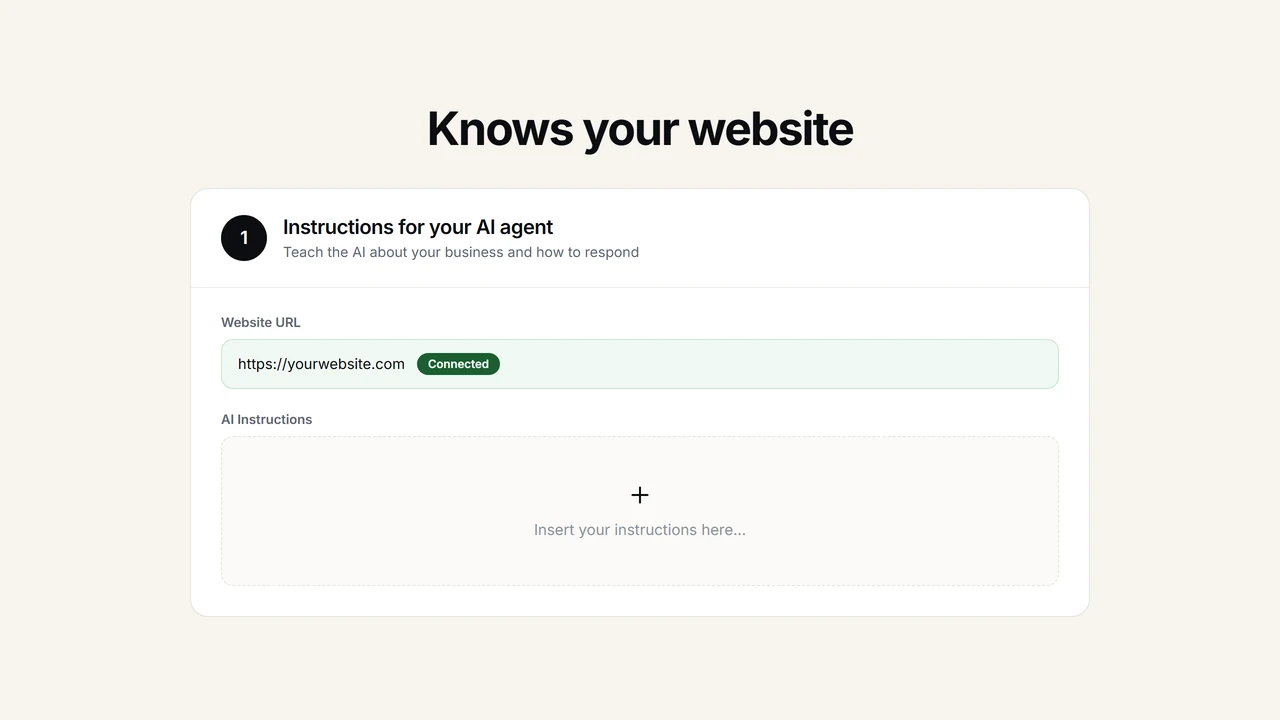
- The AI crawls the store's product pages, shipping policies, return rules, and FAQ content automatically. The knowledge base populates within hours.
- Paste the one-line embed script into the store — the branded AI shopping assistant appears and starts helping shoppers immediately, 24/7.
<!-- Products, orders, shipping — automated. -->
<script src="https://asyntai.com/widget.js"
data-id="store-id" async>
</script>
# Helping shoppers find products 24/7.
# Your brand on every interaction.
How reselling works
From signing up to billing your first client — four simple steps.
Choose a plan
Subscribe to a plan that fits how many client websites you need. Pro is the most popular for resellers — white-label plus up to 20 websites.
View plans →Add a client website
Each website you add under your account is one client's chatbot. Add up to the number your plan allows.
Go to your dashboard →Set up the chatbot
Add the client's content, customize the widget to their brand, and install it on their site. You can also give the client read-only access to their chat logs, analytics and leads on your own website.
Setup guide →Resell at your price
Charge your client whatever you like. You own the relationship and bill them directly — the margin is yours, every month.
Reseller Resources
Everything you need to get started, answer client questions, and see the dashboard in action
Reseller Guide
Step-by-step walkthrough: white-label branding, the embeddable client dashboard, and how to get your first client live.
Read the guideReseller FAQ
Pricing, margins, billing, white-label details, platform compatibility, and everything else partners ask before starting.
View FAQClient Dashboard Demo
See the embeddable white-label dashboard with sample data — conversations, analytics, and leads under your brand.
See the demoWhite label ecommerce software — FAQs
Common questions from agencies evaluating an AI chatbot for ecommerce that they can white-label and resell to online store clients.
Is this an ecommerce platform like Shopify or WooCommerce?
No. Asyntai is not an ecommerce platform. It does not handle product listings, shopping carts, checkout, payments, or inventory management. It is an AI chatbot that sits on top of existing ecommerce sites — Shopify, WooCommerce, Magento, BigCommerce, or any other platform — and helps shoppers find products, answers their questions about orders and shipping, and captures leads. Your clients keep their existing ecommerce platform. This adds an intelligent conversation layer that improves their customer experience and reduces their support workload.
How does the AI know about the store's products?
Two ways. First, the AI automatically crawls the store's product pages, category pages, FAQ sections, shipping policies, and return rules — building a knowledge base from all that published content. Second, you can connect a Real-Time Data Feed: a URL that returns the store's product catalog in JSON or CSV format with names, descriptions, prices, stock levels, and images. The feed updates automatically, so price changes, new arrivals, and out-of-stock items reflect in the AI's responses immediately. Pro plan clients get up to 10,000,000 characters of feed capacity.
Can the chatbot check order status for shoppers?
Yes. On Standard and Pro plans, Custom Tools let the AI call the store's own API endpoints during a conversation. When a shopper asks "where is my order?" the AI queries the order management system using the order number or email address and responds with tracking information, delivery estimates, and shipment status — all in real time, without a human touching the conversation. Each ecommerce client's Custom Tools are configured independently.
What ecommerce platforms does this work with?
Every major ecommerce platform. Shopify stores install via the Shopify App Store. WooCommerce/WordPress sites use the official plugin. Magento, BigCommerce, OpenCart, PrestaShop, Wix, and Squarespace all support the embed script directly or have dedicated plugins. In total, plugins exist for over 30 platforms. For custom-built stores, the single-line JavaScript snippet loads asynchronously and works on any site that renders HTML. You will never turn away an ecommerce client because of their platform.
How much does it cost to offer this to multiple ecommerce clients?
The Pro plan is $449/month for up to 20 client sites and 50,000 messages. There is no per-store surcharge, no per-message overage fee within the included volume, and no revenue share on what you charge your clients. At 20 ecommerce clients paying you $200 each, your revenue is $4,000 and your margin is $3,551. The Standard plan ($139/month, 3 sites, 15,000 messages) works for agencies starting with a smaller client roster. The Starter plan ($39/month, 2 sites, 800 messages) covers the earliest stages.
Can the AI recommend products to shoppers?
Yes. When a shopper describes what they are looking for — "I need a waterproof jacket for hiking, under $150" — the AI searches the store's product catalog (from the crawled pages or the Real-Time Data Feed) and responds with matching items, including names, prices, and descriptions. It can compare products, highlight differences, and suggest alternatives if the exact match is out of stock. This conversational product discovery often surfaces items shoppers would not have found through traditional category navigation.
Does the chatbot handle returns and shipping questions?
Yes. The AI reads the store's return policy and shipping information pages and uses that content to answer shopper questions accurately. "How long does shipping take to Germany?" gets the specific international shipping timeframe. "Can I return shoes if they do not fit?" gets the return window, conditions, and process from the published policy. For stores with Custom Tools configured, the AI can also initiate return requests or pull shipping tracking data from the store's systems in real time.
How does the white-label aspect work for ecommerce?
On the Pro plan, every visible element of the chatbot belongs to you. Your company name in the header, your logo in the window, your colors on every surface. The "Powered by Asyntai" badge is removed entirely. When a shopper on your client's online store opens the chat, they see a branded AI shopping assistant that looks like your proprietary product. Each client store gets independent branding — different name, different colors, different welcome message — all managed from your single dashboard.
Does the AI handle multiple languages for international ecommerce?
Yes. The AI supports 36 languages with automatic detection. A German shopper gets German responses. A Japanese shopper on the same store gets Japanese responses. No separate widget instances, no language-specific setup, and no per-language cost. For ecommerce stores that ship internationally, a single chatbot deployment handles every market. This is particularly valuable for cross-border ecommerce where support staff fluent in every target language would be prohibitively expensive.
Why ecommerce stores need more than a product page — and how a white-label AI chatbot fills the gap
Every online store shares the same structural limitation: the product page does the talking, and the shopper does the interpreting. The store publishes descriptions, specifications, images, pricing, and policies, and then hopes the visitor can find the right product, understand the shipping terms, and complete the checkout without hitting a question that stops them cold. When a question does come up — "does this come in wide width?" "how long does shipping take to my country?" "can I use this with my existing setup?" — the shopper either hunts through the site for an answer or leaves. Most leave. The gap between what the store publishes and what the shopper needs to know at the moment of decision is where ecommerce loses sales every hour of every day. An AI chatbot sits in that gap and closes it in real time.
To be clear about what this is and what it is not: Asyntai is not an ecommerce platform. It does not replace Shopify, WooCommerce, Magento, or whatever cart and checkout system the store runs on. It does not manage inventory, process payments, or handle fulfillment. It is a chatbot — specifically, an AI-powered conversation widget that sits on the store's existing pages and answers shopper questions using the store's own content. Product details, shipping policies, return rules, sizing guides, compatibility information — the AI reads all of it and responds when a visitor asks. The store keeps its existing ecommerce infrastructure completely intact. The chatbot adds a conversation layer on top that helps shoppers get answers without leaving the page, without emailing support, and without abandoning their cart.
The product discovery dimension is where ecommerce chatbots create the most tangible value. Traditional product search on an online store is filter-based: the shopper picks a category, selects size and color, sets a price range, and scrolls through results. That works when the shopper knows exactly what they want. It fails when they have a need but not a product name. "I need a gift for a 10-year-old who likes science" does not map to any filter combination on a toy store. "I want a moisturizer for sensitive skin that does not have fragrance" requires reading ingredient lists on a dozen products. "I need a router that covers a 3,000 square foot house with thick walls" demands technical comparison that category pages do not offer. The AI chatbot handles all of these naturally. The shopper describes what they need in plain language, and the AI searches the catalog and responds with specific product recommendations, prices, and relevant details. Conversational product discovery reaches the products that filter-based search misses.
Real-Time Data Feeds make this product discovery accurate to the minute. You connect the AI to a URL that returns the store's catalog — product names, descriptions, prices, stock levels, images — in JSON or CSV format. When the data at that URL changes, the AI's knowledge updates automatically. A price drop reflects immediately. A product going out of stock disappears from recommendations. A new arrival becomes available in responses as soon as it appears in the feed. Pro plan clients get up to 10,000,000 characters of feed capacity, which handles catalogs with thousands of SKUs. Standard plan clients get 200,000 characters. For agencies managing ecommerce clients, this means the chatbot is never quoting yesterday's prices or recommending a product that sold out this morning.
Order status inquiries make up a large portion of ecommerce support volume, and Custom Tools on Standard and Pro plans handle them without human intervention. You configure the AI to call the store's order management API during the conversation. When a shopper types "where is my order?" the AI asks for the order number or email, queries the system, and responds with the tracking number, carrier, estimated delivery date, and current shipment status. The shopper gets their answer in seconds. The store's support team never sees the ticket. For high-volume stores processing hundreds of orders daily, the deflection rate on order status inquiries alone can justify the cost of the chatbot. Every order-status question the AI handles is a support ticket a human never has to open.
Shipping and return questions are the other high-volume category that the AI absorbs completely. Every ecommerce store publishes shipping rates, delivery timeframes, and return policies — but shoppers routinely ask about them anyway because finding the policy page requires navigating away from the product they are considering, which breaks the purchase flow. The AI answers inline. "How long does shipping take to Canada?" gets the international shipping timeframe from the store's published policy. "What is the return window for electronics?" gets the specific category return rules. "Is there free shipping over a certain amount?" gets the threshold. The shopper stays on the product page, gets their answer, and the purchase continues without the friction of navigating to a separate policy page and navigating back.
The white-label layer turns this ecommerce chatbot into a product you sell to online stores under your own brand. On the Pro plan, every visible element belongs to you. Your company name in the widget header. Your logo in the chat window. Your brand colors on every surface — the bubble, the message backgrounds, the header bar. The "Powered by" badge is gone. Not minimized, not tucked away, but removed entirely. When a shopper on your client's store opens the chat, they interact with what looks and feels like a product your agency designed specifically for ecommerce. Your client never discovers the underlying platform. For you, this means you are not just recommending a third-party tool — you are selling your own AI shopping assistant service, with full brand ownership and margin control.
The economics of reselling AI chatbots to ecommerce clients are straightforward. The Pro plan is $449/month for up to 20 stores and 50,000 messages. At full capacity, your per-store cost is approximately $22. Charge each ecommerce client $200/month for a "24/7 AI shopping assistant" and your revenue at 20 clients is $4,000 — a $3,551 margin. At $300/month per client, margin reaches $5,551. These margins hold because the subscription cost is flat: adding client number fifteen does not cost more than client number five. There is no revenue share, no commission owed, and no per-store fee. You invoice your clients directly, set your own pricing, and keep every dollar of the markup.
Each ecommerce client gets a completely isolated environment. The fashion boutique's product catalog stays in the fashion boutique's knowledge base. The pet supply store's product feed stays in the pet supply store's environment. The electronics retailer's order management API connections stay in the electronics retailer's configuration. Twenty stores, twenty sealed compartments. Each has its own widget design, its own AI instructions, its own conversation history, its own lead data, and its own Custom Tools. A product data update on one store does not touch any other store. You manage all twenty from a single dashboard, switching between clients with a click.
Platform compatibility removes any friction from the sales conversation. Shopify, WooCommerce, Magento, BigCommerce, OpenCart, PrestaShop, Wix, Squarespace, and more than 20 other ecommerce platforms are supported with official plugins or direct JavaScript embedding. The Shopify store installs from the Shopify App Store. The WooCommerce store uses the WordPress plugin. The custom-built store pastes a single script tag. The widget loads asynchronously and does not interfere with the store's existing functionality — no conflict with the cart, no interference with checkout, no impact on page speed. For agencies serving ecommerce clients across a mix of platforms, this universality means every prospect is a viable client regardless of their tech stack.
Multilingual ecommerce is where the AI chatbot delivers outsized value relative to the alternative. An online store that ships to 15 countries would traditionally need customer support staff who speak the relevant languages — or at minimum, a localized FAQ page for each market, which rarely gets maintained. The AI supports 36 languages with automatic detection. A German shopper on a US-based store types in German and receives German responses about products, shipping, and returns. A Korean shopper on the same store types in Korean and gets Korean responses. No separate widget setups per language. No multilingual support agents. One deployment covers every international shopper in their native language, around the clock, at no additional cost per language. For cross-border ecommerce, this is a cost structure that manual support cannot match.
Lead capture during ecommerce conversations adds a revenue dimension beyond immediate sales. When a shopper engages with the AI about a product category, expresses interest in a specific item, or asks about pricing for a bulk order, the AI can capture their name and email. That lead appears in the client's dashboard with full conversation context: what the shopper looked at, what questions they asked, what products were discussed. CSV export sends those leads into the client's email marketing platform or CRM. For ecommerce stores running remarketing campaigns, these are warm leads with known product interest — far more valuable than generic newsletter signups.
Vertical specialization within ecommerce is where the highest reseller margins live. Instead of selling a generic chatbot to any online store, you specialize: AI shopping assistants for fashion retailers, configured with size-guide knowledge and style recommendation logic. AI assistants for electronics stores, set up to compare specifications and check compatibility. AI assistants for food and beverage merchants, programmed to answer allergen and dietary questions. The underlying platform is the same, but your expertise in configuring the AI for a specific ecommerce niche commands premium pricing and makes your service harder to comparison-shop against generic competitors.
The affiliate program offers a passive revenue stream alongside the reseller model. For ecommerce businesses you encounter that want a chatbot but do not need your managed service, share a referral link and earn 20% recurring commission on their subscription. A Pro plan referral generates $89.80/month for up to 12 months. Some agencies run both models: white-label AI shopping assistants for managed clients, and affiliate links for ecommerce businesses they connect with but do not want to actively manage.
Questions about white label ecommerce chatbots? Reach out at [email protected] — we respond within 24 hours.