White label chat plugin that runs under your brand, not ours
You built the client relationship. Your brand should be the one they see. Asyntai's white label chat plugin lets agencies, resellers, and SaaS companies deploy AI-powered chat under their own name, logo, and colors. Your clients see your brand. Their visitors interact with your widget. Asyntai's AI engine does the work behind the curtain — answering questions using your client's own content, knowledge base, and product data. No "Powered by Asyntai" badge. No competing brand in the corner. Just your name on a world-class AI chat experience you can deploy for every client in your portfolio.
See how the white label chat plugin works for your brand
Enter a client site URL and imagine the widget running under your agency's name, colors, and logo
Remove Asyntai branding — your name, your colors, your logo on every widget
White labeling isn't a cosmetic tweak — it's the difference between selling a service and reselling someone else's product. With Asyntai's white label option, the chat widget your clients see carries your brand identity entirely. You set the widget name that appears in the header. You choose the primary and accent colors that match your brand palette. You upload your logo. The "Powered by" badge disappears. When your client's visitors interact with the chat, they experience your brand — not a third-party tool with unfamiliar branding. For agencies selling AI chat as part of a managed service package, this is what makes the offering yours.
- Full brand replacement, not just a color swapSet the widget display name to your agency's name or your client's brand name. Upload a custom logo that appears in the chat header. Choose primary colors, accent colors, background tones, and font styles. The widget looks like you built it from scratch — because from the visitor's perspective, you did.
- No "Powered by" badge competing for attentionThe default Asyntai branding is completely removed on white label configurations. No footer link, no corner badge, no tooltip that reveals the platform behind the widget. Your client's visitors interact with a branded experience that reinforces your agency's name, not ours. That's the point.
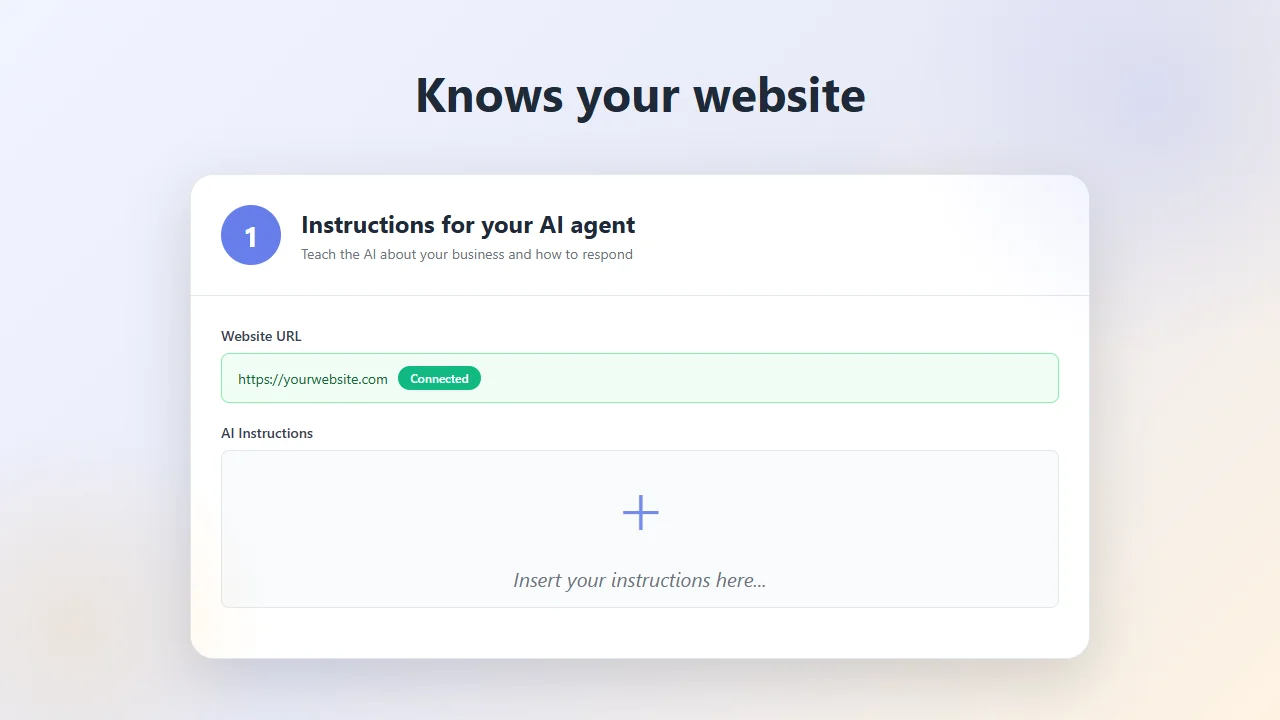
- Client-ready deployment in minutesEach client gets their own Asyntai account with a separate knowledge base, separate widget configuration, and separate branding. You set up the white label appearance once per client, embed the widget script on their site, and the branded AI chat is live. No development work, no custom builds, no waiting on a white label approval process.
Multi-site deployment, separate knowledge bases, and recurring revenue
A white label that only works for one site isn't a business — it's a side project. Asyntai is built for agencies managing multiple clients. The Pro plan supports up to 20 sites under a single account, each with its own widget configuration, branding, and knowledge base. Each client's AI answers using their own content — their product catalog, their FAQ, their policies — completely isolated from your other clients. And with the affiliate program paying 20% recurring commission on every referral, you're not just deploying widgets — you're building a revenue stream that compounds every month.
- Up to 20 sites on a single Pro accountThe Pro plan lets you run the AI chat widget on up to 20 different domains. Each site gets its own widget embed, its own appearance settings, and its own knowledge base. You manage everything from one dashboard. For agencies with a client roster, this means one subscription covers your entire portfolio — and each client gets a fully independent, branded experience.
- Separate knowledge bases keep client data isolatedEach client's AI answers using only their content. Client A's product catalog never leaks into Client B's answers. You upload documents, connect data feeds, and configure crawling independently per site. The AI for a law firm client answers legal questions from that firm's content. The AI for an ecommerce client searches that store's product catalog. Complete separation, zero cross-contamination.
- 20% recurring affiliate commission on every referralBeyond deploying for your own clients, Asyntai's affiliate program pays 20% recurring commission on every customer you refer. When a referral signs up and stays subscribed, you earn 20% of their monthly payment for up to 12 months per referral. Agencies and resellers who introduce clients to Asyntai build a passive revenue stream that grows alongside their client base. Payouts via PayPal, tracked from your affiliate dashboard.
- Custom Tools let each client's bot take actionsWhite labeling goes beyond appearance. With Custom Tools, each client's AI bot can call their own API endpoints — check order status, look up appointments, process returns, query inventory. An ecommerce client's white-labeled bot checks shipping status. A SaaS client's bot pulls account details. Each deployment becomes a fully functional AI assistant, not just a Q&A widget.
Deploy a white label chat plugin for your first client in minutes
No custom development. No SDK. No waiting for API keys. Sign up, configure your branding, paste the embed code on your client's site, and the white-labeled AI chat is live.
- Sign up at Asyntai, go to the Customize page, and set the widget name, logo, and colors to your agency's brand or your client's brand.
- Remove the "Powered by Asyntai" badge by enabling the white label option (available on the Pro plan).
- Add your client's content — let the AI crawl their site, upload documents, or connect a Real-Time Data Feed for product catalogs.
- Copy the embed script from your dashboard and paste it into your client's site. The branded AI chat widget goes live immediately.
<!-- No Asyntai branding visible to end visitors -->
<script src="https://asyntai.com/widget.js"
data-id="your-client-site-id" async>
</script>
# Your brand. Your client's content. Our AI.
White label chat plugin — FAQs
Common questions from agencies, resellers, and SaaS companies evaluating white label AI chat for their clients.
Is the white labeling fully complete — no Asyntai branding at all?
Yes. When white labeling is enabled, all Asyntai branding is removed from the chat widget. The "Powered by Asyntai" badge disappears. The widget header shows whatever name and logo you configure — your agency name, your client's brand name, or any custom label. End visitors interacting with the chat widget see no indication that the underlying technology is Asyntai. The only place Asyntai appears is in your own dashboard, which your clients' visitors never see. For agencies reselling AI chat as part of a managed service, the experience is indistinguishable from a proprietary solution you built in-house.
What plan do I need for white labeling?
White label branding removal is available on the Pro plan ($449/month). Pro includes 50,000 messages per month and supports up to 20 sites — making it the natural choice for agencies managing multiple clients. The Pro plan includes Custom Tools, Real-Time Data Feed, and all the features you need to deliver a professional AI chat deployment. The Free, Starter, and Standard plans include widget customization (colors, name) but retain the Asyntai branding badge.
Can I manage multiple clients from one account?
Yes. The Pro plan supports up to 20 sites, each with its own widget configuration, knowledge base, and branding. You manage all of them from a single Asyntai dashboard. Each client's site gets a unique embed code and a completely independent knowledge base — their content, their products, their AI instructions. One client's data never appears in another client's chat responses. For agencies with more than 20 clients, you can run multiple Pro accounts or contact us about volume arrangements.
How does the affiliate and reseller program work?
Asyntai's affiliate program pays 20% recurring commission on every customer you refer. You get a unique referral link from your affiliate dashboard. When someone signs up through your link and subscribes to a paid plan, you earn 20% of their monthly payment for up to 12 months per referral. Commissions are tracked automatically and paid out via PayPal. For agencies, this creates two revenue streams: the markup you charge clients for your managed AI chat service, plus the affiliate commission from Asyntai on the underlying subscription. The program is free to join and there is no cap on earnings.
Can each client have their own custom domain or subdomain for the widget?
The widget is embedded via a JavaScript snippet that loads on whatever domain your client's site runs on — their existing domain, their subdomain, any URL. The widget itself does not require a custom domain or subdomain to function. It loads asynchronously and runs on the client's page regardless of domain. The embed code is domain-agnostic, so if a client changes domains or adds a staging environment, the same snippet works everywhere. The widget URL (asyntai.com/widget.js) is not visible to end visitors — it loads in the background like any analytics or chat script.
Do my clients need their own Asyntai accounts?
It depends on how you want to structure your service. Option one: you manage everything from your own account, using one site slot per client. You control the branding, knowledge base, and widget configuration. The client never logs into Asyntai. Option two: each client has their own Asyntai account (signed up through your affiliate link), and you manage it on their behalf or hand them the dashboard. Option one gives you more control and keeps things consolidated. Option two generates affiliate commissions on each client's subscription. Many agencies use a hybrid — they manage smaller clients from their own account and set up larger clients with their own accounts.
Can the white-labeled bot do more than answer questions?
Yes. With Custom Tools, each client's white-labeled bot can call external API endpoints to take real actions — not just answer questions. An ecommerce client's bot can check order status, look up shipping tracking, verify product availability in specific sizes. A SaaS client's bot can pull up account details, check subscription status, or trigger password reset flows. A healthcare provider's bot can look up appointment availability. You define the tools per client, so each deployment has actions specific to that client's business. The bot becomes a branded AI assistant that does things, not just a chat widget that talks.
What happens if a client outgrows the message limits?
The Pro plan includes 50,000 messages per month, shared across all sites on the account. If your combined client volume approaches that limit, you have options: upgrade to a higher volume arrangement, distribute high-traffic clients across separate accounts (which also generates affiliate commissions per account), or contact us about enterprise pricing for agencies with very high aggregate volume. Your dashboard shows message usage per site, so you can see exactly which clients are driving volume and plan accordingly. Most agencies find that Pro's 50,000 messages comfortably handles 5-10 small-to-medium client sites.
Why white label AI chat is the highest-margin service an agency can add in 2026
There's a moment in every agency's growth when the founder realizes something uncomfortable: they've been selling time. Every project is a custom engagement. Every month requires new deliverables to justify the retainer. Revenue is a function of hours worked, and hours are finite. The agencies that break out of this trap are the ones that find productizable services — offerings that can be deployed for multiple clients with minimal incremental effort, generate recurring revenue, and scale without proportionally scaling headcount. In 2026, white label AI chat is the clearest example of that kind of service.
The mechanics are straightforward. You take a proven AI chat platform — one that already handles natural language understanding, knowledge base management, multilingual support, and widget rendering — and you rebrand it as your own. Your agency name on the widget. Your colors. Your logo. The underlying technology is invisible to both your clients and their visitors. You're not reselling a tool with someone else's branding stamped on it. You're offering a proprietary-looking AI chat service that happens to be powered by infrastructure you didn't have to build. The distinction matters, because clients who think you built it value the service differently than clients who know you're marking up a third-party subscription.
Asyntai's white label option is designed specifically for this model. When you enable white labeling, the "Powered by Asyntai" badge is removed completely. You set the widget display name — it can be your agency name, your client's brand name, or a product name you've invented for your AI chat offering. You upload a logo. You pick the color palette. The chat header, the message bubbles, the input field, the greeting — all of it reflects the brand identity you choose. A visitor interacting with the widget has no way to determine that Asyntai is involved. From their perspective, this is the AI chat solution your agency provides.
The multi-site architecture is what makes this viable at scale. A single Asyntai Pro account supports up to 20 sites. Each site gets its own widget embed, its own appearance settings, its own knowledge base, and its own AI instructions. Client A is a dentist's office — the bot answers questions about services, insurance, and appointment scheduling using content from the dental practice's website. Client B is an ecommerce store — the bot searches the product catalog using a Real-Time Data Feed and shows results as Dynamic Product Cards. Client C is a law firm — the bot answers questions about practice areas using uploaded case studies and FAQ documents. Each deployment is independent. The dentist's bot never mentions product prices. The ecommerce bot never discusses legal services. The law firm's bot never shows product cards. Complete isolation, one dashboard.
The pricing math favors the agency heavily. Asyntai's Pro plan costs $449 per month and supports 20 sites with 50,000 messages. If you charge each client $150/month for "AI chat support" — a conservative price for a managed AI service — your 20 clients generate $3,000/month against a $449 cost. That's roughly a 6.5x margin on the subscription alone, before you factor in setup fees, customization charges, or any other services you bundle. And because deployment takes minutes, not weeks, the labor cost per client is minimal. You're not writing code. You're configuring a dashboard, pasting an embed code, and uploading your client's content. The AI handles everything else.
The affiliate program adds a second layer of economics. Beyond deploying widgets from your own account, every client you refer to Asyntai through your affiliate link earns you a 20% recurring commission on their subscription for up to 12 months per referral. A client on the Standard plan at $139/month generates $27.80/month — up to $333.60 over 12 months. A Pro client generates $89.80/month — up to $1,077.60 over 12 months. If you prefer a model where each client has their own Asyntai account (which gives them direct dashboard access and independent billing), the affiliate commission replaces the markup model — and you still earn monthly recurring revenue without managing their subscription. Many agencies use both approaches: managed accounts from their own Pro subscription for smaller clients, independent accounts with affiliate commissions for larger clients who want their own dashboard.
The knowledge base architecture is what makes separate client deployments practical. When you set up a new client, you point the AI at their website and it crawls their pages automatically — about us, services, FAQ, product pages, blog posts. Within hours, the bot answers questions using the client's own content. For deeper knowledge, you upload documents — PDFs, policy documents, training manuals, product spec sheets. For ecommerce clients, you connect a Real-Time Data Feed that syncs their product catalog. The AI searches across all of these sources and composes answers. It doesn't memorize a script. It doesn't rely on pre-written responses. It reads the client's content and answers visitors' questions in its own words, citing the information it found. Each client's content is completely isolated from every other client's content.
Custom Tools extend white-labeled deployments from question-answering into action-taking. For each client, you can define API endpoints that the AI bot calls during conversations. An ecommerce client's bot checks order status by calling the store's order API. A SaaS client's bot retrieves account details by querying the client's user database. A property management company's bot checks maintenance request status by calling their ticketing system. These aren't pre-programmed chatbot flows with decision trees and static responses. The AI decides when to call a tool based on the conversation context, passes the right parameters, and incorporates the response into its reply. Each client's tools are configured independently, so every deployment has actions specific to that business. A white-labeled bot with Custom Tools doesn't just answer questions — it does things. That's a fundamentally different value proposition than a standard FAQ chatbot, and it justifies a significantly higher monthly fee to clients.
The deployment process is fast enough that it doesn't require dedicated development resources. Here's the actual sequence: create a new site in your Asyntai dashboard (30 seconds). Enter the client's domain, set the widget name to their brand, upload their logo, choose colors that match their visual identity (5 minutes). Let the AI crawl their website (automatic — takes a few hours, no action needed). Upload any additional documents the client provides (2 minutes per document). Configure the AI instructions — tone, boundaries, escalation behavior (10 minutes). Copy the embed code and send it to the client to paste into their site header, or paste it yourself if you manage their hosting (1 minute). Total active time: under 20 minutes. The bot is live and answering questions from the client's content with the client's branding the same day you start.
For agencies that already offer web design, marketing, or managed IT services, white label AI chat fits into the existing service model without creating a new line of business. You add it to your retainer packages as "AI-powered website chat" or "intelligent visitor support." It sits alongside the other services you already provide — SEO, content marketing, paid ads, hosting management — and adds a new monthly line item to the invoice. The client perceives it as a natural extension of what your agency does. They don't need to evaluate a separate vendor, sign a separate contract, or manage a separate relationship. You're their agency. You handle their digital presence. The AI chat is part of that presence. The fact that you deployed it in 20 minutes using Asyntai is an implementation detail they don't need to know.
The 36-language support eliminates a common objection agencies hear from international clients: "our visitors speak multiple languages." With Asyntai, the AI automatically detects the visitor's language and responds accordingly. A French-speaking visitor asks a question in French and gets an answer in French — even if the knowledge base content is in English. A German visitor asks in German and gets a response in German. The AI handles the language layer. The content layer stays in whatever language your client provides it. This means an agency in Canada can deploy one widget for a client who serves both English and French markets, without maintaining two knowledge bases or two separate chatbot configurations. For agencies with international client rosters, this is a significant competitive advantage over chatbot platforms that require separate language configurations.
Agencies sometimes ask whether they should present the AI chat as a product or a service. The answer is both, and the distinction drives pricing. As a product, you're selling access to a widget — here's your AI chat, it answers questions, the monthly fee covers the technology. Agencies who sell it this way typically charge $50-$200/month per client, depending on the market. As a service, you're selling managed AI support — you set up the knowledge base, tune the AI instructions, review conversation logs, update content monthly, and optimize the bot's performance over time. Agencies who sell it as a managed service charge $300-$1,000/month or more, because they're providing ongoing value, not just access to a tool. The white label branding supports both models equally, but the managed service model is where the economics get interesting. The actual work — reviewing logs, tweaking instructions, updating content — takes maybe 30 minutes per client per month once the initial setup is done. That's $300-$1,000 for 30 minutes of work, running on a $30/month slice of your Pro subscription. The margins are extraordinary.
Client retention is unusually high for AI chat services because the switching cost increases over time. Every week the bot runs, it builds a conversation history that tells the client what their visitors actually ask about. The knowledge base gets refined — gaps are filled, outdated information is corrected, edge cases are handled. AI instructions get tuned to match the client's tone and boundaries. After three months, the bot is significantly better than it was on day one — and the client sees that improvement. Switching to a different platform means starting over: rebuilding the knowledge base, re-tuning the AI, losing the conversation history. Even a client who finds a cheaper alternative hesitates, because the current bot works and a new one is unknown. This is the stickiest kind of recurring revenue — the service gets better the longer it runs, which makes cancellation feel like regression.
The agency model also solves Asyntai's hardest marketing problem: reaching businesses that would benefit from AI chat but don't know it exists and aren't searching for it. A plumber doesn't Google "AI chatbot for plumbing businesses." A regional law firm isn't browsing SaaS directories for chat widgets. A local restaurant isn't evaluating AI support tools. But these businesses do have agencies. They have a web design firm. They have a marketing consultant. They have an IT managed service provider. Those intermediaries are already trusted, already have the relationship, and already sell monthly services. When an agency adds white label AI chat to their offering, they bring Asyntai's technology to businesses that Asyntai could never reach through direct marketing. The agency is the distribution channel, and the white label branding makes that channel frictionless — because the agency isn't introducing a new vendor, they're adding a new capability.
The competitive landscape for white label chatbot solutions in 2026 includes a handful of platforms that offer some degree of rebranding. Most of them require you to use their chatbot builder — a visual flow editor where you design conversation trees with branching logic and pre-written responses. That approach worked in 2020. It doesn't work now. Visitors in 2026 expect the conversational fluency of ChatGPT. They type natural sentences. They ask follow-up questions. They change topics mid-conversation. A decision-tree chatbot that responds with "I didn't understand that. Please choose from the options below" is immediately identified as a low-quality bot, and it reflects poorly on whatever brand is displayed in the header. Asyntai's AI-powered approach — where the bot answers using the client's content in natural language, handles follow-ups contextually, and takes actions through Custom Tools — delivers an experience that feels like talking to a knowledgeable support agent. That quality difference is what allows agencies to charge premium prices and what keeps clients subscribed.
Vertical specialization is where individual agencies create the most defensible market position. A marketing agency that focuses exclusively on dental practices can build a white label AI chat service specifically for dentists — pre-configured knowledge base templates covering insurance questions, common procedures, emergency protocols, and appointment scheduling. An agency that specializes in ecommerce can package AI chat with Dynamic Product Cards as a "conversational commerce" offering. An agency serving law firms can deploy AI chat optimized for lead qualification — the bot asks about the nature of the legal issue, the timeline, the jurisdiction, and hands qualified leads to the attorney. Each vertical deployment starts from the same Asyntai platform, but the packaging, pricing, positioning, and value proposition are unique to the agency's niche. This is productization in its purest form: take a horizontal platform, add vertical domain expertise, and sell the combination at a premium.
For SaaS companies rather than service agencies, white label AI chat solves a different problem: adding intelligent support to an existing platform without building an AI stack from scratch. A CRM vendor can embed a white-labeled Asyntai widget in their product, offering their users built-in AI chat support. An ecommerce platform can provide AI chat as a native feature for their merchants. A help desk tool can add conversational AI as an upgrade. In each case, the SaaS company's users see a native feature — not a third-party integration — because the white label branding makes Asyntai invisible. The SaaS company avoids the multi-year, multi-million-dollar investment of building their own AI chat infrastructure. They get a production-ready AI engine, knowledge base management, multilingual support, and widget rendering by configuring an existing platform. Time-to-market drops from years to weeks.
The financial model for agency AI chat services improves nonlinearly as the client count grows. The first few clients cover the Pro subscription cost. Clients 5 through 20 are nearly pure margin — the incremental cost of adding a client to an existing Pro account is zero on the subscription side and 20 minutes of setup time on the labor side. If an agency grows beyond 20 clients and moves to a second Pro account, the economics still hold — the second account's cost is distributed across the next 20 clients. Affiliate commissions on independent client accounts add recurring revenue that requires no ongoing effort. Setup fees collected at onboarding cover the initial configuration time several times over. The unit economics get better, not worse, at scale. This is the defining characteristic of a productizable service, and it's the reason agencies that discover this model tend to scale it aggressively.
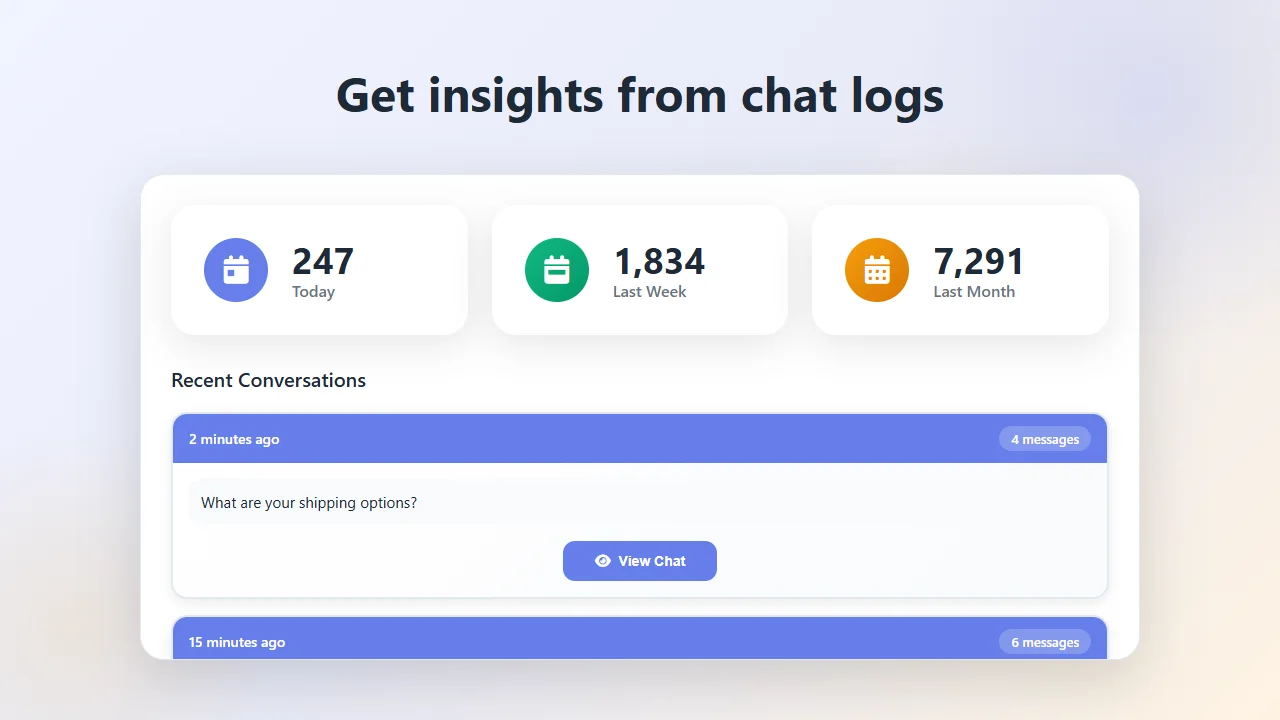
There's an underappreciated benefit to managing AI chat for clients: you see what their visitors actually want. Conversation logs reveal the questions real people ask — questions that don't show up in Google Analytics, that clients forget to mention during onboarding calls, that no survey would uncover. A law firm's bot reveals that 40% of visitors ask about free consultations — which tells the agency something valuable about that firm's website messaging. An ecommerce client's bot shows that visitors frequently ask about a product category the store doesn't carry — which is market intelligence the client would pay for independently. As an agency, you're sitting on a gold mine of first-party visitor intent data for every client you manage. That data informs your other services — content strategy, SEO, ad targeting, product recommendations — and creates opportunities to upsell work that you can now justify with evidence. The white label AI chat isn't just a revenue line. It's a discovery engine for everything else you sell.
Starting a white label AI chat service requires no upfront investment beyond the Asyntai subscription. There's no custom development. No SDK to integrate. No API authentication to configure. No servers to provision. No models to fine-tune. You sign up, configure the branding, deploy the widget, and charge your clients. The entire technical infrastructure — AI inference, knowledge base indexing, multilingual support, widget rendering, conversation storage — is handled by the platform. Your role is client acquisition, relationship management, and initial configuration. Those are the activities that agencies are already good at. The technology just works. That's the value proposition of white labeling: you get the outcomes of building an AI product without the cost, complexity, or timeline of actually building one. Your clients get an AI chat experience that looks and feels proprietary. And you get a recurring revenue stream with margins that would make a SaaS founder envious.