Sell AI agents that take real action — not just another chatbot
White-label AI agents that check orders, book appointments, and pull live data from your clients' systems. Deploy under your brand. Bill monthly. Keep every dollar of margin.
Watch an AI agent handle a real visitor question
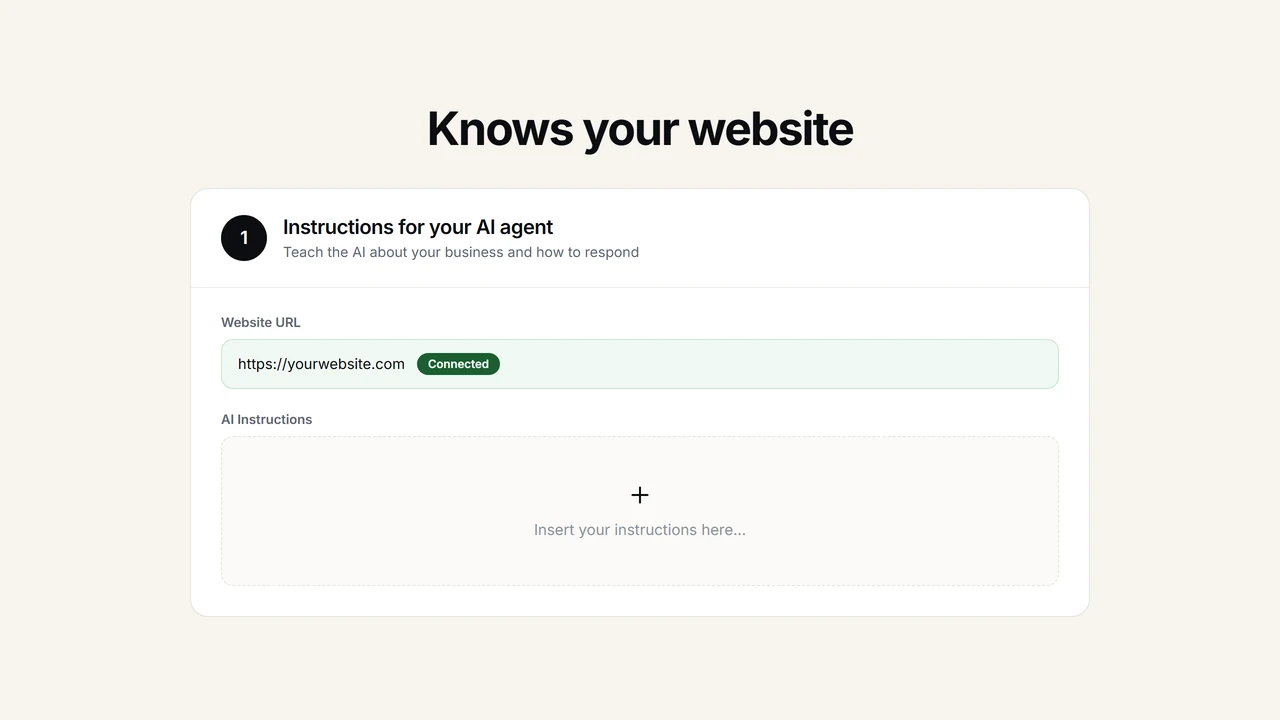
Enter any website URL and see the AI build a knowledge base from the content, then answer visitor questions using that information. Now imagine adding Custom Tools so it can also check orders, pull inventory, or schedule appointments — all under your brand.
AI agents command higher prices because they replace workflows, not just answer questions
A chatbot that answers visitor questions is useful. An AI agent that checks order status, looks up appointment availability, verifies insurance coverage, and processes return requests is indispensable. That is the difference Custom Tools create. Available on Standard ($139/month) and Pro ($449/month) plans, Custom Tools let the AI call your client's own API endpoints during a live conversation — pulling real data and performing real actions, not reciting static FAQ answers. When a visitor asks "where is my order," the agent calls the client's order management system and returns the tracking number in real time. When someone asks "do you have the blue version in stock," the agent checks live inventory and gives a definitive answer. This is not a scripted decision tree or a rule-based bot. It is an AI agent that reasons about the question, decides which tool to call, passes the right parameters, interprets the response, and delivers a natural-language answer — all within seconds. For resellers, the practical consequence is pricing power. You can charge $200-$400 per month for an AI agent that replaces a support workflow, compared to $100-$150 for a chatbot that only answers questions. The agent does more, so the client pays more, and your margin grows proportionally.
- Custom Tools turn a chatbot into an agent that performs actionsEach tool is a connection to one of your client's API endpoints. The AI decides when to call it, what parameters to send, and how to present the result. You configure the tool once — endpoint URL, parameters, authentication — and the agent uses it whenever a visitor's question requires that data. No coding on your part, no AI expertise needed.
- Agents justify premium pricing because they replace staff tasksA chatbot saves a business time by answering common questions. An AI agent saves a business money by handling tasks that previously required a person — checking order status, looking up account details, scheduling appointments, verifying coverage. When you sell an agent that replaces a workflow, the ROI conversation shifts from "nice to have" to "this pays for itself." That shift supports monthly fees of $200, $300, or more.
- Each client gets independent tools — no cross-contaminationThe ecommerce client's order-lookup tool does not appear in the dental clinic's chatbot. Each website under your account has its own set of Custom Tools, its own knowledge base, its own AI instructions, and its own conversation history. Full isolation means you can serve wildly different industries from a single dashboard without any risk of data or functionality bleeding between clients.
Real actions across every industry your clients operate in
Custom Tools are not limited to a predefined list of integrations. Any system your client uses that exposes an API — whether it is a REST endpoint, a webhook, or a third-party service — can become a tool the AI agent calls during conversation. This means the range of actions is as broad as your clients' tech stacks. An ecommerce store's agent checks order status, finds tracking numbers, initiates returns, and looks up product availability. A medical clinic's agent checks appointment openings, collects patient intake information, and confirms insurance providers. A property management company's agent pulls lease details, submits maintenance requests, and checks payment history. A car rental company's agent searches available vehicles by date and location, quotes rates, and starts the booking process. Each of these actions happens live, in the chat, without the visitor needing to navigate to a different page, call a phone number, or wait for an email response. The agent handles it in seconds. You configure the tools once per client, and the AI figures out when and how to use them based on what the visitor asks.
- Order and shipment lookups for ecommerce clientsConnect the agent to your client's order management system. Visitors type their order number or email, and the agent returns order status, tracking information, estimated delivery dates, and item details — all in natural language, in the chat window. No portal login, no hold music, no email wait.
- Appointment scheduling for service businessesThe agent checks real availability from the client's calendar or booking system, presents open slots, and collects the visitor's details to confirm the appointment. Dental offices, salons, repair shops, consultants — any business that books time benefits from an agent that schedules while the visitor is still on the site.
- Account and policy lookups for professional servicesInsurance agencies, property managers, financial advisors — businesses where customers frequently ask about their account status. The agent verifies identity, queries the relevant system, and provides the answer: policy coverage, payment history, document status, renewal dates. Sensitive data stays protected because the tool endpoints enforce the same authentication your client already uses.
- Inventory and pricing checks for retail and wholesaleA visitor asks whether a product is in stock, what sizes are available, or what the bulk pricing is. The agent calls the client's inventory API and returns a live answer — not a cached page from last week, but the actual current count. This converts browsers into buyers by removing the uncertainty that makes people leave.
- Return and refund processing for customer serviceInstead of directing the visitor to a form or an email address, the agent collects the order details, checks eligibility against the client's return policy via an API call, and initiates the process — generating a return label, confirming the refund timeline, or escalating edge cases to a human. The visitor gets resolution in the same conversation where they raised the issue.
Deploy your first AI agent to a client in under an hour
No machine learning background needed. No API development. You configure the agent, connect the tools, and embed it — the AI handles the rest.
- Subscribe to the Pro plan at asyntai.com/pricing — $449/month gets you white-label branding, 20 client sites, 50,000 messages, and Custom Tools on every site.
- Add your client's website domain in the dashboard. Set your brand name, logo, and colors on the chat widget. The AI crawls the client's site and builds a knowledge base from their content automatically.
- Configure Custom Tools for the client — add their API endpoints (order lookup, appointment check, inventory query, or whatever their business needs). Define the parameters and the AI learns when to call each tool.
- Copy the one-line embed script, paste it into the client's site, and the AI agent goes live — answering questions from content and performing real actions via Custom Tools, all under your brand.
<!-- Custom Tools: order lookup, scheduling, inventory -->
<script src="https://asyntai.com/widget.js"
data-id="client-site-id" async>
</script>
# One script tag. Full AI agent. White-labeled.
# The agent answers questions AND takes actions.
How reselling works
From signing up to billing your first client — four simple steps.
Choose a plan
Subscribe to a plan that fits how many client websites you need. Pro is the most popular for resellers — white-label plus up to 20 websites.
View plans →Add a client website
Each website you add under your account is one client's chatbot. Add up to the number your plan allows.
Go to your dashboard →Set up the chatbot
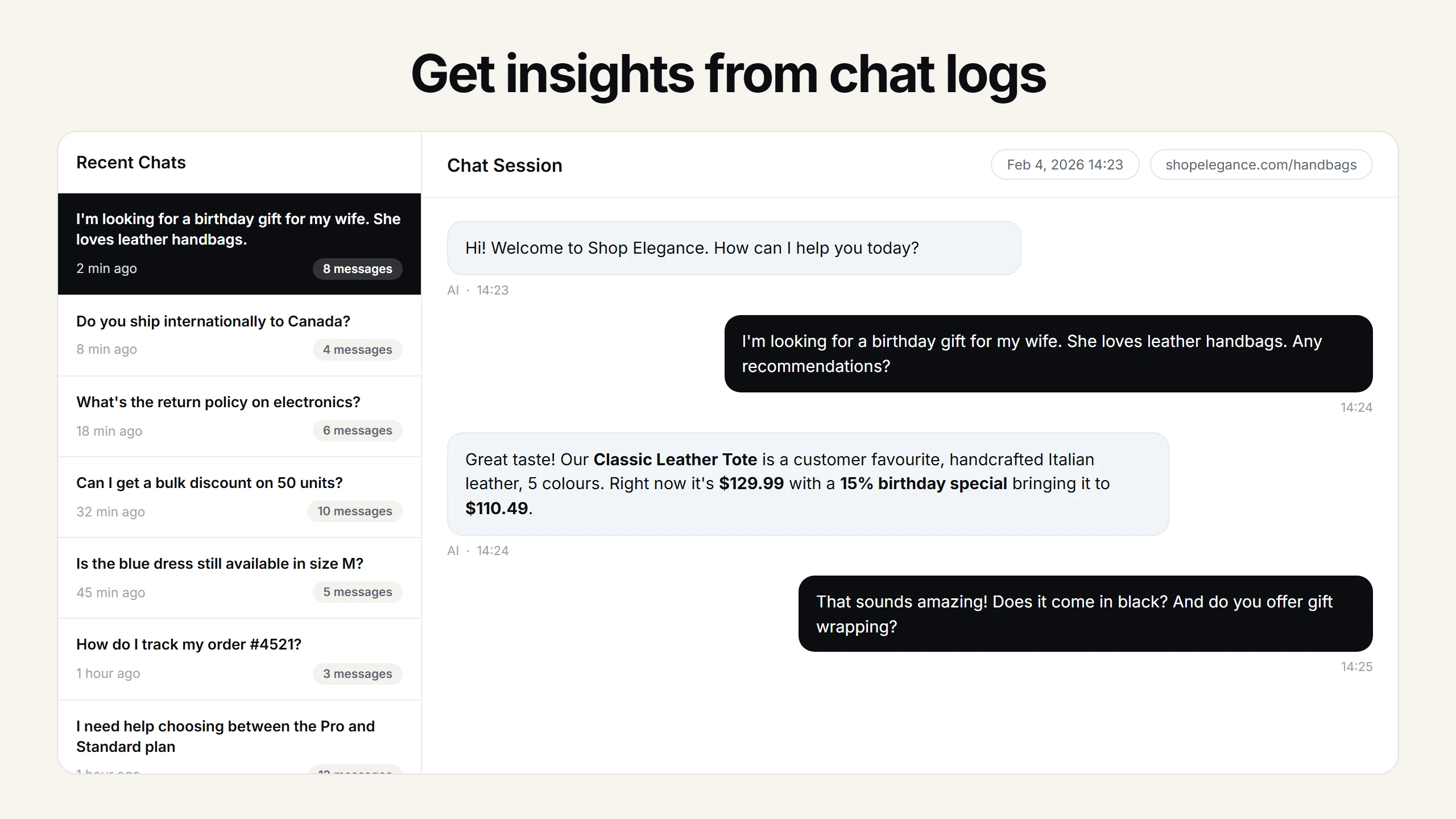
Add the client's content, customize the widget to their brand, and install it on their site. You can also give the client read-only access to their chat logs, analytics and leads on your own website.
Setup guide →Resell at your price
Charge your client whatever you like. You own the relationship and bill them directly — the margin is yours, every month.
Reseller Resources
Everything you need to get started, answer client questions, and see the dashboard in action
Reseller Guide
Step-by-step walkthrough: white-label branding, the embeddable client dashboard, and how to get your first client live.
Read the guideReseller FAQ
Pricing, margins, billing, white-label details, platform compatibility, and everything else partners ask before starting.
View FAQClient Dashboard Demo
See the embeddable white-label dashboard with sample data — conversations, analytics, and leads under your brand.
See the demoSelling AI agents — frequently asked questions
Common questions from agencies and entrepreneurs evaluating AI agents as a resellable service for their clients.
What is the difference between a chatbot and an AI agent?
A chatbot answers questions using information from a knowledge base — website content, uploaded documents, FAQs. An AI agent does everything a chatbot does, plus it takes actions. With Custom Tools, the agent can call your client's API endpoints during a conversation to check order status, look up appointment availability, verify account details, query inventory, process returns, and more. The agent decides when to use a tool based on what the visitor asks, calls the endpoint, and delivers the result in natural language. It is the difference between telling a visitor "check our returns page" and actually processing their return in the chat.
How do Custom Tools work technically?
Each Custom Tool is a connection to an API endpoint. You configure it in the dashboard by specifying the endpoint URL, HTTP method, parameters, headers, and authentication. When a visitor asks a question that requires live data — like "where is my order" — the AI recognizes the intent, calls the appropriate tool with the right parameters (e.g., order number), receives the API response, and translates it into a conversational answer. You do not write code. You fill in the configuration fields, and the AI handles the logic of when and how to call the tool. Full documentation is available in the Custom Tools guide.
Which plans include Custom Tools?
Custom Tools are available on Standard ($139/month, 3 sites, 15,000 messages) and Pro ($449/month, 20 sites, 50,000 messages) plans. For resellers, the Pro plan is the standard choice because it includes white-label branding removal, support for up to 20 client sites, and Custom Tools on every site. The Starter plan ($39/month) does not include Custom Tools.
Can every client site have different tools configured?
Yes. Each website under your account has its own independent set of Custom Tools, its own knowledge base, its own AI instructions, and its own conversation history. The ecommerce client's order-lookup tool exists only on that client's site. The dental clinic has its own appointment-check tool. There is no overlap and no risk of one client's data or functionality appearing in another client's chatbot.
What kind of APIs can the agent connect to?
Any system that exposes a REST API, webhook, or HTTP endpoint. This includes ecommerce platforms (order status, inventory), booking systems (appointment availability), CRMs (customer records), ERPs (pricing, stock levels), payment processors (invoice status), helpdesk tools (ticket creation), and custom internal systems. If your client's system can receive an HTTP request and return data, the AI agent can use it as a Custom Tool.
How much can I charge for an AI agent versus a basic chatbot?
Agents that take actions command higher prices because they replace manual workflows. A chatbot that answers FAQs might sell for $100-$150 per month. An AI agent that checks orders, schedules appointments, or processes returns typically sells for $200-$400 per month because the ROI is clearer — the client can point to specific staff hours saved or support tickets eliminated. On a Pro plan at $449/month covering up to 20 clients, even at $200 per agent, three clients cover your subscription and every client after that is nearly pure margin.
Do I need to build the client's API for Custom Tools to work?
No. Custom Tools connect to APIs that already exist. Most businesses that benefit from AI agents already have systems with API access — their ecommerce platform has an order API, their booking software has a scheduling API, their CRM has a customer lookup endpoint. You connect the agent to what is already there. If a client does not have an API, many modern platforms (Shopify, Square, Calendly, HubSpot, and others) provide API access out of the box. You are configuring connections, not building software.
Can I start with basic chatbots and add Custom Tools later?
Absolutely. Many resellers begin by selling AI chatbots that answer questions from website content — no Custom Tools involved. Once the client sees value, you upsell the agent capability: "Your chatbot is handling 500 conversations a month. Want it to also check order status and schedule appointments? That is the next tier." This staged approach lets you land clients quickly with a simpler pitch and expand revenue per client over time. Custom Tools are added per-site without affecting the chatbot's existing knowledge base or conversation history.
The complete guide to selling AI agents as a business
The market for AI agents is growing faster than the market for chatbots because agents solve a fundamentally different problem. A chatbot deflects questions. An agent handles tasks. When a customer asks "where is my order" and the chatbot replies with a link to the tracking page, that is deflection — useful, but the customer still has to navigate somewhere else to get their answer. When an AI agent receives the same question, calls the order management API, retrieves the tracking number and delivery estimate, and presents it right there in the chat, that is resolution. The customer's problem is solved in the same window where they raised it. Businesses will pay significantly more for resolution than deflection because resolution replaces a support ticket, a phone call, or a staff member's time. Deflection just redirects the workload. If you want to sell AI agents to businesses, the pitch writes itself: this replaces a workflow your team currently handles manually, and it does it around the clock without a salary.
Custom Tools are the mechanism that transforms a chatbot into an AI agent, and understanding how they work is essential for selling them confidently. Each Custom Tool is a configured API endpoint — a URL the AI can call when a visitor's question requires live data or an action. You set up the tool in the dashboard: the endpoint URL, the HTTP method, the parameters the AI should send, and any authentication headers. The AI then learns what each tool does from a description you provide — "checks order status given an order number" or "returns available appointment slots for a given date." When a visitor asks a relevant question, the AI reasons about which tool to use, constructs the request, calls the endpoint, reads the response, and translates it into a natural-language answer. You do not write logic, decision trees, or conversation flows. The AI handles the reasoning. You handle the connection. The full configuration process is documented in the Custom Tools guide, and most tools take five to ten minutes to set up once you have the client's API credentials.
The economics of selling AI agents differ from selling chatbots in one critical way: the price ceiling is higher. A basic AI chatbot that answers visitor questions using website content is a commodity — valuable, but difficult to charge more than $100-$150 per month because the client perceives it as an FAQ tool. An AI agent that checks orders, schedules appointments, verifies insurance, or processes returns is a workflow replacement. The client can measure the ROI directly: how many support tickets did the agent handle, how many phone calls did it eliminate, how many hours of staff time did it save. That measurability supports monthly pricing of $250, $350, even $500 for high-volume clients. On a Pro plan at $449/month covering up to 20 client sites, the math becomes compelling quickly. Five clients at $300 each generates $1,500 in monthly revenue against $449 in cost — a 70% gross margin. Ten clients at $300 each brings in $3,000, and fifteen clients at $300 pushes past $4,000 in monthly revenue. The subscription stays flat at $449 regardless of how many of those 20 slots you fill.
The types of businesses that benefit most from AI agents are those with high-frequency, repetitive interactions that currently require a human to look something up. Ecommerce is the most obvious: every online store gets "where is my order" questions daily, and the answer always requires looking up an order ID in a system. An AI agent connected to the store's order API resolves that in seconds. But the opportunity extends far beyond ecommerce. Medical and dental clinics field constant calls about appointment availability — an agent connected to the scheduling system can check openings and collect patient details. Property management companies handle maintenance requests, lease questions, and payment inquiries — an agent can pull tenant records, submit work orders, and confirm payment status. Insurance agencies get questions about coverage, claims status, and policy details — an agent connected to the policy management system provides instant answers. Auto repair shops, law firms, accounting practices, fitness studios, educational institutions — any business where customers ask questions that require looking something up in a system is a candidate for an AI agent, not just a chatbot.
Selling AI agents rather than chatbots changes the sales conversation in your favor. When you sell a chatbot, you are selling convenience — "your website visitors will get instant answers to common questions." That is true, but it is a soft value proposition. Some business owners respond with "my FAQ page already does that." When you sell an AI agent, you are selling labor replacement — "this agent will handle order status inquiries that currently take your team 3-5 minutes each, and it will do it 24 hours a day." That is concrete. The business owner can calculate: 30 order status inquiries per day times 4 minutes each is 2 hours of daily staff time. At $20/hour, that is $1,200 per month in labor. An AI agent at $300/month saves $900 per month from day one. You do not need to convince them that AI is impressive or that chatbots are the future. You show them the math on their own workload, and the agent sells itself.
White-labeling is what makes selling AI agents a viable business model rather than a one-time referral. On the Pro plan, all platform branding is removed from the chat widget. Your name goes in the header. Your logo loads in the widget. Your colors define the visual identity. When a visitor on your client's website interacts with the AI agent, they see your brand — or the client's brand, if you configure it that way. The embeddable client dashboard extends this further: three tabs (Conversations, Analytics, Leads with CSV export) embedded on your own website via a JS snippet, carrying your logo, brand name, and primary color. Your client logs into your site, reviews their agent's performance, exports lead data, and never sees the underlying platform. This is what separates a reseller from an affiliate. Affiliates refer customers and earn a commission. Resellers own the relationship, set the price, and build a brand around the service. The margin difference is substantial — an affiliate earns 20% recurring commission, while a reseller keeps 100% of the gap between their subscription and their client revenue.
The onboarding process for a new AI agent client follows a repeatable pattern that takes about thirty to forty-five minutes per client — slightly longer than a basic chatbot because of the Custom Tools configuration. First, you add the client's domain in your dashboard and set up the widget branding with your agency identity. The AI automatically crawls the client's website and builds a knowledge base from their content — pages, products, services, FAQs, blog posts, contact information. This takes minutes to hours depending on site size, and happens in the background. Second, you configure the Custom Tools specific to that client's business. For an ecommerce client, you add their order lookup API. For a clinic, you add their appointment availability endpoint. For a property manager, you add their maintenance request submission URL. Each tool is a form you fill out: endpoint, method, parameters, auth headers, description. Third, you customize the AI's instructions — tone, escalation rules, what topics to handle versus redirect to a human. Fourth, you copy the embed script and paste it on the client's site. The agent goes live, answering questions from the knowledge base and performing actions through Custom Tools, branded entirely as your product.
Scaling from one AI agent client to twenty follows the same dynamics as scaling any white-label software business, with one added advantage: the stickiness of Custom Tools. A basic chatbot is easy for a client to switch away from because any chatbot can read their website. An AI agent with configured Custom Tools is deeply integrated into the client's operational systems — the order API, the booking endpoint, the CRM lookup. Switching means reconfiguring all of those connections with a new provider, rewriting tool descriptions, testing edge cases, and accepting downtime during the transition. That integration is a natural moat. It does not lock the client in through a contract — it locks them in through operational dependency. For you as a reseller, this means lower churn rates and more predictable monthly revenue. A client who has been using an AI agent with three Custom Tools for six months is far less likely to cancel than a client with a basic FAQ chatbot. The deeper the integration, the stickier the relationship, and the more secure your recurring revenue.
Language support adds another dimension to the AI agent's value that many resellers overlook. The AI supports 36 languages and auto-detects the visitor's language, responding naturally in whatever language the question arrives in. This applies to Custom Tools responses too — the agent calls the same API endpoint regardless of language, receives the same data, and translates the response into the visitor's language. A Spanish-speaking customer asking about their order status gets a Spanish answer with the same tracking data an English speaker would receive. For resellers targeting businesses with multilingual customer bases — clinics in diverse neighborhoods, ecommerce stores with international shipping, hotels serving global travelers — the agent handles all 36 languages without additional configuration or cost per language. That is a selling point worth mentioning in every pitch because multilingual support is expensive to staff but free with the agent.
The question of whether to start with chatbots and upsell to agents, or lead with agents from day one, depends on your market. If you are targeting small businesses that have never used AI — a local bakery, a single-location gym, a neighborhood law office — starting with a chatbot is easier. The pitch is simpler ("answers your website visitors' questions instantly"), the setup is faster (no Custom Tools to configure), and the price point is lower ($100-$150/month is an easy yes for most small businesses). Once the client sees value in the chatbot — conversations happening, leads being captured, common questions being handled — you upsell the agent tier: "Your chatbot handled 400 conversations last month. Ready for it to also check appointment availability and take booking requests?" That staged approach works well and increases your revenue per client over time. If you are targeting mid-market businesses that already use multiple software systems — an ecommerce brand doing $500K+ in annual revenue, a clinic with 5+ providers, a property management firm with 50+ units — lead with the agent. These businesses have the APIs, the volume, and the operational pain points that make the agent's ROI immediately obvious.
Pricing your AI agent service is one of the most important decisions you will make as a reseller, and the answer depends on the depth of integration. A basic chatbot with no Custom Tools — just knowledge base Q&A — supports pricing of $99-$150/month. An agent with one or two Custom Tools (order lookup plus returns, or appointment check plus intake form) supports $200-$300/month. A fully integrated agent with three or more Custom Tools, refined AI instructions, and periodic optimization by you supports $350-$500/month. At the high end, some resellers offer a "managed AI agent" package that includes monthly performance reviews, tool adjustments, and knowledge base updates for $500-$750/month. On a Pro plan at $449/month, even at the lower agent pricing of $200/month, three clients cover your cost and the remaining seventeen are margin. At $300/month with ten clients, you collect $3,000 against $449 — an 85% gross margin. Agencies that exceed 20 clients can move to a Custom Pro plan with higher site and message limits.
The competitive landscape for selling AI agents favors resellers who move early. Most businesses have not yet deployed an AI agent — they may have a basic chatbot, or more likely, nothing at all. The window to become the go-to AI agent provider in your market or your vertical is open now. Every month you wait, another agency discovers the same opportunity and starts pitching the same businesses. The first reseller to deploy an agent for a local dental clinic, a regional ecommerce brand, or a property management company in a given market establishes the relationship and benefits from the switching cost described earlier. Being second means competing against an entrenched incumbent whose agent is already integrated into the client's systems. The operational advantage of Asyntai for getting started quickly is that there is no development, no ML engineering, no infrastructure to manage. You subscribe to the Pro plan, add a client's site, configure Custom Tools, and deploy — all in under an hour. The barrier to entry is your subscription and your willingness to pick up the phone or send the email to your first prospect.
For resellers who want to combine active selling with passive income, the affiliate program runs alongside the reseller model without conflict. The affiliate program pays a 20% recurring commission on every customer referred through your tracking link. If someone you refer signs up for the Pro plan at $449/month, you earn $89.80 every month for up to 12 months — without managing their setup or support. Some resellers use a hybrid approach: white-label AI agents for clients they manage directly (higher margin, full control, $200-$400/month per client) and affiliate referrals for businesses they encounter but do not want to support (passive recurring commissions with zero ongoing work). The two revenue streams complement each other and provide different risk profiles — the reseller income is higher per client but requires setup time, while the affiliate income is lower per referral but requires nothing after the initial introduction. For questions about reselling AI agents, Custom Tools configuration, or your specific use case, reach out at [email protected] — we respond within 24 hours.