Recurring revenue for agencies: deploy AI chatbots once, bill clients every month
Turn a single afternoon of setup into monthly income that compounds. White-label AI chatbots give your agency a service line that renews automatically — no re-pitching, no project handoffs.
See the product your clients will pay for — every month
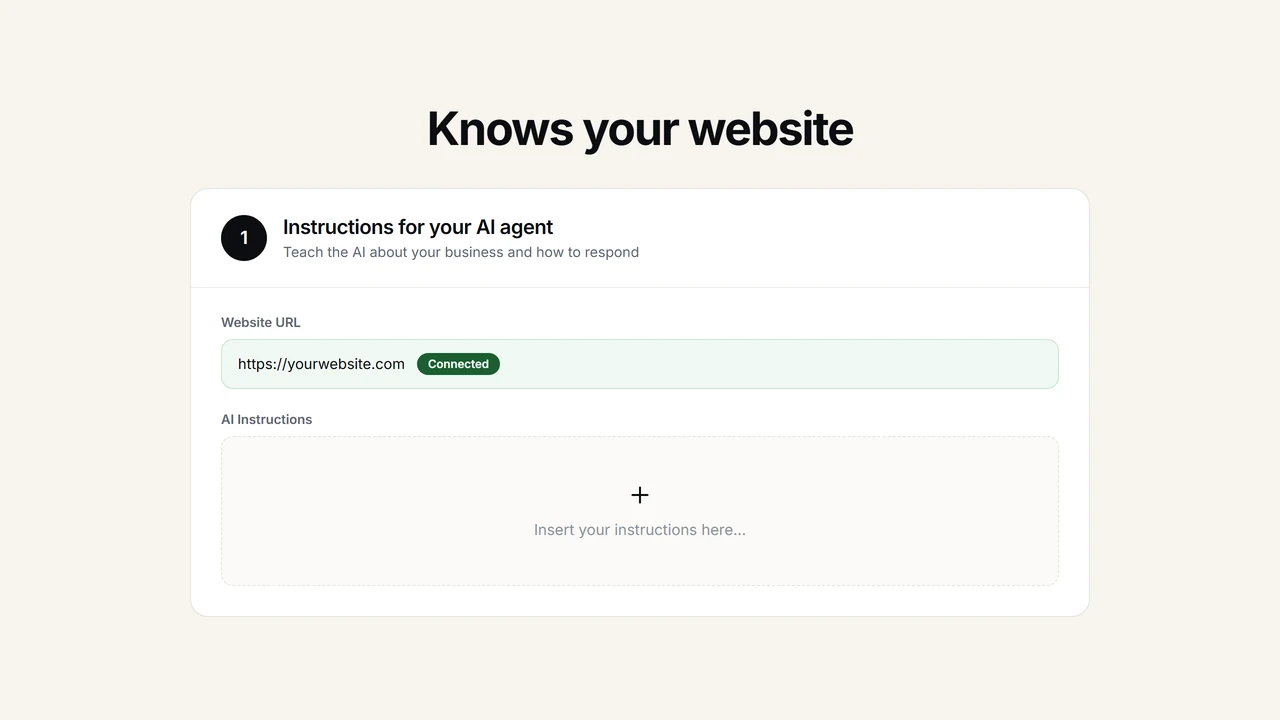
Paste any website URL. The AI reads the content and builds a working chatbot in seconds. This is the service that generates recurring revenue for your agency.
Project fees end — monthly subscriptions keep paying
Most agency revenue disappears the moment a project wraps. You deliver the website, the brand identity, or the campaign — the client pays, and then the cash flow stops until you sell something new. Recurring revenue inverts that pattern. An AI chatbot deployed on a client's website bills every month because it delivers ongoing value: answering visitor questions, capturing leads, and operating around the clock using the client's own content. The Pro plan at $449/month covers up to 20 client websites with full white-label branding, letting you charge each client separately and keep the entire margin. For agencies starting with a smaller book, the Standard plan at $139/month handles 3 sites with 15,000 messages. You can email [email protected] to request manual white-label activation on Standard.
- Revenue that survives between projectsWebsite redesigns pay once. SEO audits pay once. A chatbot subscription bills monthly because it answers questions, captures leads, and supports visitors continuously. Your agency earns whether you are actively working on that client's account or not. The income accumulates alongside your project work instead of replacing it.
- Twenty minutes of setup, months of incomeAdd the client's URL, configure the widget to match their brand, and paste a one-line script on their site. That is the entire deployment. From that point forward, you bill monthly for a service that runs itself. No maintenance, no content updates, no technical support tickets — the AI stays current by re-reading the client's website automatically.
- Margins that improve the more clients you addYour subscription cost is fixed. Your revenue grows with every client you onboard. The first three clients cover the Pro plan cost. Client four through twenty is almost pure margin. By the time you fill half your capacity, you are earning more from chatbot subscriptions than many agencies earn from their largest retainer.
Fixed cost, scaling revenue — your margin improves with every deployment
The compounding economics of AI chatbot reselling work because your cost does not rise as you add clients. One Pro subscription at $449/month covers 20 websites and 50,000 shared messages. Whether you fill five slots or all twenty, the subscription stays the same. Agencies growing past 20 clients move to a Custom Pro plan with higher limits tailored to their scale.
- Month 1 — 3 clients at $200 each: $151/month marginYou onboard three existing clients in a single afternoon. Revenue: $600/month against $449 in cost. You are already profitable from day one, and you have 17 empty slots still generating zero cost. Every agency has three clients who would say yes to a working AI chatbot on their site.
- Month 3 — 7 clients at $250 each: $1,301/month marginAdding one or two clients per month is conservative. At seven clients, you collect $1,750/month with over $1,300 in margin. That is $15,600 in annual recurring profit from a service line that did not exist three months ago. None of it required a pitch deck, a project timeline, or a single revision cycle.
- Month 6 — 14 clients at $275 each: $3,401/month marginFilling 70% of your capacity at a moderate price point generates $3,850/month in revenue. Annual margin exceeds $40,000. At this stage, your chatbot service line is likely your most profitable offering per hour of effort invested — and you still have six empty slots generating no additional cost.
- Month 12 — 20 clients at $300 each: $5,551/month marginFull capacity. $6,000/month in revenue, $5,551 in margin, $66,612 in annual recurring profit. The next step is the Custom Pro plan for higher limits. You never rebuild this revenue from scratch — it renews automatically because clients depend on the chatbot daily.
- 50,000 messages pooled, 36 languages includedMessages are shared across all client sites, absorbing the natural variation between high-traffic and low-traffic clients. Language detection is automatic — French, Japanese, Spanish, Arabic, and 32 others — so multilingual clients require no extra configuration or cost. Both features are included on the Pro plan at no extra charge.
First client live in 20 minutes — billing them by end of day
No APIs, no code, no ML knowledge. Sign up, add the client site, brand the widget, and paste one script tag. Start billing immediately.
- Pick your plan at asyntai.com/pricing — Pro ($449/month) gives you white-label branding and 20 sites. Standard ($139/month) covers 3 sites. Starter ($39/month) handles 2 sites for testing the model.
- Add your first client's domain in the dashboard. Set the widget to your agency brand — your name, your logo, your colors. On Pro, the original branding is completely removed.
- The AI automatically reads the client's website and builds a knowledge base from their content. Upload supplementary documents — PDFs, product catalogs, policy sheets — to fill any gaps.
- Copy the embed script and install it on the client's website. Works on WordPress, Shopify, Wix, Squarespace, Magento, and 30+ other platforms. The chatbot goes live immediately — send your first invoice.
<!-- Your brand. Your pricing. Your client relationship. -->
<script src="https://asyntai.com/widget.js"
data-id="client-site-id" async>
</script>
# One script tag. Works everywhere.
# Your agency delivers AI. The client sees your brand.
How reselling works
From signing up to billing your first client — four simple steps.
Choose a plan
Subscribe to a plan that fits how many client websites you need. Pro is the most popular for resellers — white-label plus up to 20 websites.
View plans →Add a client website
Each website you add under your account is one client's chatbot. Add up to the number your plan allows.
Go to your dashboard →Set up the chatbot
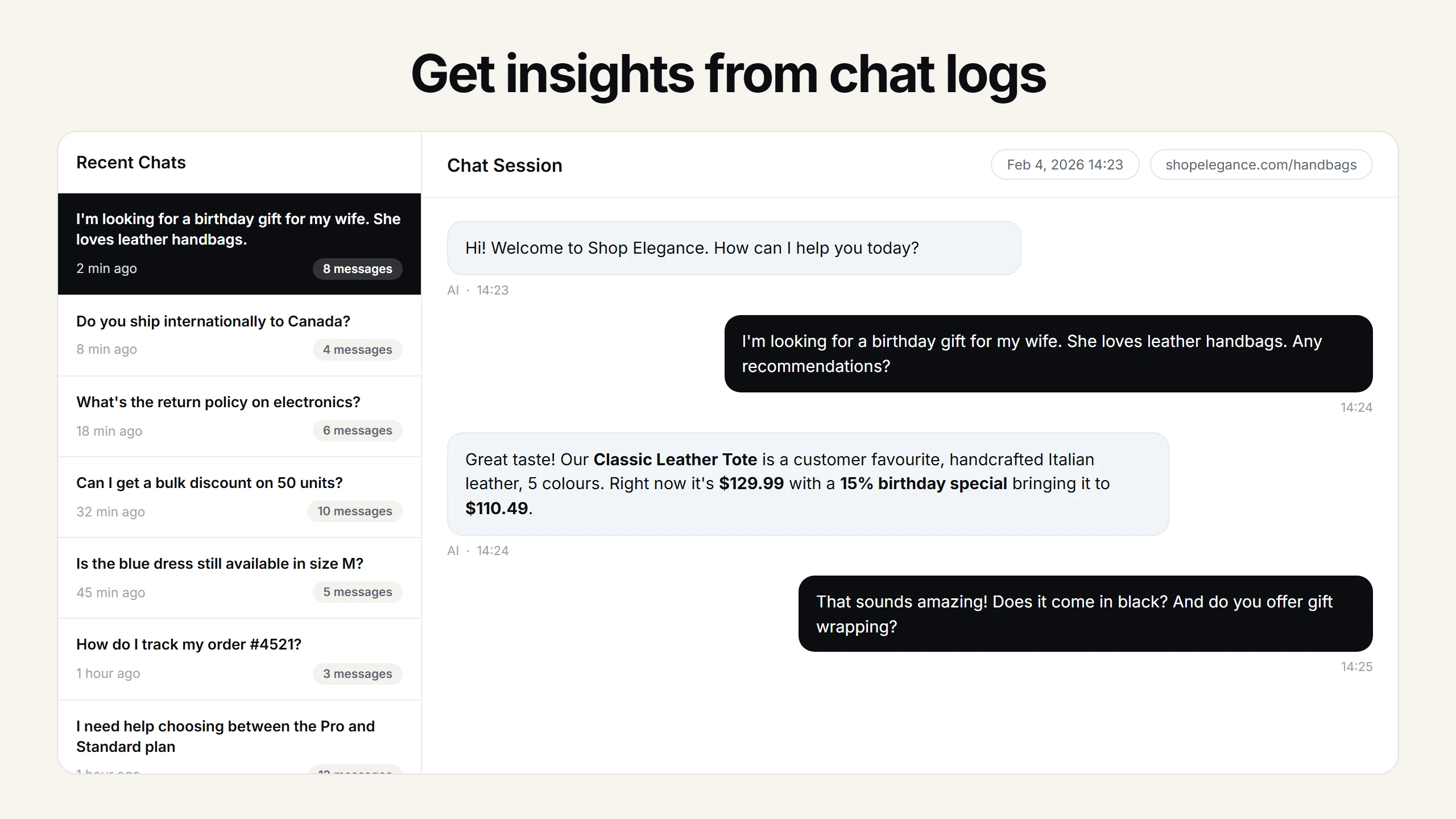
Add the client's content, customize the widget to their brand, and install it on their site. You can also give the client read-only access to their chat logs, analytics and leads on your own website.
Setup guide →Resell at your price
Charge your client whatever you like. You own the relationship and bill them directly — the margin is yours, every month.
Reseller Resources
Everything you need to get started, answer client questions, and see the dashboard in action
Reseller Guide
Step-by-step walkthrough: white-label branding, the embeddable client dashboard, and how to get your first client live.
Read the guideReseller FAQ
Pricing, margins, billing, white-label details, platform compatibility, and everything else partners ask before starting.
View FAQClient Dashboard Demo
See the embeddable white-label dashboard with sample data — conversations, analytics, and leads under your brand.
See the demoRecurring revenue for agencies — FAQs
Common questions from agencies exploring AI chatbot reselling as a recurring revenue stream.
How quickly can I start earning recurring revenue from this?
Most agencies deploy their first client chatbot within 20 minutes of signing up. You can bill that client immediately — the chatbot is live on their site and answering visitor questions from the moment the script is installed. If you onboard three existing clients in your first week, you are already generating recurring revenue by the end of that week. There is no development cycle, no waiting period, and no beta phase. The product works on day one.
What makes this revenue genuinely recurring — why would clients keep paying?
The chatbot becomes part of the client's daily operations. It answers visitor questions 24/7, captures leads with name and email, and handles inquiries in 36 languages automatically. Clients see the conversations happening in their dashboard. They export the leads. They watch the analytics. After three months, they have hundreds of captured leads and a full conversation history. The switching cost is high because the chatbot is actively doing work for them — removing it means going back to unanswered visitor questions and lost leads.
What are realistic margins on this service?
The Pro plan costs $449/month and covers 20 client sites. If you charge $250/month per client and fill 10 slots, your revenue is $2,500/month against $449 in cost — $2,051/month in margin, or about $24,600 annually. Your per-client cost is roughly $22. Most agencies charge between $150 and $400/month depending on the vertical and whether the chatbot is bundled with other services. You set the price, own the billing, and keep the full margin.
Is there a contract or minimum commitment?
No. All plans are month-to-month with no contracts, no setup fees, and no early termination penalties. You can upgrade, downgrade, or cancel at any time. The free tier gives you 1 site and 50 messages to test the product before committing. The Starter plan at $39/month with 2 sites and 800 messages is enough to pilot with one or two real clients. Most agencies that start a pilot convert to Pro within 60 days because the margins speak for themselves.
Do clients know I am reselling a product?
Not unless you tell them. On the Pro plan, all original branding is removed from the chat widget and client dashboard. Your agency name, logo, and brand colors replace it everywhere — the widget header, the chat interface, and the dashboard your clients access. Visitors interacting with the chatbot see your brand. Clients reviewing their conversations and leads see your brand. There is no way to trace it back to the underlying platform. Standard plan users can request manual white-label activation by emailing [email protected].
How does the chatbot know what to say about my client's business?
When you add a client's domain, the AI automatically reads their website — up to 50 pages — and builds a knowledge base from the content it finds. Product information, FAQs, pricing, policies, service descriptions, hours — all of it becomes available for the chatbot to reference in conversations. You can supplement the knowledge base with uploaded documents like PDFs, product catalogs, or internal guides. The AI re-reads the website periodically, so when the client updates their content, the chatbot's responses stay current.
Can I earn passive income from clients who want to manage their own chatbot?
Yes. For clients who prefer self-service and do not need your ongoing management, use your affiliate link to refer them. You earn a 20% recurring commission on their subscription for up to 12 months. A Pro plan referral generates $89.80/month in passive income. Many agencies use both models: reselling (high margin, full control, white-labeled) for managed clients and affiliate referrals (passive income, zero management) for self-service clients.
What happens when I need more than 20 client sites?
The Custom Pro plan extends your capacity beyond 20 sites and 50,000 messages. It is designed for agencies that have validated the recurring revenue model and are scaling. Contact [email protected] to discuss your volume and get a plan built around your growth trajectory. Your margins improve further at higher volumes because the per-site cost decreases.
Can I bundle the chatbot with my existing services?
Absolutely — and bundling is one of the most effective ways to increase recurring revenue from existing clients. Agencies commonly add AI chatbot service to website maintenance packages, SEO retainers, or digital marketing bundles. You can price the chatbot as a standalone add-on or fold it into a higher-tier package. Because the product is white-labeled, clients perceive it as part of your agency's offering, which strengthens the overall value proposition of your bundle and reduces churn across all your services.
Recurring revenue for agencies: the service line that pays you while you sleep
There is a number on every agency owner's mind that rarely gets discussed openly: the gap between this month's revenue and next month's certainty. Project-based billing creates a treadmill. You finish a website, deliver a campaign, hand over brand guidelines — the client pays, and the relationship goes quiet until they need something else. Between projects, there is nothing. No invoice going out, no payment coming in, just the overhead ticking and the pipeline needing to be refilled. It is a structurally exhausting way to run a business, and it is the reason most agencies plateau at a revenue ceiling they cannot seem to break through, no matter how good their work is or how many referrals they generate.
Recurring revenue does not just solve cash flow problems — it changes the fundamental nature of the business. When a portion of next month's revenue is already locked in before the month begins, everything downstream improves. Hiring decisions become less risky because you can forecast payroll further out. Investments in marketing or tools feel less like gambles because you know the baseline revenue they need to justify themselves. You stop saying yes to projects you should decline simply because you need the cash. The psychological weight of wondering whether next quarter will be lean enough to force a layoff — that weight lifts. Agencies with recurring revenue grow faster, survive downturns better, and sell for higher multiples when the owner eventually decides to exit. This is not theoretical. It is arithmetic.
The problem has always been finding a recurring service that is worth offering. Traditional retainer work — social media management, ongoing SEO, content marketing — generates recurring revenue, but it also demands recurring labor. You are selling hours, not leverage. Every new retainer client requires a proportional increase in the team managing the work. Margins stay flat or compress as you scale because the delivery model is fundamentally linear. What agencies need is a product-shaped service: something you deploy once, bill monthly, and maintain with minimal ongoing effort. An AI chatbot fits this description precisely. You add a client's domain, the AI reads their website content, you configure the widget, paste a script on their site, and the chatbot is live. Twenty minutes of setup. Monthly billing from that point forward. No hourly deliverables, no revision rounds, no weekly reports to compile.
The mechanics of how the chatbot generates client value are straightforward, which is important because recurring revenue only sticks if the client feels they are getting something for the money every month. The chatbot sits on the client's website and answers visitor questions using the business's own content — product details, service information, pricing, hours, policies, FAQs. It runs continuously, including at night and on weekends, which means visitors who arrive outside business hours still get accurate answers. It captures leads by collecting visitor contact information during conversations. And it supports 36 languages with automatic detection, so international visitors are served without any additional configuration. The client opens their dashboard each week, sees conversations happening, sees leads accumulating, and understands exactly what they are paying for. There is no abstraction to explain, no report to interpret, no meeting to justify the spend. The chatbot is visibly working.
What makes the margin structure so attractive for agencies is the fixed-cost, variable-revenue model. The Pro plan at $449/month covers 20 client websites and 50,000 shared messages. Your first client does not cover the subscription. Your second probably does not either. But by client three, you have broken even, and every client after that is almost entirely margin. At ten clients charging $250/month each, you collect $2,500 against $449 in cost — $2,051 in monthly margin. At fifteen clients, margin exceeds $3,300/month. At full capacity with twenty clients, you are looking at over $5,500/month in margin from a service that requires no ongoing labor to deliver. No other agency service line offers this ratio of margin to effort, because no other service line has a cost structure that stays flat while revenue scales.
The compounding effect is what separates this from a nice side income and turns it into a structural business advantage. Traditional project revenue is additive — you earn it once and move on. Recurring chatbot revenue is cumulative. Month one, you onboard three clients: $600 in revenue. Month two, you add two more: now $1,250. Month three, two more: $1,750. You are not starting from zero each month. You are building on the revenue that already exists. By month six, if you have been adding two clients per month, you have twelve clients generating $3,000/month without having to sell anything new that month. By month twelve, you are at or near capacity and earning over $5,000/month from a service that barely appears on your calendar. This compounding dynamic is the core financial argument for recurring revenue, and the chatbot model delivers it with unusually low friction because the deployment effort per client is so small.
White-label branding is not a feature checkbox — it is the mechanism that enables premium pricing and makes the recurring revenue sustainable. On the Pro plan, every trace of the underlying platform is removed. Your agency name, logo, and colors appear on the chat widget, the client dashboard, and every visible surface. The client perceives the chatbot as something your agency built and operates. This perception is what justifies charging $250 or $350/month for a product that costs you $22/client at full capacity. A generic chatbot with a third-party brand in the corner is worth $50/month to a client. A branded AI assistant that appears to be proprietary technology belonging to their trusted agency is worth five or six times that. The white-label removes the ceiling on your pricing power, and pricing power is what determines whether recurring revenue compounds into real money or stays a marginal line item.
Client retention — the engine of recurring revenue — is reinforced by the dashboard and the data it accumulates. Each client gets a white-labeled dashboard with Conversations, Analytics, and Leads tabs. It is embeddable on your agency's website, so clients access it within your ecosystem, under your brand. Every month the chatbot runs, more conversation history and lead data accumulate in that dashboard. After six months, a client has hundreds of captured leads, detailed analytics on visitor behavior, and a complete record of every question their website visitors asked. That data has real business value, and it exists only inside your dashboard. Removing the chatbot means losing access to that history. This is why churn rates on chatbot subscriptions are naturally low: the product gets stickier the longer it runs, because the accumulated data becomes increasingly difficult to replace.
Vertical specialization amplifies both the revenue potential and the retention rate. An agency that offers "AI chatbot for your website" competes on features and price. An agency that offers "AI receptionist for dental practices" or "24/7 AI concierge for property management companies" competes on expertise and fit. When you specialize in a vertical, you develop template AI instructions that work immediately for that industry. You know the common visitor questions before the client mentions them. You can set up a new client in ten minutes because you have already solved the configuration once. Your marketing becomes sharper, your close rate rises, and your perceived expertise supports a price premium. The chatbot you deploy to a dental practice is the same underlying product as the one on a plumbing company's website, but the positioning — the language, the setup, the packaging — is what allows one agency to charge $150/month and another to charge $400.
Custom Tools — available on Standard ($139/month) and Pro ($449/month) plans — create a natural upsell tier within your recurring revenue model. Without Custom Tools, the chatbot answers questions using the client's website content. With Custom Tools, the chatbot calls the client's own API endpoints during a conversation. A restaurant's bot checks reservation availability and books a table. A software company's bot looks up subscription status and processes a cancellation. An ecommerce client's bot tracks a shipment and initiates a return. Each integration is configured independently — you point the tool at an endpoint and define what data it sends and receives. For agencies, this creates a two-tier pricing structure: basic chatbot at $200/month, chatbot with live integrations at $350/month. The higher tier generates more margin per client and creates deeper entrenchment because the integrations are custom to each business.
Platform compatibility eliminates the objection that kills most reseller opportunities before they start: "it does not work on my client's website." The chatbot installs via a single JavaScript tag that works on any website capable of loading a script — which is all of them. Official plugins exist for WordPress and Shopify. The embed script is natively compatible with Wix, Squarespace, Webflow, Magento, WooCommerce, Joomla, Drupal, OpenCart, and over 30 other platforms. If a client has a website, the chatbot works on it. An agency with clients on five different website builders deploys the chatbot the same way on every single one. This universality means your addressable market is your entire client roster — there is no subset you have to exclude because of technical limitations.
The affiliate program adds a passive income layer alongside your managed reseller revenue. When you encounter a prospect who wants to own and manage their own chatbot without agency involvement, send them through your affiliate link. You earn a 20% recurring commission on their subscription for up to 12 months. A Pro plan referral generates $89.80/month. A Standard plan referral generates $27.80/month. This income requires zero setup, zero management, and zero ongoing effort from your agency. The two models — reselling at a margin and affiliating for passive commissions — complement each other and maximize revenue across different client types without creating conflicts.
The agencies that build the strongest recurring revenue streams are the ones that treat the chatbot as a standard part of their offering rather than an optional add-on. They include it in every proposal. They mention it in every client meeting. They deploy it on every website they build or manage. When AI is baked into your service stack rather than bolted on as an afterthought, adoption happens faster, revenue compounds sooner, and the service line reaches a scale where it meaningfully changes your agency's financial profile. The difference between $1,000/month in chatbot revenue and $5,000/month is not skill or luck — it is consistency. The agency that deploys to every client methodically outearns the agency that sells it selectively.
Timing matters in a market that is still forming. Right now, most small and mid-size businesses do not have an AI chatbot on their website. Their visitors leave unanswered questions behind. Their after-hours traffic converts at a fraction of the rate it could. They know AI is important but they have no idea how to implement it, and they are waiting for someone they trust — like their agency — to show them the path. The window where this demand exists without a saturated supply is open now. Every month you wait, a percentage of your clients will find a solution elsewhere, and once they have something in place, you have lost the recurring revenue opportunity permanently. The Pro plan is $449/month, month-to-month, no contract. If the margins do not work for your agency, cancel anytime. But the agencies that started building this revenue stream six months ago are not canceling — they are upgrading to the Custom Pro plan because they filled all twenty slots.
Ready to build recurring revenue that compounds? Start with the Pro plan and deploy your first client chatbot today — or email [email protected] if you have questions about scaling.