An automation platform that lets agencies deploy AI chatbots to every client site
Automate support, lead capture, and FAQ handling across all your clients from one account. White-label it under your brand and bill at your own price.
Watch automation in action on any website
Drop a client URL below. The AI reads their content and builds a working chatbot in seconds — handling questions, capturing leads, and deflecting support requests without a human in the loop
Replace repetitive human tasks with AI that works around the clock
An automation platform for agencies is not another dashboard to check or another tool to train staff on. It is the opposite — a system that removes manual work from your delivery model entirely. When you deploy an AI chatbot to a client's website, you are automating the tasks that normally require a human sitting behind a screen: answering the same five visitor questions, collecting contact details, qualifying leads, and responding outside of business hours. The chatbot reads your client's own website content and uses it to answer accurately, in the visitor's language, at any hour. For agencies managing multiple clients, this means each deployment compounds the total hours of labor you no longer need to provide. One subscription on the Pro plan covers up to 20 client sites for $449/month — the automation stacks, but the cost stays fixed.
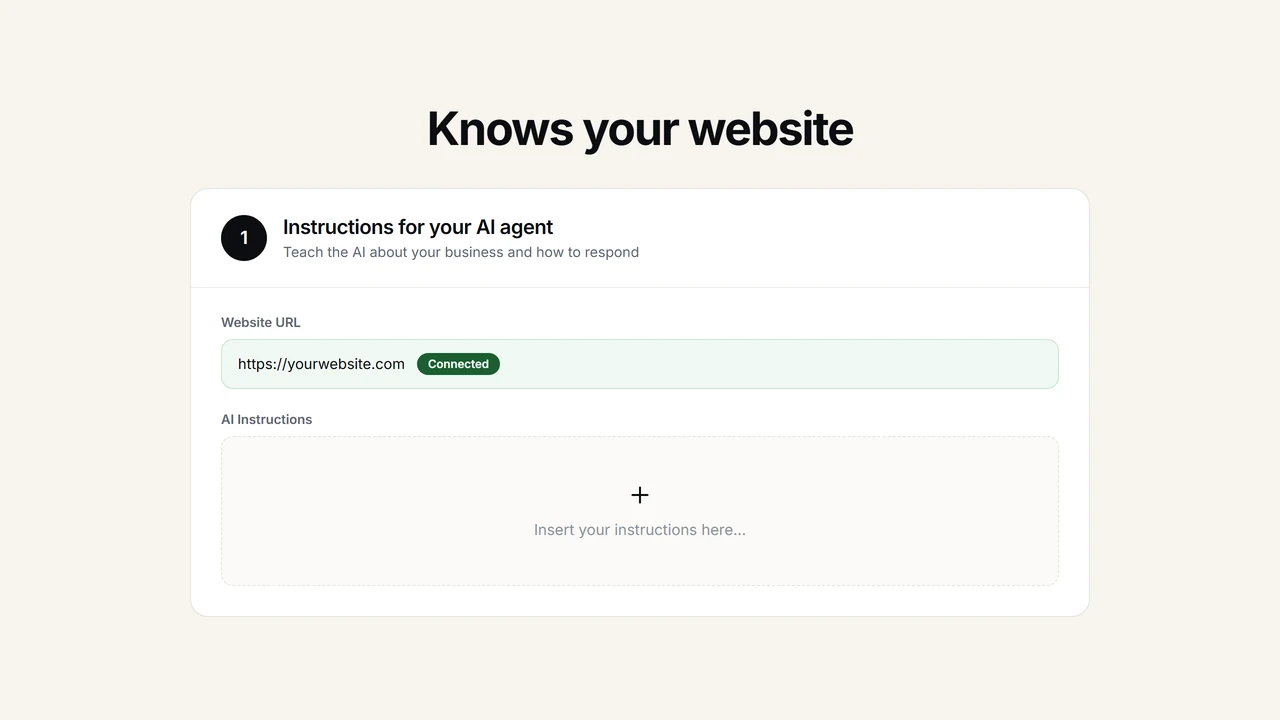
- Automate support without writing a single ruleTraditional chatbot automation relies on decision trees, keyword triggers, and manually mapped flows. This AI reads the client's actual website content and generates answers on its own — no rule-writing, no flow-mapping, and no maintenance when the client updates their site. The knowledge base refreshes automatically, so the automation stays current without anyone touching it.
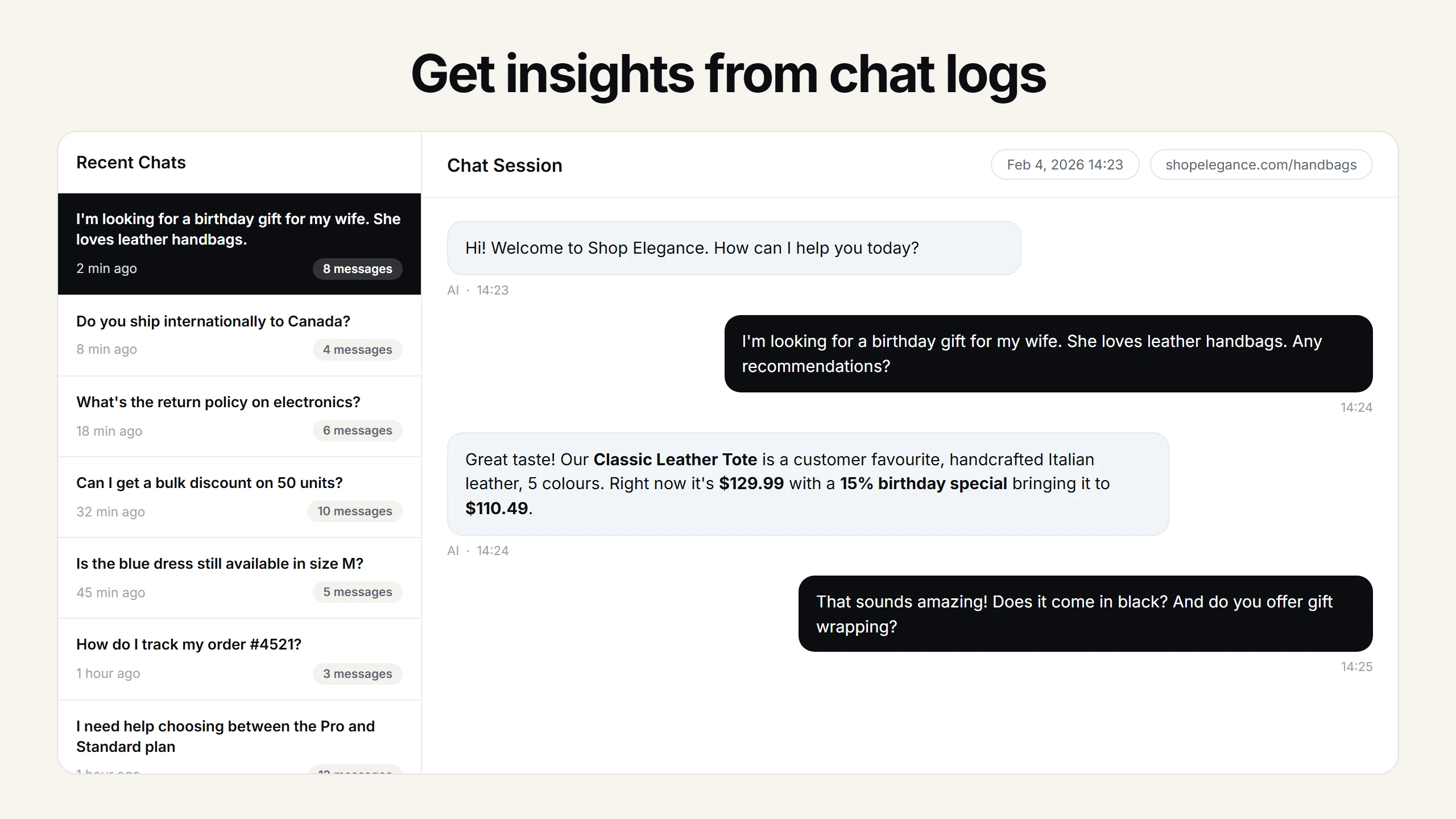
- Capture leads while humans are offlineMost website visitors arrive outside of working hours. Instead of losing them to an empty contact form, the AI engages them in conversation, answers their questions from the client's own content, and collects their name, email, and inquiry reason. All captured leads appear in the dashboard with full conversation transcripts and are exportable as CSV for import into any CRM.
- Scale to 20 clients without scaling your teamEach chatbot you deploy runs independently — separate knowledge base, separate branding, separate conversation history. Adding client number twelve takes the same twenty minutes as client number two. You do not need a bigger team to serve more clients because the automation handles the volume. Your team focuses on strategy and relationships; the chatbot handles the repetitive front-line work.
One account, 20 automated client sites, zero per-client overhead
Agencies evaluating automation platforms care about two things: does it actually reduce my workload, and does it scale without breaking my margin structure? The Pro plan at $449/month answers both. You manage up to 20 client sites from a single dashboard, each with its own isolated knowledge base and branded widget. The 50,000 monthly messages are pooled, so quiet clients balance out active ones naturally. White-label branding means every chatbot carries your agency's identity. Agencies growing past 20 sites can move to a Custom Pro plan with expanded limits.
- Each client site is fully isolatedEvery website you add gets its own knowledge base, its own widget configuration, its own conversation history, and its own AI instructions. A veterinary client's chatbot never crosses wires with an auto dealership's. You configure each one independently, and the AI uses only that client's content to generate responses.
- White-label removes all traces of the underlying platformOn the Pro plan, the chatbot carries your agency name, your logo, and your colors. The "Powered by" badge is removed completely. Each client also gets access to a white-labeled dashboard — embeddable on your own website — with Conversations, Analytics, and Leads tabs, all under your brand. Your client sees your platform, not ours.
- 50,000 messages shared across all sitesThe message pool spans your entire client portfolio. A boutique law firm might generate 150 conversations per month; a busy catering company might generate 1,200. The pooling model means you rarely have to think about per-client usage. Most agency portfolios of 15-20 small business clients sit well within the allocation.
- Custom Tools let the chatbot take actions, not just answer questionsAvailable on Standard and Pro plans, Custom Tools connect the AI to your client's own API endpoints. An ecommerce client's chatbot can check order status. A medical practice's bot can look up appointment availability. A property management client's bot can pull maintenance request status. The automation goes beyond answers — it performs tasks that normally require a logged-in human.
- 36 languages with automatic detectionThe AI detects the visitor's language and responds in kind. A French visitor gets French answers; a Japanese visitor gets Japanese. The content can be in any language. For agencies serving multilingual markets or international clients, this means one deployment handles every language without extra configuration.
Deploy your first automated client chatbot in 20 minutes
No coding required. No decision trees to build. Add the client site, let the AI learn their content, brand the widget, and paste one embed line.
- Sign up for the Pro plan at asyntai.com/pricing — $449/month covers 20 client sites, white-label branding, and 50,000 messages.
- Add your client's domain in the dashboard. The AI automatically crawls the website and builds a knowledge base from their pages, products, and content — no manual data entry required.
- Brand the widget with your agency name, logo, and colors. Set the AI instructions to match the client's tone and any specific handling rules they want (like redirecting billing questions to a phone number).
- Copy the one-line embed script and paste it on the client's site. The chatbot goes live immediately — answering visitor questions, capturing leads, and running 24/7 under your brand.
<!-- Handles support, captures leads, never clocks out -->
<script src="https://asyntai.com/widget.js"
data-id="client-site-id" async>
</script>
# One line. Full automation. Your brand on every surface.
# The chatbot handles the rest — you collect recurring revenue.
How reselling works
From signing up to billing your first client — four simple steps.
Choose a plan
Subscribe to a plan that fits how many client websites you need. Pro is the most popular for resellers — white-label plus up to 20 websites.
View plans →Add a client website
Each website you add under your account is one client's chatbot. Add up to the number your plan allows.
Go to your dashboard →Set up the chatbot
Add the client's content, customize the widget to their brand, and install it on their site. You can also give the client read-only access to their chat logs, analytics and leads on your own website.
Setup guide →Resell at your price
Charge your client whatever you like. You own the relationship and bill them directly — the margin is yours, every month.
Reseller Resources
Everything you need to get started, answer client questions, and see the dashboard in action
Reseller Guide
Step-by-step walkthrough: white-label branding, the embeddable client dashboard, and how to get your first client live.
Read the guideReseller FAQ
Pricing, margins, billing, white-label details, platform compatibility, and everything else partners ask before starting.
View FAQClient Dashboard Demo
See the embeddable white-label dashboard with sample data — conversations, analytics, and leads under your brand.
See the demoAutomation platform for agencies — FAQs
Common questions about deploying AI chatbot automation across client websites.
How is this different from a rules-based chatbot builder?
Rules-based chatbots require you to manually write every question-and-answer pair, build decision trees, and maintain keyword triggers. When a client updates their website, you have to go back and update the chatbot rules to match. This AI reads the client's actual website content and generates answers on its own — there are no rules to write, no flows to map, and no manual maintenance. The knowledge base updates automatically when the site content changes. The result is a chatbot that handles questions you never anticipated, because it understands the content rather than matching keywords.
What kinds of tasks can the chatbot automate?
Out of the box, the chatbot automates visitor Q&A (using the client's website content), lead capture (collecting name, email, and inquiry details through natural conversation), after-hours engagement (responding to visitors at any time), and FAQ deflection (answering common questions without human involvement). With Custom Tools on Standard and Pro plans, automation extends to action-based tasks: checking order status, looking up appointment availability, pulling account details, and any other task you can connect to a client's API endpoint. The AI handles the conversation flow and calls the appropriate tool when the visitor's request matches.
Do I need to write AI instructions for every client?
You can, but you do not have to. The AI works well out of the box by reading the client's website content and answering questions from it. AI instructions are optional — they let you fine-tune behavior, such as telling the chatbot to always recommend booking a consultation, or to redirect billing questions to a specific phone number. Once you have set up a few clients in the same industry, you develop instruction templates that make new setups faster. A dental office template, for example, can be reused across all your dental clients with minor adjustments.
How does lead capture work without forms?
The AI collects contact information through natural conversation rather than static forms. When a visitor asks a question that suggests buying intent — pricing inquiries, availability checks, service comparisons — the chatbot answers their question first and then asks for their name and email so someone can follow up with specifics. This conversational approach captures leads that traditional forms miss, because visitors who would never fill out a "Contact Us" form will readily share their email after getting a helpful answer. All leads appear in the dashboard with full transcripts and are exportable as CSV.
Can the chatbot handle multiple languages automatically?
Yes. The AI supports 36 languages and detects the visitor's language automatically. If a French-speaking visitor asks a question on an English-language website, they receive a French response generated from the English content. No configuration is needed — language detection and response generation happen automatically. For agencies serving multilingual markets or clients with international visitors, this eliminates the need for separate chatbot instances per language.
What does the client see — do they know it is Asyntai?
On the Pro plan, all Asyntai branding is removed from the chatbot widget. Your agency name, logo, and colors appear instead. Each client also gets access to a white-labeled dashboard — embeddable on your own website — with three tabs: Conversations (full transcripts), Analytics (usage trends), and Leads (captured contacts with CSV export). The dashboard displays your branding throughout. Your client experiences it as part of your platform, not a third-party tool.
What happens when the chatbot cannot answer a question?
When the AI encounters a question that falls outside the client's website content and uploaded documents, it acknowledges the limitation and offers to connect the visitor with a human or collect their contact information for follow-up. You can customize this fallback behavior through AI instructions — for example, directing the chatbot to suggest emailing a specific address, calling a phone number, or submitting a particular form. The chatbot never invents information; if the answer is not in the knowledge base, it says so and guides the visitor to the right next step.
How much does it cost to run automation for 10-15 clients?
The Pro plan at $449/month covers up to 20 client sites and 50,000 messages. Whether you have 5 clients or 18, the cost is the same $449. At 15 clients, your per-client cost is approximately $30/month. If you charge each client $200/month for an automated chatbot, you collect $3,000/month against $449 in cost — $2,551 in gross margin. The economics improve with every client you add because the fixed cost spreads further. Agencies exceeding 20 sites can move to a Custom Pro plan with higher limits.
Can I start small and scale up later?
Yes. The Starter plan at $39/month supports 2 sites with 800 messages — enough to test the platform and onboard your first client. The Standard plan at $139/month supports 3 sites with 15,000 messages and includes Custom Tools for API-connected automation. When you are ready for white-label branding and more capacity, upgrade to Pro. Many agencies start on Standard with 2-3 clients, validate the automation model, and scale to Pro within a few months. There are no contracts or upgrade fees — plans are month-to-month.
Why automation is the highest-leverage service an agency can sell
Every agency hits the same ceiling eventually. You add clients, which means you add work, which means you add staff or hours. Revenue grows, but so does the cost of delivering it. The ratio between what you charge and what it takes to fulfill stays roughly constant, and the business scales linearly at best. An automation platform breaks that pattern by giving you a service that scales with zero marginal labor. When you deploy an AI chatbot to a client's website, the chatbot handles the visitor interactions — answering questions, capturing leads, deflecting repetitive support queries — and it does this at three in the morning on a holiday weekend with the same quality it delivers at ten on a Tuesday. You set it up once, and the automation runs continuously. Adding the eleventh client takes the same effort as the third, but your delivery cost for clients one through ten has not increased by a dollar.
The shift from human-powered services to automation-powered services changes how agencies think about pricing. With traditional services — SEO audits, ad management, content calendars — your pricing is anchored to the hours your team puts in. You can mask it with flat monthly retainers, but underneath, the constraint is always labor. With an automated chatbot, the constraint disappears. The chatbot does not have hours. It does not take vacation. It does not slow down when your team is stretched across a product launch and three client onboardings. This means the price you charge has nothing to do with your internal cost of delivery and everything to do with the value the client receives. A restaurant getting 40 automated lead captures per month and 300 after-hours visitor questions answered is getting value worth $250 to $400 per month — regardless of whether it cost you 20 minutes or 20 hours to set up. The margin structure is fundamentally different from any human-delivered service.
AI-powered automation works differently from the rules-based chatbots agencies may have tried and abandoned. Rules-based systems require someone to anticipate every question a visitor might ask, write a response for each one, and maintain the map as the client's business changes. They break constantly because visitors ask questions in ways the rule-writer did not predict. They require ongoing labor to maintain, which erases most of the margin they were supposed to create. AI-powered automation inverts this entirely. Instead of writing rules, you point the AI at the client's website. It reads the content — service pages, product descriptions, pricing tables, blog posts, FAQs — and uses that content to generate accurate, contextual responses to any question that falls within the scope of what the site covers. When the client publishes a new page or updates their pricing, the AI picks it up automatically. There are no rules to update, no flows to rebuild, and no maintenance tickets to process. The automation maintains itself.
For agencies, the compounding effect of automation across multiple clients is where the economics become genuinely compelling. Your first deployment costs you setup time plus a subscription. Your second deployment costs you setup time — the subscription is already paid. By your fifth client, you have refined your onboarding process to the point where a new deployment takes fifteen to twenty minutes, and each one generates an additional $150 to $300 per month in recurring revenue against zero incremental cost. The Pro plan at $449/month covers up to 20 sites. At full capacity with conservative pricing of $200 per client, you collect $4,000/month in revenue against $449 in platform cost. The gross margin is $3,551 per month — $42,612 per year — from a service that requires virtually no ongoing labor to deliver. Compare that to any other agency service and the leverage is immediately obvious.
The practical question agencies ask is how to position automation when talking to clients who are used to buying human-powered services. The answer is simpler than it seems: you do not sell automation. You sell the outcome. A dental practice does not care whether their visitor questions are answered by a human receptionist or an AI chatbot — they care that visitors are engaged, questions are answered accurately, and prospective patients leave their contact information instead of bouncing to the next search result. Lead the conversation with what the client gets: a chatbot on their site that answers visitor questions using their own content, captures leads around the clock, and runs in 36 languages without any setup per language. The technology is the mechanism, not the message. When you demo the chatbot — paste their URL, show it answering a real question from their website — the value is self-evident. You do not need a slide deck about AI.
One underappreciated advantage of this automation model is that it makes your agency stickier with clients. A chatbot that has been running for three months accumulates configuration — AI instructions tuned to the client's tone, supplementary documents uploaded to cover edge cases, response patterns refined from real conversation data. This accumulated intelligence makes the chatbot increasingly accurate over time, which increases the value the client receives month after month. It also makes switching costly. A client who has spent twelve weeks refining their chatbot's behavior is not going to start over with a different provider, because the configuration represents real effort and real improvement. Your monthly retention rate on automated chatbot services will typically exceed your retention on project-based work because the switching cost is tangible and the value is compounding.
Vertical specialization amplifies the automation advantage. When you build ten chatbots for dental practices, you develop an instruction template that handles the questions dental visitors always ask: insurance acceptance, emergency appointment availability, cosmetic procedure pricing, new patient intake requirements. Your eleventh dental deployment takes ten minutes instead of twenty because you already know the patterns. You can also charge more, because a chatbot positioned as an "AI front desk for dental practices" commands a higher price than a "chatbot for your website." The specialization is in your configuration and positioning, not in the technology — every deployment uses the same platform. But the client perceives specialized expertise, which justifies premium pricing and builds referral networks within the vertical.
Custom Tools expand what automation can accomplish beyond answering questions. Available on Standard and Pro plans, Custom Tools let you connect the AI chatbot to a client's own systems via API endpoints. An auto dealership's chatbot can check whether a specific vehicle is in stock. A property management company's bot can look up maintenance request status by tenant name. A SaaS client's bot can retrieve account details and walk the visitor through a password reset. These integrations transform the chatbot from a Q&A tool into an operational automation layer — it does not just tell visitors things, it does things for them. For agencies, Custom Tools create a natural upsell path: basic chatbot automation at one price, advanced automation with system integrations at a premium. The setup is straightforward (you define the API endpoint, parameters, and when the tool should be triggered), and the perceived value to the client is substantial because the automation now replaces human tasks, not just human responses.
The white-label component of the Pro plan is what turns a tool into a product you can sell as your own. When branding is removed and replaced with your agency's name and logo, the client perceives the chatbot as part of your service platform. You embed a white-labeled dashboard on your own website where each client can log in and review their Conversations, Analytics, and Leads — all under your brand. The client exports lead CSVs from what they believe is your dashboard. They see your logo in the chat widget on their site. There is no visible connection to the underlying platform. This matters because agencies selling automation need the client to trust the agency as the provider. If the client can trace the tool back to its source, they might wonder why they are not subscribing directly. White-label branding closes that gap completely.
Platform compatibility means you never turn away a client because of their website builder. The chatbot installs via a single line of JavaScript that works on any site that supports custom scripts. WordPress has an official plugin. Shopify has an App Store listing. Wix, Squarespace, Webflow, Magento, WooCommerce, Joomla, Drupal, and over 30 other platforms support the embed natively. For agencies, this eliminates the most common barrier to selling an automation tool across a mixed client roster. Your clients use different platforms, and the deployment process is identical for all of them — paste the script tag, and the chatbot is live.
Message pooling across client sites is a structural advantage that agencies often underestimate. The Pro plan includes 50,000 messages per month shared across all 20 available sites. This pooling model works in your favor because client usage varies widely. A boutique consulting firm might generate 80 chatbot conversations per month. A popular café with online ordering might generate 900. A real estate agency with high-traffic listings might spike seasonally. The pool absorbs these variations naturally — quiet clients subsidize active ones, and you rarely need to think about per-client limits. If your portfolio grows beyond what the pool covers, the Custom Pro plan scales both site count and message allocation to match your volume.
The affiliate program offers an alternative revenue stream for agencies that encounter prospects who want automation but prefer to manage it themselves. Instead of white-labeling the chatbot and billing the client directly, you refer them to sign up with a tracking link and earn a 20% recurring commission on their subscription for up to 12 months. A referral who subscribes to the Pro plan generates $89.80/month in affiliate income with zero ongoing management on your part. Many agencies run both models: white-label reselling for clients who want a managed service (higher margin, full brand control), and affiliate referrals for clients who prefer a self-serve approach (passive income, no fulfillment). The two channels complement each other and maximize revenue across different client profiles.
Measuring the automation's impact for clients is straightforward because the data is built into the dashboard. Each client's Analytics tab shows message volume, conversation counts, and engagement trends. The Leads tab captures every contact collected through conversation, with full transcripts attached. The Conversations tab provides a complete record of every visitor interaction. When you review performance with a client, you can point to specific numbers: 240 conversations handled this month, 38 leads captured, 92% of visitor questions answered without human involvement. These are tangible metrics that justify the monthly fee and make renewal conversations easy. You are not defending an abstract service — you are showing measurable output that the client can tie directly to their business results.
The operational reality of managing an automation platform across 10 to 20 clients is lighter than any other service you could offer at comparable revenue. New client setup takes about twenty minutes. Ongoing maintenance is close to zero because the AI updates its knowledge base automatically when website content changes. Client communication centers on periodic performance reviews and the occasional AI instruction tweak. There are no creative revisions, no campaign builds, no reporting deadlines. The automation runs, the leads flow in, the clients pay monthly, and you spend your time growing the book of business rather than servicing it. For an agency looking to build high-margin recurring revenue without proportionally expanding its team, that is the promise of automation — and the numbers deliver on it.
Ready to add automation to your agency? Start with the Pro plan and deploy your first client chatbot in under 20 minutes — or email [email protected] with any questions about scaling.