Customer service software that works when your team cannot
Asyntai handles visitor questions around the clock using your own website content — no hiring, no scheduling, no ticket queues. Small business customer service that scales without headcount.
Preview your AI customer service agent
Type your URL below and see how the AI answers the same questions your customers ask every day
Cover every shift without covering a salary
Hiring a dedicated customer service representative costs a small business $35,000 to $50,000 a year before benefits, and that person still only works forty hours a week. An AI chatbot powered by your own content covers nights, weekends, holidays, and lunch breaks — fielding the repetitive questions that eat most of a support person's day while reserving human attention for the conversations that genuinely need it. The economics are not subtle: the chatbot's annual cost is a fraction of one hire, and it handles an uncapped number of simultaneous conversations.
- Instant first responseVisitors get an answer in seconds, not hours. No hold music, no "we will get back to you within 24 hours" auto-reply, no ticket number that sits in a queue over the weekend.
- Handles the repetitive eighty percentShipping times, return policies, product specs, business hours, pricing details — the questions you answer five times a day. The chatbot absorbs that volume so your team handles the twenty percent that needs a human.
- Never calls in sickNo coverage gaps from vacation, sick days, turnover, or time zones. The chatbot is available every minute the website is live, in every language your visitors speak.
From answering questions to resolving them
Good customer service software does not just point visitors to a help page — it resolves the issue in the conversation. With Custom Tools on Standard ($139/month) and Pro ($449/month), the chatbot can call your own systems to check order status, look up account details, verify return eligibility, or trigger a refund workflow. The visitor walks away with a resolution, not a reference number.
- Order and shipment lookupsThe chatbot queries your order management system and returns tracking information, delivery estimates, and order details directly in the conversation — no portal login required.
- Account verificationVisitors can confirm their subscription status, check balances, or review past transactions by providing an identifier. The chatbot fetches the data from your API and presents it securely.
- Return and exchange processingConfigure the chatbot to check return eligibility against your policy and initiate the process if the item qualifies. The customer gets a decision in the chat instead of waiting for an email.
- Escalation with contextWhen a conversation exceeds what the AI can resolve, it collects the visitor's details and the full transcript and delivers them to your team — so the human who picks up already knows the entire history.
Add customer service to your site in one line
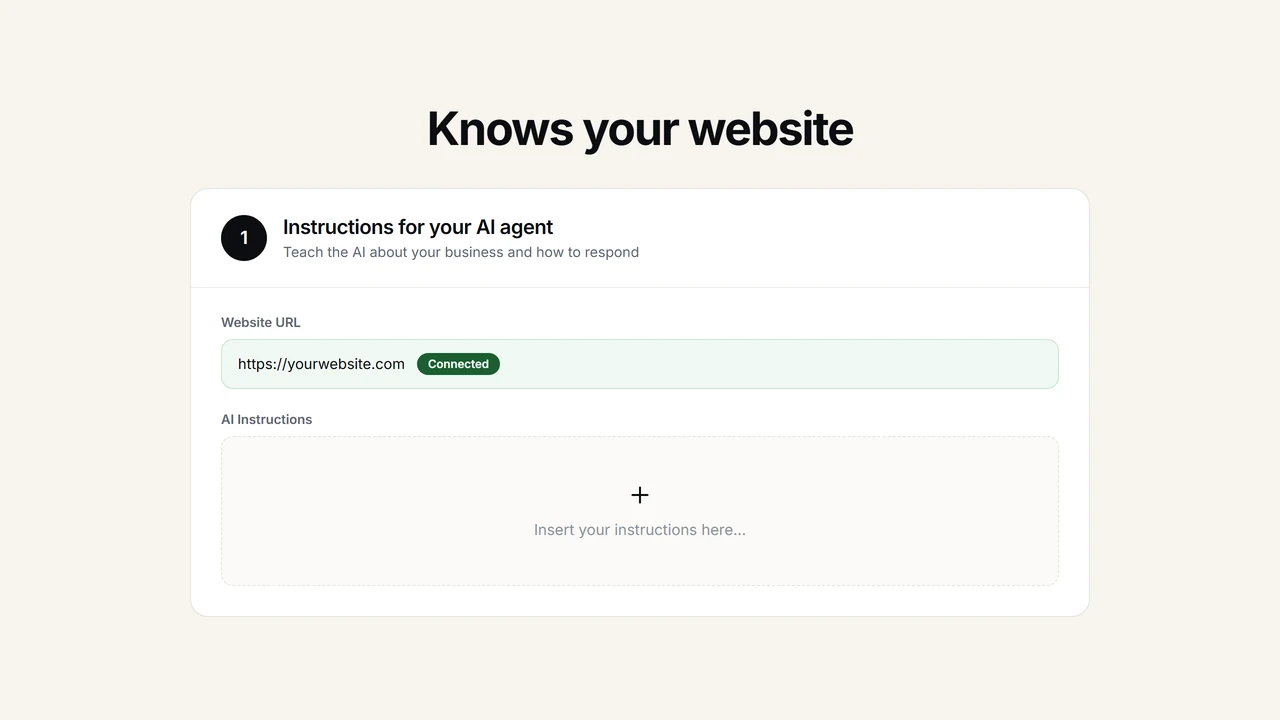
The entire deployment is a single script tag. No helpdesk platform to configure, no agent seats to provision, no phone system to wire up. Paste the snippet, let the crawler read your content, and your customer service channel is live.
- Create a free account — 1 site, 50 messages/month, $0. No credit card, no sales call, no trial expiration.
- Paste the script tag into your site header. Plugins for WordPress, Shopify, WooCommerce, Magento, Joomla, Drupal, Odoo, and more make it a one-click install on most platforms.
- Feed the chatbot your URL (crawls up to 50 pages) plus any PDFs, policy documents, or FAQ sheets you want it to reference.
- Scale with your needs: Starter $39/mo for 2 sites and 800 messages, Standard $139/mo for 3 sites and 15,000 messages, Pro $449/mo for 20 sites and 50,000 messages.
<script src="https://asyntai.com/widget.js"
data-id="your-site-id" async>
</script>
# Your support team just got bigger. No interviews required.
Small Business Customer Service Software — FAQs
Questions small business owners ask when exploring AI-powered customer service for the first time.
Can AI really handle customer service for a small business?
For the majority of incoming questions — the ones about hours, policies, pricing, product details, and order status — yes. The AI retrieves answers directly from your website content and uploaded documents, so it gives accurate, specific responses rather than generic ones. For complex or sensitive situations, it collects the visitor's information and escalates to your team with the full conversation history attached.
How does this compare to hiring a part-time support person?
A part-time support hire covers maybe 20-25 hours a week at $15-20 per hour, costing $1,200-2,000 monthly before any benefits or management overhead. The chatbot covers all 168 hours in a week, handles unlimited simultaneous conversations, and starts at $0 on the free plan. It does not replace the need for human judgment on complex cases, but it dramatically reduces how much human time those cases require.
What if the chatbot gives a wrong answer?
The AI only answers from content it has indexed — your pages and your documents. If the information in your knowledge base is accurate, the answers will be accurate. When the AI cannot find relevant content for a question, it tells the visitor it does not have that information rather than guessing. You can also review conversation transcripts in the dashboard to catch any issues early.
Does it work outside business hours?
That is the primary advantage. The chatbot runs 24 hours a day, 7 days a week, 365 days a year. Visitors who land on your site at midnight, on holidays, or over the weekend get the same quality of response as someone visiting during peak hours. No shift scheduling needed.
Can it handle multiple customers at the same time?
Yes, with no degradation. Unlike a human agent who can realistically manage two or three conversations simultaneously, the chatbot handles any number of concurrent visitors. During a traffic spike — a product launch, a seasonal sale, a social media mention — the chatbot absorbs the volume without queues or delays.
What languages does the customer service chatbot support?
Thirty-six languages with automatic detection. The chatbot identifies the visitor's language from their first message and responds in the same language. This is particularly valuable for small businesses in diverse communities or those with international customers — it eliminates the need for multilingual staff.
How do leads get captured during service conversations?
When a visitor asks a question that the chatbot resolves, it can naturally follow up by collecting a name and email for follow-up or future communication. Leads appear in the dashboard with the full transcript, and optional email notifications alert your team the moment a new lead is captured.
Can the chatbot check order status or process returns?
On Standard and Pro plans, Custom Tools let the chatbot call your own API endpoints to fetch order data, verify return eligibility, or trigger workflows. If you have an existing backend or order management system with API access, the chatbot can query it in real time during the conversation.
Is there a long-term contract?
No. All plans are month-to-month with no minimum commitment. You can start on the free plan, upgrade when ready, and cancel anytime. There are no setup fees, no cancellation penalties, and no annual lock-in requirements.
Small business customer service software — the case for AI-first support
There is a particular kind of exhaustion that comes with running customer service at a small business. It is not the volume — although that grows faster than anyone budgets for — it is the repetition. The same twelve questions arrive every week in slightly different words: what are your hours, do you ship to my area, can I return this, how long does delivery take, what is the difference between these two options. Each one deserves a thoughtful, accurate answer. Each one takes two minutes to type. Multiply that across a week and you have lost a full workday to questions that your website already answers, if only visitors would read the right page.
This is the gap that customer service software is supposed to close, but most solutions designed for small businesses miss the mark in one direction or another. Traditional helpdesk platforms bring ticketing systems, agent routing, and SLA management — machinery that makes sense when you have a support team of ten but feels absurd when it is just you and maybe one other person answering emails between other responsibilities. Live chat tools solve the speed problem but create a staffing one: someone has to be watching the screen, and the moment they step away, the widget shows "offline" and the visitor leaves. Neither approach addresses the core constraint of a small business, which is that there are not enough people to cover the hours.
AI-powered customer service changes the equation because it removes the dependency on human availability for the routine layer of support. The chatbot reads your website content and any documents you provide, indexes that material, and uses it to answer visitor questions in real time. It does not generate answers from its imagination — it retrieves the relevant passage from your content and constructs a response grounded in your own words. A visitor who asks about your cancellation policy gets the text from your cancellation policy page, rephrased naturally for conversation. A visitor who asks about sizing gets your sizing guide data. The accuracy comes from the source material, not from the model's general knowledge.
The financial arithmetic is where this story gets compelling for a small business owner. A single full-time customer service representative in North America costs roughly $40,000 to $55,000 a year with benefits and overhead, and that person works eight hours a day, five days a week. They take vacation, sick days, and bathroom breaks. They handle one conversation at a time, maybe two with multitasking. Asyntai's Starter plan at $39 a month covers 800 messages across two sites — that is $468 a year for a support presence that works every hour of every day, handles unlimited simultaneous conversations, and never needs to be replaced because it quit for a better offer. The chatbot does not eliminate the need for human support entirely, but it handles enough of the volume that the humans can focus on the conversations that actually require judgment, empathy, or authority to resolve.
Speed of response is the customer service metric that small businesses consistently underperform on, not because they are slow by nature but because there simply are not enough people available. A visitor who submits a contact form at 9 PM on a Tuesday might wait until the next morning for a reply — by which time they have likely found the answer on a competitor's site. A chatbot answers in seconds. That speed is not just convenient; it is the difference between a visitor who stays and a visitor who bounces. Studies on customer service consistently show that response time is the single strongest predictor of satisfaction, ahead of resolution quality and ahead of politeness. The chatbot wins on this axis by default because it has no queue.
The after-hours problem deserves its own discussion because it is uniquely punishing for small businesses. A large company with a global support team or a call center contract never truly goes offline. A small business closes at five or six, and from that point until the next morning, every website visitor who has a question is on their own. For businesses that serve consumers — restaurants, retail shops, professional services, local trades — evenings are often when potential customers browse. A visitor at 8 PM comparing three local plumbers will choose the one that answered their question in the moment, not the one whose contact form promised a reply "within one business day." AI customer service software erases the gap between closing time and opening time without requiring anyone to work a night shift.
Multilingual support is another area where small businesses face a structural disadvantage. A dental clinic in Toronto serves patients who speak English, French, Mandarin, Tamil, and Tagalog. A short-term rental in Lisbon hosts guests from across Europe and beyond. Hiring staff who speak every relevant language is not realistic, but ignoring those languages means leaving money and goodwill on the table. Asyntai supports 36 languages with automatic detection — the visitor writes in their language and the chatbot responds in the same language, all from a single installation. The small business does not need to configure anything, hire anyone, or even know which languages their visitors speak. The platform handles it.
Lead capture in a customer service context is often more effective than dedicated lead generation forms because the visitor is already engaged. Someone who has just had three questions answered accurately and quickly is in a receptive state — the chatbot can naturally ask for a name and email to send a follow-up or a quote, and the conversion feels like a continuation of the conversation rather than a sales pitch. Every lead captured this way lands in the Asyntai dashboard with the complete conversation transcript, so when you reach out, you know exactly what the person asked about, what the chatbot told them, and where their interest lies. This context makes follow-up emails dramatically more effective than following up on a bare contact form submission.
For small businesses with order management, appointment scheduling, or account systems, Custom Tools on Standard and Pro plans push the chatbot beyond answering questions into resolving them. A customer asks where their package is and the chatbot fetches the tracking status from your fulfillment system. A prospective client asks about available time slots and the chatbot queries your calendar API. A returning customer asks about their account balance and the chatbot looks it up securely. Each of these interactions would normally require a phone call or a login to a separate portal — the chatbot collapses that friction into a single chat exchange. The visitor gets an answer and a resolution, and your team never has to touch the conversation.
The operational simplicity of the platform matters specifically because small business owners do not have time for complicated software. Setup takes minutes: sign up, paste a snippet into the website header (or use a plugin for WordPress, Shopify, and dozens of other platforms), point the crawler at the URL, and let it index. There is no decision tree to build, no intent classifier to train, no conversation flow to diagram. The AI figures out what the visitor is asking and retrieves the relevant content. If your website content changes — new hours, updated pricing, additional services — re-crawl and the chatbot reflects the update immediately.
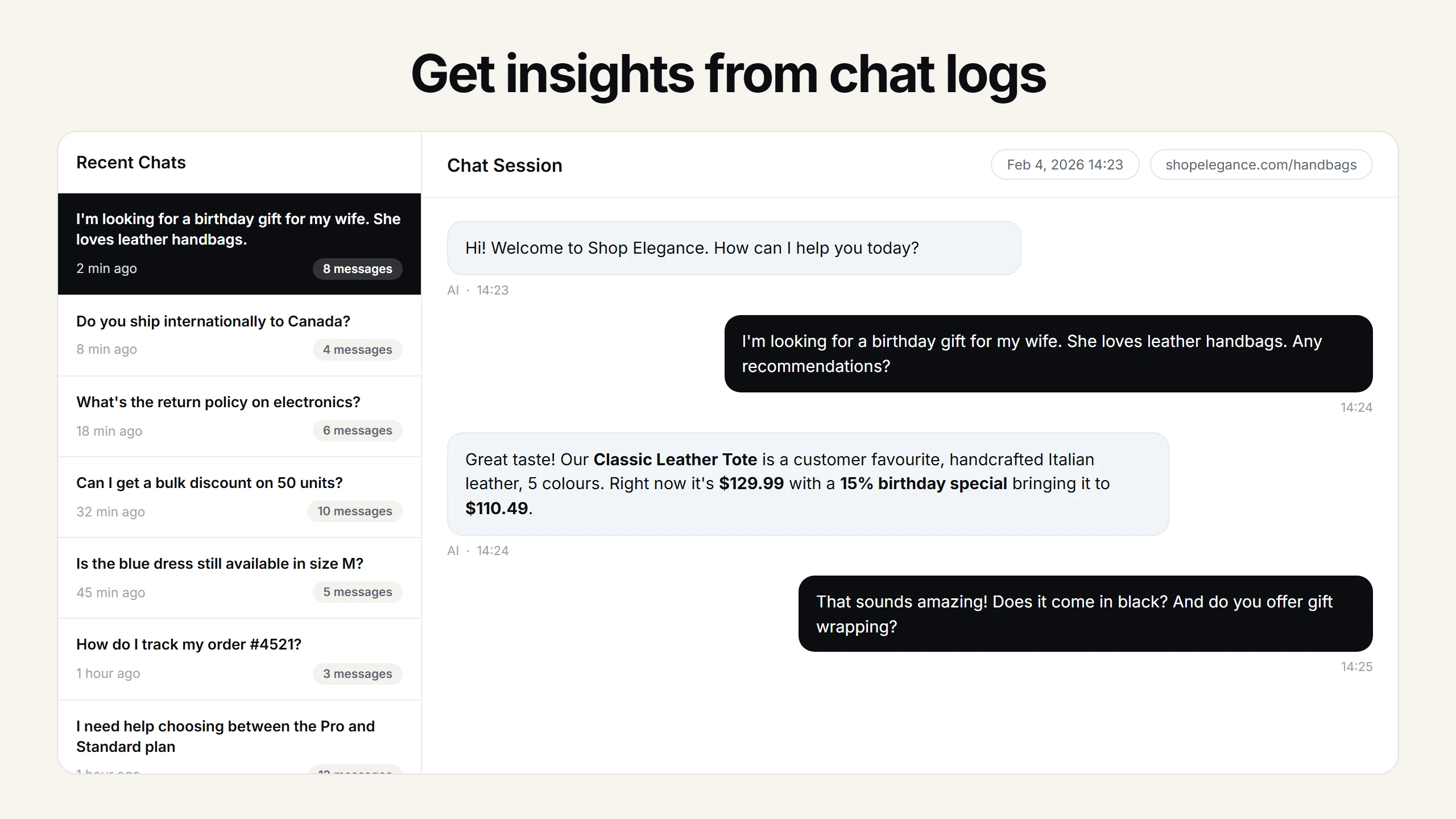
Conversation quality is something you can monitor and improve over time without technical skills. The dashboard shows every conversation transcript, so you can see exactly what visitors asked and how the chatbot responded. If a particular question type gets a weak answer, the fix is usually adding better content to the knowledge base — a more detailed product description, a clearer policy statement, a new FAQ entry. The chatbot improves as your content improves, which aligns the incentive: investing in better website content pays dividends both for SEO and for customer service quality.
Branding matters even in customer service interactions, and the platform lets you control the visual and tonal identity of the chatbot completely. Colors, logo, welcome message, conversation starters, and response tone are all configurable through the dashboard. A law firm can present a formal, professional assistant. A children's toy store can present something warm and playful. On the Pro plan, the Asyntai badge is removed for a fully white-label experience; on Standard, the same option is available by contacting [email protected]. The chatbot feels like part of your brand, not like a third-party tool bolted onto the side of your site.
The final piece of the argument for AI customer service software is what it frees up. A small business owner who spends two hours a day answering repetitive inquiries gets those hours back — not to sit idle, but to work on the parts of the business that generate growth. Following up on warm leads instead of answering "what are your hours" for the fourth time. Improving the product instead of explaining the return policy. Building relationships with high-value customers instead of fielding the same shipping question from the contact form. The chatbot is not a replacement for caring about customer service; it is a tool that lets you care about it more effectively by handling the volume so you can handle the nuance. Try the free plan and see how many hours it gives you back, or review the paid tiers to find the right message volume for your traffic.