Shopify help desk app that resolves tickets before they become tickets
Asyntai acts as the AI pre-ticket deflection layer for your Shopify store — absorbing your policies and product catalog, answering the repetitive shopper questions that fill your queue, and only escalating what genuinely needs a human agent.
See the Shopify help desk app on your store
Enter your Shopify URL and watch how the AI deflects a real shopper question on the spot
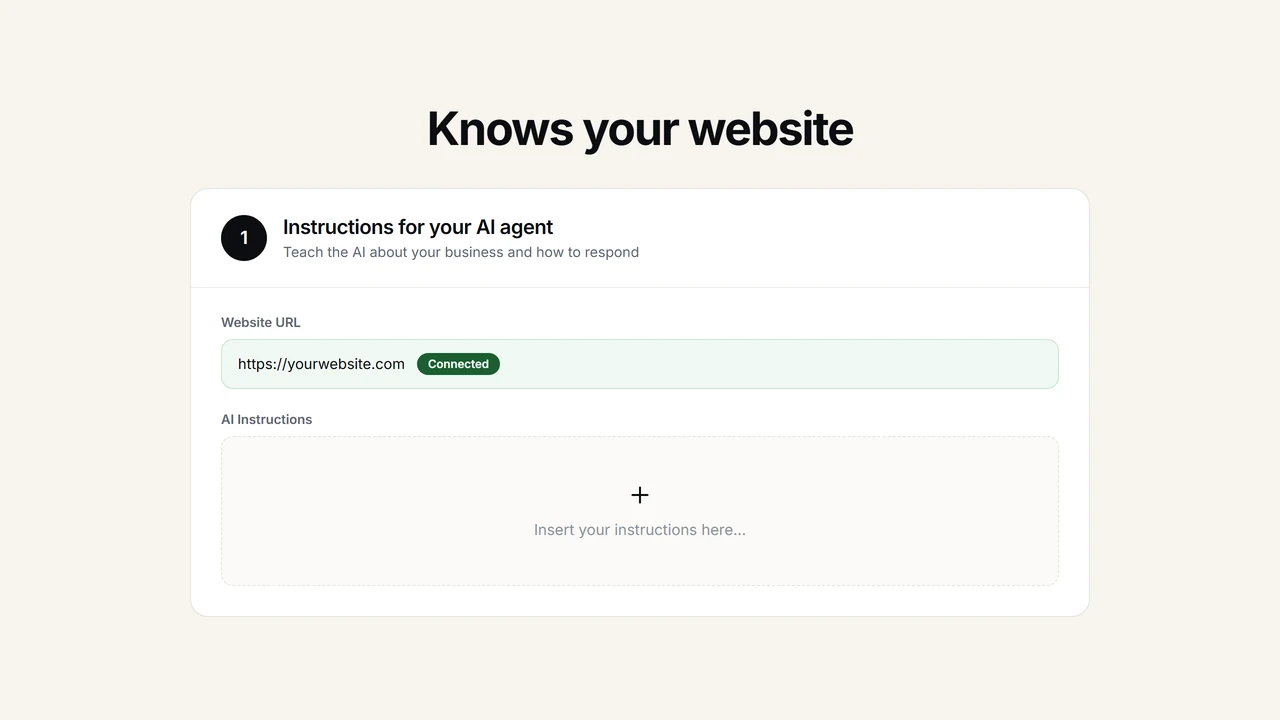
Knows your return policy, shipping tables, and product details inside out
Most Shopify help desk volume comes from questions your store has already answered on a policy page, a product listing, or an FAQ section. Asyntai absorbs all of that content automatically, plus any internal docs you upload, so the AI's first reply is a resolution rather than a placeholder.
- Auto-indexes your public store contentProduct descriptions, variant details, collection pages, shipping policy, refund policy, FAQ, terms of service — everything visible on your storefront feeds the AI without manual tagging.
- Upload internal help desk materialsCarrier escalation procedures, VIP return workflows, seasonal promotion guides, warranty claim steps — add them as PDFs or pasted text so the AI handles edge cases your public pages do not cover.
- Escalation rules in your own words"Collect the order number before answering any shipping status question." "Route damaged-item claims to a human after acknowledging the issue." "Never promise a refund amount — direct the shopper to email support for exact figures." Your rules, enforced on every conversation.
The 70% of your tickets that are policy-answerable never reach your inbox
A traditional Shopify help desk queues every inbound message for a human. Asyntai sits in front of that queue. The AI resolves the shopper questions that have clear answers in your content — sizing, shipping windows, return eligibility, payment methods — and only passes through the issues that require judgment, negotiation, or system access your team controls.
- Instant resolution at the point of confusionThe shopper gets their answer on the product page or cart page where the question arose, rather than filing a ticket and waiting hours for a response that quotes the same policy they could not find.
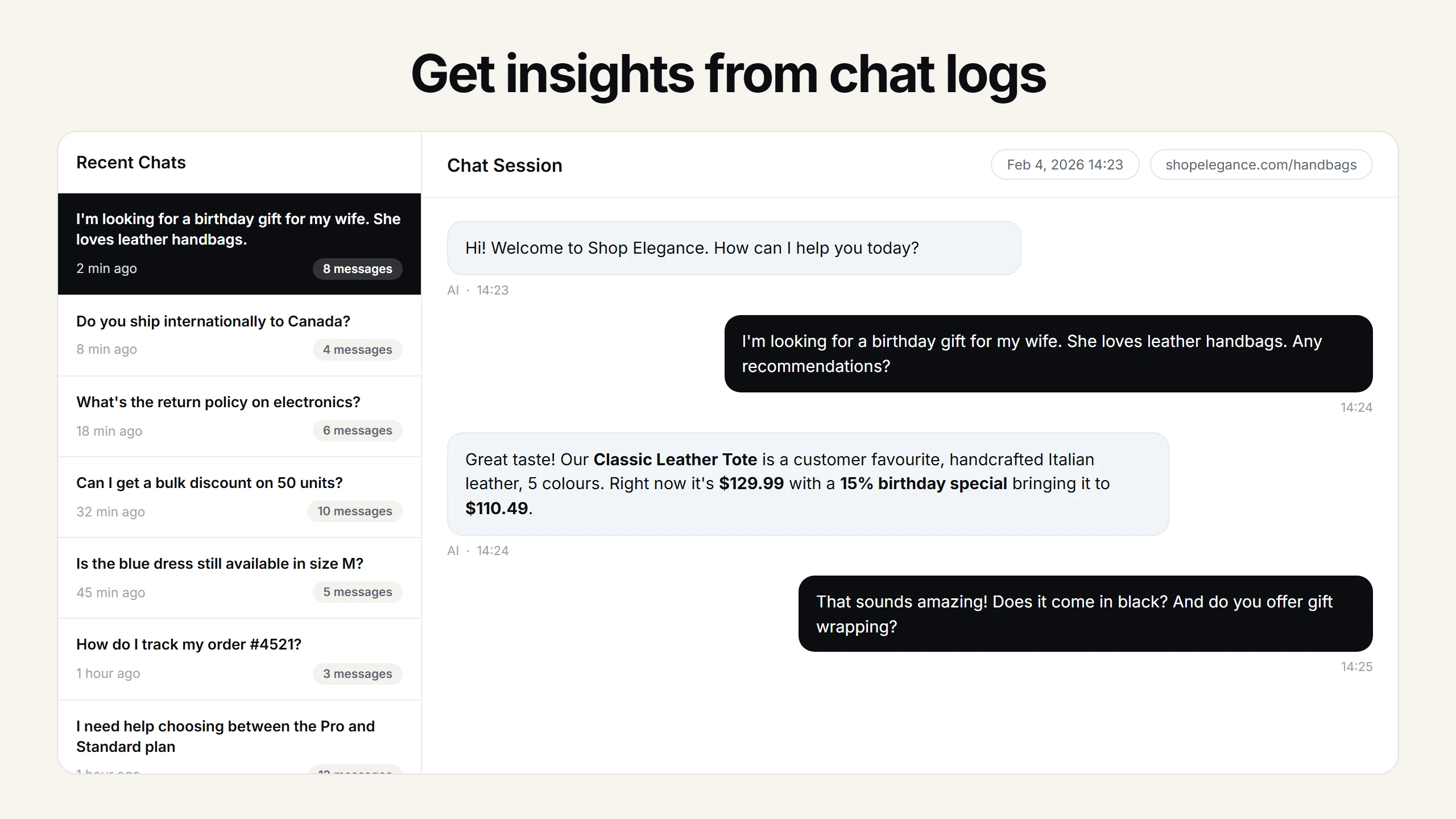
- Human escalation with full transcriptWhen a conversation exceeds what the AI can resolve, it captures the shopper's email and the entire dialogue. Your help desk team receives the escalation with complete context — no back-and-forth to reconstruct what was already discussed.
- Order-aware replies on Standard and ProThrough User Context via window.Asyntai.userContext, your Shopify storefront passes logged-in customer order data to the AI. The help desk app then answers "where is my order" directly, without the shopper needing to file a ticket or wait for an agent lookup.
Install from the Shopify App Store or via theme.liquid
Asyntai is listed on the Shopify App Store — install with two clicks from your admin panel. If your workflow prefers the snippet approach, the same widget is available as a theme.liquid paste. Both paths produce identical help desk functionality on every page of your store.
- Find Asyntai on the Shopify App Store and click Install, or sign up at asyntai.com and copy the theme.liquid snippet.
- For the App Store path, approve the read-only scopes and the embedded app opens inside your Shopify admin.
- For the snippet path, open Online Store → Themes → Edit Code, paste the snippet in
theme.liquidbefore</body>. - Point the AI at your store URL, let it index your catalog and policies, and activate the help desk layer.
[ Install from App Store ]
# Option B: theme.liquid snippet
<script src="https://asyntai.com/widget.js"
data-id="your-store-id" async>
</script>
Shopify help desk app — FAQs
What store operations teams ask before layering AI deflection in front of their help desk.
Is Asyntai a full help desk like Gorgias or Zendesk?
No — and this distinction matters. Gorgias, Zendesk, Freshdesk, and similar platforms are full-featured help desk systems with shared inboxes, ticket routing, macros, SLA tracking, and agent performance metrics. Asyntai is not that. It is a pre-ticket deflection layer: an AI chat widget that sits on your storefront, resolves the shopper questions that have clear answers in your content, and hands off everything else. You keep your existing help desk for agent-handled tickets; Asyntai reduces how many tickets actually reach it.
Can it work alongside Gorgias, Zendesk, or Freshdesk?
Yes. Asyntai runs as a separate widget on your storefront and does not interfere with any help desk widget or integration you already have installed. The typical pattern is: Asyntai deflects the common policy questions on the spot, and issues the AI cannot resolve get escalated to your existing help desk inbox via email notification with the full transcript attached.
How does order status work through the help desk app?
Through the User Context feature on Standard and Pro plans. Your Shopify storefront passes the logged-in customer's order data — status, tracking number, shipping carrier, expected delivery date — into a JavaScript object before the widget loads. The AI reads that data and answers "where is my order" directly, without the shopper filing a ticket. You decide exactly what order data to share.
What percentage of help desk tickets can the AI realistically deflect?
For most Shopify stores, 60-80% of inbound tickets are content-answerable: shipping policy, return windows, product specs, sizing, payment methods, promotion terms. The AI resolves those. With User Context enabled, order-status questions are also handled, covering another significant slice. The remaining 20-40% — refund disputes, carrier-lost shipments, complex exchanges, wholesale negotiations — escalate to your team with full conversation context.
Does the Shopify App Store listing grant access to my store data?
The App Store install requests read-only scopes: product catalog, content pages, and theme access for embedding the widget. No write access, no customer data access, no order data access through the app itself. Order data for the help desk feature flows through User Context, which your storefront controls entirely — the app never pulls it from Shopify's backend.
How does this compare in price to a dedicated Shopify help desk?
Gorgias starts around $50-60/month for basic plans. Zendesk Suite starts higher. Asyntai starts free for 50 messages, with paid plans at $39/month for 800 messages. The comparison is not apples-to-apples because Asyntai is a deflection layer, not a full agent workspace. Many stores run both: Asyntai to shrink the ticket volume, and their existing help desk for the tickets that need a human. The combined cost is often lower than upgrading to a higher help desk tier to handle the same total volume.
Does the help desk app handle multiple languages?
Yes. The widget UI supports 36 languages and the AI detects the shopper's language from their first message. A German shopper gets German answers, a Korean shopper gets Korean, a French shopper gets French — from the same installation. For Shopify stores selling internationally, this eliminates the need for per-language help desk agents handling the routine questions.
Can I run it across multiple Shopify stores?
Yes on paid plans. Free covers 1 store, Starter covers 2, Standard covers 3, Pro covers up to 10. Each store gets its own independently trained help desk chatbot with its own knowledge base, policies, and escalation rules — essential for brand holding companies or agencies managing multiple Shopify properties.
Shopify help desk app: what a pre-ticket deflection layer actually looks like
Every Shopify store that reaches a certain volume of daily orders crosses the same threshold: the support inbox becomes a bottleneck. Not because the questions are hard, but because there are so many of them and the vast majority have answers that already exist somewhere on the store. Return eligibility windows, international shipping rates, product dimensions, fabric care instructions, payment method availability, loyalty point redemption steps. The information lives on a policy page or a product listing, but the shopper either could not find it or did not look. They opened a ticket instead. That ticket joined a queue. An agent read it, looked up the same policy page, copied the relevant paragraph, and sent a reply. Fifteen minutes of human labor to deliver information the store had already published. Multiply that by fifty tickets a day and you have the central cost problem of Shopify customer support.
Dedicated help desk applications like Gorgias, Zendesk, Re:amaze, and Freshdesk address this problem from the agent side. They give your support team a unified inbox with macros, tagging, SLA timers, and auto-responders that make processing tickets faster. What they do not fundamentally change is the volume of tickets arriving in the first place. Macros help an agent answer a shipping question in thirty seconds instead of two minutes, but the ticket was still created, still queued, and still consumed a slot in the workflow. The Shopify help desk app category is evolving toward a different architecture: resolving the shopper's question before a ticket is created at all. That is what a pre-ticket deflection layer does, and it is the honest framing for what Asyntai provides.
Asyntai is not a replacement for Gorgias, Zendesk, or any full-featured help desk. It does not offer a shared agent inbox, ticket routing rules, SLA enforcement, canned response libraries, or CSAT scoring. It does one thing: it sits on your Shopify storefront as a chat widget, reads your published store content and any internal documents you upload, and answers the shopper's question on the spot using AI that understands your specific policies. When the question exceeds what the AI can resolve — a damaged-item claim that needs a photo review, a refund amount that requires manager approval, a shipping exception that involves calling the carrier — the chatbot captures the shopper's email and the complete conversation and delivers the escalation to your inbox. Your existing help desk picks up where the AI left off, with the full context already documented.
The training process works by crawling your Shopify storefront. Point the AI at your store URL and it reads everything publicly visible: product titles, descriptions, variant options, collection pages, the shipping policy page, the refund policy page, the FAQ, the terms of service — all the content your store has already created. Then you supplement with internal materials. A carrier escalation procedure your team follows when packages go missing. A VIP returns workflow that applies to loyalty tier members. A seasonal promotion guide that explains the current sale terms. A warranty claim checklist for specific product categories. These get uploaded as PDFs or pasted text, and the AI treats the combined corpus as a single knowledge base it draws from during conversations.
Behavioral rules give you precision control beyond knowledge. "When a shopper asks about a return on an item older than 30 days, acknowledge the request and explain that it falls outside the standard window, then offer to connect them with our support team for an exception review." "If a shopper mentions a damaged or defective product, immediately apologize, ask for the order number, and escalate — do not attempt to resolve independently." "Never quote a specific refund amount; always direct the shopper to email support with the order number for an exact calculation." These rules run on top of the knowledge base, shaping how the AI behaves in sensitive scenarios where tone and accuracy matter more than speed.
Order status is the single highest-volume question category in most Shopify help desk queues, and handling it through the deflection layer has the largest impact on ticket count. The mechanism is User Context on Standard and Pro plans. Your Shopify storefront knows who the logged-in customer is, and it knows their current order data — status, tracking number, carrier, expected delivery date, line items. Before the chat widget loads, your theme pushes that data into a JavaScript object via window.Asyntai.userContext. The AI reads the object and answers "where is my order" with the shopper's actual order details, not a generic instruction to check their email. This resolves the ticket at the point of origin without the shopper filing a request, without an agent seeing the question, and without any backend integration beyond what your theme already renders.
The relationship between a pre-ticket deflection layer and a traditional help desk is additive, not competitive. The cleanest deployment pattern is Asyntai on the storefront plus your existing help desk for the tickets that get through. The AI handles the high-frequency, low-complexity questions — the shipping windows, the return steps, the payment methods, the sizing guides — instantly and at any hour. Your help desk handles everything that needs judgment, negotiation, or system-level actions the AI cannot perform. The net effect: your help desk queue shrinks by the percentage of tickets that were content-answerable, your agents spend their time on genuinely complex cases, and your overall first-response time drops because the AI answers in seconds rather than the minutes or hours a queued ticket requires.
The financial math behind this architecture tends to favor stores that are approaching or have crossed the tier boundaries of their current help desk plan. Gorgias, for instance, prices by ticket volume — more tickets means a higher monthly bill or the need to upgrade to a higher plan. If the deflection layer absorbs 60% of what would have been tickets, your effective ticket count drops, your Gorgias bill stays at a lower tier, and the Asyntai cost ($39/month for 800 messages) is offset by the help desk tier savings. The same logic applies to Zendesk, Freshdesk, or Re:amaze plans that gate features or capacity by volume. The deflection layer pays for itself by compressing the volume that hits your paid help desk infrastructure.
Multilingual deflection adds another cost-efficiency dimension. Hiring support agents who speak German, French, Japanese, Korean, Spanish, and Portuguese is expensive and operationally complex. Outsourced multilingual support introduces quality variance. The Shopify help desk app handles 36 languages from the same installation — a French shopper asking "quelle est votre politique de retour" gets an accurate French reply assembled from your return policy, and a Japanese shopper asking the equivalent gets the same answer in Japanese. For Shopify stores selling internationally, this resolves the multilingual support gap without headcount or outsourcing. The tickets that do escalate arrive with the translated conversation, so your English-speaking team can see what the shopper asked and what the AI already told them.
What the deflection layer reveals about your store is often as valuable as the tickets it prevents. Conversation analytics show which questions shoppers ask most frequently, which product pages generate the highest support-adjacent inquiries, and which policy areas confuse visitors most often. If forty shoppers asked whether expedited shipping is available and the answer was buried in a footnote, that footnote should become a banner. If a product generates repeated sizing questions, the size chart needs rework. The deflection layer does not just answer questions — it maps the terrain of where your store's self-service content fails.
Installation happens through two parallel paths. The Shopify App Store listing lets you install with two clicks from your admin panel — approve the read-only scopes, and the embedded app opens inside Shopify admin for configuration. If you prefer the manual approach, paste the JavaScript snippet into theme.liquid before the closing body tag. Both paths produce the same storefront experience. The App Store route suits merchants who prefer native installs; the snippet route suits development teams wanting tighter control. Neither path grants broad data permissions.
The honest limitation of this approach is that it does not replace a help desk — it reduces the workload that hits one. If your store has zero help desk infrastructure and you need a shared inbox, ticket assignment, performance dashboards, and CSAT workflows, you still need a Gorgias or Zendesk or equivalent. What the Shopify help desk app eliminates is the cost spiral of scaling that infrastructure in proportion to your order volume. Your ticket volume grows linearly with orders; the AI deflection layer flattens that curve, so your agent headcount and help desk spend grow slower than your revenue. For stores in the scaling phase — past the point where one person can handle support, not yet at the scale where a full support team is affordable — that curve-flattening is the entire value proposition.
Pricing for the deflection layer is structured by message volume, not by ticket count or agent seat. Free gives you 50 messages per month and one store — enough to pilot the approach on a single Shopify store and validate the deflection rate against your actual ticket patterns. Paid plans start at $39/month for 800 messages, scaling to higher message caps on Standard and Pro. Multi-store support follows the plan: Starter covers 2 stores, Standard covers 3, and Pro covers up to 10 — each with independent training and analytics. Each storefront under a brand holding company gets its own tuned deflection layer without knowledge base bleed between brands.
The practical test for any Shopify store evaluating this approach is to install the widget, feed it your store URL, and let it handle a week of live traffic. Watch which questions it resolves successfully, which it escalates, and compare the volume of tickets landing in your actual help desk inbox against the prior week. The deflection rate tells you whether the investment makes sense. For most Shopify stores with meaningful order volume, the answer surfaces within days: the routine questions stop reaching your team, response times for genuine issues improve because the queue is shorter, and your agents spend their shift on work that actually requires human skill rather than policy transcription.