A Shopify AI agent that knows your catalog and handles your customers
Asyntai's Shopify AI agent crawls your entire store — products, collections, policies, pages — and connects to Shopify's APIs through Custom Tools to look up orders, check inventory, verify return eligibility, and resolve customer requests. Available as an official Shopify app. Install it in minutes and let it handle the support cycle your team shouldn't be spending hours on.
Watch the AI agent answer your Shopify store's questions
Paste your Shopify store URL and see the AI agent respond to real customer questions using your actual product data
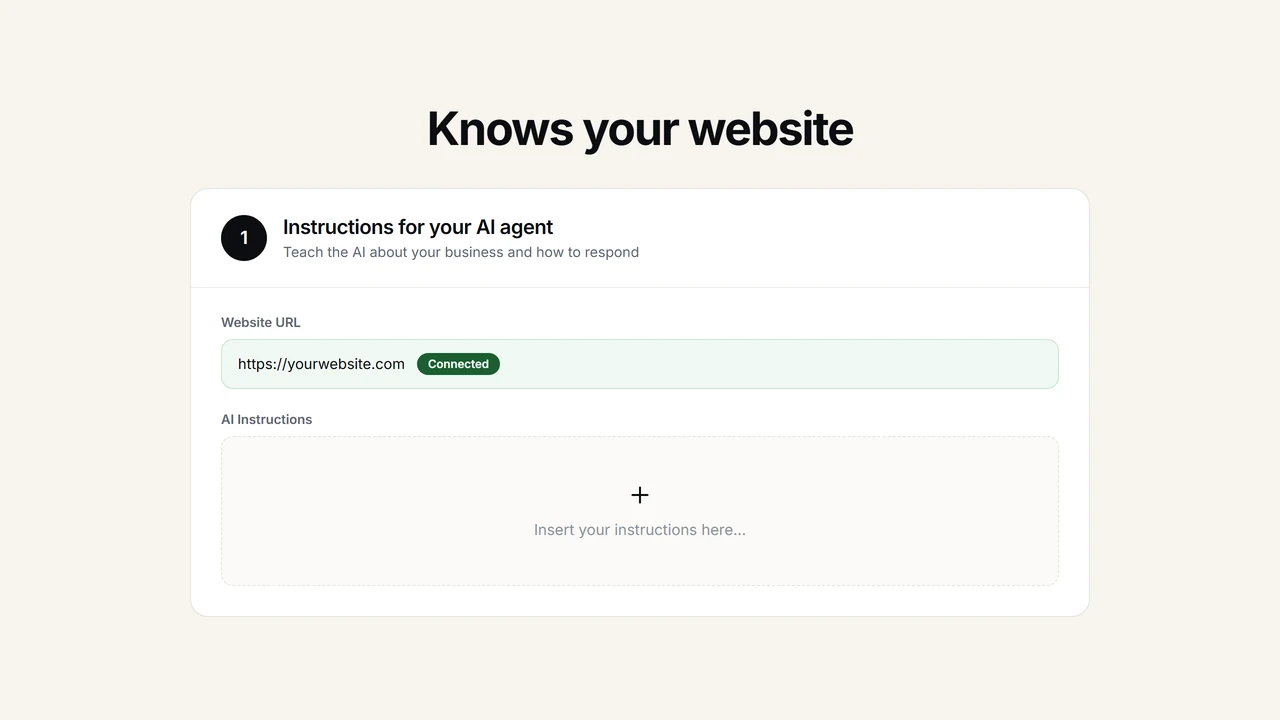
Learns every product, collection, and policy on your Shopify store
The Shopify AI agent crawls your storefront the way a new hire would read through your entire catalog — except it finishes in minutes and retains everything. Product descriptions, variant details, collection pages, FAQ content, shipping policies, return windows. When a customer asks "do you carry leather wallets under $50?" or "what's the difference between the Pro and Standard plan?", the agent answers from your actual store content, not a generic script.
- Crawls your full Shopify storefrontEvery product page, collection, blog post, and policy page on your Shopify store is indexed automatically. The agent understands your catalog structure — which products belong to which collections, how variants relate to parent products, and what your policies actually say.
- Answers product discovery questions naturallyCustomers don't search your store the way you organized it. They ask "what's a good gift for a runner?" or "do you have anything waterproof?" The AI agent matches those intent-driven questions to the right products from your catalog — the kind of recommendation a knowledgeable salesperson would give.
- Stays current with automatic re-crawlingWhen you add a new product, update a description, or change a policy, the agent picks up the changes on its next crawl. You don't manually sync content. Your Shopify store is the single source of truth, and the AI agent always reflects what's live.
Connects to Shopify APIs to track orders, check stock, and process returns
Knowing your catalog makes the agent helpful. Connecting to Shopify's APIs makes it autonomous. Through Custom Tools, the Shopify AI agent calls your order management, inventory, and customer endpoints mid-conversation — retrieving live data and taking action without a human ever touching the ticket. Pair it with User Context to pass logged-in customer data into the chat, and the agent resolves requests that would otherwise sit in your inbox for hours.
- Order tracking with real shipment dataWhen a customer asks "where's my order?", the agent calls your Shopify order endpoint, retrieves the tracking number, carrier, fulfillment status, and estimated delivery — and replies with specifics, not a generic "check your email for tracking info."
- Live inventory checks across variantsA customer asks "is the black jacket available in large?" The agent queries your Shopify inventory API and responds with the actual stock level for that specific variant. No more losing sales because a customer assumed something was out of stock.
- Return eligibility and customer data via User ContextPush the logged-in customer's email, order history, or loyalty tier into the chat widget with User Context. The agent combines that identity data with Custom Tool calls to verify return windows, check warranty status, and personalize every interaction.
Install the Shopify AI agent from the Shopify App Store
Asyntai has an official listing on the Shopify App Store. Install it like any Shopify app — no code, no developer, no theme editing. The agent embeds itself in your storefront and starts crawling your catalog immediately. Connect your first Custom Tool to Shopify's APIs and the agent goes from knowledgeable to autonomous in minutes.
- Find Asyntai in the Shopify App Store and click Install — it adds the chat widget to your storefront automatically.
- The agent crawls your Shopify store and learns your products, collections, policies, and content pages.
- Go to Custom Tools in your Asyntai dashboard and connect Shopify API endpoints — order status, inventory, returns — so the agent can take action.
- Test by asking your bot a customer question — it pulls live data from Shopify and answers with real order details, stock levels, or policy info.
<!-- Installed automatically via Shopify App Store -->
<script src="https://asyntai.com/widget.js"
data-id="your-shop-id" async>
</script>
</head>
# Installed via Shopify. Your AI agent is live.
Shopify AI agent — FAQs
Common questions from Shopify merchants evaluating an AI agent for their store's customer support.
How do I install the Shopify AI agent?
Asyntai has an official listing on the Shopify App Store. Click Install, authorize the app, and the chat widget appears on your storefront automatically. No theme code editing, no liquid file modifications, no developer required. The agent begins crawling your store immediately after installation and is ready to answer customer questions within minutes.
Does the agent learn my specific Shopify products and collections?
Yes. The agent crawls your entire Shopify storefront — every product page, variant, collection, blog post, FAQ page, shipping policy, and return policy. It understands your catalog structure and answers from your actual content. When you ask "do you have running shoes under $100?", the agent searches your real product data, not a generic database.
Will it work with my Shopify theme?
The chat widget works with every Shopify theme — Dawn, Debut, custom themes, and third-party themes from the Theme Store. It renders as a floating widget that sits on top of your theme without interfering with your layout, fonts, or styles. You can customize the widget's colors, position, and branding from your Asyntai dashboard to match your store's design.
Can the agent actually look up order status from my Shopify store?
Yes, through Custom Tools. You connect your Shopify order status API endpoint in the Asyntai dashboard, and the agent calls it whenever a customer provides an order number. It retrieves tracking numbers, carrier info, fulfillment status, and delivery estimates — and replies with the real data. The customer gets a specific answer instead of "check your order confirmation email."
Does it handle inventory questions for specific variants?
Yes. Connect your Shopify inventory endpoint as a Custom Tool, and the agent checks stock levels for any combination of product, size, color, or material the customer asks about. "Is the navy hoodie available in XL?" gets a real-time answer based on your current Shopify inventory, not a cached number from last week.
What happens when a customer asks about returns or exchanges?
The agent combines your return policy (learned from crawling your store) with live order data (from Custom Tools). It can check when the order was placed, determine whether the customer is still within the return window, and guide them through the process — or escalate to your team if the case requires human judgment, like a damaged item claim.
Does it work with Shopify Plus?
Yes. Asyntai works with all Shopify plans — Basic, Shopify, Advanced, and Plus. The AI agent's capabilities are the same regardless of your Shopify plan tier. The only variable is which Asyntai plan you choose, which determines your monthly message volume and access to features like Custom Tools (Standard+) and User Context (Standard+).
Can the agent handle questions in languages other than English?
Yes. The Shopify AI agent supports 36 languages and detects the customer's language automatically. A customer browsing your Shopify store in French asks "Ou est ma commande?" — the agent understands the question, calls your (English) Shopify API endpoint, gets the order data, and replies in French. Your API doesn't need to support multiple languages. The agent handles all translation.
Why Shopify merchants need an AI agent — not another chatbot app
Running a Shopify store means running a support operation whether you planned for one or not. The moment your first product ships, the questions start. "Where is my order?" "Do you have this in a different size?" "Can I still return this?" "Is this item compatible with the one I bought last month?" These aren't edge cases. They're the daily reality of selling online. And for most Shopify merchants — especially those running lean teams or solo operations — every hour spent answering these questions is an hour not spent on product development, marketing, or the strategic work that actually grows the business.
The Shopify App Store has hundreds of chat apps. Most of them are chatbots — they read your FAQ page, match keywords, and recite answers. They handle the "what's your return policy?" type of question adequately because that answer is static. It lives on a page. It doesn't change based on who's asking. But the questions that actually fill your inbox aren't static. "Where is my order?" requires looking up a specific order. "Is this available in medium?" requires checking live inventory for a specific variant. "Can I return the jacket from my last order?" requires knowing when the order was placed and comparing it against your return window. A chatbot that can only repeat your FAQ stalls on every one of these and tells the customer to email your support address — which is where you started.
A Shopify AI agent closes that gap. It does two things that a chatbot cannot. First, it crawls your entire Shopify storefront and genuinely learns your catalog — not just product titles, but descriptions, variant details, collection structures, blog content, shipping policies, return windows, sizing guides. When a customer asks a question that your store content can answer, the agent answers it accurately, in natural language, drawing from your actual pages. Second — and this is what makes it an agent rather than a smarter chatbot — it connects to Shopify's APIs through Custom Tools to retrieve live, customer-specific data and take action. Order lookups, inventory checks, return eligibility verification, customer account data. The agent calls these endpoints mid-conversation, interprets the response, and gives the customer a real answer. Not "please check your email." An actual tracking number, an actual stock count, an actual return eligibility confirmation.
The way this works in practice starts with what the agent knows passively. When you install Asyntai on your Shopify store — which happens through the Shopify App Store, same as any app — the agent crawls your storefront. Every product page with its title, description, price, images, and variants. Every collection page and how products are organized within it. Your shipping policy, return policy, terms of service, FAQ page, about page, blog posts. All of it gets indexed into the agent's knowledge base. This is the foundation: the agent can answer any question that your published content answers. "What materials is the Classic Tote made from?" "Do you ship to Australia?" "What's your exchange policy?" "Which products are in the Summer Sale collection?" These get handled instantly, drawn from your actual store pages, in whatever language the customer is browsing in.
But knowledge alone doesn't resolve the tickets that consume most of your time. The top support question for virtually every Shopify store is "Where is my order?" A knowledge-base-only chatbot has nothing to say here because the answer isn't on any page — it's in your Shopify admin, tied to a specific order number and fulfillment record. This is where Custom Tools transform the agent. You connect your Shopify order status endpoint in the Asyntai dashboard — name the tool, describe when the AI should use it ("call this when a customer asks about an order or provides an order number"), paste the endpoint URL, and define the parameter (order_number). From that point forward, when a customer types "where is my order #1042?", the agent extracts the order number, calls your endpoint, receives the fulfillment data — tracking number, carrier, shipped date, delivery estimate — and responds with specifics. "Your order #1042 shipped via USPS on June 12th, tracking number 9400111899223100047. It's currently in transit and estimated to arrive by June 18th." That's a resolved ticket. No human saw it. No email was written. The customer got their answer in seconds.
Inventory questions are the second largest category, and they directly impact revenue. A customer lands on a product page, sees three color options, but wants to know if the green one is available in their size before they commit. On most Shopify stores, the only way to check is to click through every variant combination and see if "Add to Cart" is active. Many customers don't bother — they leave. With the AI agent connected to your Shopify inventory API, the customer simply asks "is the green bomber jacket available in large?" and gets an immediate answer with the actual stock level. If it's in stock, the agent can share the direct product link. If it's not, the agent can suggest the closest available option from your catalog. That's a product discovery interaction that would have been a lost visitor without the agent.
Returns and exchanges reveal the full value of combining the agent's knowledge base with Custom Tools. When a customer says "I want to return the sneakers from my last order," the agent needs two pieces of information: the order details (when it was placed, what was ordered) and your return policy (the window, the conditions, the process). A chatbot can only provide the policy. The AI agent calls the order lookup tool, retrieves the order date and items, compares the purchase date against the return window it learned from your policy page, and gives a definitive answer: "Your order #1089 was placed 11 days ago. Your return window is 30 days, so you're eligible to return the sneakers. Here's how to start the process." If the return window has passed, the agent says so honestly and explains the customer's options. If the request is complex — a damaged item, a partial order return, a high-value refund — the agent escalates with the full context: the customer's name, the order details, the conversation history, and the data it retrieved. Your team picks up a complete case file, not a vague email.
Shopify merchants face a support challenge that's unique in its seasonality. Most stores aren't steady-state operations. Traffic spikes during product launches. Volume triples during holiday sales. A viral TikTok drives thousands of visitors overnight. Flash sales generate concentrated bursts of orders — and concentrated bursts of support questions — in windows of hours. Hiring for these spikes is impractical. You can't onboard temporary support staff for a 48-hour flash sale. You can't train someone on your full catalog and return policy for a weekend promotion. The AI agent absorbs these spikes without degradation. It answers the 500th "where is my order?" question of the day with the same speed and accuracy as the first. It doesn't get overwhelmed, doesn't make mistakes when tired, doesn't need a shift change. For merchants who run frequent promotions or experience unpredictable traffic, this isn't a convenience — it's the difference between maintaining customer satisfaction during your busiest periods and watching your support queue spiral while you manually copy-paste tracking numbers.
The economics of a Shopify AI agent versus the alternatives are worth examining directly. The most common alternative for small Shopify merchants is doing it yourself — answering every email, every DM, every chat message personally. This works when you're shipping ten orders a week. It breaks when you're shipping fifty. At that volume, support easily consumes two to three hours daily. If your time is worth $50/hour as a founder — a conservative estimate — that's $3,000/month in opportunity cost spent on questions that are repetitive, data-dependent, and automatable. The next alternative is a virtual assistant. A part-time VA costs $500-$1,500/month depending on skill level and hours. They need training on your products, policies, and Shopify admin. They make mistakes during the learning curve. They're available during set hours, not 24/7. They can handle one conversation at a time. And when you add a new product line or change a policy, you retrain them. The AI agent costs a fraction of a VA, requires no training (it crawls your store), handles unlimited concurrent conversations, and operates around the clock in 36 languages. The math isn't close.
For larger Shopify stores with dedicated support teams, the calculus is different but the conclusion is the same. A support agent handling Shopify tickets spends a significant portion of their day on "where is my order?" — opening Shopify admin, searching the order, copying the tracking number, pasting it into a reply. Each of these takes two to four minutes. At fifty tickets per day, that's up to three hours of a paid support agent's time on a task that is entirely mechanical. The AI agent handles these tickets in seconds, freeing your human team for the cases that genuinely need human judgment: product recommendations for complex use cases, damage claims with photos, wholesale inquiries, custom orders. The agent doesn't replace your team. It removes the repetitive, data-lookup tickets from their queue so they can focus on the work where human empathy, creativity, and judgment actually matter.
Product discovery is an underappreciated use case for a Shopify AI agent. Shopify stores organize products into collections, but customers don't think in collections. They think in needs. "I need a birthday gift for my sister who likes hiking." "What's the most durable bag you sell?" "I'm looking for something like the blue dress on your Instagram but more formal." These questions don't map to a collection page or a search filter. They require understanding your entire catalog and matching products to an intent. The AI agent, having crawled every product page on your store, can make these connections. It acts like a knowledgeable shop assistant who has memorized every item you carry — suggesting products based on the customer's description, comparing options, explaining differences between similar items. For stores with large catalogs — hundreds or thousands of SKUs — this turns the chat widget into a guided shopping experience that increases average order value and reduces the browse-to-buy friction that causes cart abandonment.
Multilingual support on Shopify is notoriously difficult to do well. Shopify's native translation tools handle static content, but they don't help when a customer writes a question in Portuguese or Japanese. A human support team either needs multilingual agents — expensive and hard to find — or relies on Google Translate, which produces visibly awkward responses that erode trust. The Shopify AI agent handles this natively. It detects the customer's language from their first message and responds in that language throughout the conversation. When it calls your Shopify APIs through Custom Tools, the API response comes back in English (or whatever your systems use), and the agent translates the data into the customer's language. A Japanese customer asking about their order gets the tracking number, carrier, and delivery estimate in natural Japanese, composed by the AI from your English-language Shopify data. Thirty-six languages are supported. For Shopify merchants selling internationally — which is increasingly the default — this eliminates the language barrier entirely.
Installation deserves mention because it's the primary objection merchants raise before seeing it. "I don't have a developer." "I don't want to edit my theme files." "Last time I installed a chat app it broke my checkout." Asyntai is available as an official Shopify app through the Shopify App Store. You install it the same way you install any Shopify app — click install, authorize, done. The chat widget appears on your storefront without any theme file editing, liquid code modifications, or developer involvement. The app follows Shopify's embed standards, which means it sits cleanly on top of any theme without interfering with your layout, navigation, or checkout flow. Removing it is equally simple — uninstall from Shopify admin and it's gone. This is not a script tag you need to manually paste into your theme.liquid file. It's a proper Shopify app that follows the platform's conventions.
User Context adds a layer that makes the agent feel like it knows who it's talking to. For Shopify stores with customer accounts, User Context pushes the logged-in customer's data — name, email, order history, loyalty status — into the chat widget before the conversation starts. The agent greets the customer by name, knows their past orders, and can proactively reference relevant information. Combined with Custom Tools, this creates interactions that feel remarkably personal. "Hi Sarah, I see your order #1203 shipped yesterday — were you reaching out about that, or something else?" That's not scripted. The agent assembled that greeting from User Context data and a Custom Tool call, in real time, for that specific customer. For Shopify Plus merchants with B2B portals or VIP customer segments, User Context allows the agent to tailor its responses based on customer tier, wholesale pricing, or account-specific policies.
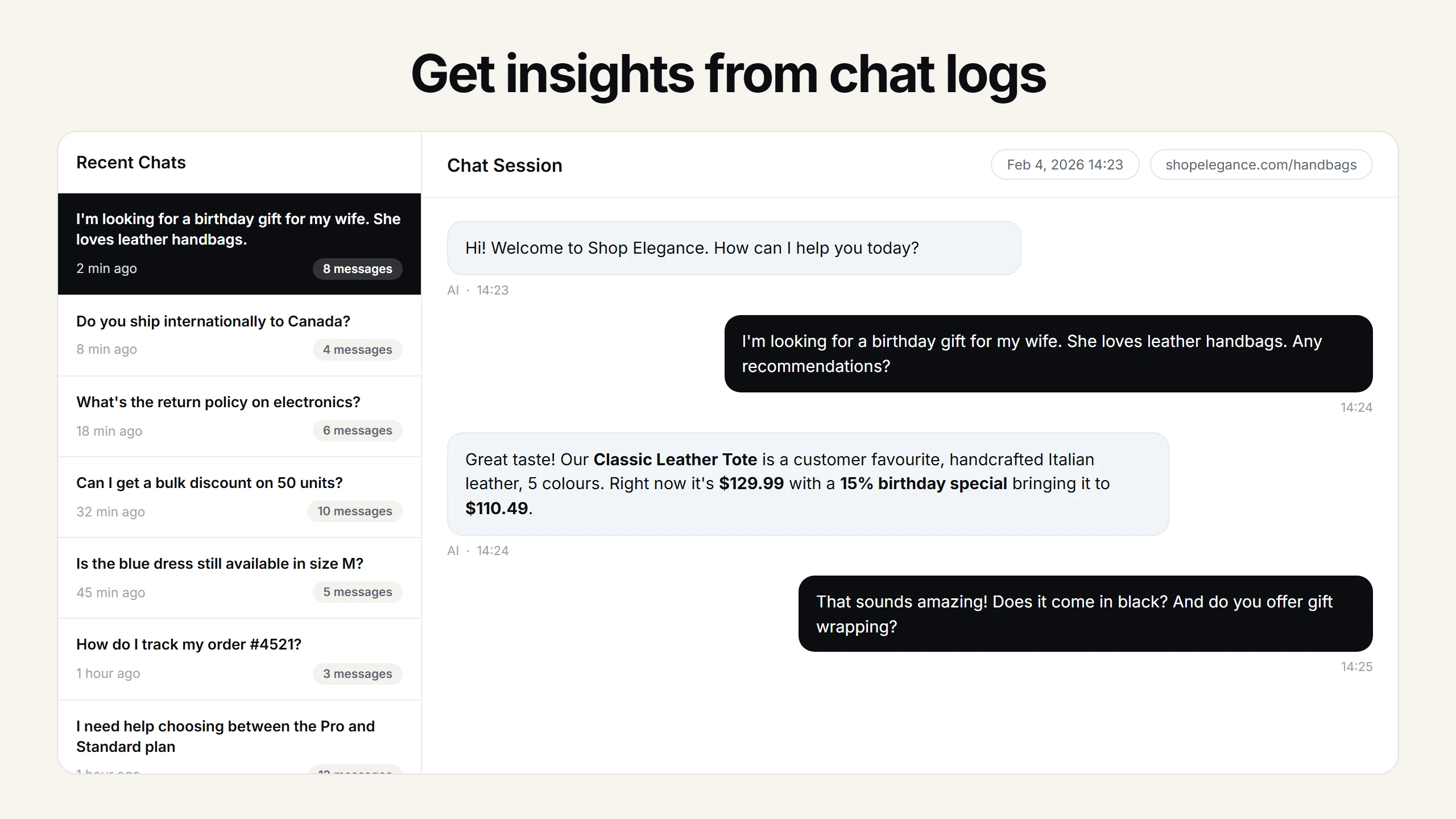
The conversation logs from a Shopify AI agent provide operational intelligence that goes beyond support metrics. When you see that inventory check calls for a particular SKU spike on weekdays, you know that product page isn't communicating availability clearly enough. When order status lookups peak 48 hours after a promotion, you know your order confirmation emails need better tracking visibility. When return eligibility checks cluster around specific products, you've identified a quality or expectation mismatch before it shows up in your return rate reports. The AI agent's dashboard becomes a window into what your customers are trying to do — not just what they're asking, but what actions they need, which products confuse them, and where your store's information architecture fails. This is customer research that happens passively, at scale, as a byproduct of resolving tickets.
The Shopify merchants who get the most from an AI agent share a pattern: they have products customers ask questions about, they process enough orders that "where is my order?" is a daily occurrence, and they value their own time (or their team's time) too highly to spend it on tasks that a well-connected AI can handle autonomously. That describes most Shopify stores above the hobbyist level. The agent doesn't require you to change how you run your store. It connects to the store you already have — the products you already sell, the policies you already wrote, the APIs Shopify already provides — and handles the support layer that's been consuming hours you can't afford. Not a chatbot that reads your FAQ. An agent that knows your catalog, calls your systems, and resolves your customers' requests from start to finish.