Reduce support tickets with AI that answers before your team has to
Ticket deflection is the fastest path to lower support costs. Asyntai's AI chatbot intercepts repetitive questions, answers them from your own content, and only escalates what genuinely needs a human — cutting ticket volume by 60-80%.
Test ticket deflection on your own site
Enter your URL and see how many of your common questions the AI can handle without a ticket
Stop the ticket before it's born — answer common questions at the point of contact
Every support team has a category of tickets that shouldn't exist. "What are your business hours?" is on your homepage. "How do I reset my password?" is in your help center. "Do you ship to Canada?" is in your FAQ. These questions are perfectly reasonable from the visitor's perspective — they just didn't find the answer. But from your team's perspective, each one is a ticket that takes three to five minutes to close and adds nothing to customer satisfaction beyond what a well-placed answer would have provided. Asyntai crawls up to 50 pages of your site and positions an AI chatbot that intercepts these questions at the source — the moment a visitor would have opened a ticket, the chatbot answers instead.
- Answers from your own contentThe AI uses your FAQ, help articles, product pages, and policies as its knowledge base — not generic responses. Visitors get the same answer your agent would have given, delivered instantly.
- Intercepts at the moment of intentInstead of letting a visitor navigate to your contact form, wait for a reply, and create a ticket, the chatbot catches the question live on the page where the visitor is already looking.
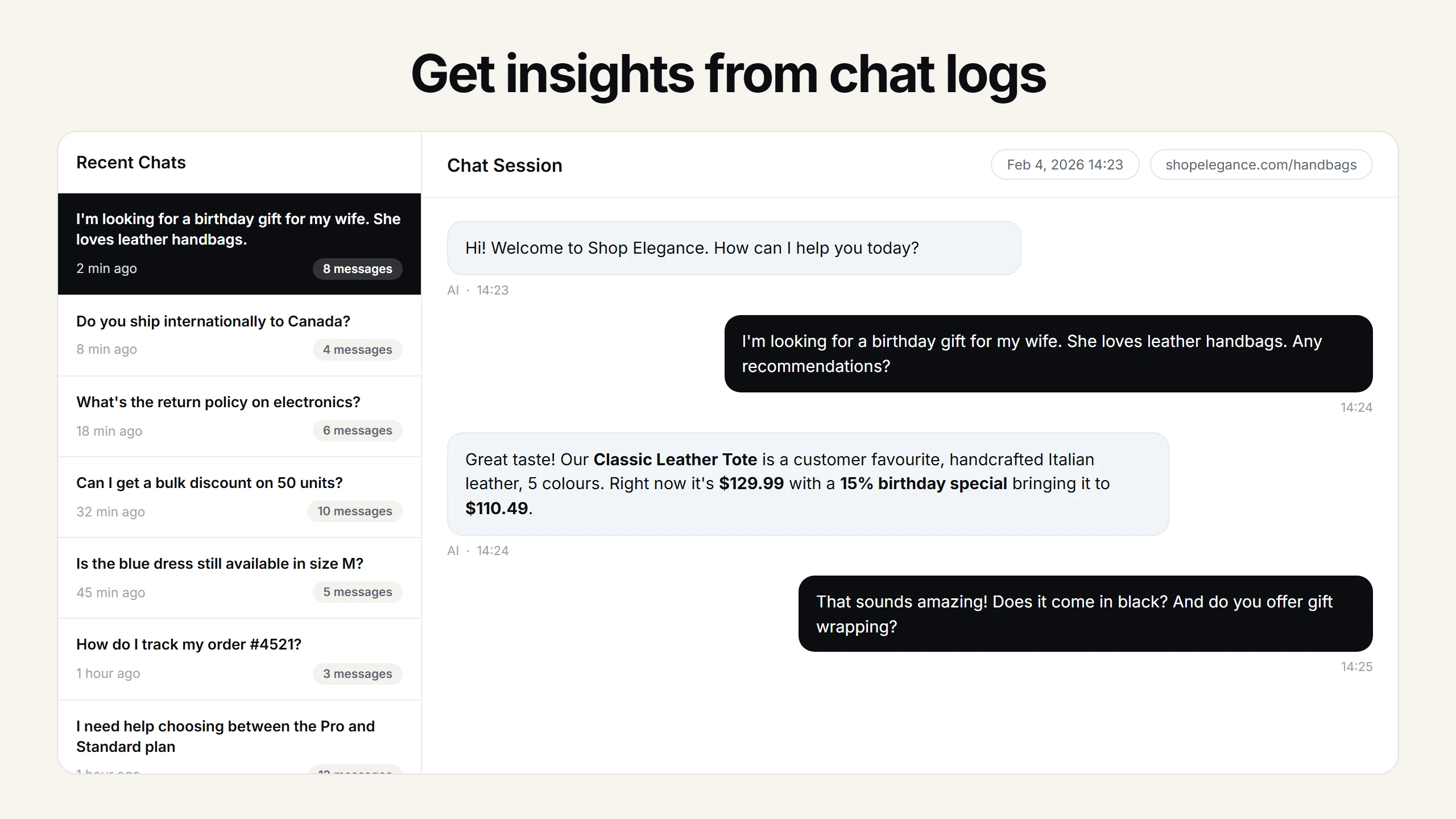
- Measurable ticket reductionEvery conversation the chatbot resolves is a ticket your team never sees. The dashboard shows exactly how many questions were deflected and what topics they covered.
When deflection alone isn't enough, give the AI access to your live data
Static content covers the first wave of deflection — FAQ answers, policy questions, how-to guides. But a significant share of tickets involve data the chatbot needs to look up: order status, account details, subscription information, inventory availability. On Standard ($139/month) and Pro ($449/month) plans, Custom Tools let the chatbot call your own API endpoints to fetch live data and even perform actions like initiating a return or updating a preference. This pushes deflection rates past what content alone can achieve, because the chatbot can now resolve the "where's my order" tickets that otherwise require an agent to open your admin panel.
- Order status without human lookupThe chatbot queries your system directly and gives the visitor their tracking number, delivery estimate, or shipment status — no ticket created, no agent time spent.
- Account-aware answersPass logged-in user context to the chatbot so it can answer plan-specific questions, check subscription status, or confirm billing details without agent involvement.
- Action-capable, not just informationalCustom Tools can trigger real actions — cancel a subscription, update a shipping address, apply a credit — so the chatbot resolves tickets that static FAQ answers never could.
- Escalation with full contextWhen the chatbot does escalate, your agent gets the visitor's email, the entire conversation, and any data the chatbot already looked up — cutting average handle time on escalated tickets.
Start deflecting tickets in under 30 minutes
No engineering sprint required. One JavaScript snippet, your website URL, and the chatbot starts intercepting repetitive questions immediately.
- Create a free account and paste your website URL
- The AI scans up to 50 pages and builds a knowledge base from your content
- Copy the one-line embed snippet into your site header
- The chatbot goes live — answering visitor questions in 36 languages
<script src="https://asyntai.com/widget.js"
data-id="your-site-id" async>
</script>
</head>
# Deflecting repetitive tickets from every page of your site.
Reducing support tickets — FAQs
Questions support leaders and operations teams ask when evaluating AI ticket deflection.
What percentage of tickets can this realistically deflect?
It depends on your ticket mix. Businesses with comprehensive help content and a high share of repetitive, content-answerable questions — shipping, billing, how-tos, policy inquiries — typically see 60-80% deflection. Businesses with more complex per-account support needs see lower deflection but still a meaningful reduction in queue volume. The dashboard tracks deflection metrics so you can measure the impact directly.
How does the chatbot know what's on my website?
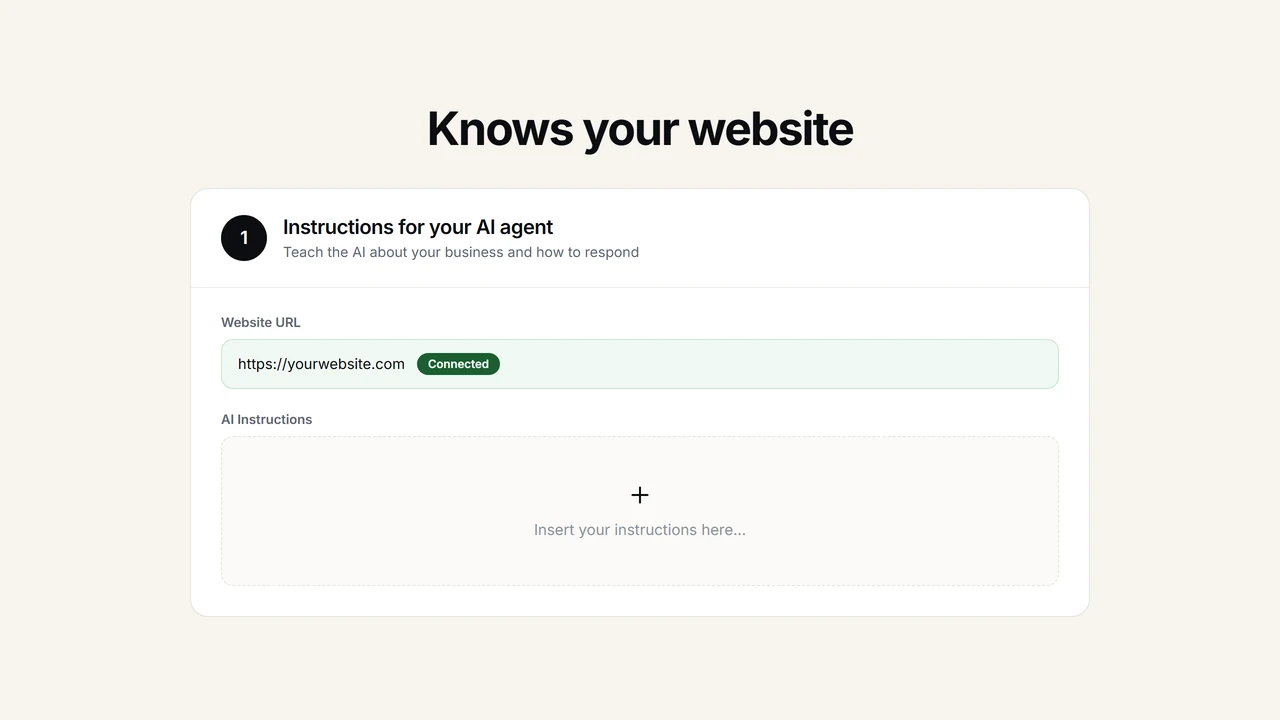
When you sign up, you provide your website URL. Asyntai crawls up to 50 pages — FAQ, product pages, help articles, policy pages — and builds a knowledge base from that content. The chatbot answers using your own content, not generic AI responses. You can also upload additional documents and write custom instructions to expand or constrain what it covers.
Does this replace our existing helpdesk or ticketing system?
No. Asyntai sits in front of your existing system as a pre-ticket deflection layer. It handles the questions it can answer from your content and escalates the rest to your current inbox or helpdesk — Zendesk, Freshdesk, Intercom, Help Scout, Gmail, or any email-based system. Your team keeps using the tools they already know; they just get fewer tickets.
What happens when the chatbot can't answer a question?
It collects the visitor's email and the full chat transcript, then sends your team an email notification with everything attached. If you route that notification to your helpdesk's ticket intake address, it becomes a properly contextualized ticket in your existing system. Your agent sees what was asked, what the chatbot tried, and where the conversation needs to pick up.
Can the chatbot do more than answer questions from static pages?
Yes. On Standard ($139/month) and Pro ($449/month) plans, Custom Tools let the chatbot call your API endpoints to fetch live data — order status, account details, subscription information — and even perform actions like processing a return. This expands deflection well beyond what FAQ-based answers alone can handle.
How does pricing work?
Free: $0/month, 1 site, 50 messages — enough to pilot. Starter: $39/month, 2 sites, 800 messages. Standard: $139/month, 3 sites, 15,000 messages, plus Custom Tools. Pro: $449/month, 20 sites, 50,000 messages. Pricing is based on chatbot message volume, not agent seats — so your cost scales with conversations, not headcount.
Does it support multiple languages?
36 languages with automatic detection. The chatbot identifies each visitor's language from their first message and responds in that language, even if all your content is in English. A German visitor gets German answers. A Korean visitor gets Korean. Your documentation stays in one language; the chatbot handles the translation layer.
How quickly can we see results?
Most teams see measurable deflection within the first week. Setup takes under 30 minutes — sign up, provide your URL, paste the snippet. The chatbot starts handling questions immediately. The deflection dashboard shows volume trends in real time, so you can compare ticket counts before and after deployment within days.
The ROI case for ticket deflection — and why most support teams are leaving it on the table
Support costs grow linearly with ticket volume, and ticket volume grows linearly with customers. That arithmetic has no natural ceiling. Every new customer brings a predictable stream of questions — some complex, most mundane — and every one of those questions becomes a ticket that costs time and money to close. For a support team handling 500 tickets a month at an average resolution time of six minutes, that's 50 hours of agent time consumed monthly. If 70% of those tickets are questions already answered in the help center, you're spending 35 hours a month having humans read a question, look up the answer, type a reply, and click send. The economics of that are hard to justify when the entire interaction could have been resolved by surfacing the right content at the right moment.
Ticket deflection is the practice of resolving a customer's question before it ever enters the support queue. It's distinct from ticket avoidance (removing the reason the question exists, like fixing a confusing UI) and from ticket automation (auto-responding to tickets after they're created). Deflection happens upstream of the queue — at the point where the visitor is about to ask the question. The idea isn't new; self-service knowledge bases have been the standard deflection tool for a decade. What's changed is that self-service only works when the visitor finds the right article, reads it, and recognizes it answers their question. In practice, most visitors don't search your help center — they open a chat, find a contact form, or send an email. The help article exists, but the visitor doesn't encounter it before they create a ticket.
An AI chatbot closes that gap. Instead of hoping the visitor navigates to the right help article, the chatbot meets them where they already are — on the product page, the checkout flow, the account dashboard, the homepage — and answers the question conversationally, pulling from the same content the help article would have provided. The visitor gets an immediate answer. The support team never sees the interaction. The ticket is not deflected — it's prevented from existing in the first place.
Asyntai implements this deflection layer by crawling your website content and building a knowledge base the chatbot uses for every conversation. You provide your URL, the AI scans up to 50 pages — FAQ, product documentation, help center articles, policy pages, pricing pages — and absorbs the text into a searchable knowledge base. When a visitor types a question into the chatbot, the AI finds the relevant content and synthesizes a direct answer. The response comes from your own published material, not from the AI's general training data. This matters because accuracy is what determines whether deflection actually works: a chatbot that gives vague or incorrect answers trains visitors to skip it and file tickets anyway.
The content types that drive the highest deflection rates follow a pattern. Policy and procedure questions — returns, refunds, shipping times, business hours, cancellation processes — deflect at extremely high rates because the answers are definitive and already documented. Product information questions — specifications, compatibility, sizing, availability — deflect well when the product pages are detailed. How-to and troubleshooting questions deflect when the help center covers the relevant workflows. Billing and account questions partially deflect from content but hit their ceiling when the visitor needs account-specific data that the chatbot can't access from static pages alone.
That ceiling is where Custom Tools on Standard and Pro plans become relevant. A "where's my order" question can't be answered from a FAQ page — it requires looking up the visitor's specific order. A "what plan am I on" question needs their account data. A "can I get a refund for my last charge" request needs transaction details. Custom Tools let the chatbot call your API endpoints during a conversation to fetch live data: order status, account tier, subscription details, transaction history, inventory counts. The chatbot synthesizes the data into a conversational response and resolves the ticket without human involvement. This pushes deflection into the category of tickets that content alone can never handle — the data-dependent tier that typically represents 15-25% of total volume.
Measuring deflection requires discipline because the metric is inherently counterfactual: you're measuring tickets that didn't happen. The cleanest approach is to compare total ticket volume before and after chatbot deployment, controlling for traffic and seasonal variation. Asyntai's dashboard provides conversation-level data — how many chats occurred, how many were resolved without escalation, what topics they covered, and where the chatbot cited gaps in your knowledge base. The gap analysis is particularly useful because it tells you exactly which content to write next. If the chatbot is escalating 40 conversations a week about "how to migrate from plan A to plan B" and you don't have a help article on that topic, writing that article directly reduces future escalation volume. The chatbot becomes a feedback loop for your content strategy.
Language coverage extends deflection to visitor segments that most support teams can't serve efficiently. If your documentation is in English but you have visitors from Latin America, Europe, and Asia, those visitors either struggle through English self-service, use machine translation on their own, or give up and file a ticket in their language — which then requires your agent to use a translation tool to respond. The chatbot supports 36 languages with automatic detection. A Spanish-speaking visitor types in Spanish, gets a Spanish answer synthesized from your English help center, and the interaction resolves without any language barrier reaching your team. For businesses with international traffic, this alone can account for a meaningful share of ticket deflection.
The escalation path determines whether the chatbot earns trust or erodes it. A chatbot that tries to answer everything — including questions it doesn't have enough information to answer confidently — will give wrong answers, frustrate visitors, and teach them to skip the chatbot entirely. Asyntai handles this with plain-English escalation rules. You write instructions like "escalate any question about custom enterprise pricing," "always offer a human handoff for billing disputes," or "never try to troubleshoot hardware issues." The chatbot follows these rules and recognizes when a question falls outside its confident range. When it escalates, it collects the visitor's email and sends your team the full conversation — not a summary, the actual transcript. Your agent picks up with full context, which also reduces handle time on the tickets that do make it through.
Cost structure matters because the ROI case for ticket deflection depends on the math working at your specific volume. Asyntai's free tier — 50 messages per month on one site — is enough to pilot the chatbot on a low-traffic section of your site and see what it deflects. Starter at $39 per month handles 800 messages across two sites, which covers the deflection needs of most small and mid-sized support operations. Standard at $139 per month adds Custom Tools and scales to 15,000 messages across three sites. Pro at $449 per month scales to 50,000 messages across twenty sites. The pricing model charges per message rather than per agent seat, so the cost scales with the volume of questions deflected rather than the number of people on your team. For most support operations, the cost of one plan tier is less than the fully loaded hourly cost of the agent time it saves in a single week.
The teams that extract the most value from AI ticket deflection share a profile: they have a meaningful volume of inbound tickets, a substantial portion of those tickets are answerable from existing content, and their support cost is growing in a way that additional hiring alone cannot sustainably address. Ecommerce companies with high order volumes see massive deflection on shipping, return, and product questions. SaaS companies with self-serve tiers deflect onboarding, billing, and feature-usage questions. Professional services firms deflect scheduling and policy inquiries. Educational institutions deflect admissions, enrollment, and course information questions. In every case, the chatbot doesn't replace the support team — it replaces the portion of the support workload that was never a good use of human time, and returns that time to the cases that genuinely benefit from human judgment, empathy, and expertise.