Your customer portal finally has someone at the front desk
Asyntai sits inside your portal and answers account questions, tracks orders, and walks customers through billing — instantly, in 36 languages, without adding a single support seat.
See it working inside a portal like yours
Enter your website URL and watch the AI field the same account and order questions your support team handles every day
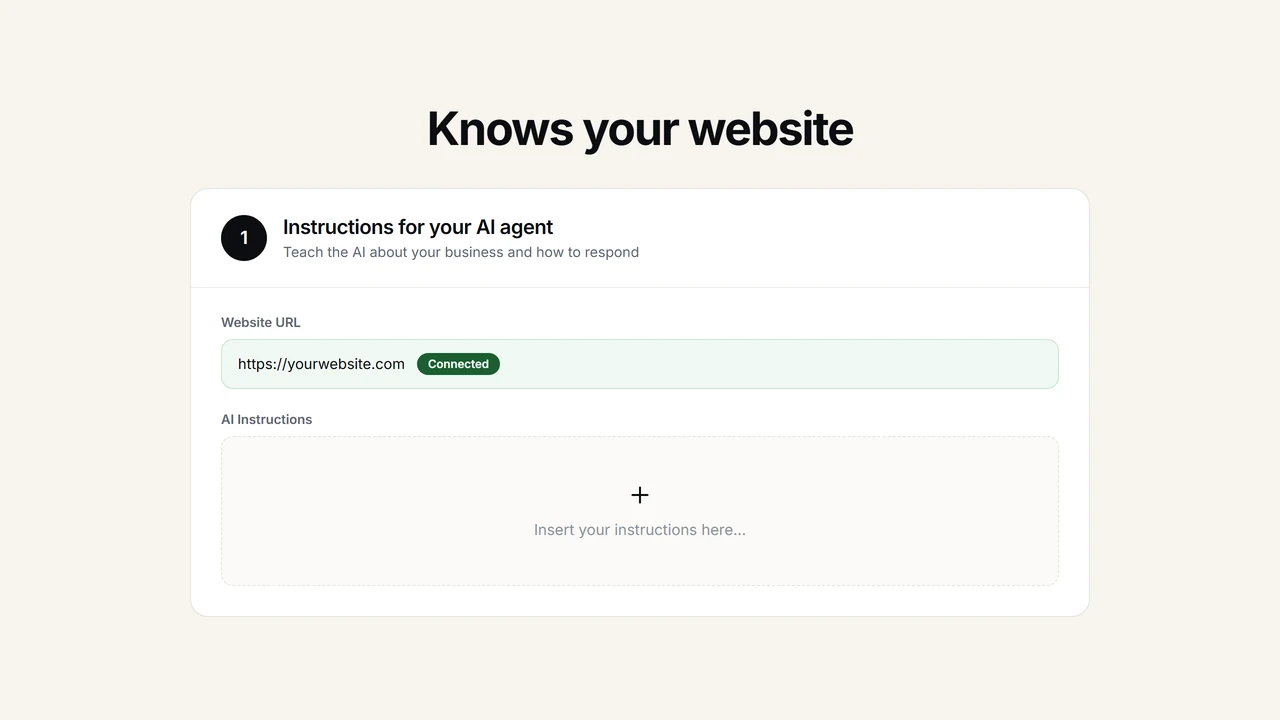
Reads every help page, policy, and FAQ your portal already publishes
Customer portals accumulate a dense web of documentation over the years — return policies buried three clicks deep, billing FAQs that haven't been updated since the last redesign, shipping tables organized by region that nobody bookmarks. The knowledge exists, but it sits behind navigation that customers abandon before they find the right article. Asyntai absorbs all of it. Point the crawler at your portal domain and it walks through up to fifty pages of help content, terms, product guides, and policy documents. Upload anything internal as a PDF or paste it directly. From that point forward, the AI answers questions by pulling the relevant sentence from the relevant source — not by guessing, not by summarizing the whole page, but by retrieving the specific piece that matches what the customer actually asked.
- Absorbs your published portal contentHelp articles, shipping tables, return windows, account FAQs, product guides, terms of service — anything publicly accessible on your portal domain gets ingested and made conversational.
- Accepts private operational documentsInternal escalation guides, edge-case handling notes, region-specific policies, or seasonal promotions — upload as PDFs or paste directly so the AI references material customers would otherwise need an agent to access.
- Stays current with a single re-crawlUpdated your refund window or changed a shipping carrier? Re-crawl from the dashboard and the assistant references the latest version within minutes. No manual article mapping required.
Pulls real order status, billing details, and subscription info mid-conversation
Portal visitors rarely ask generic questions. They want to know where their specific order is, when their next invoice drops, or whether their subscription renewal went through. Custom Tools on Standard ($139/month) and Pro ($449/month) plans let the AI call your own API endpoints during the conversation — retrieving order tracking numbers, checking payment method status, looking up subscription tiers, or verifying refund progress — and folding that live data into a natural response the customer can act on immediately.
- Order status and trackingThe AI calls your fulfillment endpoint and returns the carrier, tracking number, and estimated delivery date — no need for the customer to dig through confirmation emails.
- Billing and invoice lookupsCustomers asking about their last charge, upcoming renewal, or payment method on file get a direct answer pulled from your billing system in real time.
- Subscription management queriesPlan tier, renewal date, usage limits, upgrade options — the AI surfaces the details from your backend so customers understand their account without navigating settings menus.
- Return and refund progressFor customers who initiated a return, the AI checks the status — received, inspected, refund issued — and provides a concrete update instead of a generic timeline.
- User Context for personalizationPush signed-in customer data (name, tier, last order ID) into the widget via a JavaScript object. The AI greets them by name and answers account-specific questions without any backend integration on its side.
Add an AI concierge to your portal before lunch
No portal redesign. No backend integration sprint. One JavaScript snippet placed in your portal template, one pass through your help content, and your customers have a conversational assistant that handles the questions your support queue used to own.
- Sign up for a free Asyntai account — the Free plan gives you 1 site and 50 messages per month at $0, enough to test inside your staging portal before going live.
- Paste the widget snippet into your portal template's
<head>tag. Works with any framework — React, Vue, plain HTML, or a CMS-rendered portal. - Point the crawler at your portal domain and upload any private documents (internal SOPs, escalation guides, seasonal policy overrides) to round out the knowledge base.
- Write custom instructions for tone and escalation rules, preview a handful of real customer questions, and publish. Scale to Starter ($39/mo, 2 sites, 800 messages), Standard ($139/mo, 3 sites, 15,000 messages), or Pro ($449/mo, 20 sites, 50,000 messages) as portal traffic grows.
<script src="https://asyntai.com/widget.js"
data-id="your-site-id" async>
</script>
# One snippet. Every portal page covered.
Online Customer Portal Software — FAQs
Answers to the questions portal owners and customer experience leads ask before embedding an AI assistant.
Does the AI only answer generic questions, or can it handle account-specific lookups?
Both. Out of the box it answers general questions using your portal's published help content — return policies, shipping details, product specs, billing FAQs. On Standard and Pro plans, Custom Tools let the AI call your own API endpoints mid-conversation to pull live account data: order tracking, subscription status, invoice history, refund progress. The customer gets a specific answer about their specific account, not a link to a help article.
Will the widget slow down my portal or conflict with existing scripts?
The widget loads asynchronously via a single script tag, so it never blocks your portal's rendering. It runs in its own scope and doesn't touch the DOM outside its own container. Teams running React, Angular, Vue, and server-rendered portals all embed it without conflicts. Total payload is under 50 KB.
Can the AI answer in the same language my customer is typing?
Yes. The widget interface renders in 36 languages, and the AI responds in whichever language the visitor uses. A customer typing in Japanese receives Japanese. Someone typing in Portuguese receives Portuguese. Language detection is automatic — no routing, no manual toggles, no separate knowledge bases per language.
How does the AI know when to hand off to a human agent?
You define escalation rules in plain English through custom instructions. Common examples: escalate billing disputes above a dollar threshold, escalate any conversation where the customer mentions legal action, escalate cancellation requests that involve a contract. The assistant obeys and passes the full transcript to your team with context attached, so the agent picking up the conversation doesn't start from scratch.
What happens when the AI doesn't have an answer?
It says so honestly. Rather than improvising or making something up, the assistant tells the customer it doesn't have that information and offers to connect them with your support team or capture their details for a follow-up. You can fine-tune this behavior with custom instructions — for instance, directing the AI to suggest specific help center sections before offering escalation.
Can I white-label the widget so it matches my portal brand?
On Pro plans, white-labeling is automatic — all Asyntai branding is removed and the widget adopts your colors, name, and avatar. On Standard plans, white-labeling is available manually by emailing [email protected]. Both options let the widget blend seamlessly into your portal design.
What does this cost compared to hiring another support agent?
The Free plan gives you 50 messages per month at no cost — enough to validate inside a staging portal. Starter runs $39 per month for 800 messages across 2 sites. Standard is $139 per month for 15,000 messages and 3 sites, including Custom Tools for live data lookups. Pro is $449 per month for 50,000 messages across 20 sites. Each resolved portal conversation costs a fraction of a cent, compared to the fully loaded cost of a human support interaction.
Can I run the assistant on multiple portals or brands?
Yes. Free covers 1 site, Starter handles 2, Standard 3, and Pro up to 20. Each portal gets its own knowledge base, its own custom instructions, and its own escalation rules — ideal for agencies managing client portals or companies running separate portals for different product lines.
The portal your customers log into should be smarter than a list of links
Every customer portal starts with good intentions. A clean dashboard. A sidebar of account options. A help section. A contact link somewhere in the footer. And for the first few hundred customers it works fine, because the team behind it can absorb the tickets that slip through. But portals don't stay small. The product catalog grows, the billing model adds tiers, the return policy picks up regional exceptions, and suddenly the portal that once felt intuitive becomes a maze of nested menus where customers wander looking for a specific answer about their specific situation. The help section has the information — buried in an article that was written two product versions ago, under a heading that doesn't match the way any customer would phrase the question.
That gap between having the information and delivering it at the moment a customer needs it is where most portal support tickets are born. Not because the company failed to document something, but because the documentation lives behind an interface the customer couldn't navigate fast enough. They click Account, then Billing, then scroll past three sections, don't find their answer, and open a ticket that says "I just need to know when my next payment is." Somebody on your team reads the ticket, looks up the answer in twenty seconds, and sends a two-line reply. The customer waited hours for a response that took less time to produce than to type. Multiply that across every portal visitor with a billing, shipping, or subscription question, and you start to see why the support queue never shrinks no matter how much documentation you add.
Asyntai approaches this differently. Instead of rebuilding your portal or migrating your help content into yet another system, it sits on top of what you already have. One script tag in your portal template, and the AI assistant is present on every page — reading the same help articles, policy documents, and FAQ entries your team already wrote, and converting them into conversational answers the moment a customer asks. A shopper typing "when does my annual subscription renew" doesn't need to find the Subscription Management page and scan for the Renewal section. They type their question and get a direct answer referencing the content your team published. The information hasn't changed. The distance between the customer and the answer just collapsed to zero.
What makes a portal assistant fundamentally different from a generic website chatbot is that portal visitors are already customers. They have accounts. They have order histories. They have payment methods on file and subscriptions with renewal dates and loyalty points accruing somewhere in a database. A generic chatbot that can only answer from static content is useful, but it hits a wall the moment someone asks about their own account. Asyntai's User Context feature, available on Standard and Pro plans, breaks through that wall by letting your portal push customer-specific data into the widget before it loads. First name, subscription tier, last order number, loyalty balance — whatever you choose to share. The assistant then answers questions like "has my refund been processed" or "what plan am I on" using that context, without any backend API call required on the basic level.
For portals that need deeper integration, Custom Tools on Standard and Pro plans go further. You define API endpoints — your order management system, your billing platform, your subscription service — and the AI calls them mid-conversation to retrieve live data. A customer asking "where is my order" gets the tracking number and carrier pulled from your fulfillment API, not a suggestion to check their email for a shipping confirmation. A customer asking about their upcoming invoice gets the amount and date from your billing system. The conversation feels like talking to a support agent who has every system open on their screen, except it happens at machine speed, at any hour, without anyone on your team lifting a finger.
Language is an underappreciated dimension of portal self-service. If your product ships internationally — or your SaaS serves companies in multiple countries — your portal visitors arrive in dozens of languages. Most portals handle this with a language toggle that swaps the interface text but leaves the help content untranslated, which means a German-speaking customer navigates a German dashboard but reads English help articles. Asyntai's assistant responds in whichever language the visitor types, drawing from your English-language source content and delivering the answer in fluent German, Japanese, Spanish, Arabic, or any of 36 supported languages. The customer never sees a language mismatch. They ask in their language, they receive in their language, and the underlying source of truth remains the single set of help documents your team maintains.
Portals also carry a unique trust dynamic that public-facing websites don't. A visitor on your marketing site is evaluating your brand. A visitor inside your portal has already committed — they're a paying customer, they've handed over payment details, they expect the experience behind the login wall to be better than the one outside it. When the portal can't answer a straightforward billing question without a support ticket, that trust takes a hit. The customer doesn't think "their help center needs work." They think "I'm paying for this and they can't even tell me when my order ships." An AI assistant that responds in seconds with a specific, sourced answer reinforces the trust that brought the customer through the door in the first place.
Escalation inside a portal context works differently too. On a public marketing site, escalation usually means "pass them to sales." Inside a portal, escalation means "this specific customer has a specific problem that requires human judgment." Billing disputes, account ownership transfers, refund amounts above a threshold, contract renegotiations — these need a person. Asyntai lets you define those lines in plain-language custom instructions, and the assistant respects them without gate-keeping. When a conversation crosses an escalation boundary, the full transcript passes to your support team with the customer's account context attached. The agent who picks up the ticket sees what was already discussed, what was already answered, and what the customer is actually asking for — no cold start, no "could you repeat that."
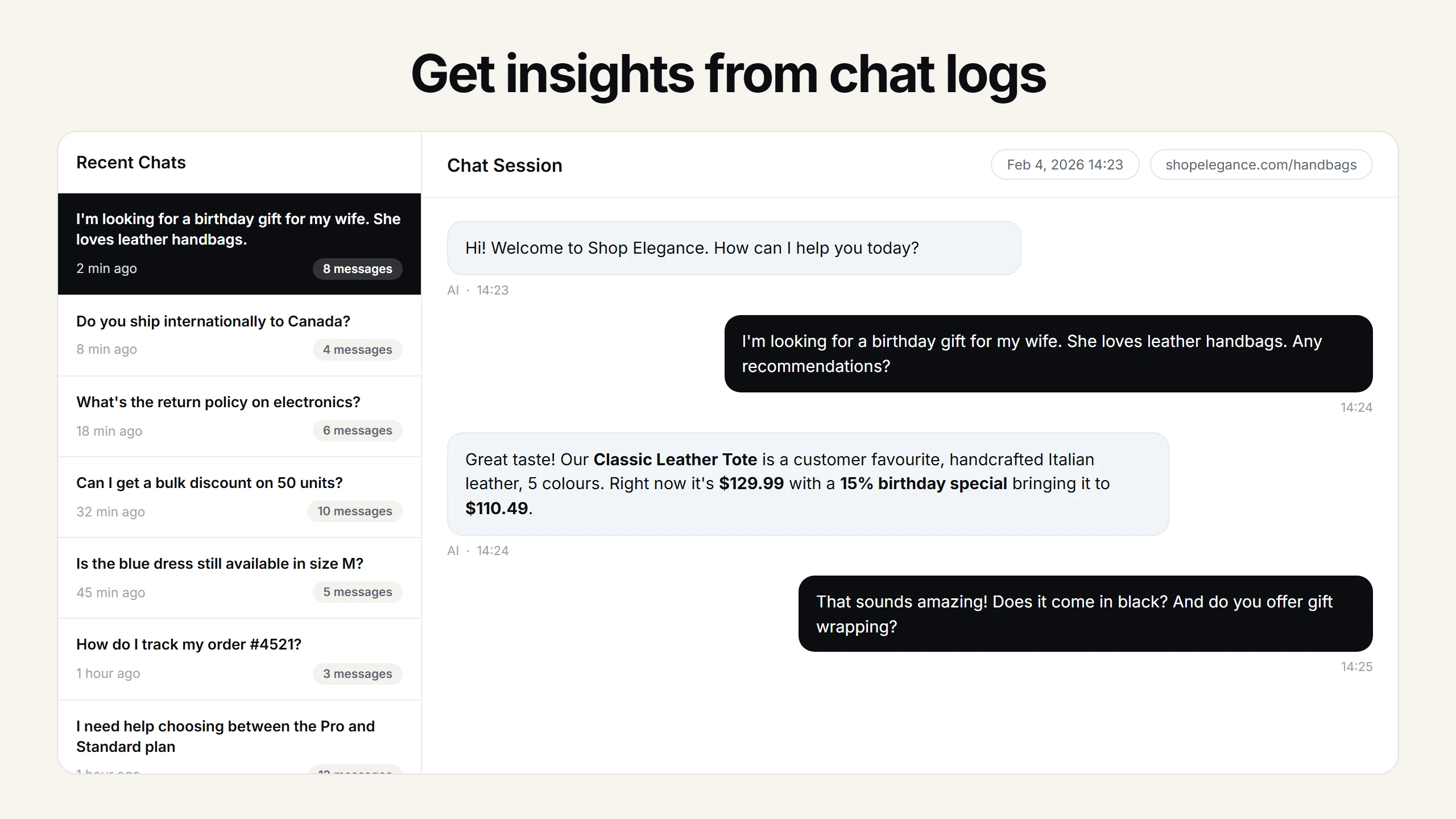
The analytics dimension is where portal-embedded AI starts paying compounding returns. Every conversation the assistant handles is a data point about what your customers struggle with. If five hundred portal visitors per month ask about updating payment methods, that's a signal — maybe the Payment Methods page is hard to find, maybe the button label is confusing, maybe there's a UX issue on mobile. Asyntai's dashboard groups these patterns by topic and frequency, giving your product and UX teams a prioritized list of portal friction points ranked by real customer behavior. Over time, the portal gets better because the assistant keeps teaching you where it falls short.
White-labeling matters more inside a portal than almost anywhere else, because the portal is your branded space. On Pro plans, Asyntai branding is removed automatically — the widget adopts your portal's colors, your company name, and your chosen avatar. On Standard plans, white-labeling is available by contacting [email protected]. Either way, the assistant feels native to the portal rather than bolted on. Customers interact with it as part of your product, not as a third-party tool you embedded.
Multi-portal operations are handled by plan tier. A single Asyntai account on the Pro plan can run up to twenty separate portal assistants, each with its own knowledge base and escalation rules. Agencies managing client portals, SaaS companies with separate products, and retail groups with distinct brand portals all benefit from centralized management without cross-contamination between knowledge bases. Each assistant only knows what its own portal teaches it, which keeps answers relevant and prevents data leakage between brands.
The economics of portal self-service through AI are unusually clean because the baseline comparison is direct. Every question the assistant resolves is one fewer ticket in your support queue. If your average ticket costs seven to twelve dollars in fully loaded agent time and your Asyntai plan costs $139 per month for 15,000 messages, the math closes quickly — even if the assistant only handles a fraction of total portal volume, each deflected ticket pays for itself many times over. The free tier at 50 messages is large enough to test on a staging portal, and the pricing curve from Starter ($39) through Pro ($449) scales with actual message volume rather than seats or features you might not use.
There's a philosophical point underneath all of this that's worth stating plainly. A customer portal should be the place where your relationship with the customer is easiest, not where it's most frustrating. Every unresolved question that forces a ticket, every policy lookup that requires navigating four pages, every billing inquiry that sits in a queue for hours — those are moments where the portal is working against the relationship instead of for it. An AI assistant that answers immediately, accurately, and in the customer's own language turns the portal from a dashboard they tolerate into a resource they trust. That shift doesn't require rebuilding anything. It requires giving the content you already have a voice that customers can actually hear.
Getting started takes less time than your last portal team meeting. Sign up at the pricing page, paste the snippet into your portal template, point the crawler at your help content, set your escalation rules, preview a few real customer questions, and publish. From that point forward, every portal visitor has an assistant that knows your policies, speaks their language, and — on Standard and Pro plans — can look up their account in real time. Your support queue gets lighter. Your customers get faster answers. And the portal starts doing what it was always supposed to do: make the relationship effortless. See which plan fits your portal.