Omnichannel customer engagement — one voice across every page and every language
Asyntai delivers a consistent AI-powered conversation on every page of your website, in 36 languages, with one knowledge base and one dashboard. No fragmented tools, no disconnected experiences.
Experience unified engagement on your own site
Drop your URL below — see how a single AI assistant delivers consistent, contextual answers drawn from your content
The same knowledge, the same voice, on every page
Fragmented engagement tools create fragmented experiences. One chat widget on the homepage, a different FAQ page for the help section, a contact form buried three clicks deep. Visitors who navigate between pages encounter different tones, different information, and different capabilities depending on where they land. Asyntai eliminates that fragmentation with a single AI assistant — powered by one knowledge base — that follows the visitor across every page and delivers a consistent, contextual conversation regardless of where the interaction happens.
- Single knowledge base, universal presenceEvery page on your site draws from the same indexed content — crawled pages, uploaded documents, and configured instructions. The visitor gets the same quality of answer on the blog as on the checkout page.
- Consistent brand voiceTone, personality, and response style are configured once and applied everywhere. The chatbot sounds the same whether the visitor is browsing products, reading documentation, or checking policies.
- Conversation continuityA visitor who starts a conversation on the pricing page and navigates to the features page does not lose context. The dialogue persists across page loads, maintaining the thread of the interaction.
Global engagement without a global team
True omnichannel engagement means speaking the visitor's language — literally. Asyntai supports 36 languages with automatic detection at the message level. A visitor in Seoul writes in Korean and gets a Korean reply. A visitor in Berlin writes in German and gets a German reply. The same chatbot, the same knowledge base, the same subscription. On Standard ($139/month) and Pro ($449/month), Custom Tools extend this multilingual engagement to backend actions — order lookups, availability checks, and account queries — all delivered in the visitor's own language.
- Automatic language detectionNo routing rules, no language selectors, no separate bots. The AI identifies the visitor's language from the first message and responds natively. Switching languages mid-conversation is handled seamlessly.
- 36 supported languagesArabic, Bulgarian, Czech, Danish, Dutch, English, Estonian, Finnish, French, German, Greek, Hebrew, Hindi, Croatian, Hungarian, Indonesian, Italian, Japanese, Korean, Lithuanian, Latvian, Malay, Norwegian, Polish, Portuguese, Romanian, Russian, Slovak, Slovenian, Serbian, Swedish, Thai, Turkish, Ukrainian, Vietnamese, and Simplified Chinese.
- Custom Tools in any languageOn Standard and Pro, backend queries and actions work in the visitor's language. An order status lookup returns results naturally in Japanese just as smoothly as in English — no translation layer needed.
- One subscription, global reachNo per-language add-ons, no international surcharges. The same plan that serves your domestic audience serves your international audience without a change to the invoice.
Deploy omnichannel engagement in a single snippet
One script tag places a unified AI assistant on every page of your site. The same line of code that works on WordPress works on Shopify, Magento, Joomla, Drupal, Odoo, Webflow, Wix, and any platform that accepts custom scripts.
- Sign up for free — 1 site, 50 messages/month, $0. No credit card, no contract, no implementation timeline.
- Add the snippet to your site-wide header. It loads on every page automatically. Native plugins are available for WordPress, Shopify, WooCommerce, Magento, Joomla, Drupal, Odoo, and many more.
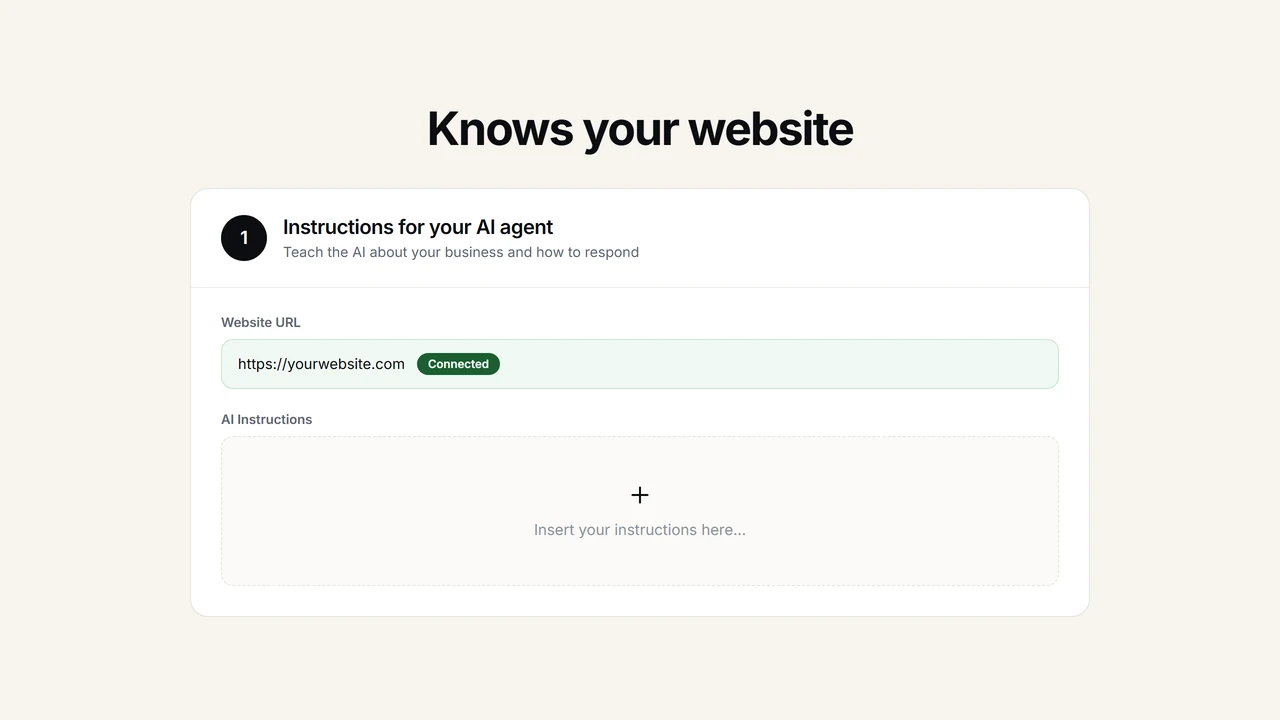
- Feed the knowledge base your URL (crawls up to 50 pages) and upload any supplementary documents — product guides, policy PDFs, help articles.
- Scale as engagement grows: Starter $39/mo for 2 sites and 800 messages, Standard $139/mo for 3 sites and 15,000 messages, Pro $449/mo for 20 sites and 50,000 messages.
<script src="https://asyntai.com/widget.js"
data-id="your-site-id" async>
</script>
# One snippet. Every page. Every language. One voice.
Omnichannel Customer Engagement Software — FAQs
Questions teams ask when evaluating unified engagement platforms for their websites.
What does omnichannel mean in the context of a website chatbot?
In this context, omnichannel means delivering a consistent, unified engagement experience across every page of your website and in every language your visitors speak. Rather than having separate tools for different pages or different audiences, one AI assistant handles all interactions with the same knowledge, the same tone, and the same capabilities — regardless of where or how the visitor engages.
Does the chatbot work on every page or just specific ones?
The snippet loads site-wide, so the chatbot appears on every page by default. If you want to exclude specific pages, you can configure that in the dashboard. Most businesses leave it site-wide because the unified presence is the whole point — visitors get help wherever they happen to be browsing.
How does language detection work?
The AI analyzes the visitor's first message and identifies the language automatically. No language selector, no browser-language sniffing, no manual routing. If a visitor switches languages mid-conversation, the chatbot adapts to the new language on the next reply. All 36 supported languages work this way out of the box.
Can the chatbot handle visitors on mobile and desktop equally well?
Yes. The widget is fully responsive and adapts to the visitor's screen size. The experience on a phone is not a shrunken version of the desktop widget — it is a purpose-built mobile interface with touch-friendly controls and appropriate sizing. The same snippet handles both without separate configuration.
Is the conversation preserved when a visitor navigates between pages?
Yes. The conversation persists across page loads within the same session. A visitor who starts asking about pricing on one page and then navigates to the features page can continue the same thread without repeating themselves. This continuity is a core part of the omnichannel experience.
How many sites can I run on one account?
Free covers 1 site, Starter covers 2, Standard covers 3, and Pro covers 20. Each site has its own knowledge base, styling, and lead inbox, all managed from one dashboard and one subscription. For multi-brand businesses or agencies, Pro provides broad coverage under a single account.
Does the platform integrate with CRM or helpdesk tools?
Leads are captured in the Asyntai dashboard and can be forwarded via email notifications to any inbox. There is no native CRM sync — teams that want leads in HubSpot, Salesforce, or another system export from the dashboard or route email notifications into their existing intake workflow. On Standard and Pro, Custom Tools can connect to any system with an API.
What does white-labeling look like on an omnichannel deployment?
On Pro, the Asyntai badge is removed automatically across all pages and all languages — the widget appears as a native part of your site. On Standard, this option is available by contacting [email protected]. The white-label experience applies uniformly: same branding, same absence of third-party marks, on every page the widget appears.
Can I use Custom Tools with the omnichannel setup?
Yes, on Standard ($139/month) and Pro ($449/month). Custom Tools work the same way regardless of which page the visitor is on — the chatbot calls your API endpoint when relevant to the conversation. An order lookup triggered on the support page works identically to one triggered on the homepage. The tools are knowledge-base-wide, not page-specific.
Omnichannel customer engagement software — building one conversation across many touchpoints
The word "omnichannel" has been stretched thin by enterprise marketing decks, but the underlying idea is sound: a customer's experience should not reset every time they move between touchpoints. In a physical store, this happens naturally — the same associate helps you whether you are at the front display or the back counter, and they remember what you asked two minutes ago. Online, this continuity is surprisingly rare. Most websites serve different interaction tools on different pages: a chatbot on the homepage, a static FAQ in the help section, a contact form on the about page, and nothing at all on the blog. Each is a dead end that knows nothing about the others. The visitor is forced to restart every interaction from zero, losing context and patience in equal measure.
Omnichannel customer engagement software on a website means eliminating those resets. A single AI assistant, backed by one knowledge base, present on every page, capable of answering any question regardless of where the visitor happens to be — and doing so in the visitor's own language without requiring a separate instance for each locale. This is the experience Asyntai delivers: one snippet in the site header creates a universal engagement layer that follows visitors across pages, maintains conversation history, and adapts to their language in real time.
The knowledge base is the foundation of consistent engagement. When a chatbot on the homepage knows about pricing but the one on the support page does not, or when the FAQ section contradicts what the help widget says, visitor trust erodes instantly. Asyntai's approach prevents this by indexing your content once — crawling up to fifty pages and incorporating uploaded documents — and making that entire index available to the chatbot regardless of which page the visitor is viewing. A question about return policies gets the same answer on the product page as on the checkout page, because both draw from the same source. This consistency sounds obvious, but achieving it without a unified platform requires careful coordination that most businesses never invest in.
Language is the dimension where omnichannel engagement becomes genuinely complex, and where most businesses give up. Supporting multiple languages typically means maintaining parallel content, hiring multilingual staff, or deploying separate chatbot instances with translated scripts. Each approach multiplies cost and management overhead linearly with the number of languages. Asyntai collapses that complexity into a single installation that supports 36 languages natively. The AI detects the visitor's language from their first message and responds accordingly — the same knowledge base, the same tone instructions, the same chatbot. A Japanese visitor on a page written in English still gets a Japanese reply. A Spanish speaker navigating a German site gets help in Spanish. The omnichannel promise extends across languages without multiplying the operational burden.
Conversation continuity across page navigations is a technical detail that visitors notice immediately when it is absent. Imagine asking a chatbot about product compatibility on one page, clicking through to the specifications page to verify something, and finding that the chatbot has forgotten the entire previous exchange. With Asyntai, the conversation persists across page loads within the same session. The thread of dialogue carries forward, so a visitor who opens with a question on the blog and continues it on the pricing page never has to repeat themselves. This continuity is essential to the omnichannel experience — without it, a site-wide chatbot is just the same stranger greeting you at every door.
The value of a unified engagement layer becomes most apparent when you consider the alternative: managing multiple tools for different purposes. A typical fragmented setup might include a live chat plugin for the homepage, a FAQ knowledge base for the help center, a contact form for general inquiries, an email capture popup for the blog, and maybe a scheduling widget for the services page. Each tool has its own dashboard, its own analytics, its own content to maintain, and none of them share information. The support team checks three places for incoming messages. The marketing team tracks engagement across two different analytics panels. And the visitor experiences a different brand personality depending on which page they are reading. Replacing all of those with one chatbot that handles every interaction is not just simpler — it produces a fundamentally better visitor experience because the consistency is built in rather than bolted on.
Multi-site deployments make the omnichannel argument even stronger. A business with two or three related properties — a main site, a blog on a subdomain, a regional variant — needs the engagement layer to work consistently across all of them. On the Starter plan, Asyntai covers two sites. Standard covers three. Pro covers twenty. Each site can have its own knowledge base and styling while sharing the same dashboard and the same subscription. An agency managing clients across different domains, or a holding company running multiple brands, can deploy a consistent engagement strategy from one account without juggling separate vendor relationships for each property.
User Context on Standard and Pro plans adds a personalization layer that deepens the omnichannel experience for logged-in visitors. By passing a JavaScript object with visitor-specific data — name, account tier, last purchase, support history — the chatbot can tailor its responses to the individual. A returning customer asking about their subscription gets an answer informed by their actual plan, not a generic overview. A premium member gets acknowledged as such. This kind of personalization used to require a dedicated CRM integration and a development project; with Asyntai, it is a JavaScript snippet that your site passes to the widget, and the AI uses that context automatically.
Custom Tools on Standard at $139 per month and Pro at $449 per month let the omnichannel chatbot perform actions, not just answer questions. These tools work uniformly across the site — an order status lookup works whether the visitor triggers it from the homepage, the support page, or a product page. The chatbot calls your API endpoint when the conversation warrants it, fetches the result, and presents it in the visitor's language. For businesses that have already invested in backend APIs, Custom Tools transform the chatbot from an informational layer into a transactional one without additional development beyond providing the endpoint.
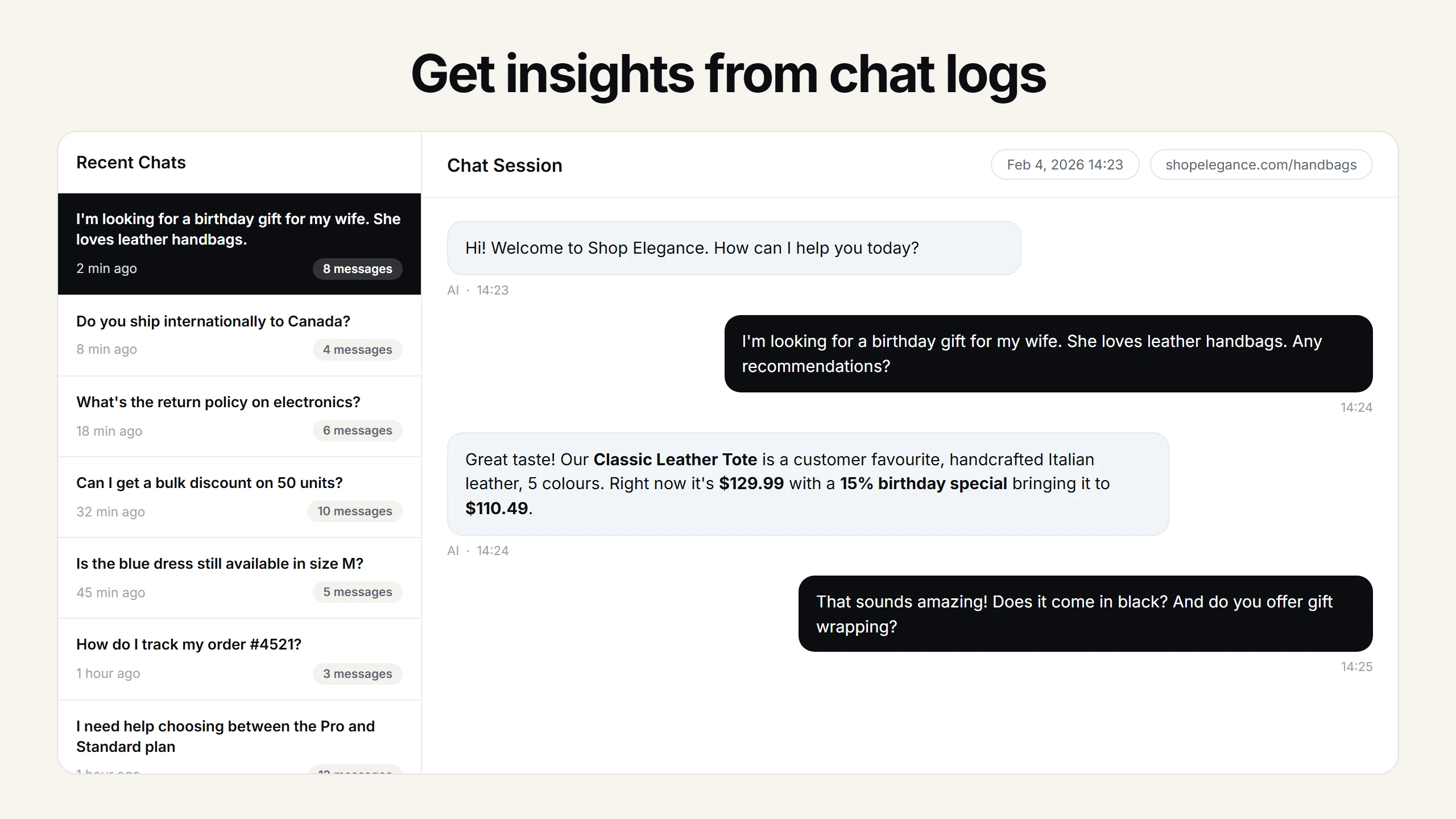
Analytics across the omnichannel deployment give you a single view of how visitors engage with the chatbot site-wide. Rather than checking separate dashboards for each page or each tool, the Asyntai dashboard shows conversation volume, topic distribution, language breakdown, and lead capture metrics in one place. You can see which pages drive the most chatbot interactions, which languages your visitors speak most frequently, and which topics generate the most questions. This unified analytics view is what makes omnichannel engagement strategic rather than tactical — it lets you optimize the experience based on data that spans the entire site.
Mobile responsiveness is a dimension of omnichannel that often gets overlooked. A visitor who browses your site on a phone at lunch and then returns on a laptop in the evening should encounter the same chatbot with the same capabilities. The Asyntai widget is fully responsive — the mobile experience is not a scaled-down desktop widget but a purpose-built interface with touch-friendly controls and appropriate sizing. The snippet handles both environments without separate configuration, and the conversation state persists regardless of device within the same session.
White-labeling in an omnichannel deployment ensures brand consistency across every touchpoint. On Pro, the Asyntai badge is removed automatically — every page, every language, every device shows a chatbot that appears to be a native part of your site. On Standard, the same option is available by contacting [email protected]. For businesses that have invested in brand consistency across their web properties, this detail matters: a third-party badge on the chat widget creates a visible seam in what should be a seamless experience.
The installation simplicity of the platform is worth emphasizing because omnichannel tools have a reputation for complex deployments. Traditional omnichannel engagement platforms require weeks of integration work, custom development for each channel, and ongoing maintenance as channels evolve. Asyntai is one script tag in the site header. It loads on every page, handles every language, and connects to the dashboard — the entire omnichannel deployment is a single copy-paste action. Plugins for WordPress, Shopify, WooCommerce, Magento, Joomla, Drupal, Odoo, Webflow, and Wix make it even simpler for businesses on those platforms.
The pricing model aligns with the omnichannel promise: one subscription covers everything. There are no per-language surcharges, no per-page fees, no separate charges for mobile versus desktop, and no premium for conversation continuity. The Free plan at $0 covers 50 messages on one site with all 36 languages. Starter at $39 per month covers two sites and 800 messages. Standard at $139 covers three sites and 15,000 messages. Pro at $449 covers twenty sites and 50,000 messages. The tiers scale on conversation volume and site count — the two axes that actually grow — while languages, features, and capabilities remain inclusive. Start free and experience the unified engagement firsthand, or select a paid plan that matches your scale from the beginning.