n8n chatbot: building chatbots in n8n vs adding one to your website
n8n's AI Agent and Chat Trigger nodes let you build chatbots inside automation workflows. That works well for internal tooling and webhook-driven assistants — but for a customer-facing chatbot on your website, you need a widget that lives in the browser. This guide explains what each approach is good for, where the boundaries are, and how Asyntai pairs with n8n to give you a website chatbot that triggers your existing automation flows.
See a website chatbot built without writing an n8n workflow
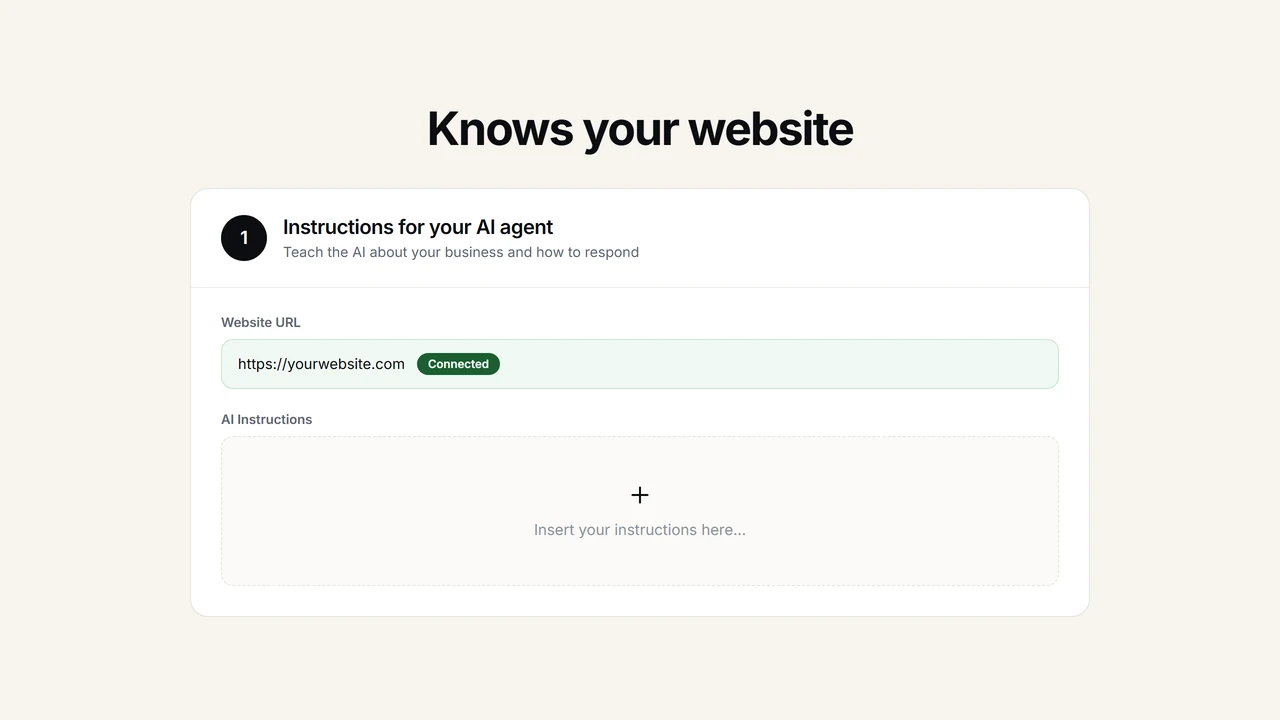
Paste a URL and watch the AI absorb the content. Same outcome as an RAG workflow in n8n, with no nodes to wire up
What you can build with n8n's AI Agent and Chat Trigger nodes
n8n ships native nodes for building conversational AI: the AI Agent node orchestrates LLM calls, tool use, and memory; the Chat Trigger node provides a webhook-style entry point for messages; and ecosystem nodes connect to OpenAI, Anthropic, vector databases, and downstream systems. For internal tools, Slack/Discord bots, webhook-driven assistants, and back-end agent workflows, the n8n-native approach is genuinely powerful and inexpensive to run.
- AI Agent node + toolsThe AI Agent node calls an LLM, decides which downstream tools to invoke, and loops through reasoning steps. You wire up the tools as separate n8n nodes — HTTP requests, database lookups, calendar actions — and the agent calls them based on conversation context.
- Chat Trigger as the entry pointThe Chat Trigger node exposes a webhook your application can post messages to, with built-in conversation memory keyed by session ID. It's ideal for Slack bots, internal API-driven assistants, or any scenario where the chat lives behind your own front-end code.
- RAG patterns with vector storesn8n's vector store nodes (Pinecone, Qdrant, in-memory) plus the AI Agent's retrieval tools let you build retrieval-augmented chatbots that answer from your own documentation. Setup involves several nodes and some prompt engineering, but it works.
When you need a website chatbot, n8n is missing the front-end half
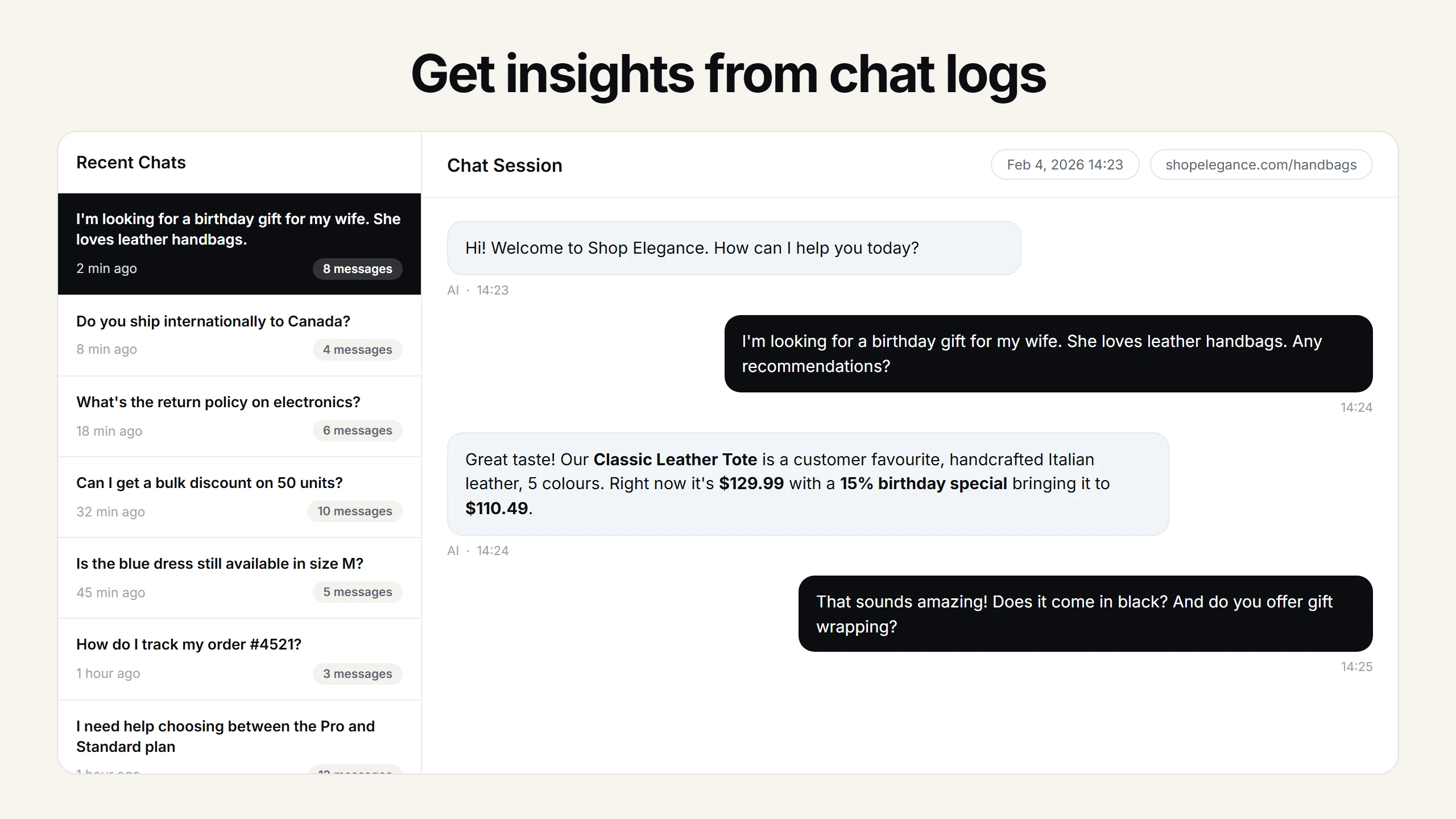
n8n's chatbot nodes give you the conversation logic. They do not give you the floating chat widget that visitors see in the corner of your website, the cross-browser CSS, the multilingual UI, the conversation history view, or the lead capture form. Building those yourself is doable but takes meaningful front-end work. Asyntai provides the website-facing widget out of the box and ships an official n8n community node, so you keep your automation flows where they already live.
- Drop-in widget for any websiteOne script tag in your site header gives you a fully styled chatbot widget that works on WordPress, Shopify, Webflow, custom builds, or any platform. No Vue, React, or vanilla JS coding required to handle the conversation UI.
- An official n8n community nodeInstall
n8n-nodes-asyntaifrom Settings → Community nodes and Asyntai appears in your node list. Send a message and get the AI answer, pull leads, conversations and sessions, or add and remove knowledge base entries — no HTTP Request nodes to hand-configure. - 36 languages handled automaticallyBuilding multilingual support in n8n means adding language detection logic, translation calls, and prompt branching. Asyntai handles 36 languages natively — visitor language is detected from the first message and responses are composed in that language from your source content.
Deploy the website chatbot, keep your n8n flows
The cleanest architecture for most teams is Asyntai handling the website conversation layer and n8n handling the back-end automation triggered from it. Install the Asyntai widget in minutes, point it at your knowledge base, and route escalations into your existing n8n workflows via email or HTTP.
- Register a free Asyntai account and copy your widget snippet from the dashboard.
- Place the snippet in the header of your website — works on any platform.
- Provide your knowledge base URL and the AI crawls and trains itself within minutes.
- Install the
n8n-nodes-asyntaicommunity node in n8n and paste your API key as a credential. - Use the Asyntai node in your workflows, and let escalation emails start the runs that need a trigger.
<script src="https://asyntai.com/widget.js"
data-id="your-site-id" async>
</script>
</head>
# Website chatbot live. Escalations trigger n8n via email or webhook.
Let's talk about reseller pricing.
Agencies using n8n for back-end automation often need a website chatbot they can deploy under their own brand for clients. We work directly with reseller partners on pricing, white-label arrangements, and onboarding support. Reach out and we'll get back to you within 24 hours.
[email protected]n8n chatbot — FAQs
Common questions from teams choosing between building chatbots in n8n and using a dedicated website chatbot platform.
Can I build a chatbot natively in n8n?
Yes, with limits. n8n provides an AI Agent node that orchestrates LLM calls and tool use, a Chat Trigger node that exposes a webhook entry point with built-in conversation memory, and ecosystem nodes for connecting to OpenAI, Anthropic, vector stores, and downstream systems. This stack works well for internal tools, Slack and Discord bots, webhook-driven assistants, and back-end agent workflows where the chat lives behind your own application code. What n8n does not provide is the website-facing widget — the floating chat bubble, the styled UI, the cross-browser handling — that visitors see and interact with on a public site.
What's the difference between n8n's chatbot and a website chatbot platform?
n8n's chatbot capabilities are workflow-side: they orchestrate the conversation logic, the AI calls, and the downstream tool use, all within an n8n workflow. A website chatbot platform like Asyntai is widget-side: it handles the visible chat interface on your website, the conversation rendering in the visitor's browser, the lead capture forms, and the multi-language UI. The two are complementary rather than competing. Many production setups use a website chatbot platform for the customer-facing layer and n8n for the back-end automation that runs when conversations escalate or trigger actions.
How does Asyntai integrate with n8n?
With an official community node. Install n8n-nodes-asyntai from Settings → Community nodes, paste your Asyntai API key as a credential, and the Asyntai node appears in your node list alongside every other integration. From there you can send a message and receive the AI answer, fetch leads, conversations and sessions, list your websites and account details, and add text or URLs to the knowledge base or delete entries from it. For starting a workflow when a conversation escalates, Asyntai still emails the transcript, which n8n's Email Trigger node picks up — the node handles the actions, the email handles the trigger.
Should I use n8n's AI Agent node or a chatbot platform?
It depends on where the chatbot needs to live. If your chatbot is for internal team use, embedded in your own application via API, or driven by webhook events, n8n's AI Agent node is a solid choice — it's flexible, you control every step, and the cost is whatever you pay for the underlying LLM API. If your chatbot needs to appear as a widget on a public website, talk to anonymous visitors, support multiple languages out of the box, and provide a polished conversation UI, a dedicated platform like Asyntai delivers that without the front-end engineering work.
Can n8n trigger workflows from chatbot conversations?
Yes. Every Asyntai escalation generates an email notification that n8n's Email Trigger node picks up and turns into a workflow run — useful for routing complex enquiries into ticketing systems, creating CRM records, or notifying a team. Once the workflow is running, the Asyntai node does the rest: fetch the conversation, pull the captured lead, or ask the assistant a question and use its answer in a later step. The node covers the actions; the email starts the run.
Do I need both n8n and a chatbot platform?
Only if you have meaningful back-end automation work to do. If your chatbot's job is to answer visitor questions from your documentation and escalate complex cases via email, Asyntai alone covers the requirement and n8n adds nothing. If you also have automation that should run when chatbot conversations occur — creating CRM records, scoring leads, dispatching to specific team members based on inquiry type, syncing with downstream systems — then the n8n layer is where that logic belongs. Many teams start with just the chatbot and add n8n workflows later as automation needs emerge.
What's the easiest way to add a chatbot to my website using n8n?
The easiest path is not to do it natively in n8n. Building a website widget from n8n's Chat Trigger requires you to create the front-end UI yourself — the floating bubble, the conversation pane, the styling, the responsive behavior, the language detection. The shortcut is to use a platform like Asyntai for the website widget and connect it to your n8n flows with the official n8n-nodes-asyntai community node for the back-end automation. You get a polished customer-facing experience without front-end engineering work, and your n8n flows stay in n8n where they belong.
Can I use n8n to build a chatbot for a client's website?
You can build the conversation logic in n8n, but delivering it as a customer-facing widget on the client's website requires either custom front-end work or a chatbot platform on top. For client work specifically, the cleanest approach is using Asyntai for the website widget — including the white-label option that puts your agency's brand on the chatbot — and using n8n for any custom back-end automation the client needs. Asyntai operates a reseller program designed for agencies that bundle this kind of stack into client offerings.
n8n chatbot — what the n8n stack covers, and where you still need a widget
n8n grew from a niche workflow automation tool into one of the dominant platforms in the AI automation stack between 2023 and 2026. The shift was driven by the maturation of n8n's AI Agent node, the addition of vector store nodes for retrieval-augmented generation patterns, and the broader recognition that workflow automation tools were the natural orchestration layer for LLM-powered systems. By 2026, "n8n chatbot" had become a common search query — but the searches reflect at least three different intents that benefit from being addressed separately.
The first intent is teams who want to build a chatbot entirely inside n8n for internal tooling. The use case is typically a Slack bot, a Discord assistant, an internal API-driven helper, or a back-end agent that processes inbound webhook events conversationally. For these scenarios, n8n's stack is genuinely well-suited. The Chat Trigger node provides a webhook entry point with built-in conversation memory keyed by session identifier. The AI Agent node orchestrates LLM calls, tool selection, and reasoning loops. Ecosystem nodes connect to OpenAI, Anthropic, Cohere, Pinecone, Qdrant, in-memory vector stores, and downstream business systems. A skilled n8n user can stand up a sophisticated internal chatbot in a few hours, with no front-end work required because the front-end is whatever Slack, Discord, or your application provides.
The second intent is teams who want a chatbot on a public website but assume that "the chatbot lives in n8n" means they will get the website widget for free. This assumption is where most n8n chatbot projects encounter friction. n8n's Chat Trigger node gives you a webhook endpoint and conversation memory — it does not give you the floating chat bubble visible in the corner of your website, the styled conversation pane, the cross-browser CSS, the mobile responsiveness, the language detection from browser settings, the lead capture forms, or any of the other front-end work that goes into a polished customer-facing chatbot. Building those pieces from scratch is a meaningful front-end engineering project, often comparable in scope to the n8n workflow itself.
The third intent is teams who already use n8n heavily for back-end automation and want to know how a website chatbot integrates with their existing flows. This is the most common case for established n8n users, and it has the cleanest answer. The architecture pattern that works in production is using a dedicated chatbot platform for the website-facing widget and using n8n for the back-end automation that runs when chatbot conversations occur. The chatbot platform handles everything the visitor sees and interacts with. n8n handles the workflows triggered by escalations, lead captures, conversation summaries, or any other event the chatbot generates. The two systems communicate via email triggers, HTTP requests, and shared API authentication.
For teams choosing the chatbot platform side of this architecture, Asyntai is one of the cleanest fits because it ships an official n8n community node. Install n8n-nodes-asyntai from Settings → Community nodes, add your API key as a credential once, and Asyntai appears in the node list like any built-in integration. The node covers the operations a workflow actually needs: send a message and receive the AI's answer, fetch leads captured by the chatbot, retrieve a conversation or list recent sessions, read your websites and account details, and add text or a URL to the knowledge base or delete an entry from it. There are no HTTP Request nodes to hand-configure and no authentication headers to assemble yourself.
The node is also declared usable as a tool, which matters if you are already building with n8n's AI Agent node. Attach Asyntai as a tool and your agent can consult your knowledge base mid-reasoning — asking your own documentation a question and using the answer in whatever it does next — rather than you rebuilding retrieval over a vector store that duplicates content the chatbot already holds. Starting a workflow from a conversation still happens by email: Asyntai sends the transcript when a chat escalates, and n8n's IMAP Email or Email Trigger node turns that into a workflow run, at which point the Asyntai node takes over for everything else.
Comparing the n8n-native chatbot approach to a chatbot platform plus n8n approach reveals which architecture fits which scenario. For internal-only chatbots that do not need a public-facing widget, n8n native is the simpler answer — fewer moving parts, full control, and direct ownership of every component. For public website chatbots, the chatbot platform plus n8n approach is meaningfully faster to build and produces a more polished result. The trade-off is paying for the chatbot platform subscription instead of getting everything from your existing n8n license. Asyntai's free tier covers 50 messages per month for proof-of-concept work; paid tiers begin at $39 per month for 800 messages across two sites and scale to 50,000 messages for higher-volume deployments.
The development time difference between the two approaches is substantial for production deployments. Building a polished website chatbot widget from n8n's Chat Trigger involves designing and styling the chat UI, handling the WebSocket or polling connection from browser to webhook, managing conversation state across page loads, adding multilingual support if required, building the lead capture and escalation routing, ensuring mobile responsiveness, testing across browsers, and handling the inevitable edge cases. This is realistic engineering work — typically several weeks of front-end and integration time even for an experienced developer. The same outcome via Asyntai plus n8n integration is a single working session: install the widget, point it at your knowledge base, wire the escalation email into n8n.
The multilingual dimension is one of the most-underestimated benefits of using a dedicated chatbot platform. Building multilingual support in n8n means adding language detection logic to your workflow, calling translation APIs, branching prompts by language, and managing the increased complexity of testing across language combinations. Asyntai handles 36 languages natively — visitor language is detected from the first message, responses are composed in that language from your source documentation regardless of what language the documentation was originally written in, and the UI localizes automatically. For any business with an international audience, the multilingual capability alone often justifies using the platform over building from n8n nodes.
For agencies and consultancies building AI automation stacks for clients, the n8n plus Asyntai pairing has become a recognizable productized offering. The agency uses n8n for the bespoke back-end automation each client needs — workflow orchestration, system integrations, custom decision logic — and uses Asyntai for the standardized website chatbot layer that every client wants. Asyntai's reseller program supports this model with separate billing for client subaccounts, white-label widget options that carry the agency's brand, and centralized management for handling multiple clients from a single dashboard. The pattern lets agencies productize the chatbot delivery while preserving the custom integration work as the higher-value billable service.
The decision framework for any individual team comes down to scope. If your chatbot need is limited to internal use cases — Slack, Discord, internal APIs — n8n native is the simpler answer. If your need is a website chatbot with no associated back-end automation, a chatbot platform alone covers it without n8n at all. If your need is a website chatbot plus back-end automation triggered by conversations, the platform plus n8n architecture is the production-tested pattern. Each scenario has a clean answer, and the answer depends on what the chatbot actually needs to do rather than on which tool you started with. Pick the architecture that matches the scope, not the architecture that matches your existing tooling — the latter is how teams end up building front-end widgets in n8n and regretting it three months in.
Pricing for the combined stack stays modest at small to mid-scale deployment. n8n's self-hosted edition is free; the cloud edition starts in the low double digits monthly. Asyntai's free tier covers proof of concept with 50 messages per month; paid plans start at $39 per month for 800 messages and two sites. A typical small business deploying a chatbot on a single site with moderate traffic and a handful of n8n automation flows runs the entire stack for well under $100 per month — meaningfully less than what an agency engagement to build the same setup would charge as a one-time project fee. For higher-volume deployments, Asyntai's higher tiers handle 15,000 and 50,000 messages monthly with multi-site coverage scaling to ten properties. The economics favor direct subscription over agency-built equivalents at every volume tier.