A Magento live chat plugin that handles most conversations without a human
Most live chat plugins for Magento put the burden on your team. Every product question, every order status inquiry, every "do you ship to Canada?" — someone has to be there to type a reply. Asyntai flips that. An AI agent answers automatically using your crawled catalog and connected Magento REST API, shows Dynamic Product Cards with images and prices, tracks orders in real time, and only escalates to a human agent when the conversation genuinely needs one. Your Magento store gets 24/7 live chat coverage without 24/7 staffing.
See the AI handle your Magento store questions live
Enter your Magento or Adobe Commerce store URL and watch the AI answer product questions using your actual catalog data
The AI answers first — your team steps in only when it matters
Traditional live chat for Magento means hiring agents, managing shifts, and watching response times climb during off-hours. Asyntai reverses the model. The AI handles the first response to every conversation — answering product questions from your crawled catalog, navigating configurable and bundle product options, and displaying matching items as Dynamic Product Cards with images, prices, and direct links to your Magento product pages. For the conversations that need a human touch — complaints, complex returns, edge cases — the AI escalates with full context so your agent picks up mid-conversation, not from scratch. Most Magento stores find that 70-80% of incoming chat volume never needs a human at all.
- Configurable and bundle product knowledgeMagento's configurable products — a shirt available in five colors and four sizes — confuse most chatbots. Asyntai's AI understands product variants because it reads your crawled catalog structure. When a visitor asks "do you have the Alpine Fleece in large?", the AI knows which variants exist and can answer accurately, not generically.
- Dynamic Product Cards inside the chatWhen the AI recommends products, it renders them as visual cards — product image, name, price, short description, and a button linking directly to your Magento product page. Multiple recommendations appear as a swipeable carousel. The visitor browses products inside the conversation without navigating away from the page they are on.
- Automatic answers from your catalogThe AI crawls your Magento storefront and answers using your content — product descriptions, category pages, CMS blocks, shipping policies, return information. No manual training required. When you update a product page in Magento Admin, the AI picks up the changes on its next crawl cycle. Your live chat stays current without anyone maintaining a separate knowledge base.
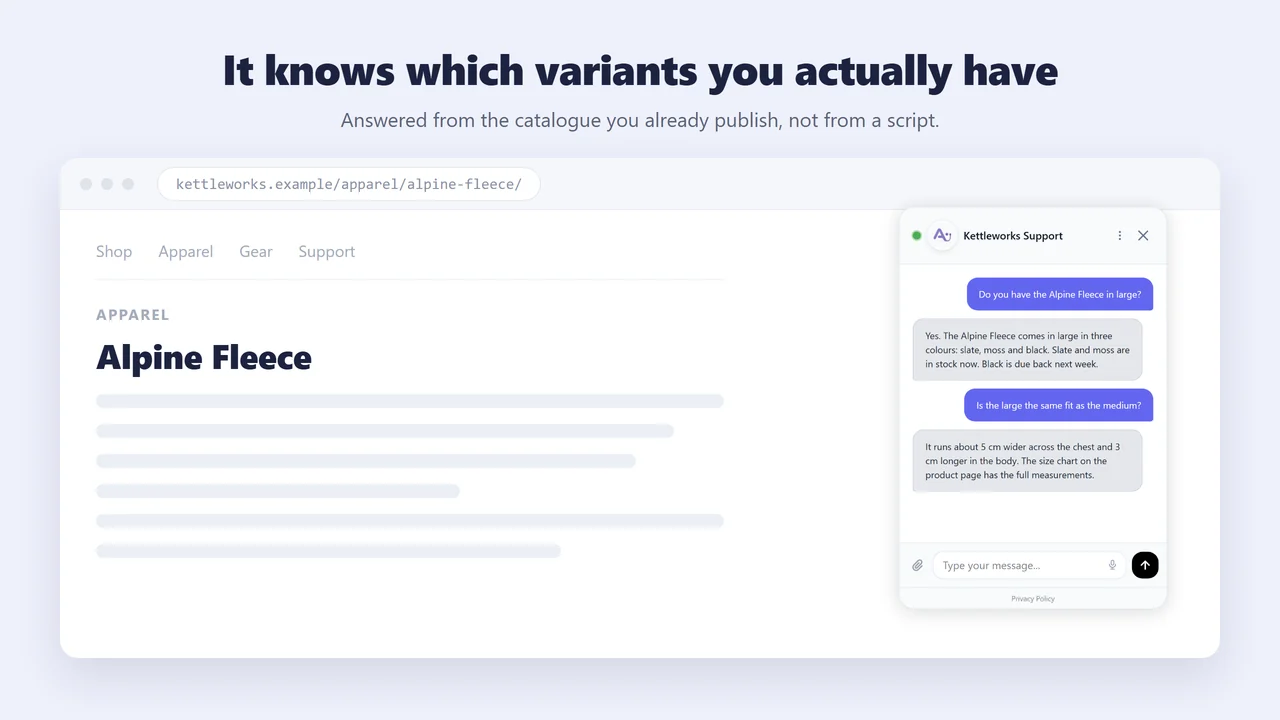
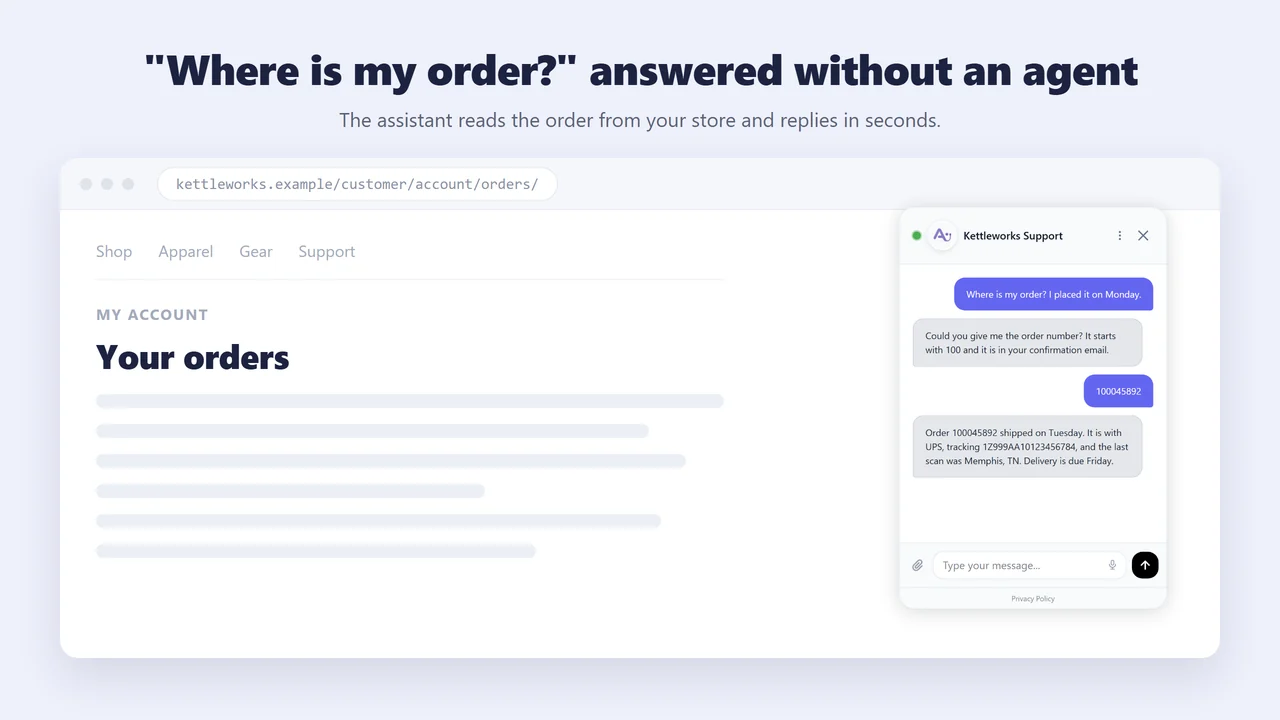
Order tracking, inventory lookups, and human escalation — all wired into your Magento backend
Live chat that can only answer pre-sale questions covers half the job. The other half — order status, shipping updates, return eligibility — requires a connection to your Magento backend. Asyntai's Custom Tools let the AI call your Magento REST API directly to look up orders, check real-time inventory for specific SKUs, and verify shipping estimates. When the AI encounters a situation it cannot resolve — a billing dispute, a damaged item, a request that requires human judgment — it escalates the conversation to your team with the full transcript attached. For multi-store Magento deployments, you can run separate Asyntai widgets per store view, each with its own language and catalog scope.
- Order tracking via Magento REST APIConnect Custom Tools to your Magento REST API endpoints and the AI can look up order status, tracking numbers, and shipment details in real time. A returning customer asks "where is my order?" and the AI pulls the answer from Magento directly — no agent needed, no copy-pasting from the admin panel. Works with Magento's standard order API and custom endpoints alike.
- Human escalation with full contextWhen the AI determines a conversation needs a human — or when the visitor explicitly asks for one — it hands off the entire chat transcript to your support team via email notification or integration. Your agent sees every message exchanged, every product discussed, every question already answered. They resume the conversation, not restart it. Escalation rules are configurable: you decide which topics trigger automatic handoff.
- Multi-store and multi-language supportMagento's multi-store architecture means you might run separate storefronts for different regions, languages, or brands. Asyntai supports this natively — deploy a separate widget per store view, each crawling its own storefront URL, each responding in the appropriate language. Asyntai supports 36 languages, so your French store view gets French responses and your German store view gets German, all from the same Asyntai account.
Add AI live chat to your Magento store in minutes
No Magento extension marketplace download required. You add a single JavaScript snippet to your theme's head section — via default_head_blocks.xml or a CMS static block — and the AI starts answering from your crawled catalog immediately. Connect Custom Tools for order tracking when you are ready.
- Sign up at Asyntai and copy your unique JavaScript snippet from the dashboard.
- Add the snippet to your Magento theme's head section — paste it into app/design/frontend/YourTheme/default/Magento_Theme/layout/default_head_blocks.xml, or add it via a CMS static block in Magento Admin.
- Let the AI crawl your Magento storefront — it indexes product pages, category pages, CMS content, and policy pages automatically.
- Optionally, connect Custom Tools to your Magento REST API for live order tracking, inventory checks, and shipping lookups.
<!-- Add to default_head_blocks.xml or CMS static block -->
<referenceBlock name="head.additional">
<block class="Magento\Framework\View\Element\Text">
<arguments><argument name="text" xsi:type="string">
<script src="https://asyntai.com/widget.js"
data-id="your-site-id" async></script>
</argument></arguments>
</block>
</referenceBlock>
# Deploy and clear cache. The AI handles the rest.
Magento live chat plugin — FAQs
Common questions from Magento merchants, Adobe Commerce agencies, and store managers evaluating AI-powered live chat.
How is this different from a traditional Magento live chat extension?
Traditional live chat extensions for Magento — Tawk.to, LiveChat, Zendesk Chat — require a human agent to be online and typing responses. If nobody is available, the visitor either waits or leaves. Asyntai is AI-first: the AI handles the initial response and the majority of conversations automatically, answering product questions from your crawled catalog, looking up orders via your Magento REST API, and showing product recommendations as visual cards. Human agents are only brought in when the AI cannot resolve something or the visitor requests a person. The result is 24/7 live chat coverage without 24/7 staffing — the AI covers nights, weekends, and traffic spikes, and your team handles the conversations that actually need them.
Does it work with Magento 2 and Adobe Commerce?
Yes. Asyntai works with Magento 2 (both Open Source and Adobe Commerce) across all currently supported versions. Since the widget loads via a JavaScript snippet rather than a Magento extension, there are no PHP dependencies, no module compatibility issues, and no conflicts with other extensions. You add the snippet to your theme's default_head_blocks.xml or via a CMS static block in the Magento Admin panel. It works with Luma, Hyva, custom themes, and headless PWA storefronts — if the page renders in a browser, the widget loads.
Can the AI handle configurable and bundle products?
Yes. Magento's configurable products — a single product with multiple variants defined by attributes like size, color, and material — are fully supported. The AI crawls your product pages and understands the variant structure, so when a visitor asks "do you have this in medium?" or "what colors does this come in?", the AI answers based on your actual catalog data. Bundle products with selectable options are handled the same way. The AI reads the product page content and can discuss available options, pricing differences between configurations, and stock availability for specific variants when connected to your REST API via Custom Tools.
How does order tracking work?
Order tracking uses Asyntai's Custom Tools feature to connect the AI to your Magento REST API. You configure an API endpoint (for example, /rest/V1/orders with appropriate authentication) and the AI can look up order status, tracking numbers, shipment details, and estimated delivery dates in real time. When a customer asks "where is my order?" the AI requests the information from your Magento backend and responds with the current status — no human agent needed. Custom Tools require the Standard plan or higher. Setup involves providing the API endpoint URL, authentication token, and a description of what the tool returns so the AI knows when to call it.
What happens when the AI cannot answer a question?
When the AI encounters a question it cannot confidently answer — or when the visitor explicitly asks for a human — it escalates the conversation. Your support team receives a notification with the full chat transcript, including every product discussed and every question already answered. The human agent picks up the conversation with full context, so the visitor does not have to repeat themselves. You can configure escalation rules to automatically route specific topics (returns, complaints, billing) to human agents while letting the AI handle everything else. The AI can also collect the visitor's email address before escalating so your team can follow up asynchronously if no agent is immediately available.
Does it support Magento multi-store setups?
Yes. Magento's multi-store architecture — where a single installation serves multiple storefronts with different domains, languages, or product catalogs — is fully supported. You can deploy a separate Asyntai widget on each store view, each configured with its own site ID and crawling its own storefront URL. This means your English store gets an English-speaking AI that knows the English catalog, while your French store gets a French-speaking AI that knows the French catalog. Each widget operates independently, so pricing, product availability, and content are scoped to the correct store view. All widgets are managed from a single Asyntai account.
Will the widget slow down my Magento site?
No. The Asyntai widget loads asynchronously via a single script tag, which means it does not block your page from rendering. Your Magento pages load at full speed while the widget initializes in the background. The script itself is lightweight — under 50KB — and is served from a CDN for fast delivery globally. It does not interfere with Magento's full-page cache, Varnish, or any other caching layer. Performance-conscious Magento merchants can verify this in their browser's Network tab — the widget request completes after the page is already interactive.
What plan do I need for a Magento store?
The AI chat widget works on all plans, including Free, with answers drawn from your crawled Magento content. For the features most Magento stores want — Custom Tools for order tracking via the REST API, Dynamic Product Cards for product recommendations, and Real-Time Data Feed for live catalog data — you need the Standard plan ($139/month, 15,000 messages) or Pro plan ($449/month, 50,000 messages). Human escalation is available on all paid plans. If your store handles high volume or you need Real-Time Data Feed Max for large catalogs (up to 10,000,000 characters), the Pro plan is the right fit.
How do I install it on a headless Magento / PWA storefront?
For headless Magento setups using PWA Studio, Vue Storefront, or a custom React/Next.js frontend, installation is the same as any JavaScript widget. Add the Asyntai script tag to your frontend's HTML head — in your index.html, _document.js, or equivalent entry point. The widget does not depend on Magento's server-side rendering or Luma/Hyva theme structure. It loads independently in the browser. The AI still crawls your storefront URL (your PWA's public domain) and indexes the rendered content. Custom Tools for order tracking connect to the same Magento REST API regardless of frontend architecture.
Why Magento stores need more than human-only live chat — and how AI changes the equation
Magento has always attracted merchants who need more than a basic storefront. The platform's strength — deep customization, complex catalog structures, multi-store architecture, enterprise-grade B2B capabilities — draws businesses with thousands of SKUs, configurable products with dozens of attribute combinations, and customers who expect the kind of service that matches the sophistication of what they are buying. These are not stores selling three t-shirt designs. They are retailers with layered catalogs, bundle pricing, tiered customer groups, and order histories that span years. And yet, when it comes to live chat, most Magento stores are stuck with tools built for a simpler world: a chat box that waits for a human to type.
The fundamental problem with human-only live chat on a Magento store is arithmetic. A mid-size Magento merchant might receive 200 chat inquiries per day. About half are product questions — "does this come in a size 42?", "what is the thread count on these sheets?", "is this compatible with the 2024 model?" Another quarter are order-related — "where is my package?", "can I change my shipping address?", "I never received a tracking number." The remaining quarter are policy questions, returns, complaints, and edge cases that genuinely need human judgment. To handle 200 conversations per day with human agents, you need at minimum three full-time support staff — more if you want coverage on evenings and weekends, which you do, because that is when many of your customers shop. The cost of three support agents exceeds $10,000 per month in most markets. For a Magento store doing $50,000-$200,000 per month in revenue, that is a painful line item.
Asyntai's approach eliminates the arithmetic problem by inverting the model. Instead of humans handling everything and AI helping on the side, the AI handles everything first and humans step in only when needed. The AI answers product questions by reading your crawled Magento catalog — product descriptions, specifications, category pages, CMS blocks, and static content. It answers order status questions by calling your Magento REST API through Custom Tools. It answers policy questions by reading your shipping, return, and FAQ pages. And when it encounters something it cannot resolve — a formal complaint, a damaged-goods claim, a request that requires human discretion — it escalates the conversation to your team with the full transcript attached. The human agent sees everything the AI discussed, every product the visitor asked about, every answer already given. They pick up the thread, not start over.
The catalog complexity that makes Magento powerful also makes it difficult for generic chatbots to handle. A configurable product in Magento is not one product — it is a parent product with dozens or hundreds of simple product variants, each defined by a combination of attributes: size, color, material, finish, voltage, thread type. When a visitor asks "do you have the Milano Espresso Machine in stainless steel?", a chatbot that does not understand Magento's configurable product structure either guesses or deflects. Asyntai's AI reads your product pages as they are rendered to visitors — with variant selectors, option labels, and pricing — and understands that "stainless steel" is an attribute value of a configurable product, not a separate product. The same applies to bundle products, where the visitor is assembling a package from selectable components. The AI can discuss which components are included, what the price changes when you swap options, and what combinations are available, because it reads the same content your visitors see.
Order tracking is where the gap between a content-only chatbot and a connected one becomes stark. Most live chat tools, even AI-powered ones, can answer pre-sale questions from a knowledge base. But the moment a customer asks "where is my order?", a content-only chatbot is useless — the answer lives in your Magento database, not on a webpage. This is exactly the moment when the customer is most frustrated and least patient, and it is exactly the moment when most chatbots say "please contact our support team." Asyntai solves this with Custom Tools: you configure an API endpoint that points to your Magento REST API (typically /rest/V1/orders/{orderId}), provide authentication credentials, and describe what the endpoint returns. The AI then calls this endpoint in real time when a customer asks about their order, retrieves the status, tracking number, and shipment details, and presents the information conversationally. No human agent involved. No "please wait while I look that up." The customer asks, the AI checks Magento, the customer gets their answer.
Dynamic Product Cards transform the live chat from a text conversation into a visual shopping experience. When the AI recommends products — in response to "show me your best-selling running shoes" or "what would you recommend for sensitive skin?" — it renders them as rich visual cards inside the chat window. Each card displays the product image, name, price, a short description, and a button that links directly to the product page on your Magento store. Multiple recommendations appear as a horizontal carousel the visitor can swipe through. This is fundamentally different from a chatbot that says "I recommend the Alpine Pro Running Shoe, priced at $159" as plain text. The visual format mirrors the product listing experience that ecommerce visitors expect, and it puts the buy action one click away. For Magento stores with visually rich products — fashion, home decor, electronics, beauty — the difference in engagement between text recommendations and product cards is substantial.
The installation question matters more for Magento than for most platforms, because Magento's architecture is famously complex. Extension conflicts, version compatibility issues, and deployment pipeline disruptions are real concerns for any Magento store that has invested in stability. Asyntai sidesteps all of this because it is not a Magento extension. There is no Composer package, no module to enable, no database migration, no reindex required. You add a single JavaScript snippet to your theme's head section — either by editing default_head_blocks.xml in your theme layout, or by pasting it into a CMS static block that is rendered in the header. The snippet loads the widget asynchronously, meaning it does not block page rendering, does not interfere with full-page cache or Varnish, and does not interact with Magento's PHP backend in any way. Deploy it, clear cache, and the widget appears on every page. Remove the snippet and it is gone. This zero-footprint approach means there is nothing to break, nothing to update when you upgrade Magento, and nothing that can conflict with your other extensions.
Multi-store support is a capability that Magento merchants specifically ask about because it is so central to how Magento is used in practice. A single Magento installation often serves multiple store views — different domains for different countries, different languages, different product catalogs, sometimes different brands entirely. Asyntai handles this by allowing you to deploy a separate widget on each store view, each with its own site ID and configuration. Your German store view gets a German-speaking AI widget that crawls and answers from the German product pages. Your English store view gets an English-speaking widget with its own catalog scope. Each widget operates independently, so there is no cross-contamination of languages or catalogs. Custom Tool endpoints can also differ per widget — your EU store might check inventory from a different warehouse API than your US store. The entire multi-store setup is managed from a single Asyntai dashboard, with separate analytics and conversation logs per widget.
The economics of AI-first live chat become especially compelling when you account for after-hours coverage. Magento stores selling internationally receive orders and inquiries across every timezone. A US-based merchant with European customers gets questions at 3 AM Eastern. A European merchant selling to Australia gets questions during what is their middle of the night. Human-only live chat handles this in one of three ways: ignore after-hours inquiries (and lose those customers), hire overnight staff (expensive), or use a contact form fallback (slow). Asyntai provides a fourth option: the AI answers immediately, at any hour, with the same quality it delivers during business hours. It does not get tired at 2 AM. It does not take longer to look up an order on a Sunday. The customer who shops at midnight gets the same product recommendations, the same order tracking, the same Dynamic Product Cards as the customer who shops at noon. For stores with international traffic, this alone justifies the investment.
The quality of AI responses depends entirely on the quality of content it has access to. This is where Magento stores actually have an advantage over simpler platforms. Magento product pages tend to be content-rich: detailed descriptions, specification tables, attribute lists, related product links, customer Q&A sections. CMS pages in Magento often contain thorough shipping policies, return procedures, warranty information, and FAQ content. When the AI crawls a well-maintained Magento store, it ingests a deep knowledge base without the merchant having to write a single training document. The richer your product pages, the better the AI answers. This creates a virtuous cycle: investing in product content (which also helps SEO) simultaneously improves your AI live chat quality. The two investments compound rather than compete.
Custom Tools extend the AI's capabilities beyond answering questions into taking actions. Order tracking is the most common use case, but the architecture is general-purpose. You can connect any API endpoint that your Magento installation exposes — or that your middleware provides. Check inventory for a specific SKU and warehouse. Verify whether a coupon code is valid for a particular product. Look up a customer's loyalty points balance. Calculate shipping costs for a given address and weight. Each tool you connect adds another action the AI can perform without human intervention, and each action the AI handles is a conversation your support team does not have to touch. For Magento stores running custom modules with their own API endpoints — a common scenario in the Magento ecosystem — Custom Tools provide a direct bridge between the AI and your proprietary business logic.
The escalation model deserves scrutiny because it is where many AI chat tools fail. A chatbot that escalates poorly — handing off without context, losing conversation history, or escalating too aggressively — creates more work for your team than handling the conversation from scratch. Asyntai's escalation is designed around the principle that the human agent should never start from zero. When the AI escalates, it delivers the complete conversation transcript: every visitor message, every AI response, every product discussed, every Custom Tool call made. If the AI looked up an order and found it was delayed, the human agent sees that lookup and its result. If the AI showed three product cards and the visitor asked about the second one, the agent sees exactly which product was discussed. Escalation triggers are configurable — you can set the AI to automatically escalate conversations that mention "refund," "manager," "complaint," or any other keywords your business considers human-required. You can also set the AI to escalate after a certain number of unanswered questions, ensuring that a confused visitor is never left in a loop.
For B2B Magento stores — a significant segment of the Adobe Commerce market — the live chat dynamics shift but the AI advantage remains. B2B buyers tend to ask highly specific questions: "what is the lead time for 500 units of SKU MT-4420?", "do you offer tiered pricing above 1,000 pieces?", "is this product RoHS compliant?" These questions typically require looking up information from product data sheets, pricing tiers, or compliance documentation — all content that can be crawled or uploaded to Asyntai's knowledge base. The AI answers accurately from this content while a human agent would need to look up the same information in a catalog or ERP system. Custom Tools can connect to B2B-specific Magento endpoints — requisition lists, company credit, negotiable quotes — making the AI useful not just for answering questions but for facilitating the B2B purchasing workflow.
Performance concerns are legitimate for any script added to a Magento storefront. Magento merchants invest significant effort in page speed optimization — full-page cache, Varnish, CDN, JavaScript bundling and minification, lazy loading. Adding a third-party script that degrades performance would undermine all of that work. Asyntai's widget is designed for zero performance impact. The script tag includes the async attribute, which means the browser downloads and executes it after the page has finished loading — it never blocks rendering. The script itself is under 50KB, served from a CDN with edge locations worldwide. It does not inject CSS that triggers layout shifts, does not load fonts that add to total page weight, and does not make API calls until the visitor interacts with the widget. In Lighthouse audits, the widget adds zero milliseconds to First Contentful Paint and Largest Contentful Paint. Magento merchants running Hyva or other performance-optimized themes will find that the widget fits within their performance budget without compromise.
The data the AI collects from conversations creates a feedback loop that improves over time. Every question a visitor asks reveals something about what your customers care about, what information is missing from your product pages, and where your catalog has gaps. Asyntai's analytics dashboard shows you the most common questions, the topics where the AI escalates most frequently, and the products that visitors ask about but cannot find. For a Magento merchant, this data is actionable: if 50 visitors per week ask about a product attribute that is not on your product page, that is a content gap you can fix in Magento Admin. If the AI consistently escalates questions about a particular return policy, the policy page might need clarification. The live chat becomes a continuous audit of your customer-facing content, surfacing gaps you would never find from analytics alone.
The competitive landscape for Magento live chat has been dominated by tools built for a pre-AI era. Tawk.to is free but human-only. LiveChat and Zendesk Chat are polished but require staffed agents to function. Gorgias and Re:amaze integrate with ecommerce data but still center on human agents responding to tickets. None of these tools start with the premise that the AI should handle the conversation and humans should be the exception. Asyntai starts there. It is not a help desk with an AI assistant bolted on — it is an AI agent that happens to escalate to humans when needed. For Magento stores that want live chat coverage without proportional headcount, that distinction is the difference between a cost center and a force multiplier.
Implementing Asyntai on a Magento store follows a predictable sequence. Day one: add the JavaScript snippet and let the AI crawl your storefront. Within hours, the widget is live and answering product questions, policy questions, and general inquiries from your crawled content. Week one: review the conversation logs, see what visitors are asking, and identify any content gaps on your Magento pages. Fill those gaps in Magento Admin — better product descriptions, clearer policies — and the AI picks them up on its next crawl. Week two: connect Custom Tools to your Magento REST API for order tracking. Customers can now check order status through the chat widget. Week three: enable Dynamic Product Cards and optionally connect a Real-Time Data Feed for live pricing and inventory data. By the end of the first month, you have a fully operational AI live chat covering product discovery, order tracking, policy questions, and human escalation — handling the majority of your support volume with zero human agents required for routine conversations. The staff you already have can focus on the complex cases that genuinely benefit from a human touch.