Enterprise AI chatbot solution for websites: one platform across every property, department, and language
An AI chatbot that reads your corporate websites, answers visitor questions using your own content, connects to backend systems through Custom Tools, and scales from a single site to twenty — or beyond with Custom Pro plans.
See how the AI handles your enterprise website
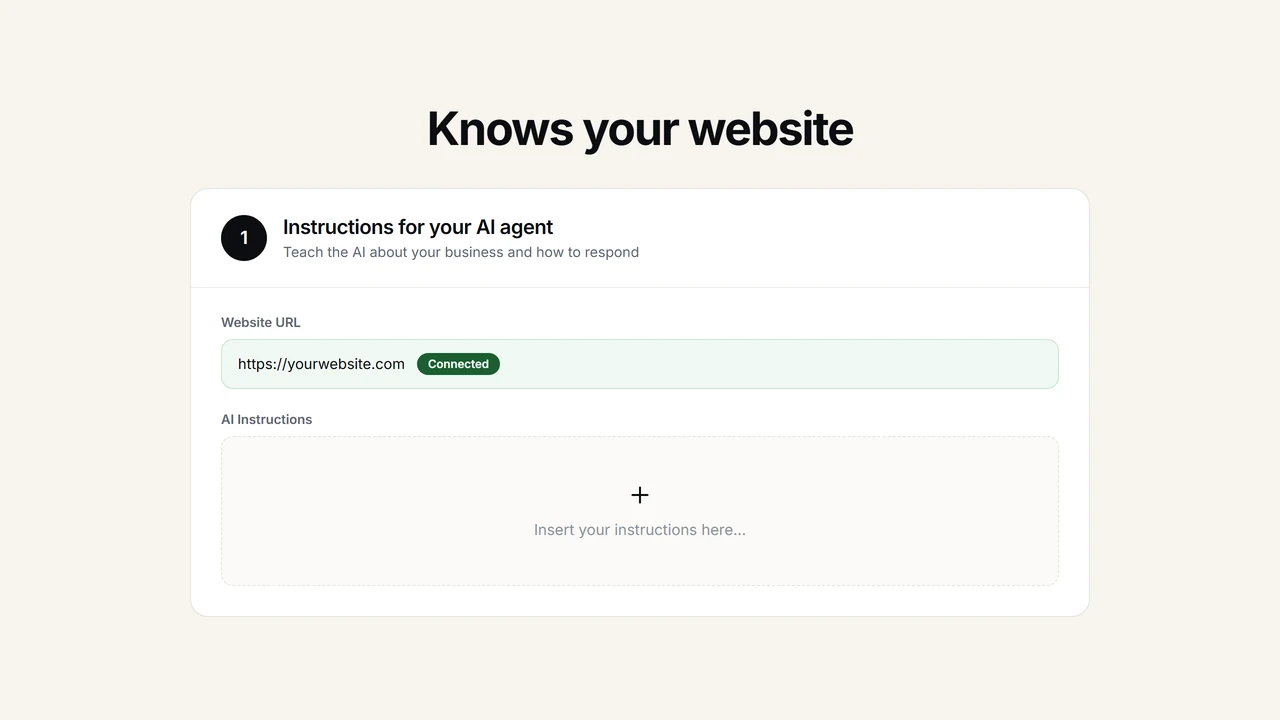
Paste your corporate website URL below. The AI reads your pages — products, services, support documentation, company information — and builds a working chatbot in seconds.
Your website has hundreds of pages and visitors still cannot find what they need
Enterprise websites accumulate content the way large organizations accumulate departments — steadily, relentlessly, and without anyone maintaining a master map of where everything lives. A mid-size company might have product pages managed by marketing, support articles written by customer success, partner information maintained by business development, investor relations content from legal, and career pages from HR — each section built on its own timeline, with its own structure, and its own internal logic. A visitor looking for implementation pricing lands on a product page that mentions "contact sales." A prospect trying to compare service tiers navigates four menus deep and still ends up on the wrong page. A potential partner looking for your technology integration documentation gives up after three searches return blog posts instead of API docs. The content exists. The answers are on your site. But the gap between "published" and "findable" costs you leads, frustrates prospects, and makes a company with deep expertise look disorganized. An AI chatbot closes that gap by reading your entire website and answering questions conversationally — no navigation required. Every plan includes this core capability. Free gives you 50 messages to test. Starter at $39/month handles 800 messages across 2 sites. Standard at $139/month covers 15,000 messages and 3 sites with Custom Tools for backend integrations. Pro at $449/month scales to 50,000 messages across 20 sites with full white-label branding. And Custom Pro plans at asyntai.com/custom-pro-plan go further for enterprises that need more.
- Handles complex, multi-department content across large websitesThe AI reads up to 50 pages from your website — product descriptions, service overviews, support documentation, company policies, partner information — and answers visitor questions using that content. When a prospect asks "Do you offer on-premise deployment for regulated industries?" the chatbot pulls the answer from your enterprise solutions page, not from general knowledge. Upload additional documents — technical whitepapers, implementation guides, compliance certifications — to extend what the AI knows beyond your public web pages.
- Custom Tools connect to your internal systemsOn Standard ($139/month) and Pro ($449/month) plans, the AI chatbot calls your backend APIs during a conversation. Connect your CRM and the chatbot can verify a customer's account status. Connect your ticketing system and it can check the status of a support request. Connect your inventory system and it can confirm product availability. The visitor gets a real answer — not "please contact support" — and your team handles one fewer inquiry.
- White-label branding matches your corporate identityEnterprise websites reflect years of brand investment. A chatbot that looks like a third-party widget undermines that investment. With white-label branding on the Pro plan, the chatbot carries your colors, your logo, your assistant name, and your visual identity. Visitors interact with what feels like a native part of your digital experience — because it is. No "powered by" badges. No external branding. Your website, your chatbot, your brand.
Deploy one chatbot or twenty — each with its own knowledge base and backend connections
Enterprise organizations rarely operate a single website. There is the corporate site, the product documentation portal, the support center, regional marketing sites, the careers hub, and the partner portal — each serving a different audience with different questions. Managing AI chatbots across these properties should not mean managing twenty separate vendor relationships or twenty disconnected configurations. With the Pro plan at $449/month, you deploy up to 20 sites from a single dashboard — each with its own crawled content, its own Custom Tools, and its own conversation history. For organizations that need more sites, higher message volumes, or dedicated infrastructure, Custom Pro plans scale beyond the standard limits.
- Multi-site deployment from a single dashboardThe Pro plan supports up to 20 websites, each with its own knowledge base. Your product site answers product questions using product content. Your support portal answers support questions using documentation. Your careers site answers candidate questions using job listings and company culture pages. Each chatbot is independent — different content, different Custom Tools, different instructions — but managed from one account with one login and one billing relationship.
- Live data from backend systems through API integrationsCustom Tools turn the chatbot from an information layer into an operational layer. A visitor on your support site asks "What is the status of ticket SR-4821?" and the chatbot calls your ticketing API, retrieves the status, and responds with specifics. A prospect on your product site asks "Is the 500-unit SKU in stock?" and the chatbot checks your inventory system in real time. The APIs are yours — Asyntai connects to them securely over HTTPS during the conversation.
- Custom Pro plans for enterprises that exceed standard limitsWhen 20 sites or 50,000 messages per month is not enough, Custom Pro plans remove those ceilings. Higher message volumes, more sites, dedicated support, custom SLAs — configured for your organization's scale. Contact asyntai.com/custom-pro-plan to discuss requirements with the team.
- 36 languages for global operationsA visitor in Tokyo types in Japanese. A prospect in Sao Paulo types in Portuguese. A partner in Munich types in German. The AI detects the language automatically and responds in kind — using your English-language content as the source. No translated websites required. No per-language configuration. One knowledge base serves a global audience in 36 languages, making every regional site feel locally staffed.
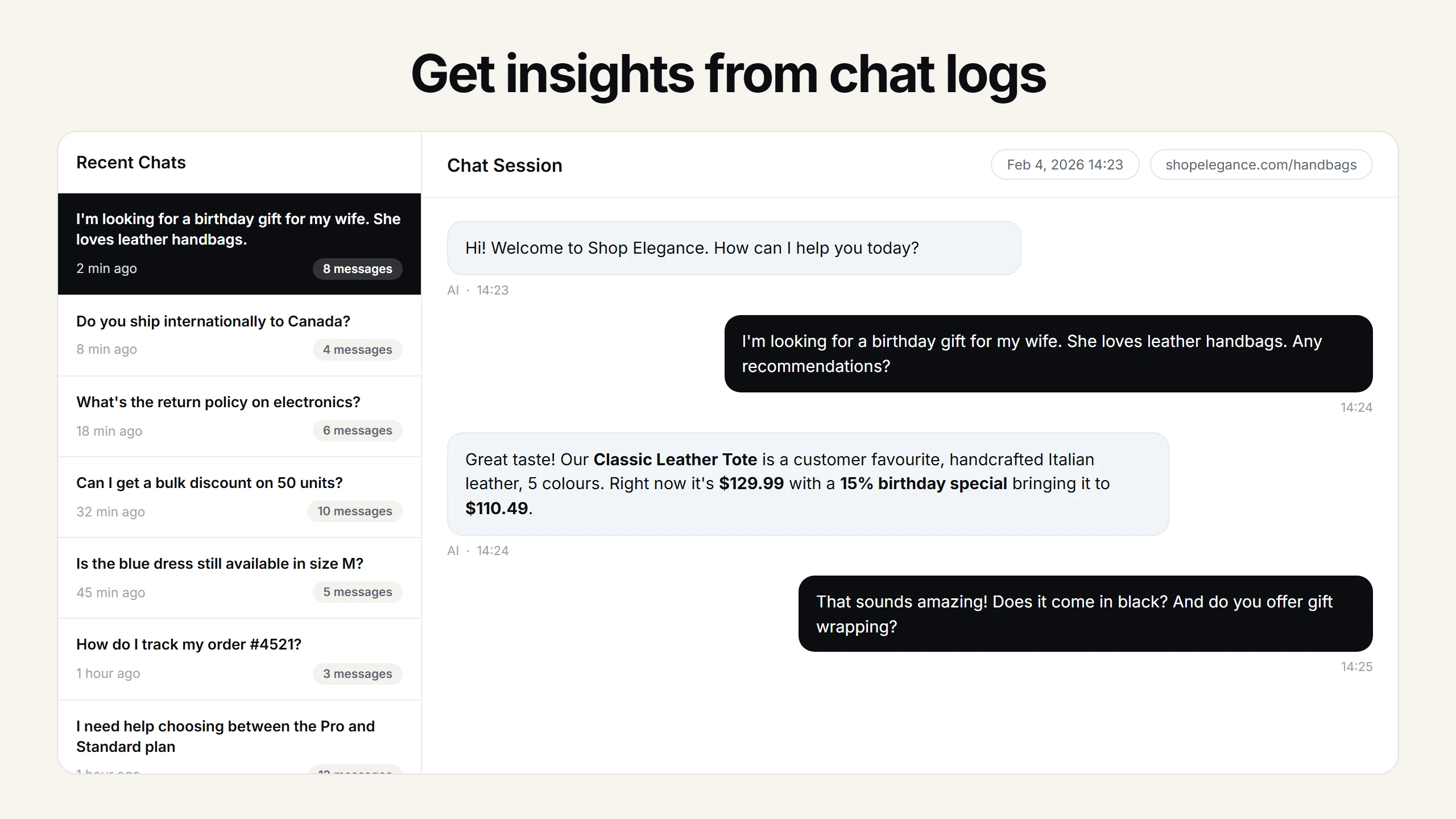
- Centralized analytics and conversation managementEvery conversation across every property flows into a single dashboard. See what visitors are asking on each site, which questions the AI handles well, where it escalates, and what topics generate the most engagement. Use these insights to improve your website content, refine the chatbot's instructions, and identify gaps in your public-facing information — all without polling individual site managers for anecdotal feedback.
Get the chatbot live on your enterprise website
No six-month implementation. No professional services engagement. Add your URL, let the AI read your content, and paste one script tag. Your IT team will spend more time approving the request than implementing it.
- Sign up at asyntai.com/pricing — Free gives you 50 messages to test before committing budget. Pro ($449/month) covers 20 sites and 50,000 messages. Custom Pro plans scale beyond that.
- Add your website URL. The AI reads your pages — product information, support docs, company policies, partner details, career listings — and builds a knowledge base automatically. Up to 50 pages crawled per site.
- Upload supplementary documents — technical whitepapers, implementation guides, compliance certifications, internal FAQs — to extend the chatbot's knowledge beyond your public web pages.
- Copy the embed script from your dashboard and add it to your website. Works with any CMS, any static site, any platform that supports a script tag. The chatbot appears on your site immediately. Roll out to additional properties by repeating the process — each site gets its own knowledge base.
<script src="https://asyntai.com/widget.js"
data-id="your-site-id" async>
</script>
# One script tag. Every visitor question answered instantly.
Enterprise AI chatbot — FAQs
Common questions from IT leaders, digital teams, and procurement evaluating an AI chatbot for enterprise websites.
How does the AI generate answers — does it hallucinate or make things up?
The AI answers using your website content and uploaded documents — not general knowledge. It reads your pages, indexes the information, and retrieves relevant content when a visitor asks a question. This retrieval-based approach means answers are grounded in what you have published. If the information is not in your content, the chatbot does not invent an answer — it follows your configured escalation instructions, such as collecting the visitor's contact information or directing them to a specific team. You control the fallback behavior through custom instructions written in plain English.
What security and data handling practices are in place?
All data is encrypted in transit and at rest. Conversation transcripts and visitor information are stored securely and accessible only through your authenticated dashboard. You can export and delete data at any time. For Custom Tools integrations, API calls are made over HTTPS and no external system data is stored beyond the conversation transcript. Review the security page for full details on infrastructure, data residency, and handling practices. Custom Pro plan customers can discuss specific compliance requirements with the team.
Can the chatbot handle high traffic volumes?
The Pro plan includes 50,000 messages per month across up to 20 sites. For enterprises with higher volumes — product launches, seasonal traffic spikes, large customer bases — Custom Pro plans scale message limits to match your traffic. There is no per-conversation cap or throttling within your plan's monthly allocation. The chatbot handles concurrent visitors without queuing or degradation.
How do Custom Tools integrations work?
Custom Tools let the AI call your APIs during a conversation. You define the endpoint, the parameters the AI should collect from the visitor, and when to trigger the call. For example: a visitor asks "What is the status of my order?" The AI asks for their order number, calls your order status API, and responds with the result. Available on Standard ($139/month) and Pro ($449/month) plans. Any system with a REST API — CRM, ticketing, inventory, ERP — can be connected. Setup is done through the dashboard with no code deployment required on your side.
Can we deploy the chatbot across multiple websites and brands?
Yes. The Pro plan supports up to 20 sites, each with its own knowledge base, Custom Tools, custom instructions, and branding. A company with separate product sites, a support portal, and regional marketing pages deploys an independent chatbot on each — all managed from a single dashboard. Custom Pro plans extend this further for organizations with more than 20 properties.
Does the chatbot support multiple languages for global websites?
Yes — 36 languages with automatic detection. The AI detects the visitor's language from their first message and responds in that language, using your content as the source regardless of what language it was published in. No translated content or per-language configuration is required. This works across all sites on your account, so a global enterprise serves visitors in Japanese, German, Portuguese, Spanish, Arabic, and 31 other languages from a single English knowledge base.
Can we remove Asyntai branding from the chatbot?
Yes. White-label branding on the Pro plan lets you customize the chatbot's appearance — your colors, your logo, your assistant name, no external branding. The chatbot looks and feels like a native part of your website. This is essential for enterprise deployments where brand consistency across digital touchpoints is non-negotiable.
What does the implementation timeline look like?
A basic deployment takes under an hour. Sign up, add your website URL (the AI reads it automatically in minutes), configure the chatbot's appearance and instructions, and paste a single script tag on your site. Custom Tools integrations add time depending on your APIs — typically 30-60 minutes per endpoint. Most enterprise teams start with one property, validate the experience, and roll out to additional sites over the following weeks. There is no multi-month implementation, no professional services prerequisite, and no training period.
How does pricing work for enterprise-scale deployments?
The Pro plan at $449/month covers 50,000 messages across 20 sites with white-label branding and Custom Tools. For organizations that need higher message volumes, more sites, custom SLAs, or dedicated support, Custom Pro plans are available. You can test with the Free plan (100 messages, 1 site) before committing budget, then scale up as you validate the chatbot's performance on your content.
Enterprise AI chatbot solution for websites: why the largest organizations need the simplest deployment
Large organizations spend millions building websites that visitors do not know how to navigate. The irony is structural: the more a company invests in content — product documentation, service descriptions, case studies, compliance information, partner ecosystems, support resources — the harder it becomes for any single visitor to find the one page that answers their specific question. A Fortune 500 company's website might have three thousand pages maintained by fifteen departments, each with its own content strategy, its own navigation logic, and its own idea of what constitutes a reasonable information architecture. The visitor searching for "implementation timeline for the healthcare vertical" does not care which department owns that page. They type a query into the site search, get twelve results sorted by date rather than relevance, scan three of them, find nothing actionable, and leave. That visitor was a qualified prospect. They had a specific question. The answer existed on the website. And the website failed to connect the two.
Site search has been the default answer to this problem for two decades, and it has never been a good one. Keyword-based search works when the visitor already knows the terminology the company uses — which is almost never the case for new prospects. A prospect searching for "pricing for large teams" will not find the page titled "Enterprise Volume Licensing" because the words do not overlap. A visitor looking for "API rate limits" will not find the page called "Developer Platform Technical Specifications" unless that exact phrase appears in the body text. Search is a matching exercise, and enterprise websites are full of mismatches between visitor vocabulary and corporate terminology. An AI chatbot sidesteps this problem entirely. The visitor asks a question in their own words, and the AI — which has read the website content and understands it semantically, not just lexically — retrieves the relevant information and answers conversationally. The visitor does not need to learn the company's internal language to get the company's own answers.
The cost of unanswered visitor questions at enterprise scale is not hypothetical — it is measurable in pipeline reports and support ticket volumes. Every visitor who cannot find what they need does one of two things: they leave (and you lose the opportunity), or they contact someone (and you absorb the cost). A large technology company might receive two hundred "where can I find X on your website?" emails per week through their general contact form. Each one is a failure of the website to serve its purpose, and each one costs a human fifteen minutes to triage and respond. That is fifty hours of labor per week spent answering questions that the website already has answers to — the answers just were not accessible. An AI chatbot on the website intercepts those questions at the point of confusion and resolves them before they become contact form submissions, support tickets, or lost prospects.
Multi-site deployments expose a challenge that single-site companies never encounter: how do you maintain consistent quality across a portfolio of web properties when each one serves a different audience? A company with a corporate site, a product documentation portal, a support center, three regional marketing sites, and a partner portal needs seven chatbots — not one chatbot stretched across seven contexts. Each property has different content, different visitor expectations, and different escalation paths. The corporate site chatbot should route partnership inquiries to business development. The support portal chatbot should check ticket statuses. The partner portal chatbot should answer certification program questions. Managing these as seven independent deployments with seven separate vendors would be an operational nightmare. Managing them from a single dashboard — with shared billing, centralized analytics, and per-site customization — is the difference between a scalable strategy and an administrative burden.
Global operations add a dimension that most chatbot solutions handle poorly or not at all. An enterprise with customers in fourteen countries needs a chatbot that works in fourteen languages — not fourteen separate chatbots, each requiring translated content and independent maintenance. The economics of translating and maintaining multilingual chatbot content are prohibitive at enterprise scale. A company would need to translate every product page, every support article, and every FAQ answer into every language, then keep all versions synchronized as the English content changes. With automatic language detection across 36 languages, the AI reads the English-language website once and responds to visitors in whatever language they type. A visitor in Seoul gets answers in Korean. A visitor in Munich gets answers in German. A visitor in Dubai gets answers in Arabic. The underlying content is the same; the delivery adapts to the audience. One knowledge base, thirty-six languages, zero translation overhead.
Brand consistency is an enterprise concern that smaller companies do not appreciate until they scale. A chatbot that appears as a third-party widget on a website that cost six figures to design and develop creates a jarring disconnect. The typography does not match. The colors are off. The interaction patterns feel foreign. And every time a visitor interacts with it, they are reminded — subtly but unmistakably — that this piece of the experience was bolted on, not built in. White-label branding on the Pro plan eliminates that disconnect. The chatbot carries the company's colors, typography sensibility, logo, and assistant name. There is no external badge, no "powered by" footnote, no visual clue that the chatbot is anything other than a native feature of the website. For enterprises that invest heavily in digital brand experience, this is not a cosmetic preference — it is a requirement.
Integration with enterprise systems is where the chatbot transitions from a content retrieval tool to a workflow participant. The knowledge base handles informational questions — "What services do you offer?" "Where is your London office?" "What certifications does your platform hold?" Custom Tools handle transactional questions — "What is the status of my support ticket?" "Is the Enterprise license available for my region?" "When does my contract renew?" The distinction matters because informational questions have static answers that change slowly, while transactional questions require live data from systems of record. A chatbot that can only answer the first category is useful but incomplete. A chatbot that handles both — content retrieval for general questions, API calls for specific lookups — replaces entire categories of low-value human interaction. Available on Standard ($139/month) and Pro ($449/month) plans, Custom Tools connect to any system with a REST API: CRM, ERP, ticketing, order management, identity providers.
IT governance and security review are the gatekeepers of enterprise technology adoption, and for good reason. A chatbot deployed on a corporate website handles visitor interactions, potentially connects to internal systems, and stores conversation data. IT teams need to evaluate data handling practices, encryption standards, access controls, and compliance posture before approving deployment. The implementation model helps here: the chatbot is a single script tag added to the website — there is no server-side installation, no database to provision, no infrastructure to manage on the enterprise side. Custom Tools connections are outbound API calls initiated by Asyntai's infrastructure over HTTPS — the enterprise exposes an endpoint, the chatbot calls it when needed, and no inbound network access to internal systems is required. The security model is simpler than most enterprise software because the deployment footprint is smaller.
The gap between what enterprise visitors expect and what most corporate websites deliver has widened over the past five years. Consumer technology has reset expectations: people can ask a banking app a natural-language question about their mortgage, ask an airline chatbot to rebook a flight, ask a retail app where their package is. Then they visit a B2B enterprise website and encounter a navigation menu with eight top-level categories, a site search that returns results from 2019, and a contact form that promises a response within two business days. The contrast is stark, and it shapes perception. A prospect evaluating two enterprise vendors — one whose website answers their questions instantly and one that requires them to fill out a form and wait — will develop a preference before any sales conversation begins. The website experience becomes a proxy for the vendor experience. Companies that close this expectation gap gain a competitive advantage that compounds with every visitor interaction.
The build-versus-buy decision for enterprise chatbots has historically tilted toward "build" because off-the-shelf solutions could not meet enterprise requirements. They lacked multi-site support, integration capabilities, white-label branding, or the accuracy needed for enterprise content. So companies spent six to eighteen months building custom solutions — hiring ML engineers, building training pipelines, maintaining infrastructure, iterating on accuracy, and eventually discovering that the maintenance cost exceeded the development cost. The calculus has changed. A retrieval-based AI chatbot that reads your content, connects to your systems through standard APIs, supports your branding requirements, and scales across your properties does not require a custom build. It requires a script tag and an afternoon of configuration. The engineering resources you would have spent building and maintaining a chatbot can be redirected to core product development — where they generate revenue rather than prevent support tickets.
Custom Pro plans exist because enterprise needs do not fit neatly into standard pricing tiers. A global software company with forty product sites needs more than twenty properties. A high-traffic consumer brand with three million monthly visitors needs more than fifty thousand messages. A regulated financial institution needs specific data residency commitments. A government contractor needs FedRAMP-aligned infrastructure. These are not edge cases — they are the realities of enterprise deployment. Custom Pro plans address them with flexible limits, dedicated support, and configurations tailored to the organization's scale and compliance requirements. The path starts at asyntai.com/custom-pro-plan with a conversation about what the organization needs — not a rigid menu of predetermined options.
ROI at enterprise volume is straightforward to calculate because the inputs are measurable. Count the number of "where can I find X" emails your contact form receives per week. Count the number of support tickets that could have been resolved by information already on your website. Count the number of prospect inquiries that arrive after business hours and wait until morning for a response. Assign a cost per interaction — the human time to triage, route, and respond — and a value per lost opportunity — the prospects who left without converting because they could not find what they needed. The Pro plan costs $449 per month. If the chatbot handles two hundred visitor questions per week that would otherwise become emails, and each email costs fifteen minutes of staff time at a blended rate, the math resolves in the first month. Enterprise ROI is not about whether the chatbot pays for itself — it is about how quickly the return exceeds the investment by an order of magnitude.
Procurement and compliance teams need documentation, not demonstrations. They need to know where data is stored, how long it is retained, who has access, what happens when the contract ends, and whether the vendor meets the compliance frameworks relevant to their industry. These are answerable questions with specific answers — and they should be answerable before a sales call, not after three. The security page covers data handling, encryption, and infrastructure practices. The vendor assessment process for a chatbot deployed via a client-side script tag is materially simpler than for a server-side application with database access and network integration — which is one of the architectural advantages of this deployment model for enterprise IT teams evaluating risk.
Phased rollout is the enterprise deployment pattern that produces the best outcomes. Start with one property — typically the corporate website or a high-traffic product site — and validate that the AI handles your content accurately. Adjust the chatbot's custom instructions based on the first few hundred conversations. Add Custom Tools connections to your most frequently queried systems. Measure the reduction in contact form submissions and support tickets. Once the first deployment is validated, roll out to additional properties — each one faster than the last because the process is already understood and the configuration patterns are established. The Pro plan's 20-site limit accommodates a phased rollout naturally: start with one, expand to five, scale to twenty, and move to a Custom Pro plan when the deployment outgrows the standard tier. No renegotiation required at each phase — just add sites and adjust the plan when the numbers warrant it.
Ready to deploy an enterprise-grade AI chatbot across your web properties? Start with the free plan — 50 messages, no credit card — and test the AI on your own content. Or explore Custom Pro plans for enterprise-scale deployments with flexible limits and dedicated support.