Ecommerce customer support that sells while it solves
Asyntai gives your online store an AI support agent that answers product questions, handles shipping and returns, and looks up orders in real time. Every unanswered question is a lost sale — the chatbot makes sure none go unanswered, in 36 languages, around the clock.
See how it would work on your store
Paste your store URL and watch the AI answer real product questions from your own catalog
Every product question left unanswered is revenue walking out the door
Online shoppers don't wait. When a visitor on your product page wonders whether the jacket runs small, or whether the vitamin supplement is gluten-free, or whether the desk ships assembled — they need an answer now, not in 24 hours when your support team opens the ticket. If the answer doesn't come, they leave. Research consistently shows that between 50% and 70% of shoppers abandon a purchase because of unanswered questions. Asyntai places an AI chatbot on your store that answers using your own product descriptions, FAQ pages, shipping policies, and return guidelines. The shopper asks, the AI answers, and the sale stays alive. It works on every page, at every hour, in 36 languages — because your store sells globally, even if your support team doesn't staff globally.
- Product expertise from your own catalogThe AI reads your product pages — specs, materials, sizing, ingredients, compatibility — and answers shopper questions with the same detail your best floor associate would.
- Shipping and delivery answers in secondsDelivery times, shipping costs, international availability, carrier options — the chatbot pulls from your shipping policy and answers without the customer hunting through your footer links.
- Returns handled before they become complaintsReturn windows, condition requirements, refund timelines, exchange processes — the AI walks customers through your return policy clearly, reducing confusion and post-purchase anxiety.
Look up orders, track shipments, process requests — inside the chat
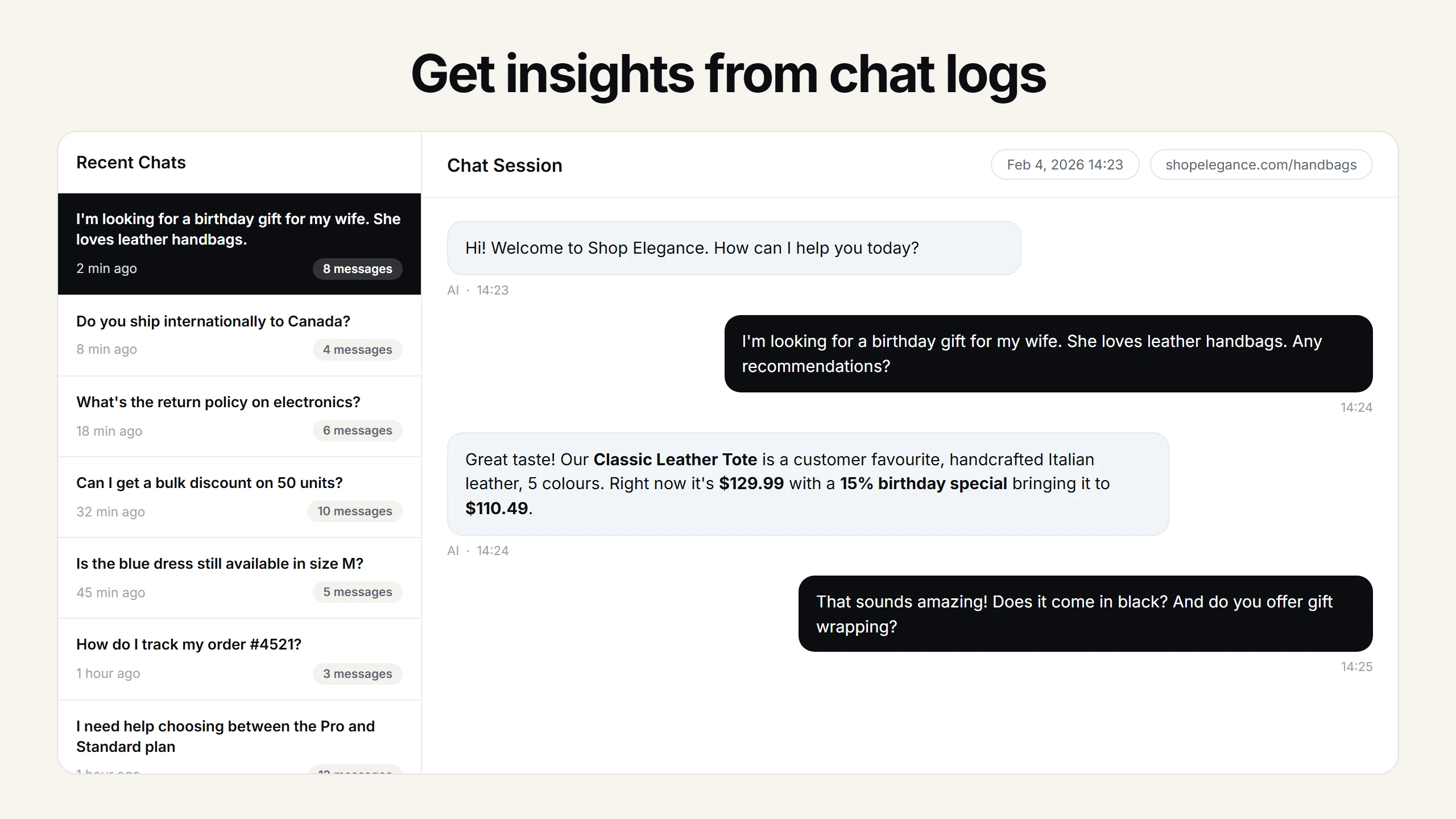
Information answers are table stakes. On Standard ($139/month) and Pro ($449/month) plans, Custom Tools let the chatbot connect to your store's backend and take real action during the conversation. A customer asks "where's my order?" — the chatbot calls your order API, pulls the tracking status, and responds with the carrier, estimated delivery, and a tracking link. Someone wants to initiate a return — the chatbot validates the order, checks the return window, and starts the process. Your support team stops being a lookup service for data that lives in your own systems and starts handling the cases that genuinely require human judgment — damaged shipments, warranty disputes, escalated complaints.
- Real-time order trackingCustomers provide an order number or email and the chatbot returns the current status, carrier details, and estimated delivery — no portal login, no tracking page hunt.
- Return and exchange initiationThe chatbot validates eligibility, explains the process, and can trigger the return workflow through your API — turning a three-email exchange into a one-minute conversation.
- Product recommendations in contextA shopper asks about a dress for a summer wedding — the chatbot suggests matching accessories or similar styles from your catalog, driven by your own product data.
- Inventory and availability checksIs the size-10 in navy blue still in stock? Does this ship to Canada? The chatbot checks your live inventory and gives a definitive answer, preventing abandoned carts from uncertainty.
- Escalation with full cart contextWhen a conversation needs a human, the chatbot hands off the transcript plus the customer's cart contents and browsing history, so the agent picks up with full context.
Add AI support to your store today
Works with any ecommerce platform — Shopify, WooCommerce, Magento, BigCommerce, Wix, Squarespace, or custom-built. One script tag and your store has an AI support agent.
- Create a free account and paste your store URL
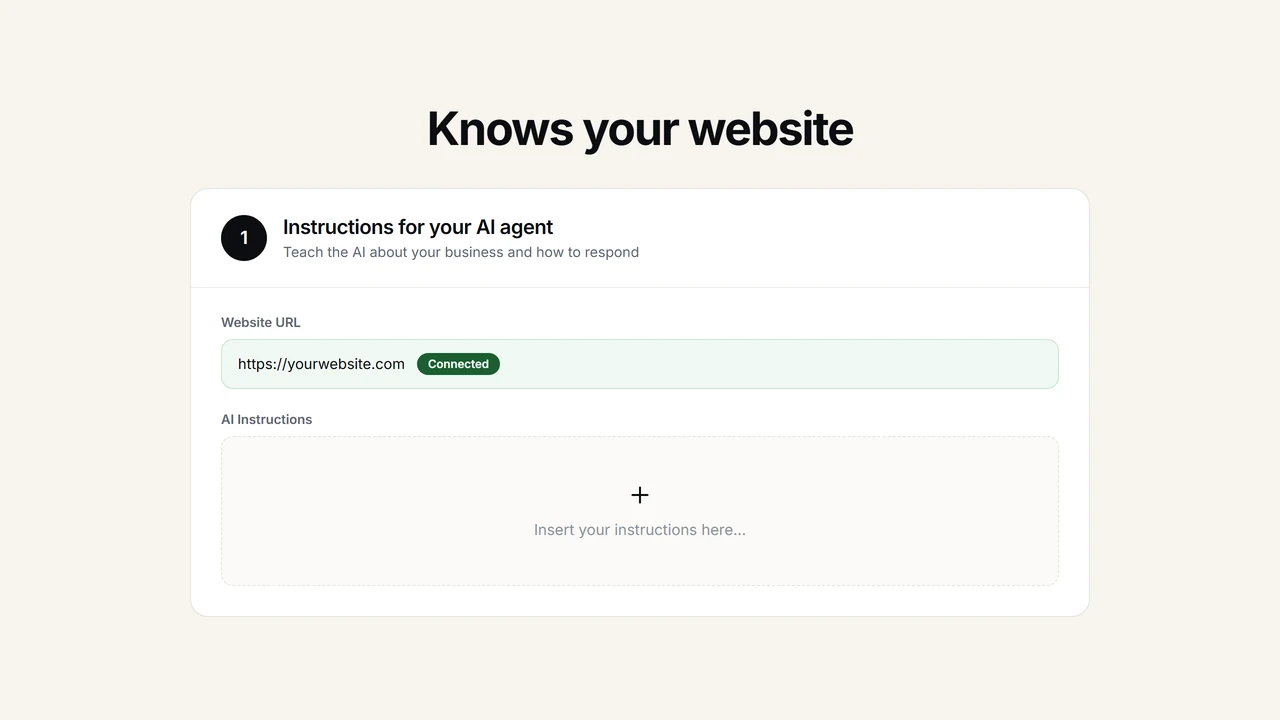
- The AI scans up to 50 pages and builds a knowledge base from your products, policies, and FAQs
- Copy the one-line embed snippet into your store's theme header
- The chatbot goes live — answering shopper questions in 36 languages
<script src="https://asyntai.com/widget.js"
data-id="your-site-id" async>
</script>
</head>
# AI support for every product, every page, every language.
Ecommerce customer support — FAQs
Questions from store owners, ecommerce managers, and support teams evaluating AI for online retail support.
Does the chatbot actually know my products, or does it give generic answers?
It knows your products specifically. Asyntai crawls your product pages — descriptions, specifications, materials, sizing charts, ingredient lists, compatibility notes — and uses that content to answer questions. When a shopper asks "is the wool blend sweater machine washable?" the chatbot answers from your product page's care instructions, not from a generic fashion knowledge base. The accuracy is limited only by the detail in your product listings. The more thorough your product pages, the more precise the chatbot's answers.
Can the chatbot look up real order information?
Yes, on Standard ($139/month) and Pro ($449/month) plans using Custom Tools. You connect the chatbot to your order management API, and it can retrieve order status, tracking numbers, delivery estimates, and shipment history in real time. The customer provides their order number or email, the chatbot authenticates against your system, and returns the current status within the conversation. No separate tracking page needed.
Does it work with Shopify, WooCommerce, and other platforms?
Asyntai works with every ecommerce platform — Shopify, WooCommerce, Magento, BigCommerce, Wix, Squarespace, PrestaShop, OpenCart, and custom-built stores. It installs as a script tag in your theme's header, which is a standard capability on all platforms. There's no platform-specific plugin required, though Asyntai also offers dedicated plugins for major platforms if you prefer a one-click install.
How does it handle returns and refund questions?
The chatbot answers return policy questions using your published policy content — return windows, condition requirements, restocking fees, refund methods, exchange options. On Standard and Pro plans with Custom Tools, it can go further: validating whether an order is within the return window, starting a return request through your API, and providing a prepaid shipping label if your system supports it. You control what actions the chatbot can take through your custom instructions and API configuration.
We sell internationally — how does multilingual support work?
The chatbot detects the shopper's language automatically from their first message and replies in that language. Thirty-six languages are supported, including Spanish, French, German, Portuguese, Japanese, Korean, Arabic, Chinese, and many more. The chatbot draws from your English-language product descriptions and policies, and adapts the response linguistically. A customer in France asking about a product in French gets a French answer with the same product details that an English-speaking customer would receive. You don't need to translate your entire catalog.
What happens during a flash sale or peak traffic?
The chatbot handles concurrent conversations without degradation. Whether you have ten shoppers asking questions or ten thousand, the response quality stays the same. If your message volume approaches the plan limit, Asyntai sends you an alert so you can upgrade before the chatbot stops responding. Free includes 50 messages/month, Starter 800, Standard 15,000, and Pro 50,000. For stores running major promotions, the Pro plan's 50,000-message allowance covers substantial traffic spikes.
How much does this cost compared to hiring support agents?
A part-time ecommerce support agent costs $1,500 to $3,000 per month. A full-time agent in the US runs $2,800 to $4,500 per month before benefits. Asyntai starts free with 50 messages and 1 site. The Starter plan is $39/month for 800 messages across 2 sites. Standard is $139/month for 15,000 messages across 3 sites with Custom Tools for order lookups. Pro is $449/month for 50,000 messages across 20 sites. The chatbot doesn't replace your team — it handles the repetitive product and policy questions so your agents focus on the complex cases.
Can I control what the chatbot says about pricing and promotions?
Completely. Your custom instructions define the chatbot's behavior. "Never offer discounts." "Mention the free shipping threshold on orders over $75." "Don't discuss upcoming sales." "Always recommend the product protection plan on electronics." The chatbot follows your rules on every conversation. If your promotion changes tomorrow, update the instructions and the chatbot adjusts immediately. There's no script to rewrite, no decision tree to rebuild.
Why ecommerce support isn't a cost center — it's the biggest conversion lever you're ignoring
Somewhere in the mythology of ecommerce optimization, support got filed under "cost center" and left there. Entire teams obsess over ad spend, conversion rate optimization, email sequences, and retargeting pixels, while the support queue — the place where customers with money in hand are literally asking for reasons to buy — gets treated as an expense to minimize. The standard playbook is to deflect: push people to an FAQ page, bury the contact form behind three clicks, and set response expectations at 24 to 48 hours. Every one of those tactics is a revenue leak. A shopper who asks "does this come in green?" and gets an answer in 10 seconds buys. A shopper who files a ticket and waits a day doesn't.
The numbers bear this out consistently. Baymard Institute research puts the average cart abandonment rate at roughly 70%. Among the reasons cited, "couldn't find enough information about the product" and "unanswered questions" appear repeatedly. These aren't price-sensitive bounces or comparison shoppers — they're people who wanted to buy and couldn't get the last piece of information they needed to commit. A chat window that answers "is this compatible with the 2024 model?" or "what's the return window if I buy during the sale?" converts that shopper at the moment of peak intent. Every minute that answer is delayed is a percentage point of conversion lost. The math isn't abstract. On a store doing $50,000 per month, a 3% improvement in conversion from answered questions is $1,500 per month — more than enough to cover any tier of AI support.
Asyntai is built for this exact problem. The AI crawls your store — product pages, collection pages, policy pages, FAQ pages, up to 50 pages total — and builds a knowledge base from your own content. When a shopper asks a question, the chatbot answers using your product descriptions, your shipping policy, your return terms, your sizing guide. Not a generic ecommerce answer. Your answer, sourced from your content, delivered in the shopper's language. The chatbot appears on every page of your store and responds instantly, at any hour, in any of 36 supported languages. A customer browsing your store at 2am in Seoul gets the same quality answer as one browsing at noon in Chicago.
Product questions represent the highest-value support category in ecommerce, and they're the ones most poorly served by traditional support models. "Is this moisturizer safe for sensitive skin?" "Does the 32-inch TV mount include the hardware?" "Can I use this protein powder if I'm lactose intolerant?" These questions sit at the intersection of product knowledge and purchase intent. The shopper has found the product, considered the price, and is looking for the last data point before clicking "add to cart." The answer lives on your product page — maybe in the description, maybe in a spec table, maybe in a bullet point the shopper didn't scroll to. The chatbot finds it and delivers it in conversation form. No hunting, no scrolling, no hoping the FAQ has a relevant entry.
Shipping questions are the second-most common support category and the most irritating to handle manually, because the answers are entirely policy-driven. "How long does standard shipping take?" "Do you ship to Australia?" "Is there a free shipping threshold?" "Can I get expedited delivery for this weekend?" Every one of these has a definitive answer that lives in your shipping policy page, and every one gets asked dozens of times per week. The chatbot answers them instantly because it has absorbed your shipping policy and can apply it to any specific question. No ticket, no queue, no human time consumed on a question whose answer hasn't changed since last quarter.
Returns are where AI support pays for itself a second time, by reducing the anxiety that causes returns in the first place. A significant percentage of ecommerce returns happen not because the product is wrong, but because the customer was uncertain about something before buying and bought anyway, then regretted it. If the chatbot answers "does this jacket run large?" accurately before purchase, the customer orders the right size. If it clarifies "this supplement contains soy" before checkout, the allergic customer doesn't order and then return. Pre-purchase clarity reduces post-purchase returns — a cost savings that's hard to measure directly but shows up in your return rate over a quarter.
Custom Tools on Standard and Pro plans move the chatbot from information into operations. When the AI can call your store's order API, it becomes a real support agent — not just an information assistant. A customer types "where's my order?" and the chatbot looks up the order, finds the tracking number, checks the carrier status, and responds with "your order shipped on Tuesday via USPS and is currently in transit, estimated delivery is Friday." That interaction, handled manually, involves a support agent opening the admin panel, searching for the order, copying the tracking number, checking the carrier site, and composing a response — five minutes of human time on a question that the chatbot resolves in seconds. Multiply by 200 order status inquiries per month and the time savings alone justifies the subscription.
The same Custom Tools capability enables return initiation, exchange processing, and inventory checks. A customer asks to return an item. The chatbot validates the order date, confirms it's within the return window, explains the process, and optionally triggers the return workflow in your system. A shopper asks if the navy size-M is in stock. The chatbot checks your live inventory and gives a definitive answer — not "check the product page" but "yes, 14 in stock" or "sorry, that's currently sold out but the charcoal is available in your size." These are the interactions that separate a store with good support from a store with a chat widget that deflects to an FAQ.
International selling is where the economics become impossible to ignore. If your store ships to 15 countries but your support team speaks English, you have a structural problem. Spanish-speaking customers in Mexico, French-speaking shoppers in Montreal, Japanese buyers in Tokyo — they all have product questions, and they're all more likely to buy if they can ask those questions in their own language. Hiring multilingual support agents is expensive and operationally complex. Running your support through Google Translate produces awkward, sometimes misleading answers. Asyntai handles 36 languages natively — the AI detects the language from the shopper's message and responds in kind, using your English-language product content. The quality of a Spanish answer about your size chart is identical to the English answer. You don't need translated product pages, localized FAQ sections, or regional support teams. One chatbot, one knowledge base, 36 languages.
The platform compatibility question comes up early and deserves a direct answer. Asyntai works with every ecommerce platform — Shopify, WooCommerce, Magento, BigCommerce, Wix, Squarespace, PrestaShop, OpenCart, and any custom-built store. Installation is a single script tag in your theme header. There's no platform-specific configuration, no middleware, no engineering project. On Shopify, you paste the snippet into theme.liquid. On WooCommerce, you add it to your header via a plugin or directly in the theme. On a custom store, you paste it in the head tag. The chatbot loads on every page and the AI starts answering questions from the knowledge base it built during the initial crawl. Most stores go from signup to live chatbot in under an hour.
Pricing scales with actual usage, not with the size of your catalog or the number of products. The Free plan gives you 50 messages on 1 site — enough to validate the concept on a small store. Starter at $39/month covers 800 messages across 2 sites, which handles most stores under $500K annual revenue comfortably. Standard at $139/month unlocks Custom Tools for order lookups and returns, covers 15,000 messages across 3 sites, and is where most mid-market stores land. Pro at $449/month gives you 50,000 messages across 20 sites — built for multi-brand operations and high-traffic stores where support volume is measured in thousands per week, not dozens.