Ecommerce automation software that handles the questions your team keeps repeating
Eighty percent of messages hitting your store are about shipping, returns, sizing, and stock. Asyntai answers them instantly from your product pages and policies, so your team focuses on the orders that actually need a human.
Try it on your online store
Enter your store URL and see how the AI handles real product and shipping questions
Knows your catalog, your policies, and the details shoppers care about
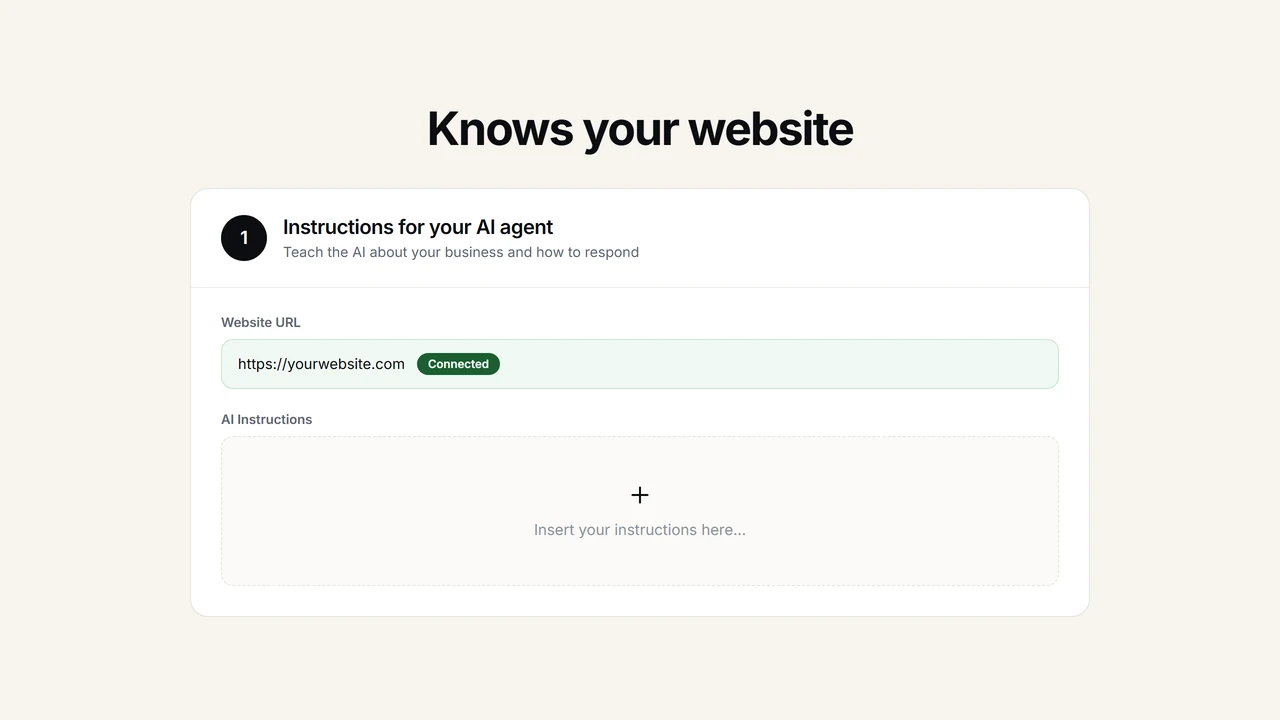
Shoppers abandon carts when they can't get a quick answer about sizing, materials, compatibility, or shipping timelines. Asyntai crawls up to 50 pages of your store — product descriptions, size guides, shipping policies, return terms, FAQ pages — and uses that content to answer pre-purchase questions in real time. The AI doesn't guess or generalize. If your size guide says the medium fits a 38-40 inch chest, that's what the AI tells the shopper. If your return window is 14 days for sale items, the AI quotes 14 days — not 30.
- Product details on demandMaterials, dimensions, compatibility, care instructions, ingredient lists — the AI pulls from your product pages to answer the specifics that push a browser toward a purchase.
- Shipping and return policies, quoted accuratelyNo more shoppers guessing at delivery timelines or return windows. The AI answers using the exact terms from your policy pages, every time.
- Recommendations grounded in your catalogWhen a shopper describes what they need, the AI suggests products from your actual inventory — not generic categories. It matches based on the attributes in your product descriptions.
Real-time inventory, order tracking, and returns — without your team lifting a finger
Pre-purchase questions are only half the conversation. Post-purchase, customers want to know where their order is, whether an item is back in stock, or how to initiate a return. With Custom Tools on the Standard ($139/month) and Pro ($449/month) plans, the AI calls your store's API endpoints to fetch live data. A customer asks "where is my order?" and the AI returns the actual tracking status from your fulfillment system. Someone asks "is the blue version in stock?" and the AI checks your inventory in real time. You define which endpoints are accessible — the AI handles the conversation naturally while your support team handles the exceptions.
- Order status and trackingCustomers ask about their order and get the real shipping status — carrier, tracking number, estimated delivery — pulled from your fulfillment system in real time.
- Live inventory checks"Is this available in size 10?" The AI queries your inventory system and gives a definitive yes or no instead of directing the customer to check the product page themselves.
- Automated return initiationA customer wants to return an item. The AI verifies eligibility against your return policy, confirms the order details, and initiates the return through your system — no ticket needed.
- Personalized account accessLogged-in customers ask about their loyalty points, subscription status, or past orders. The AI retrieves their data via User Context and answers personally.
- Back-in-stock notificationsWhen the AI confirms an item is out of stock, it can capture the customer's email and flag the item — keeping a lead warm that would otherwise bounce silently.
Live on your store in under an hour
No app store review, no developer, no theme modifications. Paste a single script tag into your store header — Shopify, WooCommerce, Magento, BigCommerce, or any platform that lets you edit the HTML head — and the AI starts answering from your product pages immediately.
- Create a free account and paste your website URL
- The AI scans up to 50 pages and builds a knowledge base from your content
- Copy the one-line embed snippet into your site header
- The chatbot goes live — answering visitor questions in 36 languages
<script src="https://asyntai.com/widget.js"
data-id="your-site-id" async>
</script>
</head>
# One line. Every store question covered.
Ecommerce automation — FAQs
What store owners and ecommerce teams ask before automating customer conversations.
Yes. The AI crawls your actual product pages — descriptions, specs, pricing, size guides, materials — and uses that content to answer. If a shopper asks about a specific SKU's dimensions or whether a jacket runs true to size, the AI answers from your product data, not from generic ecommerce knowledge.
Asyntai works with any platform that lets you add a script tag to the site header — Shopify, WooCommerce, Magento, BigCommerce, PrestaShop, Squarespace, Wix, and custom-built stores. There is no app to install or theme to modify. If you can paste HTML into your header, it works.
With Custom Tools on the Standard ($139/month) and Pro ($449/month) plans, yes. You configure API endpoints that the AI calls to check order status, verify return eligibility, and initiate return workflows. Without Custom Tools, the AI answers policy questions about returns and shipping but cannot look up specific order data.
Yes, based on the product descriptions in your knowledge base. When a shopper says "I need a waterproof jacket for hiking," the AI matches that against your product attributes and suggests relevant items from your catalog. It does not recommend products you don't sell — all suggestions come from your crawled content.
The AI detects the shopper's language from their first message and responds in that language. The widget interface supports 36 languages. A French shopper asking about shipping to Paris gets a French answer about your international delivery terms. No translation configuration required — it happens automatically.
The widget loads asynchronously, meaning it does not block your page rendering. Your product pages, images, and checkout flow load at their normal speed. The chat widget appears after the page content is ready, so there is zero impact on Core Web Vitals or perceived page speed.
Free: $0 for 1 store and 50 messages/month. Starter: $39/month for 2 stores and 800 messages. Standard: $139/month for 3 stores, 15,000 messages, and Custom Tools for live inventory and order lookups. Pro: $449/month for 20 stores and 50,000 messages. Most stores start on Starter and upgrade to Standard when they want live data integrations.
The AI captures the customer's name, email, and the full conversation, then sends the escalation to your Asyntai dashboard and optionally to your email inbox. Your support team sees everything the customer discussed — no "start over" experience. You set the escalation rules in plain English: "escalate any damage claim," "offer a human for orders over $500," or whatever fits your workflow.
The 80/20 reality of ecommerce customer conversations
Run any online store long enough and a pattern emerges that is both obvious and maddening. The vast majority of customer messages — before purchase and after — are questions with answers that already exist on your website. "Do you ship to Canada?" It's on the shipping page. "Can I return sale items?" It's in the return policy. "What's the difference between the Pro and the Standard model?" It's in the product comparison chart. "Where is my order?" It's in the tracking email. The answers are published, findable with two clicks, and perfectly clear to anyone who looks. But shoppers don't look. They ask. And every question that hits your inbox costs the same amount of human time whether it's genuinely complex or whether the answer is a sentence lifted verbatim from your FAQ. Ecommerce automation exists to break that pattern — to let the repetitive 80% get handled instantly so your team can spend real time on the 20% that deserves it.
Asyntai approaches ecommerce automation from a specific angle: the AI reads your store's content and uses it to answer customer questions. You point it at your website URL, it crawls up to 50 pages — product pages, category descriptions, shipping policies, return terms, FAQ sections, size guides, about pages — and indexes all of it into a knowledge base. When a shopper opens the chat widget and asks "is this jacket machine washable?", the AI checks the product page for care instructions and answers. When a shopper asks "what's your return window for electronics?", the AI checks your return policy and quotes the exact timeframe. The answers come from your content, not from a generic ecommerce template. This matters because your policies are yours — your return window, your shipping carriers, your size chart conventions — and the AI needs to reflect them accurately to be useful rather than harmful.
The pre-purchase conversation is where ecommerce automation has the most direct revenue impact. A shopper with a question is a shopper who has not yet decided. They're on the product page, interested enough to engage but uncertain about something — fit, compatibility, delivery timing, return safety net, material quality. Every minute they wait for an answer is a minute closer to closing the tab. Traditional live chat solves this when an agent is online, but most stores don't staff chat 24 hours a day, and the busiest shopping hours — evenings and weekends — are precisely when staffing is thinnest. An AI that answers product questions instantly, around the clock, in the shopper's own language, keeps that buying momentum alive. It is not upselling or manipulating. It is answering the question that stands between the shopper and the purchase.
Shipping questions account for a disproportionate share of pre-purchase inquiries. "How much is shipping to my country?", "how long does delivery take?", "do you offer express shipping?", "is there free shipping over a certain amount?" These questions are completely answerable from your shipping policy page. But shoppers either don't find the page or don't trust that the general policy applies to their specific situation. The AI intercepts this: it reads your shipping policy and answers with the specific terms. "Free standard shipping on orders over $75 within the US. International orders ship via DHL with delivery in 7-14 business days. Express shipping is available at checkout for $12.99." No agent needed. No ticket created. No shopper lost to uncertainty.
Post-purchase is where Custom Tools transform ecommerce automation from informational to operational. On the Standard plan at $139/month and the Pro plan at $449/month, you configure API endpoints that the AI calls to fetch live store data. The most common use case is order tracking: a customer asks "where is my order?", the AI calls your fulfillment API with the customer's order identifier, and returns the actual shipping status — carrier name, tracking number, estimated delivery date. Without Custom Tools, the AI can answer policy questions about shipping timelines, but it cannot look up a specific order. With Custom Tools, it handles the entire post-purchase inquiry without creating a support ticket.
Inventory checks are another high-impact Custom Tool integration. A shopper asks "is the navy blue version available in large?" and the AI queries your inventory system in real time. If it's in stock, the shopper proceeds to purchase. If it's out of stock, the AI can capture their email for a restock notification — keeping a warm lead instead of losing them silently. For stores with fast-moving inventory or limited editions, this real-time availability check is the difference between a conversion and a bounce. The shopper gets a definitive answer instead of navigating to the product page, selecting options, and discovering the "out of stock" message at the end of the process.
Return handling through Custom Tools follows a similar pattern. A customer initiates a return conversation. The AI verifies the order against your return policy — is it within the return window? Is the product category eligible? Were the items worn or used? If the return qualifies, the AI can initiate the process through your returns system, generate a return label, or provide return instructions. If the return doesn't qualify — a final-sale item, or past the return window — the AI explains why and offers escalation to a human for exceptions. The customer gets a clear, immediate answer either way, and your support team only handles the edge cases that require judgment.
The language dimension is particularly valuable for ecommerce because online stores naturally attract international shoppers. A French store on Shopify gets visitors from Belgium, Switzerland, Quebec, and across Africa. A German store gets Austrian and Swiss shoppers. An English-language store on any platform gets visitors from everywhere. Asyntai's AI detects the shopper's language from their first message and responds in kind — 36 languages are supported. A Japanese shopper asking about international shipping gets Japanese. A Brazilian shopper asking about sizing gets Portuguese. This happens automatically from a single knowledge base in your store's primary language. For cross-border ecommerce, where international customers historically bounce at higher rates due to language friction, this removes a meaningful barrier.
The pricing structure maps directly to store scale. Free: $0 for one store and 50 messages per month — enough to test the concept on a low-traffic store. Starter: $39/month for two stores and 800 messages — sufficient for a small to mid-size store handling normal daily chat volume. Standard: $139/month for three stores, 15,000 messages, and Custom Tools for live inventory, order tracking, and return workflows. Pro: $449/month for 20 stores and 50,000 messages — built for agencies managing multiple client stores, multi-brand retailers, and high-volume operations. The cost per automated conversation is measured in cents, compared to $3-$10 per support ticket handled by a human agent.
The operational shift after deployment is consistent across stores. Day one, the AI starts answering shipping, return, and product questions that would have become support tickets. Within the first week, the support inbox is noticeably lighter — the repetitive questions that used to fill it are resolved before they arrive. Within the first month, the support team's time allocation changes. Instead of spending mornings processing a queue of "where is my order?" and "can I return this?" messages, they handle complex cases — damage claims, custom orders, wholesale inquiries, high-value customer escalations — with enough time to actually resolve them well. The AI doesn't replace the support team. It removes the repetitive volume that was preventing the support team from doing the work that requires human skill.
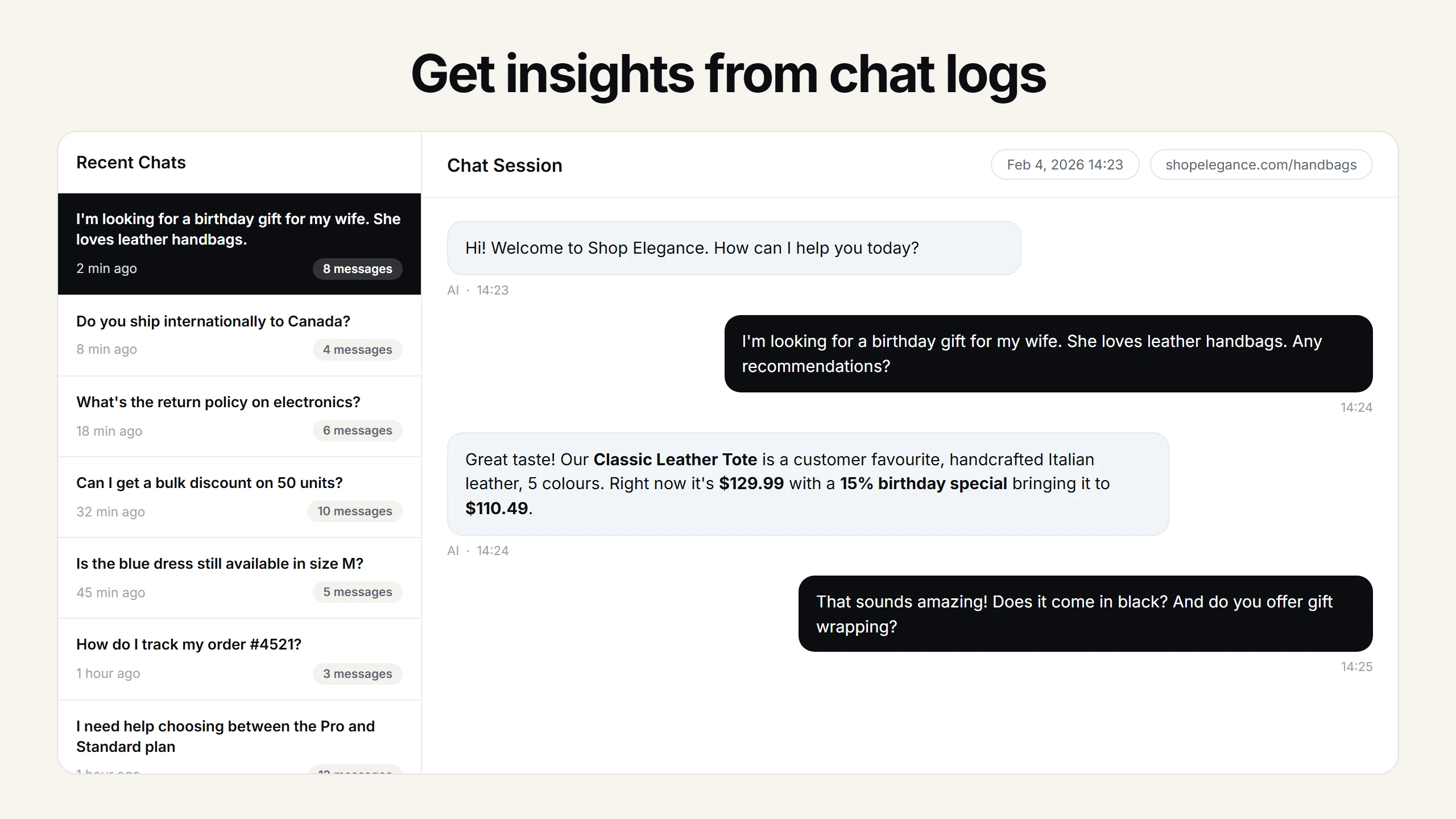
The data that flows from automated conversations turns out to be as valuable as the automation itself. Every question a shopper asks reveals something about your store's communication gaps. If fifty shoppers this month asked whether a product is machine washable, the care instructions on that product page need to be more prominent. If thirty shoppers asked about shipping to a specific country, your shipping page needs a clearer international section. If twenty shoppers asked "what size should I get?", your size guide needs work. Conversation analytics in the Asyntai dashboard group these patterns by topic and frequency, turning customer confusion into a roadmap for content improvement. Over time, the best ecommerce automation does more than answer questions — it reduces the number of questions that need asking.