The ecommerce AI chatbot that thinks like your best sales associate
Asyntai is an ecommerce AI chatbot built around how shoppers actually decide — matching them to SKUs, clearing objections, and handing the warm ones to your team when they're ready to talk human.
Put the ecommerce AI chatbot on your storefront
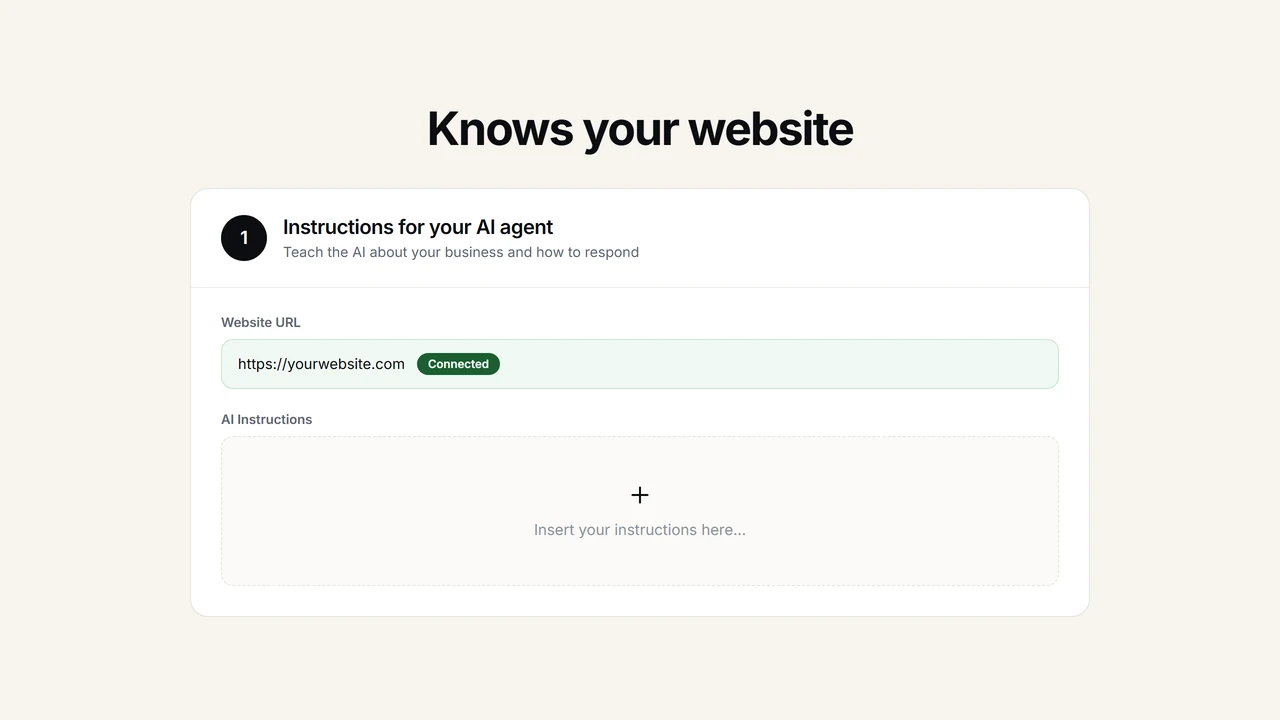
Drop in your store URL and watch the assistant handle the merchandising questions that usually go unanswered
Built around shopping behavior, not bolted onto a generic bot
Most chat tools started life as a helpdesk widget with an AI layer painted on. The Asyntai ecommerce AI chatbot was shaped the other way around — an AI assistant first, then specialized for retail workflows like variant matching, SKU lookups, policy clarification, and post-purchase tracking handoffs. Every behavior in the system exists because a shopper somewhere paused mid-decision.
- Answers from merchandise, not ticket macrosThe chatbot ingests your product pages, collection hierarchies, size guides, care notes, ingredient panels, and shipping matrices — the way a new hire would study the floor before their first shift.
- Plain-English merchandising rules"Always pair the main item with a recommended accessory." "Cross-sell the refill bundle after any first-time purchase question." "Never discount — redirect to the loyalty program instead." You write the playbook in English; the chatbot follows it.
- WooCommerce REST API sync where it countsFor WooCommerce storefronts, the WooCommerce AI chatbot pulls variations, stock flags, and live prices through read-only REST keys — so variant-level replies stay honest on busy sale days.
Two jobs, one conversation window
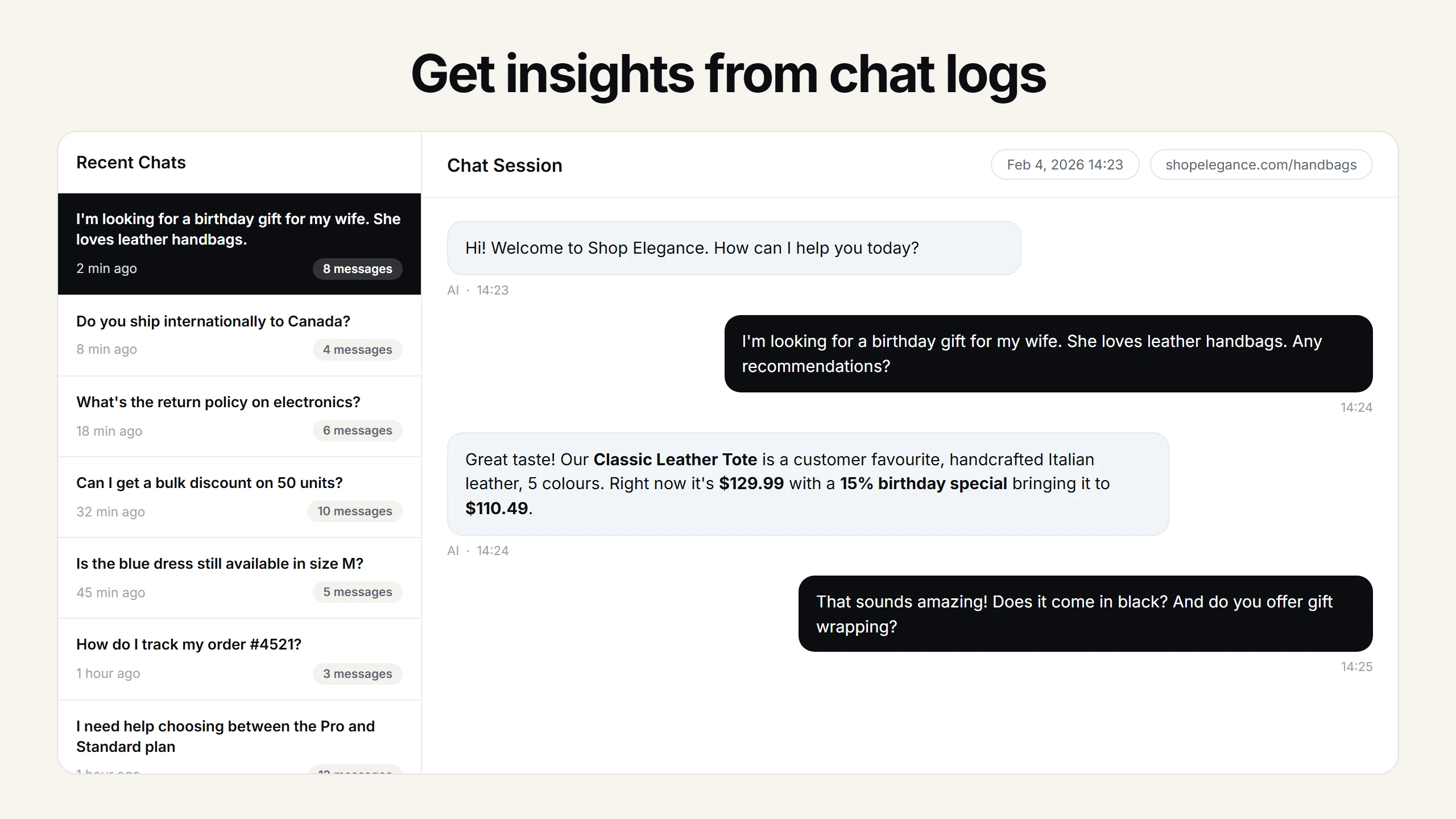
The cleanest ecommerce AI chatbot deployments handle both ends of the journey in the same widget: merchandising on the way in, tracking and returns on the way out. Asyntai doesn't separate those flows into different tools or different upsells — it's the same assistant, context-aware to which stage the shopper is in.
- Smart opener timing by page typeThe auto-trigger opens sooner on product and cart pages, later on editorial and category pages, configured separately for desktop and mobile to avoid disruptive takeovers.
- Order lookups without a backend integrationOn Standard and Pro tiers, User Context lets your theme hand the signed-in buyer's order payload to the widget through a simple JavaScript object, so the chatbot replies to tracking questions in-flow.
- Warm leads routed where you want themUnresolved questions close with a lead-capture prompt; the full chat record saves inside the Asyntai dashboard and, if notifications are on, arrives in your team inbox the moment the conversation ends.
Deploy once. Runs everywhere your cart lives.
A single async JavaScript snippet pastes into any storefront's head tag and carries the whole ecommerce AI chatbot with it — no marketplace review, no theme rewrite, no checkout interference. Whatever platform the cart runs on, the snippet runs the same way and loads after your page has painted.
- Create a free Asyntai account — you get 50 messages to try before picking a plan.
- Copy the snippet from your dashboard and paste it into your storefront's
<head>tag via your theme editor or header-injection app. - Point the training crawler at your shop URL and upload any merchant-only documents the public site doesn't reveal.
- Write 5–10 merchandising rules in plain English, preview a few conversations, then publish the chatbot to real traffic.
<script src="https://asyntai.com/widget.js"
data-id="your-store-id" async>
</script>
# Same snippet whether the cart is Shopify,
# WooCommerce, BigCommerce, or headless.
Ecommerce AI chatbot — the questions merchants actually ask
Short answers, straight from product reality — no inflated claims.
What makes this different from a generic AI chatbot with an ecommerce template?
The engine underneath is AI-first, but the behavior layer — opener timing, merchandising rules, handoff escalations, variant awareness, post-sale tracking integration via User Context — was shaped specifically for stores. A template-on-a-generic-bot usually means some preset FAQs; Asyntai's retail posture runs through every setting, including the auto-trigger's page-type logic and the rule engine that shapes recommendations.
How does the chatbot actually learn my inventory?
Two paths. For any storefront, the training crawler reads your public product pages, collections, and policy URLs and indexes them as knowledge. For WooCommerce specifically, Asyntai also syncs the live catalog through read-only REST API keys, which preserves variation structure and stock flags the way WooCommerce stores them. Either way, you can supplement with uploaded PDFs or pasted docs for anything that isn't on the public site.
Can it tell a shopper where their order is?
Yes — the User Context hook does exactly that on Standard and Pro accounts. Your storefront template populates a JavaScript object — window.Asyntai.userContext — with the signed-in buyer's current order data, and the chatbot folds that information into its replies during the session. No store permissions granted to Asyntai, no API pipeline to maintain — you decide per page what the chatbot sees.
What languages does it cover for international carts?
The widget UI is localized across 36 languages, and the AI replies in whatever language the shopper writes in from the first message. Your catalog can stay in a single language — a shopper pasting a question in Turkish still gets a Turkish reply, with the product names referenced verbatim from your catalog.
Does the chatbot feed my email marketing tool automatically?
Not on its own. Captured leads show up inside your Asyntai dashboard with their complete transcript attached and, optionally, a live email notification. From there, export or forward them into whichever CRM or ESP you run — Asyntai intentionally stays out of automated marketing-sync territory so you keep full control of who gets contacted and how.
Will the widget cause checkout or product-page slowdowns?
The script loads asynchronously after page content, so it sits off the critical rendering path and doesn't hold up checkout scripts, pixel tracking, or payment gateways. Behavior matches any other async tag you've likely already got running on the page.
I run a portfolio of brands — can one account cover them all?
Up to a point. Site allowances by plan are Free 1, Starter 2, Standard 3, Pro 10, and each site trains its own independent chatbot from its own catalog. A brand holding group with eight DTC labels fits comfortably on Pro; an agency with twelve clients plans for two Pro accounts or a custom arrangement.
What's the real entry cost?
Free to start — 50 messages per month without a card. The entry-level paid plan runs $39 monthly and includes 800 messages, enough for most small-to-medium stores' monthly chat volume. Email warnings fire before you hit the cap, so a surprise traffic spike during a sale doesn't silently brake the chatbot.
The ecommerce AI chatbot, end to end
Walk a shopper through a physical store and the best associates do three things almost without thinking: they read the person's hesitation before it hardens into a walkout, they pair items that belong together, and they remember which policies matter to which customer. An ecommerce AI chatbot earns its place on a storefront only if it replicates some fraction of that behavior online — and the places most chat tools fail are exactly those three. They wait passively for a click instead of reading hesitation. They answer one item at a time instead of pairing. They paraphrase policy pages rather than remembering them. Asyntai was engineered around closing those three gaps, which is why this page leads with behavior rather than features.
AI-first matters here because the alternative — a rule-tree builder with an AI fallback layer — produces a fundamentally different kind of conversation. Rule trees break the instant a shopper phrases something off-script: "I'm looking for a gift, something under fifty, for a guy who bakes sourdough, and it needs to ship to Dublin by Friday." That sentence contains a budget, a recipient persona, a category implication, and a shipping constraint, and a rule-tree bot either asks five separate menu questions or falls through to a boilerplate reply. An AI-first chatbot — given the catalog, the shipping matrix, and a few merchandising rules — parses the request, narrows to two or three candidates, checks the shipping time to Ireland, and either recommends or asks the one clarifying question that genuinely matters. The difference compounds across every non-standard query a store sees, and non-standard queries are the majority once traffic scales.
The content that matters most isn't a manual of polite phrases; it's your merchandise itself. Asyntai's training crawler walks the public storefront and ingests product pages, collection hierarchies, size and fit guides, ingredient panels, compatibility notes, shipping matrices, return windows, and warranty terms. For WooCommerce shops, a REST API sync runs alongside that crawl so the chatbot has structured variation data — the right stock state for the right variant on the right day. For everything the public site deliberately doesn't expose — wholesale tiers, preorder timing, supplier substitution rules, internal sizing heuristics — a supplemental upload slot accepts PDFs or pasted docs that the chatbot reads alongside the crawled catalog. The chatbot treats all of it as equally citable, and plain-English rules sit on top to shape when and how it pulls from each source.
Opener timing is where most merchants underestimate the impact of configuration. A chatbot that opens too aggressively trains shoppers to reflexively dismiss it; a chatbot that never surfaces goes ignored. Asyntai's auto-trigger separates desktop and mobile, separates first-time and returning visitors, and separates page types: product and cart pages earn earlier openers, because that's where hesitation concentrates; editorial, blog, and about pages stay quieter, because shoppers there are still exploring. Tuned honestly to your traffic pattern, the opener becomes the single largest driver of conversation volume, and therefore of recovered conversions, that the widget produces.
Merchandising rules are the quieter half of making the assistant feel like a seasoned floor associate rather than a generic answering service. "When a shopper asks about our hero jewelry piece, mention the gift-wrap option." "For supplements, always remind that we're not prescribing — ask them to talk to their GP for dosing." "If someone's comparing two sofas, surface the delivery window difference, because it's usually the tiebreaker." "Never quote an ETA more specific than 'within a week' on custom-built furniture." Each rule is a sentence; collectively they give the chatbot the house style, the guardrails, and the selling instincts that a human new-hire would absorb over months on the job. Updating a rule is also a sentence — no retraining, no rebuild, no downtime.
Post-purchase is the quiet revenue leak on most stores. A shopper who can't find their tracking link emails support, the ticket waits, frustration builds, and the next-purchase probability quietly drops. The User Context feature — gated to Standard and Pro tiers — lets the ecommerce AI chatbot handle tracking without a separate integration: your theme injects a small JavaScript object carrying the logged-in customer's order status, tracking ID, carrier, and ETA before the widget loads; the assistant speaks to that context during the conversation. "Your order shipped Tuesday via Royal Mail 48, tracking number enclosed — expected delivery Thursday or Friday." No app store review, no permission escalation, no ingestion of buyer data into Asyntai's side unless your site elects to pass it — the model is entirely merchant-controlled.
Multilingual behavior matters more on ecommerce sites than on almost any other site type, because checkout funnels are unforgiving of comprehension friction. A shopper who can't read an answer to their shipping-to-Sweden question doesn't translate in their head and proceed — they abandon. Asyntai's widget UI ships localized across 36 languages, and the AI replies in whatever language the shopper types. A Dutch cardholder asking in Dutch about VAT inclusion gets a Dutch reply grounded in your actual tax policy. A Korean shopper asking about import duties gets a Korean reply. The catalog itself stays in its source language; the conversation adapts around it. For brands that ship globally — or simply have their product featured on an international TikTok one afternoon — that one setting pays off the entire month's subscription in recovered sessions.
Lead capture is the graceful exit for the conversations the AI intentionally shouldn't close. A shopper asking about bulk pricing for a wedding order, a wholesale query from a boutique buyer, a refund escalation tied to a damaged parcel — the chatbot recognizes these as out-of-scope for autonomous handling and invites the shopper to leave their email or phone so a human can follow up. That transcript attaches to the lead record inside your Asyntai dashboard; flipping on notification emails also pushes the same exchange to your team inbox the instant the conversation ends. No Klaviyo sync, no Mailchimp bridge, no automated drip — just the information your team needs to reply warmly and well. That deliberate restraint keeps the lead pipeline something you control rather than something that auto-fires campaigns behind your back.
Analytics close the loop. Every conversation the chatbot has is a free focus-group session on what your storefront isn't telling shoppers clearly. When a run of shoppers this week asked whether a specific candle was soy or paraffin, your product page needs an ingredient line. When international shoppers keep asking whether import duties are calculated at checkout, that signal tells you the shipping page is missing a customs summary up top. When ten shoppers asked for size comparisons between two mattresses, your collection page needs a comparison table. Asyntai's dashboard clusters questions by frequency and topic so patterns surface quickly — a merchandising team can often find three or four product pages a week that need editing, and the chat volume on those SKUs then drops over the following weeks as the site itself improves.
Vertical shape matters. Jewelry brands lean heavily on stone, metal, setting, and care questions — the chatbot's job is to translate jargon and prevent the wrong-gift return. Supplement brands lean on ingredient and interaction questions, where the chatbot must stop short of medical advice while still being genuinely useful. Furniture merchants lean on dimensions, delivery windows, and assembly — the kinds of questions where a wrong answer produces a bulky, expensive return. Pet-product stores lean on compatibility: will this harness fit a greyhound, does this food suit a senior cat. Electronics stores lean on specs and compatibility with existing gear. A well-configured ecommerce AI chatbot adapts to each vertical's specific pre-purchase friction, and the rule engine gives you the controls to set those guardrails deliberately rather than hoping the model infers them.
Pricing is designed so the chatbot earns its keep early. Free includes 50 messages monthly — enough to sanity-check whether your catalog and your shoppers line up with what the assistant produces. The entry paid plan is priced at $39 and comes with 800 messages baked in — enough to cover most single-brand shops through a normal month — and the ladder above scales in steps for active DTC brands and portfolio operators. Site counts rise with the plan — 1, 2, 3, 10 — so a single-brand founder and a multi-brand agency both have a tier shaped for them. Email warnings precede any throttling, so your chatbot doesn't silently stop mid-sale; you get runway to upgrade before the cap actually bites.
Finally, there's the question of what an ecommerce AI chatbot should avoid claiming. It doesn't magically rewrite abandonment emails, it doesn't pipe leads automatically into your ESP, it doesn't replace your customer success team, and it can't answer a question whose underlying information you haven't made available to it. What it does do, reliably: intercept the merchandising questions that would otherwise be closed tabs, hand off tracking inquiries without an API stack, capture the hard cases as leads with full context, and hold a merchandising conversation in any of 36 languages at any hour. Set up once, tuned over the first week, and it becomes the layer that makes every other marketing dollar spent on traffic work meaningfully harder.