An ecommerce AI agent that sells, supports, and resolves
Asyntai deploys an AI agent on your online store that absorbs your product catalog, shipping policies, and FAQs — then goes further. Through Custom Tools, it calls your store's APIs to look up order status, check live inventory, verify return eligibility, calculate shipping rates, and handle requests from first click to final delivery. Not a scripted popup. A full-cycle ecommerce agent.
Watch the AI agent handle real ecommerce questions
Enter your store URL and see how the ecommerce AI agent answers product questions, tracks orders, and assists shoppers using your actual content
Absorbs everything your store knows — products, policies, every detail
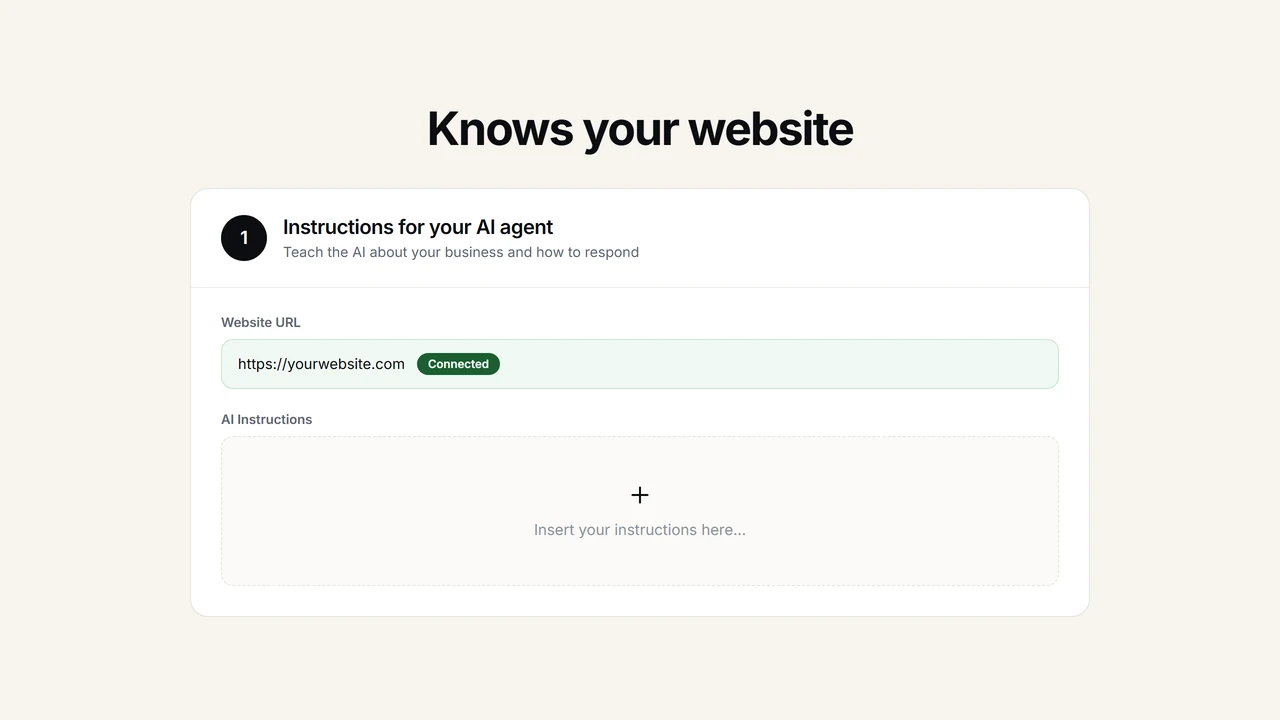
The ecommerce AI agent crawls your entire site and learns your product catalog, shipping policies, sizing guides, care instructions, warranty terms, and frequently asked questions. When a shopper asks "does this jacket run large?" or "do you ship to Australia?", the agent answers from your own content — accurate, on-brand, and instant. No manual FAQ building. Your site is the source of truth.
- Product catalog as a conversationShoppers describe what they need in plain language — "a waterproof bag under $80" or "something similar to the navy pullover but lighter" — and the agent searches your catalog and surfaces the right products with details, prices, and links.
- Policies without the page huntReturn windows, shipping timelines, warranty coverage, care instructions — all absorbed from your existing pages. The agent quotes your actual policy language instead of giving generic answers, so shoppers trust the response.
- Sizing and fit guidance that reduces returnsThe agent references your sizing charts, fit notes, and product descriptions to help shoppers pick the right size before they buy. Fewer "it didn't fit" returns means higher net revenue per order.
Calls your store's APIs to look up, verify, and process — live
Knowledge answers the "what" questions. Custom Tools answer the "where," "when," and "can I" questions. The ecommerce AI agent calls your store's endpoints mid-conversation to pull real order data, check current stock levels, verify return eligibility against actual purchase dates, and fetch live shipping rates. The shopper gets a concrete answer, not a redirect to another page.
- Order tracking with real shipment dataThe agent extracts the order number from the conversation, calls your order status endpoint, and replies with the carrier, tracking number, current location, and estimated delivery. No "check your email for tracking info" — the answer is right there.
- Inventory checks that prevent dead endsWhen a shopper asks "is the red one available in medium?", the agent calls your inventory endpoint and gives a definitive yes or no with current stock levels. If it's out of stock, it can suggest alternatives from your catalog that are available.
- Return and exchange processing in the conversationThe agent verifies purchase date against your return window, confirms eligibility, and initiates the process — all without the shopper navigating to a separate returns portal or waiting for an email reply.
Add the ecommerce AI agent to your store in minutes
One code snippet on your site, one crawl of your catalog, and your AI agent is live. Connect Custom Tools for order lookups and inventory checks through your dashboard — no plugins to install, no theme files to edit, no developer needed.
- Paste the Asyntai snippet into your store's
<head>tag — works on Shopify, WooCommerce, Magento, BigCommerce, or any platform. - The agent crawls your product pages, policy pages, FAQs, and help docs automatically. Your catalog becomes its knowledge base.
- Connect Custom Tools in your dashboard — paste your order status endpoint, inventory API, or returns endpoint and describe when the AI should call each one.
- Test with a real question like "where is order #10294?" and watch the agent call your API and answer with live data.
<script src="https://asyntai.com/widget.js"
data-id="your-store-id" async>
</script>
</head>
# One snippet. Your ecommerce AI agent is live.
Ecommerce AI agent — FAQs
Common questions from store owners, ecommerce managers, and operations teams evaluating AI agents for their online stores.
How is this different from the chatbot my ecommerce platform already includes?
Built-in platform chatbots are typically rule-based — they follow decision trees you build manually and can only answer questions you've pre-scripted. Asyntai's ecommerce AI agent reads your entire site, understands natural language, and calls your store's APIs through Custom Tools. A shopper can ask "do you have anything like the blue running jacket but warmer?" and the agent searches your catalog and recommends products. They can follow up with "where is my order?" and the agent calls your order status API with the order number. No scripting, no decision trees, no maintenance when your catalog changes.
Which ecommerce platforms does the AI agent work with?
Any platform that renders HTML. Shopify, WooCommerce, Magento, BigCommerce, Wix, Squarespace, PrestaShop, OpenCart, custom-built stores — the agent installs via a single script tag in your site's head. It crawls your pages like a search engine does, so it works regardless of your backend. For Custom Tools, you need API endpoints on your platform — most modern ecommerce systems expose order, inventory, and customer APIs that the agent can call directly.
Can the AI agent actually process returns, or does it just explain the policy?
Both. Without Custom Tools, the agent answers return policy questions from your crawled content — eligibility windows, conditions, shipping costs. With Custom Tools connected, it goes further: it looks up the specific order, checks the purchase date against your return window, confirms eligibility, and can trigger your return initiation endpoint. How far the automation goes depends on what your endpoints support. Many stores start with lookups and add write actions after they see the volume.
Does the agent update automatically when I add new products or change prices?
Yes. The agent periodically recrawls your site, so new products, updated descriptions, changed prices, and revised policies are picked up automatically. You don't need to manually upload a product feed or sync a catalog. If you make a major change and want it reflected immediately, you can trigger a manual recrawl from your dashboard. For live data like inventory levels, use Custom Tools — the agent calls your inventory API in real time rather than relying on crawled snapshots.
How does the AI agent help with pre-sale questions that reduce cart abandonment?
Shoppers abandon carts when they have unanswered questions — about sizing, shipping costs, delivery times, or product comparisons. The ecommerce AI agent answers these instantly, right on the product page or in the cart. "Will this fit a 42-inch chest?" gets a sizing chart answer. "How much is shipping to Canada?" gets a real rate from your shipping API. "How is this different from the Pro model?" gets a feature comparison from your product descriptions. Each answered question removes a friction point between browsing and buying.
Can the agent handle conversations in languages other than English?
Yes, the agent supports 36 languages and detects the shopper's language automatically. A customer browsing your English-language store can ask a question in Japanese, and the agent responds in Japanese — pulling product details from your English catalog and translating the response naturally. Custom Tool calls work the same way: the agent calls your (English) API, receives the data, and composes the answer in the customer's language. You don't need a multilingual catalog or translated API responses.
What happens during Black Friday or other traffic spikes?
The AI agent handles concurrent conversations without queuing or degradation. Whether you have 5 shoppers or 5,000 asking questions simultaneously, each one gets the same sub-second response time. The agent calls your Custom Tools endpoints as needed — your API capacity is the only constraint, and a single order lookup endpoint handles thousands of requests without issue. No seasonal hiring, no "all agents are busy" messages, no response time deterioration during your highest-revenue hours.
How much does this cost compared to hiring support agents for my store?
Asyntai plans start at $39/month for 800 messages. A single human support agent handling ecommerce inquiries costs $3,000-5,000/month and covers one shift. The AI agent runs 24/7, handles unlimited concurrent conversations, and resolves the repetitive questions — order status, shipping times, return eligibility, product availability — that consume 60-80% of a support team's time. Most ecommerce stores see the AI agent resolve enough tickets in the first week to justify the annual cost. Custom Tools for order lookups and inventory checks are available on Standard plans at $139/month.
Why online stores are replacing support scripts with ecommerce AI agents
Running an online store means fielding the same categories of questions thousands of times a month. Before the sale: what size should I get, does this ship to my country, how long will delivery take, what's the difference between these two products, is the blue one in stock. After the sale: where is my order, when will it arrive, can I change the shipping address, I want to return this, the item arrived damaged. These questions are predictable. The answers are specific to each customer's situation. And until recently, every single one required a human to look something up and type a reply.
The first generation of ecommerce chat solutions tried to fix this with scripted flows. Build a decision tree for returns. Write ten FAQ answers. Set up a keyword trigger for "order status" that replies with a link to the tracking page. These tools handled the simplest questions but broke down the moment a shopper asked something slightly outside the script — "I ordered two things and only one arrived" or "the size chart says 38 but reviews say it runs small, which is right?" The chatbot would either loop back to the start of the decision tree or display a generic "I'll connect you with a team member" message. The shopper waited. The support team's workload didn't actually shrink.
An ecommerce AI agent works differently because it operates on two layers simultaneously. The first layer is knowledge. The agent crawls your store — product pages, category descriptions, sizing charts, shipping policies, return procedures, FAQ pages, blog posts, care instructions — and builds an internal understanding of everything your store communicates to customers. This isn't keyword matching. The agent understands that "water-resistant" and "can I wear it in the rain" are the same question. It understands that a sizing chart with chest measurements in centimeters answers "will this fit a 42-inch chest" even though the units are different. It reads your content the way a well-trained employee would, then uses that understanding to answer questions conversationally, accurately, and in the shopper's language.
The second layer is action. Through Custom Tools, the AI agent calls your store's own API endpoints during the conversation. When a shopper provides an order number, the agent doesn't say "check your account page." It calls your order status endpoint, retrieves the tracking number, carrier, current location, and estimated delivery date, and presents that information in a natural sentence. When someone asks "is the medium in stock?", the agent calls your inventory API and gives a definitive answer based on current levels, not cached data from the last crawl. When a customer wants to initiate a return, the agent checks the purchase date against your return policy, verifies eligibility, and can trigger the return process through your endpoint — all within the chat window.
This combination of knowledge and action is what makes the difference between an AI agent and an AI chatbot in ecommerce. A chatbot that only has your knowledge base can answer "what's your return policy?" but not "can I still return order #8731?" — because the second question requires looking up when that specific order was placed and comparing it to the policy window. A chatbot with only API access can tell you the order status but not explain your warranty terms. The ecommerce AI agent merges both. It knows your policies and can check the specific facts. It resolves questions rather than partially answering them and hoping the shopper figures out the rest.
Pre-sale support is where most online stores leave the most revenue on the table, and it's where the knowledge layer of an ecommerce AI agent has the highest impact. Cart abandonment rates in ecommerce hover around 70%, and surveys consistently show that unanswered questions are a leading cause. The shopper found a product they like. They're ready to buy. But they need to know one more thing — will it fit, how fast will it arrive, does it work with their existing setup, what happens if they don't like it — and if they can't find the answer in three seconds, they leave. They don't email your support team. They don't submit a contact form. They just close the tab.
The AI agent sits on the page where that decision happens. A shopper on a product page for a winter jacket can ask "how warm is this compared to the alpine parka?" and get a comparison pulled from both product descriptions. They can ask "what size for a 6'1 athletic build?" and get a recommendation based on your sizing guide and the product's fit notes. They can ask "if I order today, will it arrive before December 24th?" and get an answer based on your stated shipping timelines for their region. Each answer that comes instantly — instead of requiring a search through your site or a wait for an email reply — removes a friction point between browsing and buying. The agent doesn't close sales by being pushy. It closes sales by eliminating the uncertainty that prevents them.
Product discovery is a particularly strong use case for the knowledge layer. Traditional ecommerce search is rigid — it matches keywords in product titles and descriptions. A shopper who types "lightweight rain jacket" finds products with those exact words. But a shopper who asks the AI agent "I need something I can throw in my bag for unexpected rain, nothing heavy" gets results based on understanding, not keyword matching. The agent might surface a packable windbreaker that weighs 6 ounces and has a water-repellent coating — a product the shopper wouldn't have found through search because they didn't use the right words. This kind of natural-language product discovery turns the chat widget into a personal shopping assistant that increases average order value by surfacing products the shopper didn't know existed.
Post-sale support is where Custom Tools transform the economics of ecommerce operations. The three most common post-sale questions — where is my order, can I return this, something is wrong with my item — all require looking up specific data about a specific transaction. Without tool calling, the best an AI can do is link to your tracking page or explain your return process in general terms. With Custom Tools, the agent resolves the actual question. It pulls the actual tracking data. It checks the actual purchase date against the actual return window. It retrieves the actual order contents to confirm what was shipped. Each resolution that happens in the chat window is a support ticket that never reaches your team's inbox.
Consider the math. A mid-size online store might receive 2,000 support tickets per month. Of those, roughly 35% are order status inquiries, 20% are return and exchange questions, 15% are product questions that could have been answered before purchase, and the remaining 30% are a mix of damaged items, billing issues, and edge cases. An ecommerce AI agent with Custom Tools can resolve the order status tickets autonomously — that's 700 conversations handled without a human. It can resolve most return eligibility questions — another 300-400. It handles virtually all product questions from the knowledge base. That's over half the support volume eliminated. At a fully loaded cost of $25-40 per human-handled ticket (including agent salary, tools, overhead, and resolution time), the AI agent saves $25,000-40,000 per month on a $139 plan.
Peak season scaling is where the ecommerce AI agent pays for itself most visibly. Black Friday, holiday rushes, flash sales, a product going viral on social media — these events multiply support volume 3-10x within hours. Human support teams can't scale that fast. You can't hire and train seasonal agents overnight. So customers wait. Response times spike from minutes to hours to days. And every hour a customer waits for a "where is my order" answer is an hour they might dispute the charge, leave a negative review, or decide never to shop with you again. The AI agent handles the surge without degradation. Five thousand simultaneous conversations get the same instant responses as five. Your Custom Tools endpoints handle the API calls. The agent handles the conversations. Your human team handles only the genuine exceptions — the damaged item, the incorrect shipment, the edge case that truly needs judgment.
The inventory check tool deserves special attention because it bridges pre-sale and post-sale in a way that static product pages can't. A product page might show "In Stock" based on a nightly inventory sync, but the AI agent calls your inventory API in real time. When a shopper asks "do you have this in large?", the answer reflects stock levels from seconds ago, not hours ago. This matters most for high-velocity items and during sales events when inventory moves fast. The agent can also proactively suggest alternatives when an item is out of stock — "The navy in large is currently sold out, but we have 8 units of the charcoal in large, and 3 of the navy in XL. Would either of those work?" That suggestion comes from combining the inventory API response with product knowledge from the catalog — a synthesis that neither a chatbot nor a static page can produce.
Shipping rate calculation is another Custom Tool that directly impacts conversion. "How much does shipping cost?" is one of the top three reasons shoppers abandon carts, and the answer depends on the destination, the cart weight, and the shipping method. If your store exposes a shipping rate API — and most ecommerce platforms do — the agent calls it with the shopper's location and gives a specific answer. "Shipping to Melbourne for your current cart would be $12.50 via standard (7-10 business days) or $28 via express (3-5 business days)." That's not a link to a shipping page. That's a personalized answer that removes the last objection before checkout.
The multilingual capability of the ecommerce AI agent matters more in online retail than in almost any other vertical, because ecommerce is inherently cross-border. A shopper in Tokyo browsing your American store can ask "この靴は26.5cmに合いますか?" and the agent answers in Japanese, referencing your English-language size chart and converting the measurements. A customer in Brazil asks about shipping times in Portuguese and gets an answer based on your shipping policy page — which is in English. The agent handles 36 languages without you translating a single product description. Your catalog stays in English. Your APIs stay in English. The conversational layer adapts to whoever is on the other end.
User Context and Custom Tools work together to create the most seamless post-sale experience. If a logged-in customer's account data is passed to the widget through User Context — their name, email, order history — the agent already knows who they are. When they ask "where is my latest order?", the agent doesn't need to ask for an order number. It knows the customer's email, calls the order lookup endpoint with that identifier, and retrieves the most recent order. The conversation starts with the answer, not with a round of identity verification. For returning customers, this creates a support experience that feels more responsive than calling a phone line, because the agent already has context that a phone agent would spend the first two minutes collecting.
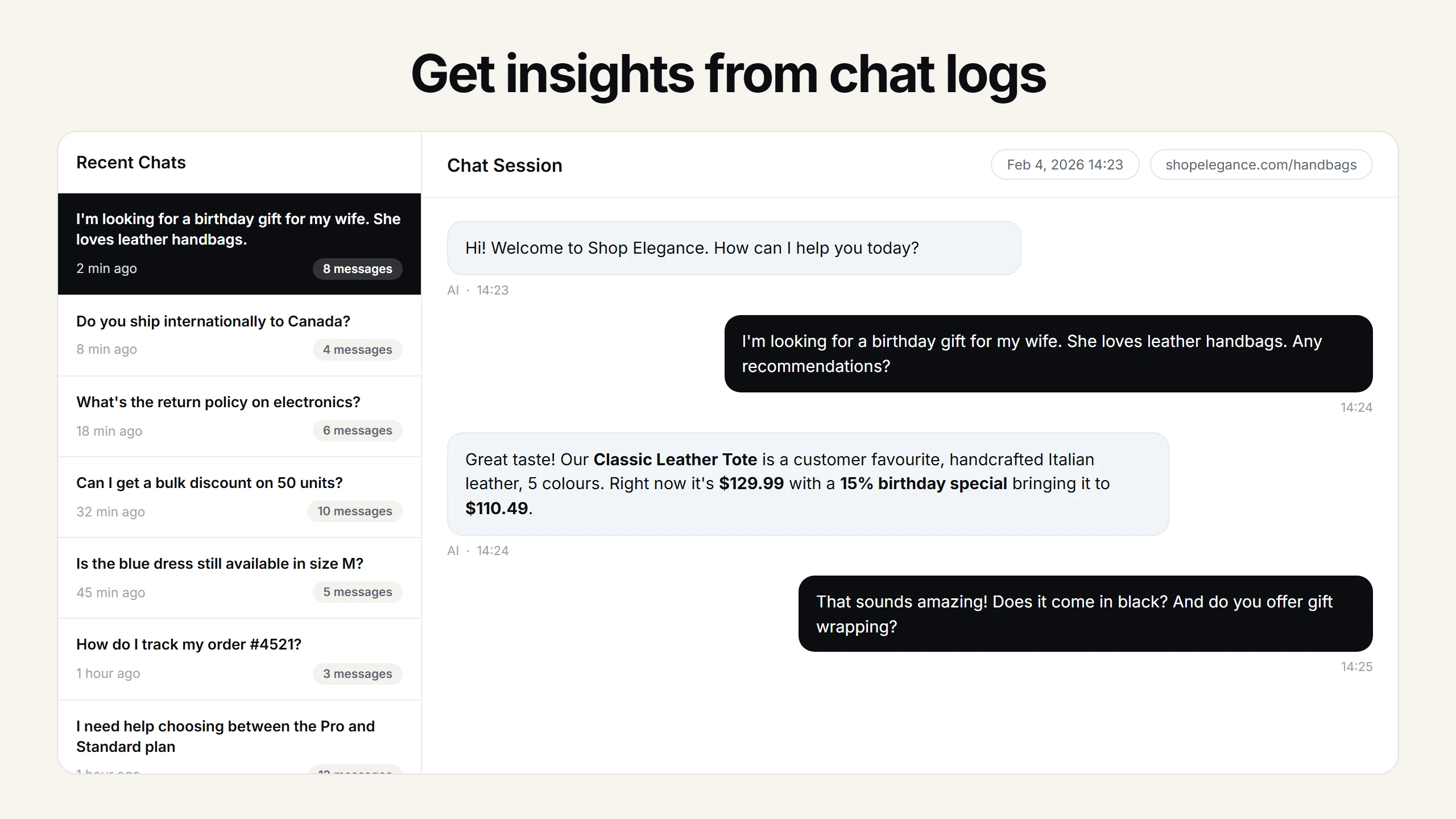
The data that flows through an ecommerce AI agent with Custom Tools is operationally valuable beyond individual conversations. When you see that 400 customers this week asked the inventory check tool about a specific product, you know demand is outpacing what your marketing reflects — that product deserves homepage placement or ad spend. When return eligibility checks spike for orders from a particular promotion, you know that promotion attracted bargain hunters who don't keep products. When shipping cost inquiries concentrate on international destinations you don't currently discount shipping to, you know there's pent-up demand you could unlock with a flat-rate international option. The agent's conversation logs and tool call data become a real-time feedback loop about what your customers want, what's confusing them, and where your store is losing conversions.
The stores that hesitate on deploying an ecommerce AI agent typically have one of two concerns: they worry the AI will give wrong product information, or they worry it will make promises the store can't keep. Both concerns are addressed by how the agent sources its answers. Product information comes from your own site content — the agent doesn't invent specifications or imagine features. If your product page says "machine washable," the agent says "machine washable." If your page doesn't mention water resistance, the agent doesn't claim it. For action-oriented answers, Custom Tools ensure the agent works with verified data from your systems. It doesn't guess whether an order has shipped — it calls the endpoint and reports what the endpoint returns. And for anything outside its knowledge or tool access, the agent escalates to your team with the full conversation context rather than fabricating an answer.
The economics of ecommerce support are uniquely suited to AI agents because the volume is high, the questions are repetitive, and the cost of slow responses is directly measurable in lost revenue. Every hour a pre-sale question goes unanswered is potential revenue that walks away. Every day a post-sale ticket sits in a queue is a day closer to a negative review or a chargeback. An ecommerce AI agent that answers product questions, tracks orders, and verifies return eligibility in seconds doesn't just reduce support costs — it protects revenue that would otherwise leak through the cracks of a human-only support operation.
The shift from ecommerce chatbots to ecommerce AI agents mirrors a broader pattern in online retail: the tools that win are the ones that reduce friction at every stage of the customer journey. Product recommendations reduced friction in discovery. One-click checkout reduced friction in payment. Real-time tracking reduced friction in post-purchase anxiety. The ecommerce AI agent reduces friction in every interaction where a customer has a question and needs an answer — whether that answer lives in your knowledge base or in your order management system. It's the layer between your store's data and your customer's conversation, and it operates at a speed and cost that no human team can match at scale.