You already wrote the answers — now let customers find them
Your help docs, FAQs, and guides hold the answers customers keep emailing about. Asyntai reads that content and turns it into an AI assistant that replies instantly, in 36 languages, without anyone filing a ticket.
See your knowledge base come alive
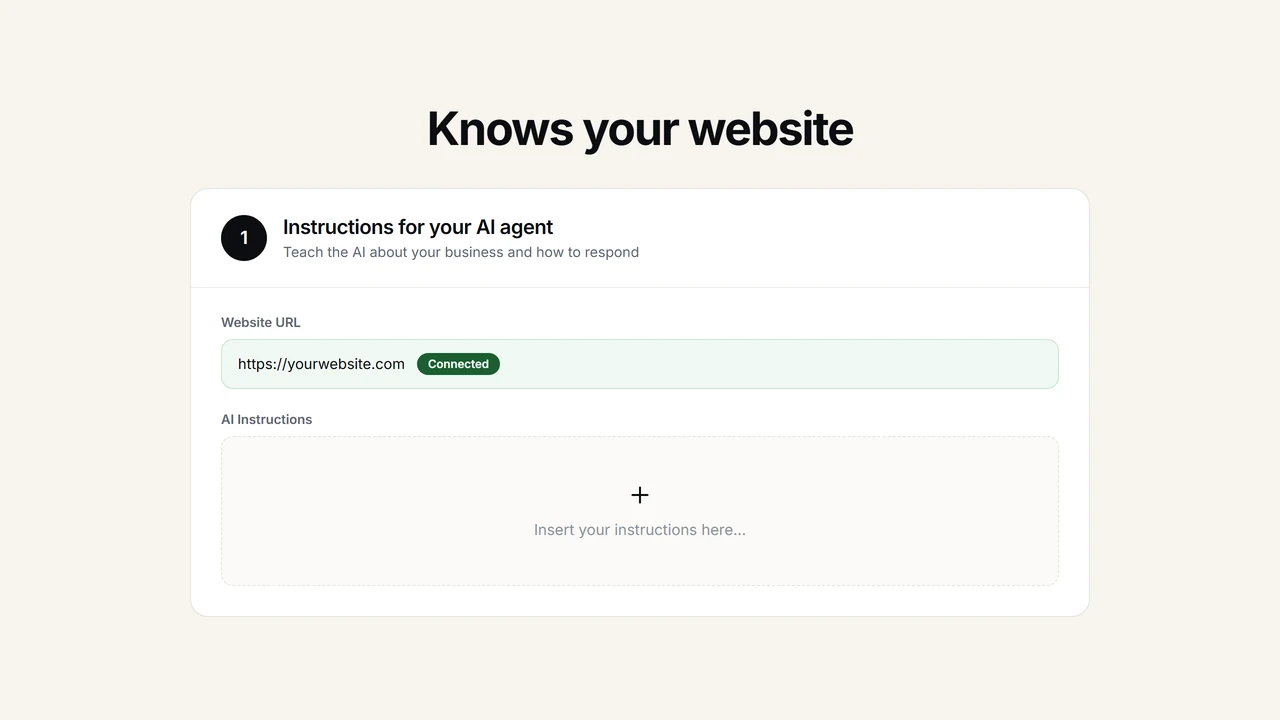
Paste your help center or website URL — watch the AI answer questions using content you already published
The content exists — the delivery was broken
Every support team has been there. You wrote a thorough help article explaining exactly how returns work. You published it, linked it in the footer, maybe even pinned it in a newsletter. And yet, every single day, customers email the same question — because they never found the article. The knowledge was there all along; the gap was between the question in someone's head and the paragraph buried on page three of your help center. Asyntai closes that gap by letting visitors ask in their own words and receiving the specific answer drawn straight from your published content.
- Questions in, answers outVisitors type what they actually want to know — no category guessing, no keyword roulette. The AI locates the right passage from your docs and responds in a single, clear message.
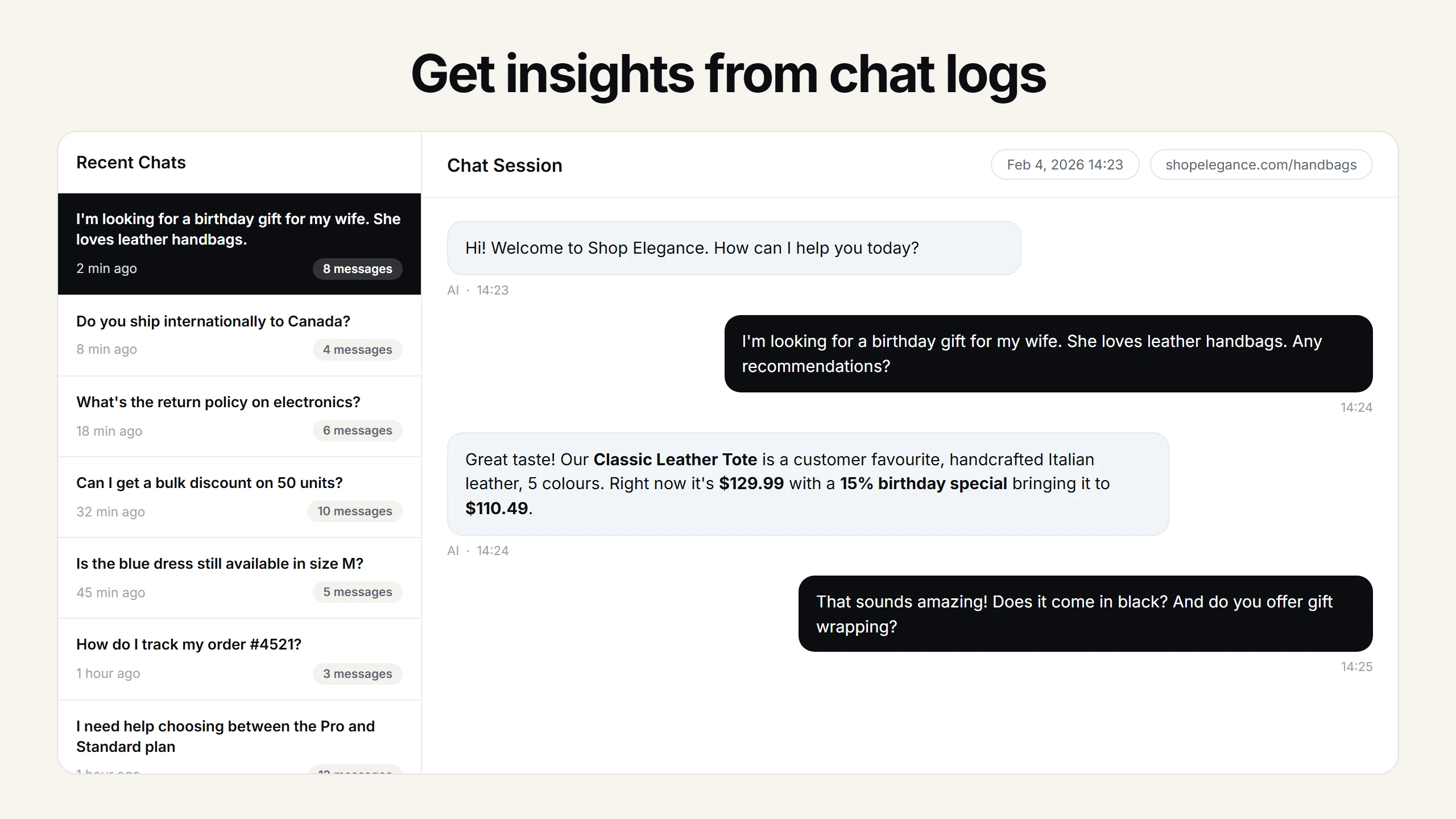
- Follow-up conversationsWhen one answer raises another question, the visitor keeps talking instead of starting a new search. Context carries forward so the second reply builds on the first without repetition.
- Always currentRe-crawl your site whenever content changes and the assistant references updated information immediately. No manual article syncing, no stale answers lingering for weeks.
From read-only docs to a living knowledge layer
A traditional knowledge base is a library: organized, maybe searchable, but ultimately passive. Visitors browse shelves hoping the right book is where they expect it. Asyntai turns that library into a librarian who has read every page. On Standard ($139/month) and Pro ($449/month) plans, Custom Tools let the assistant reach into your own systems — pulling live order status, checking account details, or triggering workflows — so the knowledge base doesn't just inform, it acts. The line between answering a question and resolving a request disappears entirely.
- Crawl and absorbPoint Asyntai at your help center URL and it reads up to 50 pages — articles, FAQs, policy pages, pricing tables, troubleshooting guides — building a knowledge base from what you already published.
- Upload what isn't publicInternal playbooks, PDF manuals, region-specific policies, onboarding checklists — anything customers might ask about but you haven't put on a webpage can be added as a file or pasted directly.
- Custom instructions shape the voiceTell the assistant to be concise or thorough, formal or friendly, when to offer a human, and which topics to handle carefully. The knowledge stays yours; the delivery matches your brand.
- Conversation analytics surface gapsSee which questions visitors ask most, which ones the assistant handles well, and which ones reveal missing documentation — a roadmap for what to write or update next.
- 36-language reach from one content setWrite your docs in English and the assistant replies in whichever language the visitor types. A single knowledge base serves every market you operate in without separate translated help centers.
From help docs to live AI answers in one sitting
No migration, no content reformatting, no database schema to learn. You keep writing help docs where you always have — the AI reads them and starts answering visitors the same afternoon.
- Create a free account and paste your website URL
- The AI scans up to 50 pages and builds a knowledge base from your content
- Copy the one-line embed snippet into your site header
- The chatbot goes live — answering visitor questions in 36 languages
<script src="https://asyntai.com/widget.js"
data-id="your-site-id" async>
</script>
</head>
# Your docs are now conversational.
Knowledge base software — questions before you start
What support leads and documentation managers typically ask before turning their help content into an AI-powered knowledge base.
How is this different from the search bar on our existing help center?
A search bar returns a list of articles ranked by keyword overlap and asks the visitor to read the right one. Asyntai returns the answer itself — a focused response assembled from the relevant paragraph of the relevant article, phrased in reaction to the exact question. The visitor reads one message instead of scanning ten links. Follow-up questions continue the same conversation without resetting context, which is something no search bar can do.
Do we need to rewrite our existing articles for the AI to use them?
No. Asyntai crawls your published pages and works with the content as written. Well-structured articles produce better results, but even informal FAQ pages and policy documents are absorbed and referenced correctly. If you have internal content that isn't on a public URL — PDF guides, training docs, text notes — you can upload or paste those separately. No reformatting, tagging, or special markup is needed.
What happens when someone asks a question our docs don't cover?
The assistant tells them honestly that it doesn't have that information and offers to connect them with a human or capture their details for follow-up. It does not guess, fabricate, or improvise beyond what your content actually says. Custom instructions let you refine this behavior further — you can specify exactly which topics should escalate immediately and which should prompt the assistant to suggest related content.
Can we use this alongside our current help center, or does it replace it?
Alongside, not instead of. Your existing help center stays live — the AI widget sits on top of it as a conversational layer. Visitors who prefer browsing articles still can. Visitors who want a quick answer get one without navigating. Over time, teams often find the widget handles enough volume that the help center becomes more of a reference archive than a primary support channel, but that shift happens naturally.
How does the AI handle multiple languages if our docs are only in English?
The assistant reads your English content and replies in the language the visitor types. Someone asking in Japanese receives a Japanese answer sourced from your English article. The widget interface itself renders in 36 languages automatically based on the visitor's browser settings. You don't need to translate your help center — the AI handles the linguistic bridge between your documentation language and the visitor's preferred language.
How quickly does the knowledge base update when we edit an article?
You trigger a re-crawl from the dashboard whenever your content changes — the assistant references the updated information from that point forward. There's no sync delay or caching window. For teams that publish frequently, re-crawling after each batch of edits keeps the knowledge base current without constant manual attention.
What does this cost compared to a dedicated knowledge base platform?
Asyntai starts with a free tier of 50 messages on one site for evaluation. Starter is $39 per month for 2 sites and 800 messages. Standard runs $139 per month for 3 sites and 15,000 messages. Pro is $449 per month for up to 20 sites and 50,000 messages. Unlike standalone knowledge base platforms that charge per author seat or per article, pricing is based purely on conversation volume — write as many articles as you want.
Can Custom Tools pull live data into knowledge base answers?
Yes, on Standard and Pro plans. Custom Tools let the assistant call your own API endpoints during a conversation — checking order status, looking up subscription details, verifying account information. This means the knowledge base isn't limited to static content; it can combine your written documentation with real-time data to deliver answers like "your order shipped yesterday and arrives Thursday" alongside policy explanations.
The knowledge base problem was never about knowledge
Somewhere in your help center right now, there is a paragraph that perfectly answers a question a customer just emailed your support team about. The paragraph has been published for months. It lives on a page that was written carefully, reviewed by someone who knows the product, and linked from at least one other page. The customer didn't find it. They tried the search bar, saw six results, clicked the second one, scanned the page, didn't see their answer, went back, tried a different search term, got discouraged, and opened a ticket instead. This is the core failure mode of every traditional knowledge base: the content is correct, but the delivery mechanism assumes customers will do the work of locating it themselves. Most won't. Most will give up and ask a human, which is exactly the outcome the knowledge base was supposed to prevent.
Asyntai addresses this problem at the delivery layer, not the content layer. Your help articles, FAQ entries, product guides, troubleshooting steps, and policy pages stay exactly where they are — on your website, in your CMS, organized however you organized them. What changes is how customers interact with that material. Instead of searching and browsing, they ask a question. Instead of reading an entire article hoping the relevant sentence is somewhere in the fourth paragraph, they get a direct response assembled from the specific passage that matches their question. The knowledge base becomes conversational. The content you already invested in becomes dramatically more useful because the last mile — from published article to answered question — finally works.
The economics of this shift are worth sitting with. Every company that has built a help center has already done the expensive work: researching common questions, writing clear answers, getting subject-matter experts to review them, publishing and maintaining the pages over time. That investment sits on a shelf when customers can't find the right article. The cost of writing content is sunk; the cost of delivering it poorly is ongoing, paid in support tickets that should never have been filed. When an AI assistant surfaces the right paragraph in response to a natural-language question, the return on every hour your team spent writing help docs goes up. Not because the content changed, but because someone finally reads it.
There's a persistent misconception that AI-powered support requires building a separate, structured knowledge base — tagging articles with metadata, organizing them into taxonomies, importing them into a specialized platform. Asyntai requires none of that. You give it your website URL. It crawls up to 50 pages — your help center, your FAQ page, your pricing page, your policies, your product descriptions — and builds its knowledge base from what it finds. If you have internal content that isn't published on a webpage — a PDF manual, a set of onboarding notes, a vendor-specific warranty guide — you upload the files or paste the text. From that moment, the assistant answers questions by referencing all of that material together, regardless of where it originally lived. You never maintained a separate system. Your website was the knowledge base all along; it just needed a better interface.
The difference between keyword search and conversational retrieval is not incremental — it changes what questions can be answered at all. A search bar works when the customer already knows the right term. Someone looking for "return policy" will find the return policy page. But someone asking "I bought this three weeks ago and it doesn't fit, what are my options" is expressing the same need in entirely different language. Keyword search fails that query. Conversational AI understands the intent — the customer wants to return something, they're within the window, they need to know the process — and responds with the relevant portion of your return policy, rephrased as a direct answer to their specific situation. This isn't smarter search. It's a fundamentally different interaction model, and it resolves the kinds of questions that traditional knowledge bases systematically miss.
Language reach compounds the value in a way that catches international teams off guard. Writing a thorough help center in one language is already a substantial effort. Maintaining parallel versions in five or ten languages — with translations that stay current as articles are updated — is a project most companies abandon or never start. Asyntai sidesteps the entire problem. The assistant reads your English content and replies in whichever language the visitor uses. A customer in Seoul types in Korean and receives a Korean answer sourced from your English help article. A customer in Sao Paulo types in Portuguese and gets the same quality of response. The widget interface itself renders in 36 languages. One set of documentation, written once, serves every market. The alternative — hiring translators, managing parallel content repositories, keeping everything in sync — costs orders of magnitude more and still falls behind on update cycles.
For teams that need the knowledge base to do more than inform — to actually resolve requests — Custom Tools on Standard and Pro plans extend the assistant's reach into your own systems. When a customer asks "has my order shipped yet," the assistant can call your order-status API, retrieve the tracking number, and include it in the response alongside the relevant passage from your shipping policy. When someone asks "can I upgrade my plan mid-cycle," the assistant can check their current subscription details before answering. The knowledge base stops being a static reference and starts behaving like a support agent who has read every document and has access to every system. The line between "I'll look that up for you" and "here's the answer" disappears.
Content gaps become visible almost immediately, and this is one of the less obvious benefits of conversational knowledge delivery. When hundreds of visitors ask variations of the same question and the assistant struggles to find a good match in your existing content, that pattern shows up in the conversation analytics dashboard. You see exactly which topics your documentation doesn't cover, which explanations confuse people, and which product areas generate the most questions. Over weeks, this data becomes a prioritized writing roadmap. Instead of guessing which help articles to create next, you write the ones customers are already asking for. The knowledge base improves because the AI shows you precisely where it's thin.
Escalation design matters, and it matters specifically because a knowledge base assistant that never hands off to a human will eventually frustrate someone whose situation genuinely requires judgment. Asyntai lets you define escalation rules in plain English: hand off when the customer mentions a damaged product, when the question involves account ownership, when the topic is billing disputes above a certain threshold, when the visitor explicitly asks for a human. The assistant follows these rules and transfers the conversation with full transcript and context, so the human agent doesn't start cold. The knowledge base handles the volume; humans handle the exceptions. Each does the part they're best at.
Pricing reflects usage, not content volume, which matters for teams that maintain large documentation libraries. Asyntai's free tier includes 50 messages on a single site — enough to test whether the approach works for your content. Starter at $39 per month covers 2 sites and 800 messages. Standard at $139 per month handles 3 sites and 15,000 messages, adding Custom Tools and User Context for personalized answers. Pro at $449 per month scales to 20 sites and 50,000 messages. You can have five hundred help articles or five — pricing is based on conversations, not pages indexed. For teams whose documentation is deep but whose support budget is finite, the math resolves quickly: the cost of resolving a question through the AI knowledge base is a fraction of a cent, compared to the fully loaded cost of a human handling the same question.