The customers you lose aren't unhappy with your product — they're tired of waiting for answers
Asyntai places an AI assistant on your site that answers customer questions instantly, using your own content. No queue, no delay, no reason to leave. Retention starts the moment someone gets help without asking twice.
See how instant answers would work on your site
Paste your URL below — the AI reads your content and shows you what your customers would experience
Close the gap between question and answer before frustration sets in
Most customers don't churn because of a single bad experience. They churn because of accumulated friction — small moments where they needed help and didn't get it fast enough. A billing question at midnight with no one online. A product detail buried three clicks deep in your help center. A return policy they couldn't find before their patience ran out. Asyntai eliminates these gaps by placing an AI assistant directly on your site that draws answers from the content you've already published, responding in seconds rather than hours or days.
- Instant resolution, zero waitCustomers get answers the moment they ask, whether it's 2pm on a Tuesday or 3am on a holiday. No ticket submitted, no callback scheduled, no friction accumulated.
- Answers drawn from your own contentThe AI references your help articles, product pages, and policy documents to answer questions accurately — not generic responses, but answers grounded in what you've actually written.
- Frustration intercepted earlyWhen a customer's question goes unanswered, irritation compounds with every passing hour. An instant answer breaks that cycle before it reaches the point where they start browsing alternatives.
Turn your support layer into a retention engine that works around the clock
Retention software usually means dashboards tracking who's about to leave. Asyntai works upstream — it prevents the frustration that leads to churn in the first place. On Standard ($139/month) and Pro ($449/month) plans, Custom Tools let the AI connect to your own systems to pull live account data, check order status, or verify subscription details in real time. A customer asking "when does my plan renew" gets a specific date, not a generic paragraph. That precision is what makes the difference between a customer who feels taken care of and one who feels ignored.
- Live account lookups via Custom ToolsOn Standard and Pro plans, the AI calls your endpoints to retrieve order status, subscription dates, or account balances — answering personalized questions without human involvement.
- 36-language coverage without staffingInternational customers get answers in their own language automatically. A French-speaking customer in Montreal and a Japanese-speaking customer in Osaka both get accurate, native-language responses from the same knowledge base.
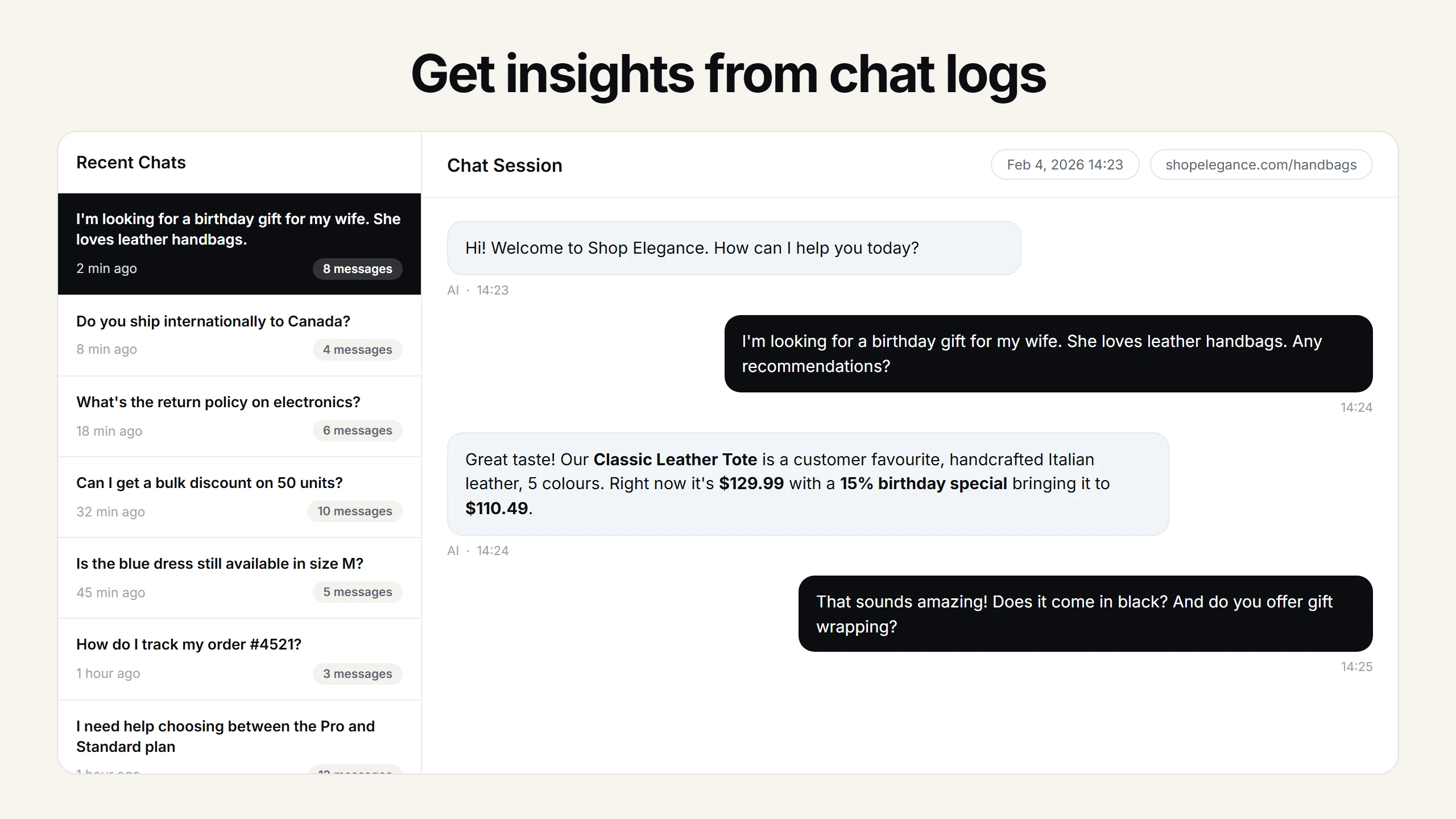
- Conversation analytics reveal churn signalsEvery question the AI handles is logged and categorized in your dashboard. Patterns emerge — if dozens of customers ask the same frustrated question, you've found a retention leak before it shows up in your churn numbers.
- Escalation with full contextWhen a conversation needs a human, the AI forwards the complete transcript so your agent doesn't ask the customer to repeat themselves — a small detail that has an outsized effect on how cared-for someone feels.
- Always available, never overwhelmedPeak traffic, holiday rushes, product launches — the AI handles volume spikes without degrading response quality. Your retention layer doesn't take sick days or get backed up on Monday mornings.
Go live in minutes, not quarters
Most retention tools require months of integration work, data imports, and team training. Asyntai reads the content you already have and starts answering customer questions immediately — no CRM migration, no onboarding project, no dedicated implementation team.
- Create a free account and paste your website URL
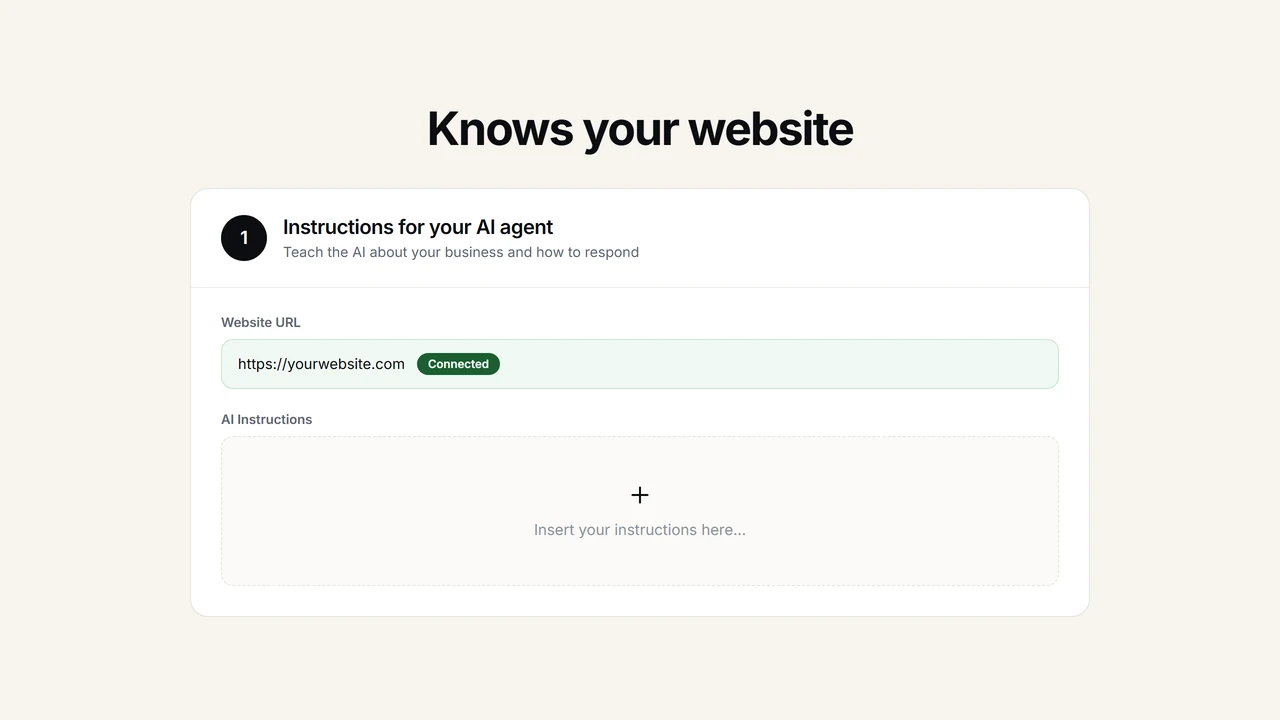
- The AI scans up to 50 pages and builds a knowledge base from your content
- Copy the one-line embed snippet into your site header
- The chatbot goes live — answering visitor questions in 36 languages
<script src="https://asyntai.com/widget.js"
data-id="your-site-id" async>
</script>
</head>
# Instant answers. Fewer churned customers.
Customer retention and AI support — your questions
What teams usually ask before adding an AI layer to their retention strategy.
How does an AI chatbot actually improve customer retention?
Retention breaks down at friction points — moments where a customer needs help and doesn't get it. An AI chatbot eliminates the most common friction point: waiting for an answer. When customers can resolve billing questions, product concerns, and policy lookups instantly on your site, the frustration that drives churn never accumulates. It's not a loyalty program or a win-back email. It's removing the reason customers start looking elsewhere in the first place.
What kind of questions can the AI actually answer?
Anything covered by the content on your website and any documents you upload. Product specifications, pricing details, return and refund policies, shipping timelines, account management steps, troubleshooting guides, compatibility questions — if you've written about it, the AI can answer questions about it. For topics outside your content, the assistant tells the customer it doesn't have that information and offers to connect them with your team, rather than guessing.
Can it handle personalized questions like order status or account details?
Yes, on Standard ($139/month) and Pro ($449/month) plans. Custom Tools let the AI call your own API endpoints to retrieve live data — order tracking, subscription renewal dates, account balances, loyalty point totals. The customer asks a specific question and gets a specific answer pulled from your system in real time, without a human agent involved.
Will the AI make up answers if it doesn't know something?
No. The assistant is anchored to the knowledge base built from your content. When a question falls outside what it knows, it says so directly and offers to capture the customer's details for follow-up by your team. You can reinforce this behavior with custom instructions — for example, telling the AI to always escalate billing disputes or legal questions to a human regardless of what's in the knowledge base.
How does this compare to traditional retention tools like win-back campaigns?
Win-back campaigns try to recover customers who have already decided to leave. Asyntai works earlier in the cycle — it prevents the frustration that leads to that decision. Both have their place, but by the time you're sending a "we miss you" email, the customer has already had weeks of accumulated friction. An AI assistant that answers questions instantly addresses churn at its source rather than its symptom.
What does it cost, and how does pricing scale?
There's a free tier with 50 messages per month for testing on one site. Starter is $39/month for 2 sites and 800 messages. Standard is $139/month for 3 sites and 15,000 messages, with Custom Tools included. Pro is $449/month for up to 20 sites and 50,000 messages. Each resolved AI conversation costs a fraction of what a human-handled support interaction runs, and the math gets more favorable as volume grows.
Do we need to rewrite our help content for the AI?
No. Asyntai reads your existing website pages — help articles, product descriptions, FAQ pages, policy documents — and builds a knowledge base from them. You can also upload PDFs or paste text for content that isn't publicly available on your site. The AI works with whatever you already have; you don't need to restructure or reformat anything.
How quickly can we see an impact on retention metrics?
The AI starts answering questions within minutes of setup, so the customer experience improvement is immediate. Impact on retention metrics like churn rate and customer satisfaction scores typically becomes visible within the first billing cycle as the volume of unanswered questions drops. Conversation analytics in the dashboard give you visibility into how many questions the AI resolves, what topics come up most, and where customers might still be hitting friction.
Customer retention is an answer-speed problem disguised as a loyalty problem
There is a moment in every customer relationship that matters more than the welcome email, the loyalty discount, or the anniversary coupon. It's the moment a customer has a question and either gets an answer or doesn't. That moment happens dozens of times across the lifecycle — when they're trying to understand a feature, when they need to check a policy before making a decision, when something isn't working the way they expected. Each time, the outcome is binary: resolved or unresolved. And each unresolved instance adds a thin layer of friction that, over enough repetitions, becomes the reason they leave. Not dramatically, not angrily — they just quietly stop coming back. The most dangerous churn isn't the customer who complains. It's the customer who gives up looking for an answer and never tells you why.
The economics of this pattern are well documented but still underappreciated. Acquiring a new customer costs five to seven times more than retaining an existing one. A five-percent improvement in retention can increase profitability by twenty-five to ninety-five percent, depending on the industry. Yet most companies spend the majority of their budget on acquisition — paid ads, content marketing, partnerships, conversion optimization — while treating retention as something that happens naturally if the product is good enough. The product might be excellent. But if a customer can't find the answer to a straightforward question at the moment they need it, product quality becomes irrelevant. They're not evaluating your product anymore. They're evaluating your availability.
Traditional retention tools approach this problem from the wrong end. They monitor engagement metrics, flag at-risk accounts, trigger automated email sequences, and offer discounts to customers who show signs of leaving. All of that is reactive. By the time the dashboard labels someone as "at risk," the friction has already accumulated. The customer has already waited too long for a response, already failed to find a policy answer, already been redirected to a help center that didn't help. A re-engagement email doesn't erase those experiences — it just adds another touchpoint to a relationship that's already strained. Asyntai works at the source of the problem instead of its symptoms. It places an AI assistant on your site that answers questions the moment they're asked, using the content you've already published, so the friction never accumulates in the first place.
The mechanics are straightforward. You point Asyntai at your website, and it reads up to fifty pages — help articles, product descriptions, pricing pages, policy documents, FAQ sections, troubleshooting guides. From that content it builds a knowledge base that the AI references when answering visitor questions. A customer wondering whether they can pause their subscription gets the answer from your own policy page, phrased conversationally, in the language they asked the question in. A customer trying to figure out compatibility between two products gets the specifics from your own spec sheets. The answers aren't generic — they're drawn from what you've actually written, which means they're as accurate as your content and as current as your last update.
What makes this a retention tool rather than just a support tool is the timing. Support operates on a request-response cycle with inherent delay — the customer submits a ticket, waits for a reply, often needs to clarify, waits again. That cycle might take hours or days. During that wait, the customer's relationship with your brand degrades. Not because your support team is bad, but because waiting itself is a negative experience. An AI assistant that answers in seconds collapses that cycle entirely. The customer asks, the customer gets an answer, the customer moves on with their day. No ticket number, no queue position, no business-hours constraint. The question is resolved before it becomes a source of frustration, and the customer's perception of your brand remains intact — or even improves, because few companies deliver that level of responsiveness.
International retention is where the impact multiplies. If your customer base spans multiple languages and you staff support in one or two, every non-covered language is a segment where questions go unanswered or get delayed until a bilingual agent is available. Asyntai's widget detects the visitor's language automatically and responds in kind — thirty-six languages, no routing rules, no multilingual hiring requirement. A German-speaking customer gets a German answer drawn from your English content. A Korean-speaking customer gets a Korean answer from the same source. The language gap, which silently drives churn in international segments that never show up as "at risk" in your dashboard because they never engaged deeply enough to be tracked, simply closes.
For businesses where retention depends on personalized service — subscription companies, membership platforms, account-based products — Custom Tools on Standard and Pro plans take the AI beyond general knowledge base answers. You define API endpoints that the assistant can call during a conversation to pull live data from your systems. A subscriber asking "when does my plan renew" gets their actual renewal date. A customer asking "has my refund been processed" gets the real-time status from your payment system. These aren't canned responses — they're live lookups that make the AI feel like a knowledgeable team member rather than a search bar. That level of personalization, available twenty-four hours a day without staffing cost, is the kind of experience that builds the habit of relying on your brand rather than shopping for alternatives.
The conversation data that flows through the AI becomes a retention intelligence layer that most companies don't otherwise have. Every question asked is logged, categorized by topic, and available in your dashboard. Over weeks, patterns emerge that traditional analytics miss. If forty customers in a month ask variations of "how do I cancel" and the AI resolves most of them by explaining the pause option instead, you've identified and addressed a churn trigger that would have been invisible in a ticket queue. If a spike appears in questions about a specific feature after an update, you've caught a usability issue before it shows up in your retention metrics. The AI doesn't just answer questions — it reveals what your customers are confused about, worried about, and considering leaving over.
Escalation design matters deeply in a retention context, because the moment a customer is handed off poorly is often the moment they decide they've had enough. Asyntai lets you set escalation rules in plain language — route billing disputes to a human, escalate any conversation where the customer mentions cancellation, hand off anything involving account ownership changes. When the AI escalates, it passes the full conversation transcript so the human agent has complete context. The customer doesn't repeat themselves, the agent doesn't ask redundant questions, and the transition feels like a warm handoff rather than a cold transfer. In retention terms, that handoff quality is the difference between a customer who feels cared for and a customer who feels processed.
Pricing aligns with the retention math that most teams already understand. The free tier gives you 50 messages per month to test on one site. Starter at thirty-nine dollars per month covers two sites and 800 messages — enough for a small business to see whether instant answers change their support volume and satisfaction scores. Standard at a hundred thirty-nine dollars per month adds Custom Tools and fifteen thousand messages across three sites, which is where account-based businesses start seeing personalized retention value. Pro at four hundred forty-nine dollars per month scales to twenty sites and fifty thousand messages for companies with multiple products or brands. Compare any of those numbers to the lifetime value of a single retained customer, and the investment case writes itself. One customer who stays instead of churning typically pays for months of the subscription.