Build a custom AI agent that knows your business inside out
Asyntai gives you full control over every dimension of your AI agent — what it knows, how it talks, what it looks like, and what it can do. Crawl your site, upload documents, write custom instructions, connect your own APIs through Custom Tools, and brand the widget to match your site. No developers required. Everything configures through a dashboard.
Watch a custom AI agent built from your own content
Paste your website URL below and see what a custom-configured AI agent looks like when it answers using your actual content
Shape what the agent knows and how it behaves — down to the last detail
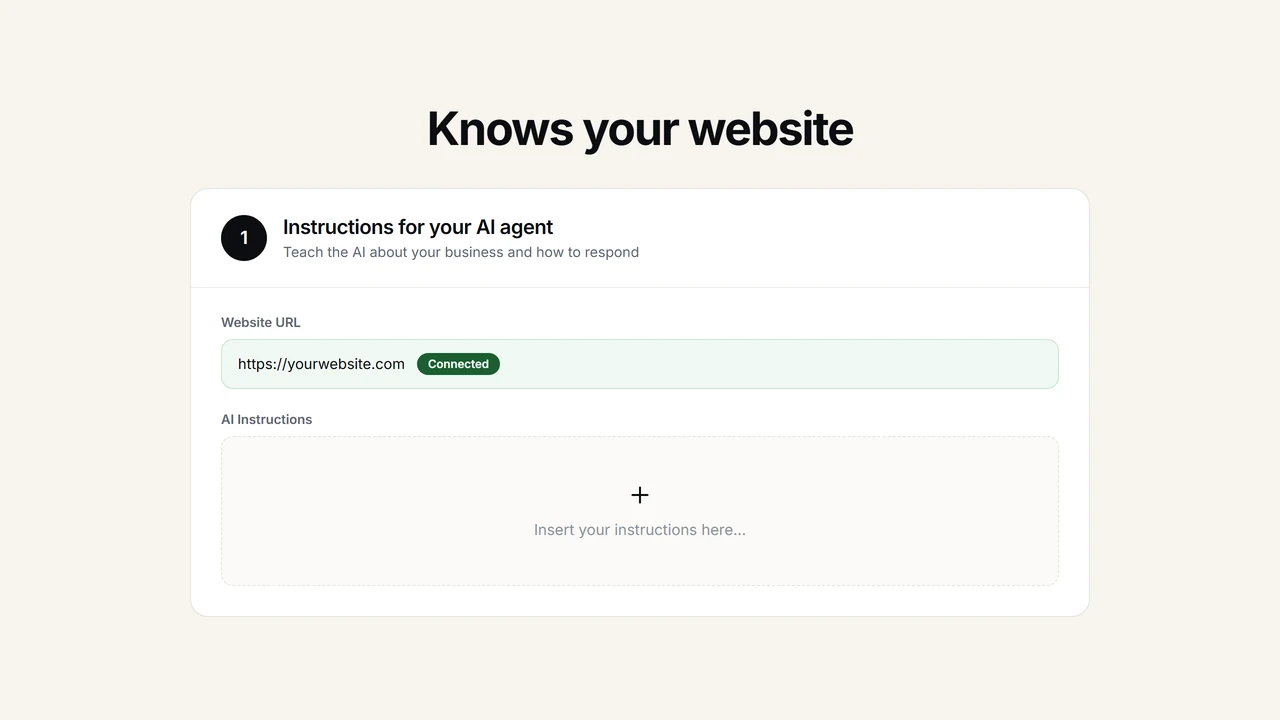
A custom AI agent starts with what it knows. Point Asyntai at your website and it crawls every page, learning your products, policies, pricing, and procedures. Upload additional documents — PDFs, internal guides, training materials — for knowledge that isn't public. Then write custom instructions that define how the agent communicates: its tone, its boundaries, when to escalate, what to never say. Finish by branding the widget with your colors, name, and avatar so it feels native to your site.
- Automatic site crawling plus document uploadsThe agent learns from every page on your site automatically. Add PDFs, DOCX files, or text documents for internal knowledge that doesn't live on a public URL — product specs, internal policies, troubleshooting guides.
- Custom instructions that stickWrite rules in plain English: "Always greet customers by name," "Never discuss competitor pricing," "If someone asks about enterprise plans, collect their email and escalate." The agent follows them in every single conversation without drift.
- Full visual brandingSet the widget color, assistant name, welcome message, avatar, and position on the page. Your visitors see your brand, not ours. The agent looks and feels like something your team built — because you configured every detail of it.
Connect your APIs so the agent takes action — not just answers questions
Knowledge makes your agent informative. Custom Tools make it capable. Connect your own API endpoints and the agent starts doing things mid-conversation: looking up orders, checking appointment availability, pulling account details, verifying warranty status. It extracts what it needs from the conversation, calls your endpoint, and delivers the result — all without leaving the chat window.
- Point at any REST endpointPaste your API URL, define the parameters the agent should extract from the conversation, add an optional auth header. If your system already has an endpoint, connecting it takes under five minutes.
- The agent reasons about when to callDescribe each tool in plain English — "Use this to check whether a product is in stock." The agent reads the conversation, matches intent, and calls the right tool at the right moment. No flowcharts or decision trees to build.
- Actions and answers in one replyThe agent pulls live data from your API and combines it with knowledge from your crawled content. A customer asking about a return gets both the order details from your system and the return policy from your help center — in a single coherent response.
Configure your custom AI agent in minutes
No SDKs to install. No frameworks to learn. No developers to hire. Every part of your custom agent — knowledge, behavior, appearance, and connected tools — configures through a visual dashboard. One snippet on your site, and it's live.
- Add the Asyntai snippet to your site and let the agent crawl your content to build its knowledge base.
- Open your dashboard and configure custom instructions — define the agent's tone, rules, escalation boundaries, and anything it should or shouldn't say.
- Brand the widget with your colors, name, avatar, and welcome message so it looks native to your site.
- Connect Custom Tools by pasting your API endpoints — the agent starts taking action in live conversations immediately.
<script src="https://asyntai.com/widget.js"
data-id="your-site-id" async>
</script>
</head>
# One snippet. Your custom agent is live.
Custom AI agent — FAQs
Answers to the most common questions from teams evaluating custom AI agent platforms.
What does "custom" actually mean here?
It means you control every layer. The knowledge base is built from your website and your uploaded documents — not generic training data. The instructions are rules you write in plain English that govern tone, boundaries, and escalation logic. The appearance is your brand colors, name, and avatar. And with Custom Tools, the agent connects to your own API endpoints to take actions specific to your business. Nothing is pre-built or one-size-fits-all. The agent you end up with is shaped entirely by what you configure.
Do I need a developer to set up the custom agent?
No. The entire configuration happens through a visual dashboard. You paste a URL for site crawling, drag and drop files for document uploads, type instructions in a text field, pick colors from a palette, and fill out a short form to connect API endpoints. The only technical step is adding a single script tag to your site's HTML — and most website platforms (WordPress, Shopify, Squarespace, Wix) have a dedicated spot for that.
How does the agent build its knowledge base?
Two ways. First, automatic crawling: you point it at your website and it reads every accessible page — product descriptions, help articles, policy pages, blog posts. Second, manual uploads: you upload PDFs, Word documents, or text files that contain knowledge not on your public site — internal training guides, technical specifications, pricing sheets. The agent uses both sources together when answering questions.
What are Custom Tools and how do they work?
Custom Tools let the agent call your own API endpoints during a conversation. You define a tool in your dashboard: give it a name, describe when the agent should use it, paste your endpoint URL, and specify what parameters the agent should extract from the conversation (like an order number or email address). When a visitor's question matches the tool description, the agent calls your endpoint, gets live data back, and uses it to compose a response. The call happens server-side — the visitor's browser never touches your API.
Can I control exactly how the agent talks?
Yes, through custom instructions. These are plain-English rules the agent follows in every conversation. You can set the tone ("Be professional but warm"), establish boundaries ("Never quote prices for custom enterprise deals"), define escalation triggers ("If the visitor asks to speak with a human, collect their email and hand off"), and create behavioral guardrails ("Never recommend competitor products"). The agent applies these rules consistently — it doesn't forget or drift over time.
Will the agent match my website's look and feel?
Completely. You set the primary color, the chat bubble color, the assistant's display name, the avatar image, the welcome greeting, the input placeholder text, and the widget position on the page. Visitors interact with something that looks like a native part of your site, not a third-party overlay. There's no "Powered by" badge on paid plans.
What happens when the agent doesn't know the answer?
That depends on your custom instructions. By default, the agent tells the visitor it doesn't have enough information to answer and offers to connect them with a human. But you can customize this behavior: "If you can't answer, ask for the visitor's email and let them know someone will follow up within 24 hours." Or: "If you're unsure, suggest they check our help center at [URL]." You define the fallback, not the system.
How quickly can I get a custom agent live on my site?
Most teams go from signup to a live, configured agent in under 30 minutes. Adding the snippet takes a minute. Crawling a typical website takes five to ten minutes. Writing initial instructions and branding the widget takes another five. If you're connecting Custom Tools, each one takes about five minutes to configure — paste the URL, define parameters, test it. The agent is live and answering visitors as soon as the crawl finishes.
What makes an AI agent truly custom — and why most businesses settle for less
The word "custom" shows up in the marketing of nearly every AI chatbot product on the market. Upload your FAQ, pick a color, deploy. That's what passes for customization in most tools — a thin layer of personalization on top of a rigid, predetermined system. The chatbot answers from your content, sure, but it answers the way the platform decided it should. It escalates when the platform decides it should. It looks the way the platform allows it to look. And when a customer asks something that requires actual data from your systems — an order status, an account balance, appointment availability — the "custom" chatbot hits a wall. It doesn't know. It can't check. It suggests the visitor call support or check their email.
A genuinely custom AI agent is different in kind, not degree. Customization isn't a coat of paint — it's structural. It means the agent's knowledge base is assembled from your specific content. Its behavior follows rules you wrote for your specific context. Its appearance matches your specific brand. And critically, it connects to your specific systems through your own API endpoints to take actions no generic chatbot could take. When every layer is configurable — knowledge, behavior, appearance, and capability — the result isn't a chatbot wearing your logo. It's an agent that operates the way your team would, with access to the same information your team uses, following the same policies your team follows.
The first dimension of a custom AI agent is its knowledge base, and this is where the gap between "custom" marketing and actual customization becomes obvious. A lot of platforms let you paste in a few FAQ entries or upload a single document. Asyntai takes a fundamentally different approach. You point it at your website URL and it crawls every accessible page — product pages, help articles, blog posts, policy documents, pricing tables, landing pages, team bios. Everything that exists on your public site becomes part of the agent's working knowledge. But public content is only half the picture. You can upload documents that don't live on any URL — internal training guides, product specification sheets, vendor agreements, onboarding checklists, standard operating procedures. The agent uses both sources seamlessly. A visitor's question might require information from a help article on your site and a technical detail from an uploaded PDF — the agent pulls from both without distinguishing between them.
The depth of the knowledge base determines how many conversations the agent can handle without escalating. An agent that only knows your FAQ handles FAQ questions. An agent that knows your entire website and your internal documentation handles questions about edge cases, obscure products, nuanced policies, and scenarios that aren't covered in any FAQ because they're too specific. The difference in resolution rate between a shallow knowledge base and a deep one is typically 20-30 percentage points. That gap translates directly into how many human support hours the agent saves.
The second dimension is custom instructions, and this is where your agent's personality and operational boundaries take shape. Instructions are rules you write in plain English that the agent follows in every conversation. They're not suggestions or guidelines — they're constraints the model applies consistently. "Always address the visitor by their first name if they provide it." "Never discuss competitor products by name." "If someone asks about pricing for more than 50 seats, do not quote a number — collect their email and say an account manager will follow up." "Use a warm, conversational tone but avoid exclamation marks." "When the visitor expresses frustration, acknowledge it before attempting to solve the problem."
The range of what you can encode in custom instructions is broad enough that two businesses using the exact same platform can produce agents that feel completely different. A luxury retailer might instruct the agent to use formal language, never abbreviate, and always offer to connect the visitor with a personal shopping associate for high-value inquiries. A direct-to-consumer brand targeting college students might instruct it to be casual, use contractions freely, and recommend bundle deals proactively. A healthcare platform might instruct it to never provide medical advice, always recommend consulting a provider, and include legally required disclaimers when discussing treatment options. The underlying model is the same. The agent it becomes is shaped entirely by what you tell it to do and not do.
Escalation logic is a subset of custom instructions that deserves its own attention because it's where the boundary between autonomous resolution and human involvement gets drawn. Most chatbot platforms have a binary escalation model: the bot either answers or it doesn't, and when it doesn't, it dumps the visitor into a generic contact form. A custom AI agent with well-written escalation instructions handles this with nuance. "If the visitor asks for a refund on an order over $500, collect the order number and their email, summarize the situation, and hand off to the billing team." "If someone reports a safety concern with a product, escalate immediately with the conversation transcript and the visitor's contact information — do not attempt to resolve." "For questions about enterprise contracts, tell the visitor that a dedicated account manager handles those discussions and ask for their preferred contact method." Each instruction produces a different escalation behavior for a different scenario. The agent doesn't just give up — it follows your protocol.
The third dimension is visual branding, and while it might seem superficial compared to knowledge and behavior, it has a measurable impact on engagement. When visitors see a chat widget that matches the site's color scheme, uses a name that feels intentional ("Ask Maya" rather than "AI Assistant"), and displays an avatar that fits the brand aesthetic, they interact with it at meaningfully higher rates. The widget doesn't feel like a bolt-on. It feels like a deliberate part of the experience. You set the primary color, the bubble color, the assistant's display name, the avatar, the welcome message, the placeholder text in the input field, and the position on the page. On paid plans, there's no external branding. Every visual element is yours.
The fourth dimension — and the one that separates a custom AI agent from a custom AI chatbot — is Custom Tools. This is where the agent stops being a conversational interface for your knowledge base and starts being an operational participant in your business. Custom Tools let you connect your own API endpoints so the agent can take action during a conversation. Not hypothetical action. Real, live, data-driven action.
Here's how it works mechanically. You go to Custom Tools in your dashboard and create a new tool. You give it a name — "Order Status Lookup." You write a description that tells the agent when to use it — "Call this whenever a customer provides an order number or asks where their order is." You paste your API endpoint URL — something like https://api.yourstore.com/v1/orders. You define the parameters — order_number, which the agent extracts from the conversation. You optionally add an authorization header. You save. From that moment on, when a visitor says "where is my order #4821?", the agent recognizes the intent, extracts "4821" as the order number, calls your endpoint with that value, receives the response, and composes a natural-language answer: "Your order #4821 shipped on June 17th via DHL. The tracking number is 9274890123. It's currently in transit and expected to arrive by June 21st."
The agent didn't read that information from a help article. It didn't pull it from a FAQ. It called your system, got live data, and delivered it to the customer in a conversational format. That's what makes it an agent rather than a chatbot. The distinction isn't philosophical — it's functional. A chatbot tells the customer what your policies say. An agent tells the customer what their specific situation is.
The number of tools you connect determines the breadth of what your agent can do autonomously. Start with order status. Add inventory availability so the agent can answer "is this in stock in size 10?" with a live check. Add appointment availability so the agent can tell a prospective client "Dr. Martinez has openings on Thursday at 2 PM and Friday at 10 AM." Add account balance retrieval so customers can ask "how many credits do I have left?" and get an exact number. Each tool you add is another category of interaction the agent handles without a human ever seeing the conversation. Businesses that connect three to five tools typically see their agent resolve 70-80% of all conversations autonomously — compared to 40-50% for a knowledge-base-only chatbot.
What makes Custom Tools particularly powerful in the context of a fully customized agent is the combination with the other three dimensions. The agent doesn't just call your API and parrot back raw data. It interprets the response through the lens of your knowledge base and your custom instructions. A customer asks "can I return the jacket from order #3390?" The agent calls the order lookup tool, discovers the order was placed 22 days ago, cross-references your return policy (learned from crawling your website) which states a 30-day return window, and responds: "Your jacket from order #3390 was delivered on May 29th. You're within the 30-day return window, so it's eligible for a full refund. I'll initiate the return process — you'll receive a prepaid shipping label at the email on your account." The tool provided the data. The knowledge base provided the policy. The custom instructions governed how the agent communicated the result. All four dimensions working together.
The setup process for a custom AI agent is deliberately built to not require technical skills. There's a persistent misconception that "custom" implies "complex" — that configuring a tailored agent requires developers, weeks of setup, and ongoing technical maintenance. The reality is closer to setting up a social media profile. You add a snippet to your site. The crawl runs automatically. You type instructions in a text box. You pick colors from a palette. You fill out a form for each Custom Tool. The most technical step is pasting an API endpoint URL, and if your team already has an API (most modern platforms do), that URL already exists somewhere in your documentation. Total setup time for a fully configured agent with branded appearance, detailed instructions, and two or three connected tools: typically under an hour.
The ongoing maintenance model is equally light. When you update your website content — new products, revised policies, updated pricing — the agent picks up the changes on its next crawl. When you need to adjust behavior, you edit the instructions text. When you add a new API endpoint, you add a new Custom Tool. There's no model retraining, no code deployment, no waiting for a support ticket to be processed. You make the change in your dashboard and it's live in the next conversation. This matters because businesses evolve. Your return policy changes seasonally. Your product catalog rotates. Your team's escalation preferences shift. A custom agent that's hard to update becomes stale within weeks. One that updates through a dashboard stays current because the barrier to making changes is effectively zero.
The multilingual dimension is worth addressing because it extends across all four customization layers. The agent communicates in 36 languages, detecting the visitor's language automatically and responding in kind. Your knowledge base doesn't need to be translated — the agent reads your English content and answers in Japanese, German, Portuguese, Arabic, or any other supported language. Your custom instructions apply universally — a rule like "never discuss competitor pricing" holds whether the conversation is in English or Korean. Your Custom Tools work unchanged — the agent calls your English API endpoint, receives an English response, and translates the answer into the visitor's language. And your branding looks the same regardless of language. A single configuration serves a global audience.
The economic argument for a custom AI agent versus a basic chatbot centers on resolution rate and its downstream effects. A basic chatbot that answers from an FAQ resolves the easy questions — the ones your customers could have found on your website themselves if they'd looked harder. The hard questions — the ones that reference a specific order, a specific account, a specific situation — get escalated to humans. Those are the expensive tickets. They take time to research. They require accessing systems. They need a person who understands the context. A custom AI agent with Custom Tools handles those tickets. It accesses the systems. It researches the context. It delivers a specific answer. Every ticket it resolves autonomously is a ticket your human team doesn't touch. At scale, the math isn't subtle: an agent resolving 200 additional conversations per month that would have required 10 minutes of human time each saves roughly 33 hours of labor. At typical support labor costs, that's several thousand dollars monthly — for a tool that starts at $39/month.
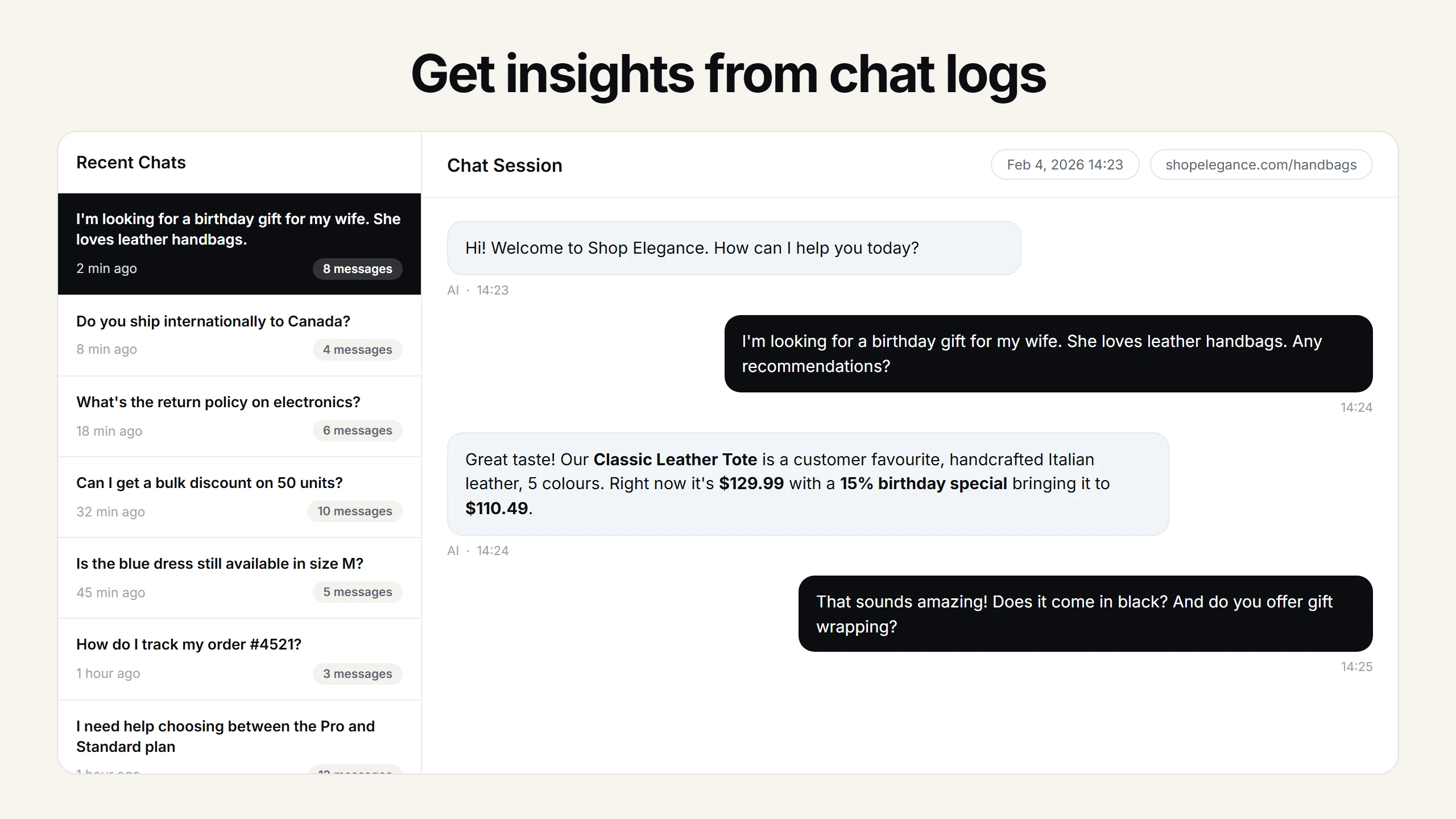
There's an operational intelligence benefit that compounds over time. Every conversation the agent handles is logged with full detail — what the visitor asked, what knowledge the agent used, which Custom Tools it called, what data came back, how it responded, and whether the visitor's issue was resolved or escalated. This creates a dataset that reveals patterns you'd never see from a basic chatbot's logs. When order status lookups spike, it might mean your shipping confirmation emails aren't clear enough. When the agent escalates frequently on a specific topic, it might mean your knowledge base has a gap you should fill. When visitors in a particular region consistently ask about a specific product variant, it might mean your localized marketing isn't reaching them. The agent doesn't just handle conversations — it generates a continuous feed of actionable insight about what your customers actually need.
The businesses that benefit most from a custom AI agent share a common characteristic: they have unique operational contexts that generic solutions can't accommodate. A boutique hotel chain whose cancellation policy varies by room type and booking channel. A SaaS platform whose support interactions require checking subscription tier, usage data, and feature availability simultaneously. An ecommerce brand with a complex return policy that depends on product category, time since purchase, and whether the item was on sale. A healthcare provider whose agent needs to follow strict compliance rules about what it can and cannot say. In each case, a one-size-fits-all chatbot falls short because the business's rules, knowledge, and systems are specific to them. A custom AI agent works because every dimension — knowledge, behavior, appearance, capability — is configured to match that specific context.
The trajectory of customer expectations is moving firmly toward this model. Visitors no longer accept "please check your email" or "a representative will get back to you" as adequate responses. They expect the same immediacy they get from consumer apps — instant answers, specific to their situation, available at any hour. A custom AI agent meets that expectation not by being cleverer than other chatbots at rephrasing FAQ answers, but by having genuine access to the information and systems needed to give real answers. Your knowledge, your rules, your brand, your tools — assembled into an agent that operates as a seamless extension of your team. That's what custom means when it's more than a marketing adjective.