Conversational AI customer support that talks with visitors, not at them
Scripted chatbots read from a menu. Conversational AI listens, holds context, and responds like a colleague who already knows the answer. Asyntai brings that to your site in minutes.
Watch conversational AI handle your own content
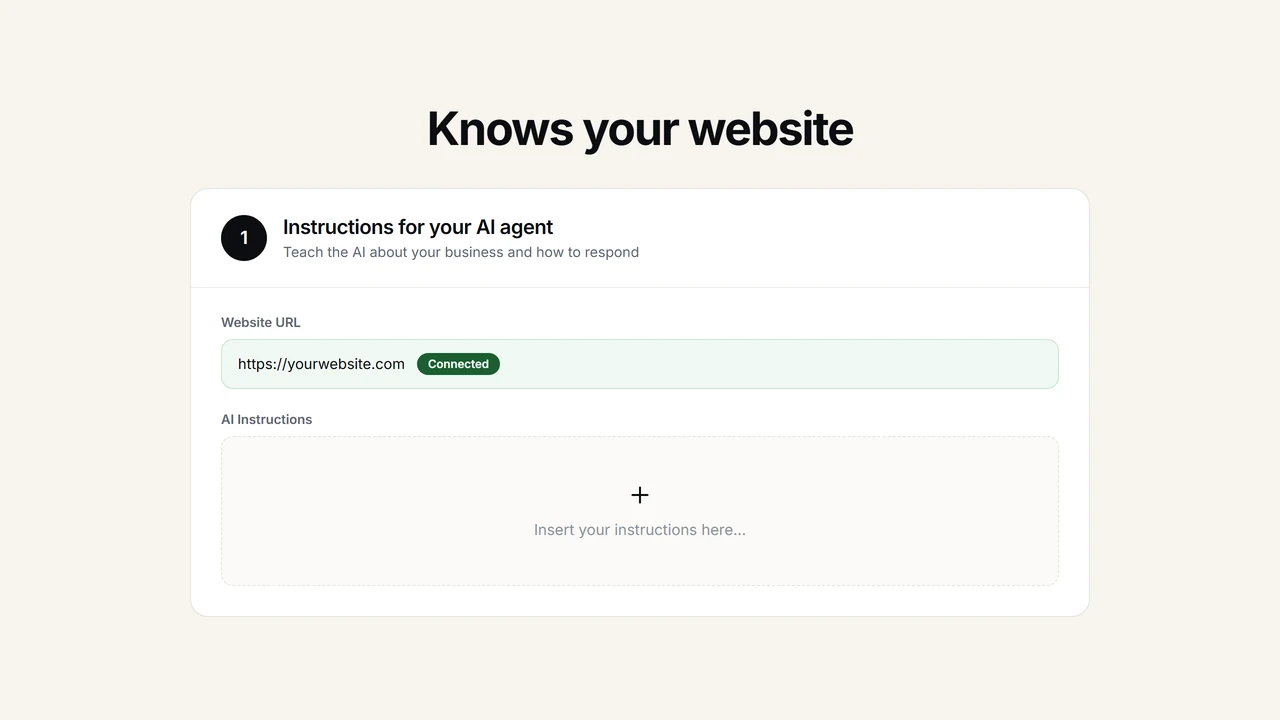
Enter your URL and see how Asyntai reads your pages and answers questions in a natural back-and-forth
Support that follows the thread instead of forcing a flowchart
Traditional chatbots behave like vending machines — press the right button sequence and you might get what you need. Conversational AI works differently. It parses the meaning behind a visitor's words, connects follow-up questions to earlier context, and adjusts its answers as the dialogue unfolds. Asyntai achieves this by retrieving relevant passages from your own website and documents at the moment a question is asked, then composing a response that fits the specific conversation in progress — not a canned reply pulled from a lookup table.
- Intent over keywordsThe AI interprets what the visitor means, not just which words they typed. Phrasing like "can I get my money back" and "what is the refund process" reach the same answer without requiring exact keyword matches.
- Multi-turn memory within a sessionWhen a visitor asks about shipping, then follows up with "what about express," the AI connects the second question to the first. No restarting, no "please select a topic again."
- Content-grounded accuracyEvery response draws from your crawled pages and uploaded documents. The AI does not guess or improvise — it retrieves the relevant section and shapes the answer around it.
Conversational AI that goes beyond answering — it acts
A genuine conversation sometimes ends with an action, not just information. On Standard ($139/month) and Pro ($449/month) plans, Custom Tools let the AI call your own endpoints mid-conversation — checking an order status, looking up account details, or initiating a return — so the visitor gets a resolution within the same dialogue instead of being told to go somewhere else.
- Live data retrieval during conversationThe AI calls your APIs to pull order tracking, inventory levels, or booking availability and weaves the result into a natural sentence — no separate lookup screen for the visitor.
- Action execution, not just informationProcess a cancellation, schedule a callback, or apply a discount code directly within the chat flow. The visitor never leaves the conversation window.
- 36-language auto-detectionConversational AI should not stumble at language boundaries. The interface and responses adapt automatically when a visitor writes in Korean, Portuguese, Arabic, or any of 36 supported languages.
- Graceful escalation with full transcriptWhen a conversation crosses into territory that needs a human — emotional situations, complex disputes, topics outside the knowledge base — the AI captures contact details and hands the entire dialogue to your team.
- Behavioral boundaries you write in plain EnglishDefine what the AI should never promise, when it should escalate, and how it should greet visitors. These rules apply across every conversation and every language.
Add conversational AI to your site in four steps
No machine learning background required. No datasets to label. Paste a snippet, point the AI at your content, and your visitors start having real conversations instead of navigating menus.
- Sign up for free — no credit card needed. The Free plan gives you 1 site and 50 messages per month at $0 to test conversational AI on real visitors.
- Copy the JavaScript snippet from your dashboard and add it to the
<head>of your website, either through your CMS settings, a plugin, or the raw HTML template. - Provide your website URL so Asyntai can crawl and index your content. Upload any additional PDFs or internal documents you want the AI to reference during conversations.
- Write behavioral instructions — greeting style, escalation triggers, topics to avoid — then run test conversations. Upgrade when ready: Starter at $39/month for 2 sites and 800 messages, Standard at $139/month for 3 sites and 15,000 messages, or Pro at $449/month for 20 sites and 50,000 messages.
<script src="https://asyntai.com/widget.js"
data-id="your-site-id" async>
</script>
# One snippet. Real conversations start immediately.
Conversational AI Customer Support — FAQs
Questions teams ask when evaluating whether conversational AI is the right fit for their support workflow.
How is conversational AI different from a regular chatbot?
A regular chatbot follows pre-built decision trees: it recognizes certain keywords or button presses and serves corresponding scripted replies. Conversational AI understands the meaning behind a sentence, maintains context across multiple exchanges, and generates responses tailored to each specific dialogue. The difference shows most clearly in follow-up questions — a scripted bot forces the visitor to start over, while conversational AI remembers what was already discussed and builds on it.
Does Asyntai need training data or labeled examples to work?
No. Asyntai uses retrieval-augmented generation rather than model fine-tuning. You provide your website URL and optionally upload documents. The system crawls up to 50 pages, indexes your content, and retrieves relevant passages at the moment each question is asked. There is no training dataset to prepare, no labeling exercise, and no waiting period before the AI can hold conversations.
Can the AI hold a multi-turn conversation without losing track?
Yes. Within a single session, the AI retains the full dialogue history. If a visitor asks about a product, then follows up with a question about compatibility, then asks about pricing for the same item, each answer takes the prior exchanges into account. The conversation flows naturally rather than resetting after every message.
What happens when the AI cannot answer a question?
When a question falls outside the indexed knowledge base or triggers an escalation rule you defined, the AI shifts into lead capture mode. It collects the visitor's name and email, preserves the entire conversation transcript, and delivers everything to your dashboard. If email forwarding is enabled, your team receives the same information in their inbox simultaneously.
How does the AI handle visitors who speak different languages?
The system detects each visitor's language from their opening message and responds in the same language. Thirty-six languages are supported, including right-to-left scripts like Arabic and Hebrew. There is no per-language setup — one installation serves a German visitor in German, a Japanese visitor in Japanese, and an English visitor in English from the same knowledge base.
Can conversational AI take actions like checking order status?
On Standard and Pro plans, Custom Tools let the AI call your own API endpoints during a conversation. You define the endpoint, what parameters to collect from the visitor, and how to present the result. The AI can check order status, look up account details, verify appointment availability, or perform any action your API supports — all within the natural flow of the dialogue.
What does conversational AI customer support cost?
The Free plan covers 1 site and 50 messages monthly with no credit card. Starter is $39/month for 2 sites and 800 messages. Standard is $139/month for 3 sites, 15,000 messages, and Custom Tools. Pro is $449/month for 20 sites, 50,000 messages, Custom Tools, and automatic white-label branding. Billing follows message volume, not seat count.
How quickly can we go live with conversational AI?
Most teams have the AI responding to real visitor questions within a few hours. The process is: register, paste a script tag, provide your URL for content indexing, write behavioral instructions, and test. There is no model training queue, no approval cycle, and no implementation partner required.
Can we control what the AI says and does not say?
Completely. Behavioral instructions are written in plain English sentences — for example, "never quote custom pricing," "escalate any complaint about data privacy," or "always offer to connect the visitor with a human if they ask twice." These rules bind every response, in every language, around the clock. You can update them at any time from the dashboard.
Conversational AI customer support — why real dialogue changes everything
There is a moment in almost every scripted chatbot interaction where the visitor hits a wall. They have asked a question in their own words, and the bot does not recognize it. The menu reappears. "Please select one of the following options." The visitor clicks the closest match, gets a pre-written paragraph that does not quite address their situation, and either leaves the site or hunts for an email address. That wall is not a bug in the chatbot — it is the architecture. Scripted systems are built around anticipated inputs, and the universe of things a real person might say is always larger than the list someone wrote down during configuration. Conversational AI eliminates that wall by understanding language the way people actually use it: messy, contextual, full of pronouns that reference earlier sentences, and almost never matching the exact phrasing the builder predicted.
The shift from scripted to conversational is less like upgrading a tool and more like hiring a different kind of employee. A scripted chatbot is the equivalent of posting a FAQ poster on the wall and pointing visitors toward it. Conversational AI is the colleague who has read every page on your website, absorbed your internal policies, and can hold a back-and-forth discussion about any of it — adjusting explanations when the visitor looks confused, connecting follow-up questions to what was said a moment ago, and knowing when to stop talking and get a human involved. Asyntai builds that colleague from your own content: it crawls your website, indexes your documents, and retrieves the relevant passages each time a visitor asks something. The AI does not invent answers. It finds them in your material and delivers them in the shape the conversation requires.
Context retention across turns is where conversational AI proves its value most visibly. Consider a visitor who asks "do you ship to France," then follows up with "how long does it take," and then asks "is there a flat rate or does it vary by weight." In a scripted system, each message is an island — the bot might answer the first, struggle with the ambiguous second, and fail entirely on the third because it does not know "it" refers to shipping. Conversational AI carries the thread. The second question inherits the France context. The third builds on both. The visitor feels heard rather than processed, and the resolution happens in one fluid exchange instead of three restarts.
Ambiguity handling separates conversational AI from every generation of chatbot that came before it. Real people are imprecise. They write "can I get the blue one in a bigger size" without specifying the product name, or "my order still has not shown up" without including an order number. A scripted bot stalls on these inputs because its branching logic requires specific data points at specific moments. Conversational AI interprets the intent — the visitor wants a size variant; the visitor is concerned about a delivery — and responds with a relevant answer or a targeted follow-up question that moves the dialogue forward. The interaction feels like a conversation between two humans who are cooperating toward a solution, not like a form that rejects your submission because you left a field blank.
Language versatility amplifies what conversational AI can do for businesses with international traffic. Asyntai supports 36 languages with automatic detection: the visitor writes in their preferred language, and the AI responds in the same one. No translation plugins, no separate bot configurations per locale, no multilingual agent roster. A single installation on a single website serves a Spanish-speaking customer in the morning, a Thai-speaking customer in the afternoon, and an Arabic-speaking customer at midnight — each receiving natural, context-aware dialogue drawn from the same underlying knowledge base. For businesses whose customer base spans borders, this capability replaces what would otherwise be a significant staffing challenge.
The knowledge layer underneath Asyntai's conversational AI is deliberately straightforward. You provide your website URL, and the system crawls up to 50 pages, extracting product descriptions, pricing details, policy documents, help articles, and any other published content. If you have internal materials — employee handbooks, carrier-specific shipping rules, warranty procedures, compliance guidelines — you upload them as PDFs or paste the text directly. The AI retrieves from this combined index every time it needs to answer a question. There is no training step, no embedding pipeline to manage, and no periodic retraining schedule. When your content changes, you re-crawl or swap the document, and the next conversation reflects the update.
Custom Tools on Standard and Pro plans extend conversational AI from dialogue into action. Most support conversations end with either an answer or a request to do something: check an order, verify an appointment, look up account details, initiate a return. Without Custom Tools, the AI can answer content-based questions but must hand off any action to a human. With Custom Tools, you define API endpoints that the AI can call mid-conversation — pulling live data or triggering operations in your own systems. The visitor asks "where is my order," the AI calls your tracking endpoint, and the response includes the actual shipment status. The dialogue does not pause for a human to intervene, and the visitor does not need to navigate to a separate tracking page.
Behavioral instructions give businesses precise control over the conversational AI without touching code. You write rules in plain sentences: "always greet returning visitors by name when User Context is available," "never commit to a delivery date faster than five business days," "escalate immediately if the visitor mentions a legal claim," "do not discuss competitor products." These instructions shape every response the AI generates, in every language, at every hour. They function like the training manual you would give a new support hire — except the AI follows them perfectly on every conversation without the drift that happens when human teams interpret guidelines differently across shifts and individuals.
Escalation in a conversational AI system works differently than in a scripted one. Scripted bots escalate by failure — the visitor hits a dead end, gets frustrated, and clicks "talk to a human." Conversational AI escalates by design. The system recognizes when a conversation has entered territory that needs human judgment — emotional distress, complex disputes, requests that exceed the AI's authority — and transitions gracefully. It collects the visitor's contact information, preserves the complete transcript, and delivers the package to the team dashboard and optionally to an email inbox. The human who picks up the case reads the entire dialogue and enters the conversation with full context, not a cold start.
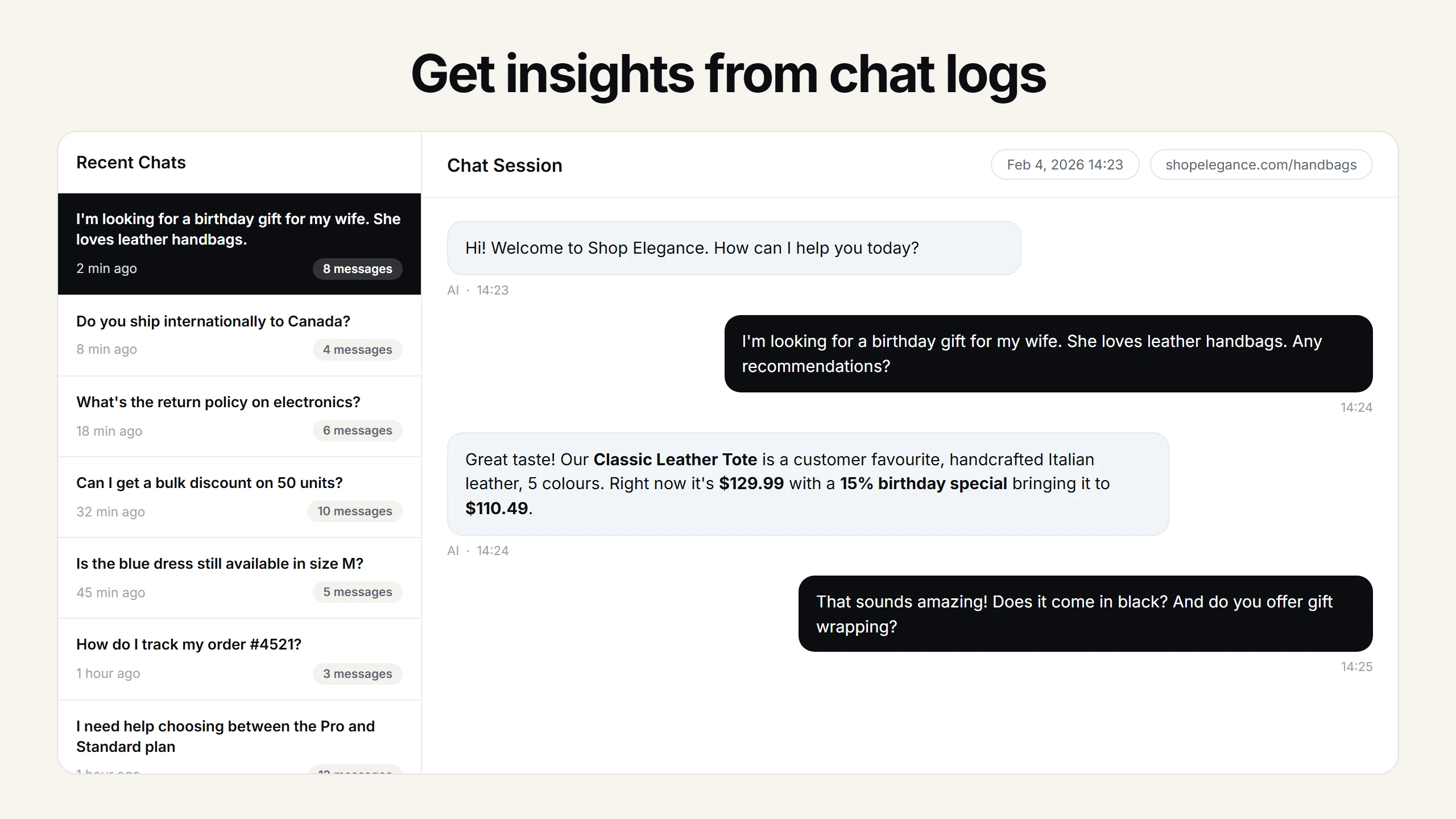
Analytics from conversational AI reveal patterns that scripted bots simply cannot surface. Because every exchange is a genuine dialogue rather than a menu selection, the data captures what visitors actually want to know — not which buttons they clicked. Recurring questions about a particular product expose documentation gaps. Frequent escalations around a specific policy suggest the policy itself needs simplifying. Language distribution data shows where international demand is growing. Over weeks and months, conversational AI transcripts become a mirror reflecting how your audience thinks about your business, and each pattern is an invitation to improve something upstream.
The economics of conversational AI lean heavily in favor of businesses that currently rely on human agents for routine questions. A support agent handling one conversation at a time, during business hours, costs tens of thousands of dollars annually. Conversational AI through Asyntai handles unlimited concurrent dialogues, around the clock, in 36 languages, starting at $39 per month. The cost per conversation drops from double-digit dollars to single-digit cents. That math does not eliminate the need for human agents — it concentrates their effort on the cases where human empathy, creativity, or authority genuinely matter, while the AI manages the volume of straightforward questions that previously consumed most of the team's hours.
Multi-site deployment lets organizations run conversational AI across distinct properties without cross-contamination. A retail group with several brands needs each storefront's AI to know only that brand's products and policies. An agency deploying chatbots for clients needs strict separation between knowledge bases. Asyntai supports this through plan-based site limits: 1 site on Free, 2 on Starter, 3 on Standard, and 20 on Pro. Each site maintains its own crawled content, uploaded documents, behavioral instructions, and conversation history. The conversational AI serving one property has zero awareness of another property's data, even when both live under the same account.
Personalization takes conversational AI from helpful to remarkable. On Standard and Pro plans, your website pushes visitor-specific data into a JavaScript variable before the chat loads — account tier, recent purchases, subscription status, loyalty points, whatever fields you choose. The AI incorporates that context into its responses naturally. A returning customer asking about upgrade options gets an answer tailored to their current plan, not a generic comparison chart. A visitor with an open support ticket gets acknowledged, not treated like a stranger. The data flow is one-directional and controlled entirely by your code, so you decide exactly what the AI knows about each visitor.
The transition from scripted chatbots to conversational AI tends to follow a pattern. Teams start with the free tier, testing against their most common visitor questions. They discover that the AI handles the predictable ones — shipping, returns, pricing, hours — with minimal instruction. They add behavioral rules for edge cases. They upload a few internal documents to cover topics the website does not address publicly. Within a week or two, the conversational AI is handling the majority of inbound questions without human intervention, and the support team's workload has shifted from answering repetitive messages to refining the knowledge base and reviewing escalated conversations. The operational rhythm changes from reactive staffing to proactive content curation.
Conversational AI customer support is not a futuristic concept waiting for the technology to mature — it is available today, installable this afternoon, and testable on your actual visitors before dinner. Asyntai's free plan lets you run 100 real conversations to see how the AI handles your specific content and your specific audience. When the results speak for themselves, paid plans scale the volume to match your traffic. The gap between scripted chatbots and genuine dialogue is not closing gradually — it has already closed. The question is whether your visitors are still navigating menus while your competitors' visitors are having conversations.