Chatbot white label: put your logo on the AI and bill clients at your own price
Asyntai disappears. Your brand stays. Deploy a fully branded AI chatbot to every client site, control the experience from a single dashboard, and pocket the margin between your price and ours.
Preview the chatbot white label experience on any URL
Enter a client site below and see how the AI reads the content and starts answering — with zero mention of Asyntai
Every pixel belongs to you — the visitor never sees our name
A chatbot white label arrangement only works if the branding removal is thorough. Half-measures — a "powered by" footer or a vendor logo in the corner — erode the premium positioning you need to justify your agency rates. Asyntai strips itself from the equation entirely on Pro plans: the widget, the greeting, the chat header, and the response signatures all carry your name, your colors, and your identity. On Standard plans the same result is available by request — email [email protected] and the team configures it manually.
- Complete brand substitutionReplace the widget name, icon, header text, and color scheme with your own. Visitors interact with what looks and feels like your proprietary product.
- Separate knowledge per clientEach client site gets its own crawled content, uploaded documents, and behavioral instructions — isolated from every other deployment under your account.
- One dashboard, many clientsManage conversations, leads, and settings across up to 20 client sites from a single login. No juggling separate vendor accounts for each engagement.
Give clients live data lookups and action-taking AI — under your brand
The chatbot white label offering goes beyond static Q&A. With Custom Tools on Standard ($139/month) and Pro ($449/month) plans, the AI can call your clients' own API endpoints during a conversation — pulling order status, checking appointment availability, initiating returns, or fetching inventory counts in real time. Your clients see a chatbot that does things, not just one that talks, and the capability carries your agency's name.
- Order and account lookupsConnect the chatbot to a client's backend so visitors can ask about their order, subscription, or appointment without leaving the chat.
- Action-taking responsesThe AI can trigger real operations — cancel a booking, request a callback, submit a warranty claim — through endpoints you configure.
- 36-language auto-detectionA client's German visitor gets German responses, a Japanese visitor gets Japanese — automatically, from the same white-labeled widget, with no per-language setup.
- Behavioral guardrails you controlWrite plain-English rules per client — escalation triggers, topics to avoid, greeting tone — so the AI stays inside each client's brand voice and policies.
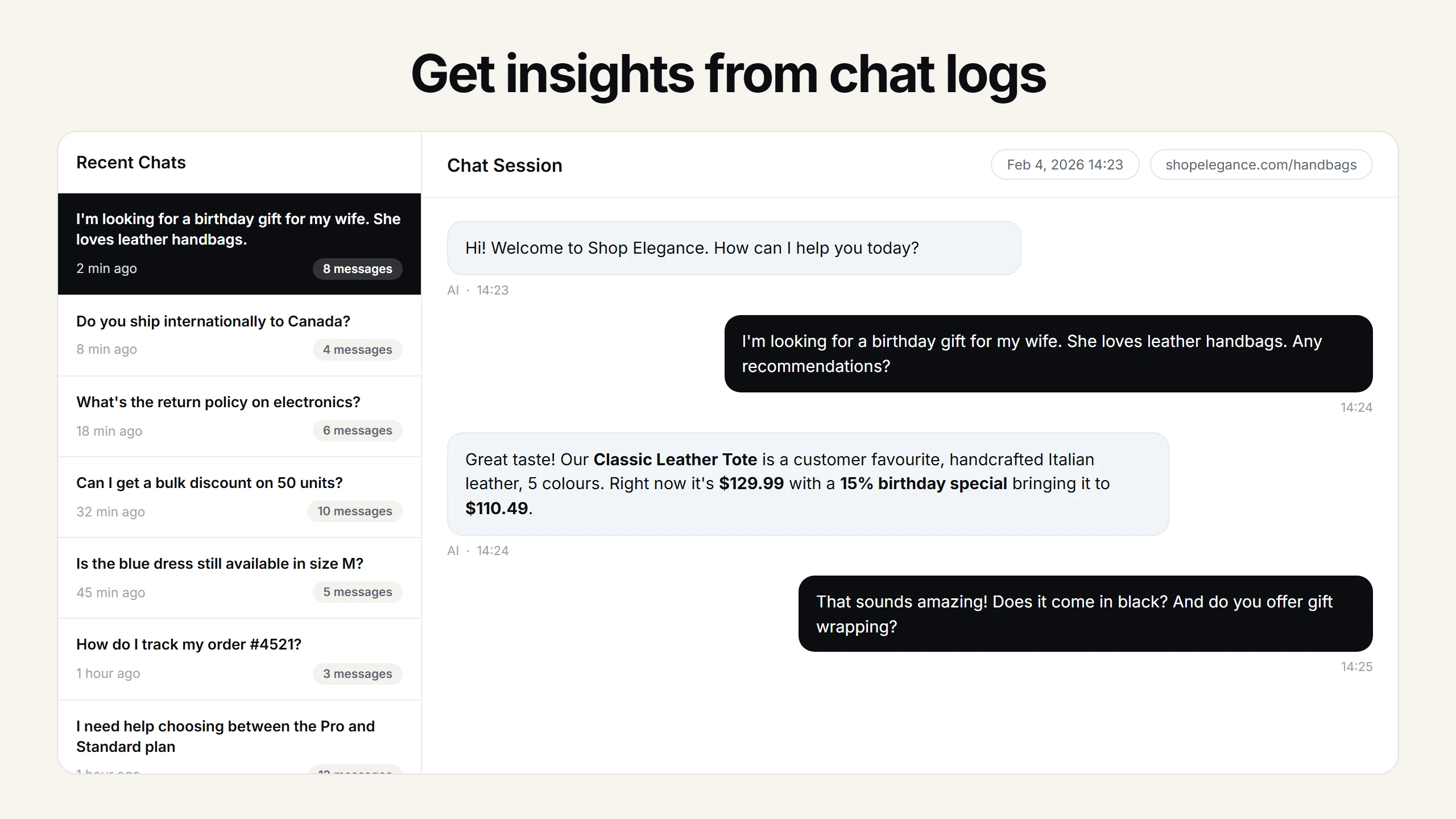
- Lead capture with transcript deliveryWhen a conversation needs human follow-up, the AI collects contact details and sends the full transcript to the client's inbox and your dashboard simultaneously.
Deploy a white-labeled chatbot to a client site in one afternoon
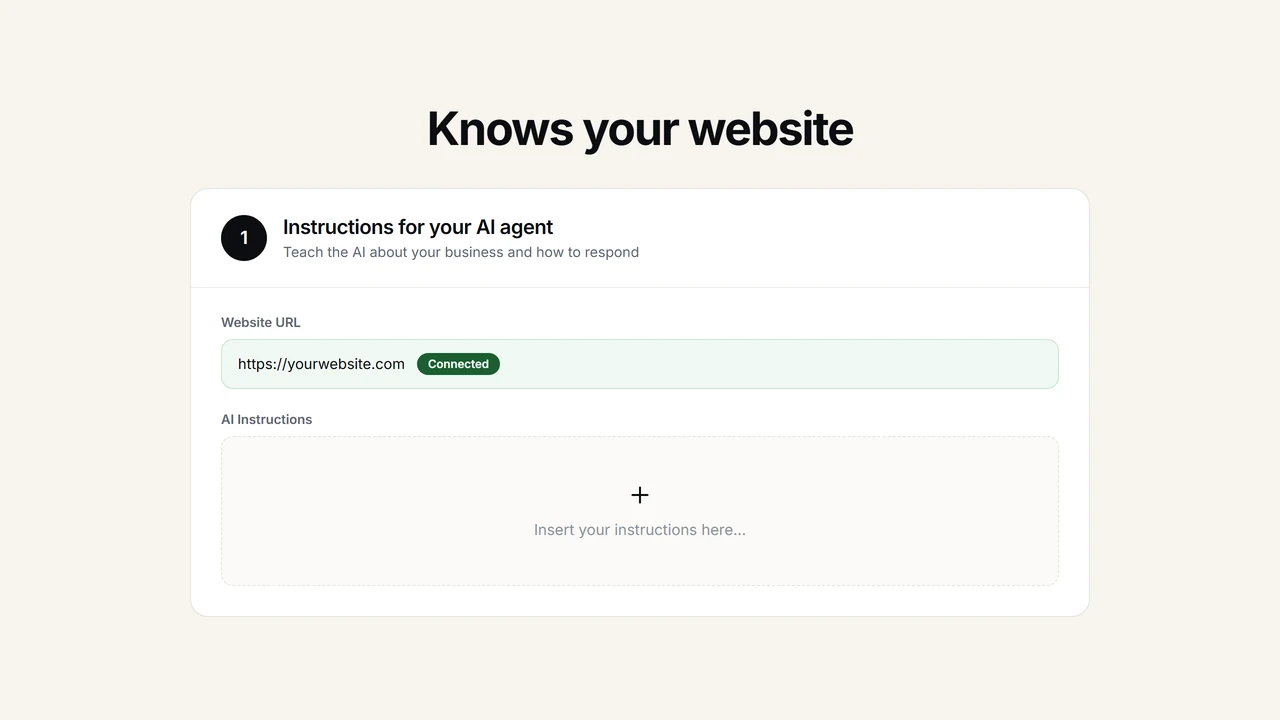
The gap between signing a client and delivering a working AI chatbot under your brand is measured in hours, not weeks. One JavaScript snippet on their site, one content crawl, a few behavioral rules, and the white-labeled widget is live.
- Create your Asyntai account and add a new site for the client. Free ($0/month) covers 1 site with 50 messages — enough to demo. Starter ($39/month) supports 2 sites with 800 messages each.
- Paste the client-specific JavaScript snippet into their site's
<head>section using their CMS, a tag manager, or a platform plugin. - Provide the client's URL for automatic content crawling (up to 50 pages) and upload any additional documents — product catalogs, policy PDFs, internal guides — that the AI should reference.
- Activate white-label branding: automatic on Pro ($449/month, 20 sites, 50,000 messages) or by request on Standard ($139/month, 3 sites, 15,000 messages). Set your brand name, colors, and greeting, then verify with test conversations.
<script src="https://asyntai.com/widget.js"
data-id="your-site-id" async>
</script>
# Your brand. Their site. AI doing the work.
Chatbot White Label — FAQs
Questions agencies and consultants ask before offering AI chatbots under their own brand.
What exactly gets white-labeled?
Everything the end visitor sees. The widget header name, the chat bubble icon, the color scheme, the greeting message, and the assistant name all reflect your brand. There is no "powered by Asyntai" watermark, no vendor logo, and no link back to our site. The visitor interacts with what appears to be your proprietary AI product.
Which plans include white-label branding?
White-label is automatic on the Pro plan at $449 per month, covering up to 20 sites and 50,000 messages. On the Standard plan at $139 per month, white-label is available by request — email [email protected] and the team configures it. Free and Starter plans display Asyntai branding.
How many client sites can I manage from one account?
Site limits scale with your plan: 1 on Free, 2 on Starter ($39/month), 3 on Standard ($139/month), and up to 20 on Pro ($449/month). Each site has its own knowledge base, behavioral instructions, lead inbox, and conversation history — fully isolated from every other client.
Can I set my own pricing when reselling to clients?
Absolutely. You pay Asyntai's subscription rate and charge your clients whatever you choose. If you pay $449 per month for Pro and charge five clients $200 each, you keep the full difference. There are no revenue-share clauses or minimum pricing requirements on white-label deployments.
What is the reseller affiliate program?
Separate from white-label, the affiliate program pays 20% recurring commission for up to 12 months on every customer you refer who signs up through your tracking link. You can combine both approaches — white-label some clients directly, refer others through your affiliate link — depending on the engagement model. Details are at /documentation/reseller/.
Does the AI answer using each client's own content?
Yes. When you add a client site, the system crawls up to 50 pages from their URL and indexes the content. You can also upload PDFs, paste text blocks, or add internal documents. The AI retrieves relevant information from that client-specific knowledge base at query time — it does not use content from your other clients or from general internet sources.
Can I give clients access to their own conversation data?
Lead notifications and transcripts can be forwarded to each client's email automatically, so they see their own conversations without needing dashboard access. If you want to share the dashboard itself, you control what level of visibility each client gets through your agency's workflow.
How fast can I deploy a white-labeled chatbot to a new client?
Most agencies report going from client sign-off to a live, branded chatbot within a single afternoon. The steps are: add the site in your dashboard, paste the snippet on the client's page, trigger the content crawl, write behavioral instructions, and test a handful of conversations. The white-label branding applies immediately on Pro.
What languages does the white-labeled chatbot support?
Thirty-six languages, with automatic detection from the visitor's first message. A client serving customers in Spanish, Arabic, and Korean gets responses in all three languages from the same white-labeled widget — no per-language configuration required and no extra cost.
Chatbot white label — how agencies build a recurring AI revenue line from scratch
Every agency eventually hits the same ceiling. You sell a website redesign, collect the project fee, and then wait for the next project to close. Retainers help, but they require ongoing labor — someone has to write the blog posts, manage the ad campaigns, or field the support requests that justify the monthly invoice. A chatbot white label offering introduces a different kind of recurring revenue: one where the product works around the clock without consuming billable hours, where the margin improves as you add clients rather than deteriorating, and where the value is visible to clients every time a visitor gets an instant answer instead of bouncing off the page.
The economics of reselling white-labeled AI chatbots reward agencies that think in portfolios rather than single engagements. A Pro subscription at $449 per month covers up to 20 client sites. If you charge each client between $99 and $299 monthly for "your" AI assistant — a price range most small businesses consider trivial compared to hiring even a part-time support person — the math compounds quickly. Five clients at $199 each yields $995 per month against a $449 cost, leaving $546 in margin before you have done anything beyond the initial setup. Ten clients at the same rate doubles that margin while your infrastructure cost stays fixed. The foundation of the business model is that one subscription scales across your entire client roster.
What separates a chatbot white label from a simple referral is ownership of the relationship. When you refer a client to a SaaS vendor, the vendor owns the account, the billing, and the renewal conversation. The client knows exactly who built it. Your role shrinks to "the person who suggested it," and your leverage evaporates at renewal time. When you white-label, the client sees your brand on the widget, pays your invoice, and comes to you for support. You are the vendor. That positioning lets you bundle the chatbot into broader retainers, cross-sell adjacent services, and negotiate from a seat of authority rather than a referral commission.
For agencies that prefer a lighter-touch model, the affiliate program offers a parallel track. Referring customers through your tracking link earns 20% recurring commission for up to 12 months on each signup — no branding work, no client management, just a revenue share on accounts that convert. Some agencies run both models simultaneously: white-label for clients where they want full control and premium pricing, affiliate referrals for prospects who prefer to manage the tool themselves. The details on structuring either path are documented at /documentation/reseller/ and /documentation/white-label/.
The construction of a white-label chatbot deployment follows a pattern that agencies can systematize and repeat. First site audit: understand what the client's visitors actually ask about, which pages carry the answers, and where gaps exist. Then configuration: crawl the client's URL, upload supplementary documents, write behavioral instructions that match the client's brand voice and escalation preferences. Then branding: set the widget name, colors, greeting text, and assistant personality. Then testing: run a dozen representative conversations and verify accuracy, tone, and escalation triggers. The whole sequence typically compresses into an afternoon, and by the third or fourth client, the agency has internalized the workflow well enough to turn a client kickoff into a polished deliverable within hours.
Client-specific knowledge isolation is the structural detail that makes multi-tenant white labeling viable. Each site you add to your dashboard operates with its own crawled content, its own uploaded documents, its own behavioral guardrails, and its own conversation history. A dentist's chatbot in Toronto knows nothing about a boutique hotel's policies in Lisbon, even though both run under the same agency account. That separation means you never risk a configuration change for one client bleeding into another client's experience — the kind of accident that would shatter an agency's credibility overnight.
Language coverage turns a chatbot white label into an especially compelling proposition for agencies serving international or multicultural markets. The widget detects visitor language from the first message and responds in kind across 36 languages — no per-language configuration, no translation plugins, no separate widget instances. An agency working with a restaurant chain that serves tourists from a dozen countries can deliver a single white-labeled chatbot that speaks to each visitor in their own language. That capability is nearly impossible to replicate manually, which makes it a powerful differentiator when pitching the service.
The operational load on the agency after deployment is deliberately minimal. Once the chatbot is live, the AI handles conversations autonomously based on the client's content and your behavioral rules. Leads get captured and forwarded to the client's email. Transcripts accumulate in the dashboard for review. The agency's ongoing role is periodic — checking conversation quality once a week, updating the knowledge base when the client launches new products or changes policies, and adjusting instructions if escalation patterns shift. That lightweight maintenance model is what makes the margin sustainable: you are not trading hours for dollars on a support contract, you are collecting a subscription fee against a product that runs itself.
Pricing your white-label chatbot service requires thinking about perceived value rather than cost-plus math. A small business owner comparing your $199 per month AI assistant to the cost of a part-time receptionist — $1,500 to $2,500 monthly — sees immediate savings. A mid-market ecommerce store comparing your $299 per month offering to the cost of after-hours support coverage sees the same calculus. The fact that your underlying cost is a fraction of what you charge is not a secret to hide; it is the fundamental structure of every software resale business. Your value is in the setup expertise, the ongoing optimization, and the brand trust your agency represents.
Custom Tools, available on Standard and Pro plans, let agencies elevate the white-label chatbot from an information desk into an operations layer. Configure the AI to call a client's API endpoints during conversations — checking order status, looking up appointment slots, verifying account details, initiating return requests — and the chatbot becomes a tool that does things rather than merely describing them. For agencies that position themselves as digital transformation partners, this capability is the difference between selling a "nice to have" chat widget and selling a "must have" operational assistant.
Scaling from a handful of white-label clients to a full practice requires a bit of scaffolding beyond the technology itself. Agencies that build this into a real revenue line typically develop a standard onboarding questionnaire — what does your ideal customer ask, what topics should the AI avoid, where do escalations go — that compresses discovery into a 30-minute call. They create a brief setup checklist they can hand to a junior team member. They document their pricing tiers so proposals go out the same day a prospect expresses interest. The technology is already systematized; the agency just needs to match that with systematized sales and delivery.
One concern agencies raise before committing to a white-label model is vendor dependency: what happens if the underlying platform changes or disappears? The honest answer is that this risk exists with any white-label arrangement, SaaS or otherwise. What mitigates it here is that the switching cost is symmetrically low. The chatbot runs from a single JavaScript snippet — removing it takes one line of code, and replacing it with an alternative takes one line of code. Client content stays on client websites; uploaded documents remain in agency hands. The relationship with the client is yours, not ours, which means a platform migration affects only the technical plumbing, not the commercial arrangement.
The difference between agencies that treat chatbot white labeling as an experiment and those that turn it into a real practice usually comes down to the first three clients. The first deployment proves the technology works. The second proves the workflow is repeatable. The third proves the economics hold under real conditions. Agencies that reach three clients almost always continue expanding, because by that point the recurring revenue is visible, the setup time is predictable, and the client feedback loop is generating improvement ideas faster than the agency can implement them.
Building a chatbot white label practice is not about becoming an AI company. It is about adding an AI-powered service line to the portfolio you already have, using infrastructure someone else maintains, under a brand your clients already trust. The foundation is a single Pro subscription. The materials are your agency's existing client relationships. The blueprint is straightforward: pick a plan, brand the widget, deploy to a client, collect monthly revenue, repeat. Start with the pricing page to see which tier fits your client roster, or create a free account and test the white-label workflow on your own site before pitching the first client.