A chatbot for university sites that handles the questions your staff answer on repeat
Universities publish everything yet still drown in the same inbound questions each cycle. Asyntai gives your institution a chatbot answering from catalogs, handbooks, and policy documents — placed across admissions portals, registrar pages, and student services with a single JavaScript snippet, replying in 36 languages at any hour.
Test a chatbot for your university site right now
Paste your .edu URL and watch the assistant pull real content from your pages
Built for the operational shape of a university, not retrofitted from retail
A university is not a store with a product catalog. It is dozens of departments, each publishing separate micro-sites, each on different update cadences, each with different audiences — seventeen-year-old applicants, graduate researchers, visiting scholars, parents paying tuition, alumni checking transcript services. The chatbot that works here must ingest across all those silos, respect the differences between them, and still deliver a single coherent conversation. Asyntai crawls your subdomains, absorbs uploaded PDFs of academic catalogs and policy manuals, and threads the answers together so one question can pull from the registrar and the bursar without the visitor knowing they lived on different servers.
- Cross-department intelligenceCrawl admissions.edu, housing.edu, financialaid.edu, and every college-specific subdomain in a single training pass — the chatbot resolves questions that span departments without bouncing the visitor between sites.
- PDF-heavy content welcomeAcademic catalogs, honor codes, residential contracts, and financial aid handbooks live in PDFs that search engines barely touch. Upload them directly and the chatbot indexes every page, turning locked documents into conversational answers.
- Semester-aligned refreshDeadlines shift, tuition tables reset, new minors launch. Re-crawl from the dashboard between terms so the chatbot never quotes last year's numbers into a current applicant's browser.
Thirty-six languages because your applicant pool is not domestic-only
Recruitment pipelines now stretch into every continent. A prospective engineering student in Seoul, a nursing applicant in Riyadh, a doctoral candidate in Bogota — none of them will phone your admissions office during Eastern time business hours, and most prefer to research in their own language first. Hiring multilingual counselors for every pipeline is not economically viable; leaving those visitors to decipher English-only content costs yield. A chatbot for university that auto-detects the visitor's language and replies from the same authoritative English source material closes the gap without new headcount or translated microsites.
- Language detected from the first messageNo flag picker, no language subdomain — a visitor types in Thai or Hungarian and the reply arrives in the same language, grounded in your English-language catalog and policies.
- Round-the-clock for every timezoneWhen it is 3 a.m. at your campus, it is mid-afternoon in Hanoi and early evening in Nairobi. The chatbot absorbs those inquiries and either answers outright or captures the email for morning follow-up.
- Context-aware escalationSensitive conversations — disability accommodations, Title IX disclosures, immigration case specifics — route to a human with the full transcript attached, so the specialist reads the background before the first reply.
One snippet places the chatbot for university across every campus property
Paste a single JavaScript tag into the common template of your web platform — whether that is WordPress Multisite, Drupal, Cascade, Sitecore, or the Moodle login gateway — and the assistant appears on every page that loads it. No per-department installation, no vendor tickets to campus IT for each subdomain.
- Sign up on the free tier (50 messages — enough for a pilot with one department) and copy the snippet from your Asyntai dashboard.
- Add the snippet to the common template file across your .edu properties. If your LMS is Moodle, use the native AI chatbot for Moodle plugin instead for a zero-code install.
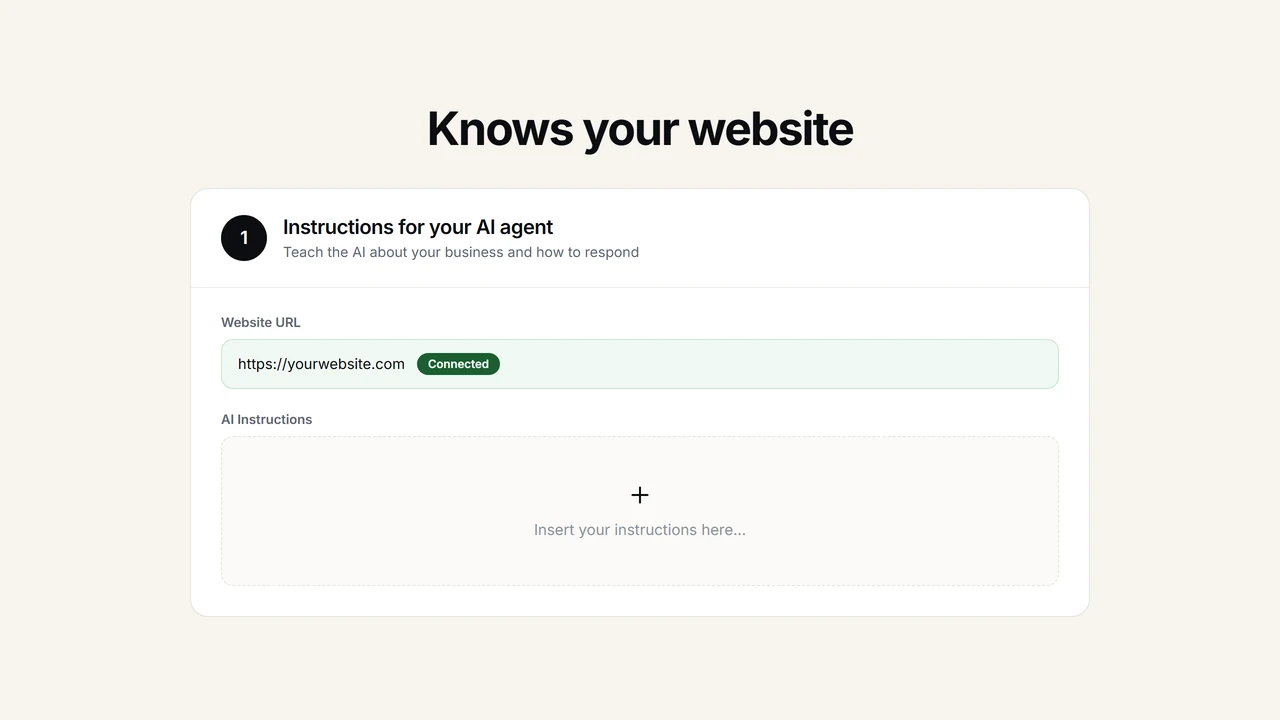
- Feed the assistant your core content: crawl your public URLs and upload the course catalog, institutional handbook, financial aid guides, and any departmental policy PDFs.
- Set escalation rules for sensitive categories — mental health referrals, FERPA-protected inquiries, specific aid appeals — so those conversations reach qualified staff rather than an AI reply.
<script src="https://asyntai.com/widget.js"
data-id="your-campus-id" async>
</script>
</head>
# Chatbot live on admissions, registrar, housing, and student portal.
Chatbot for university — questions from provosts, CIOs, and enrollment VPs
Practical concerns raised by university leadership and IT governance before campus-wide deployment.
Our university runs dozens of subdomains — can one chatbot cover all of them?
Yes. A single Asyntai chatbot drawing on content from admissions.edu, registrar.edu, housing.edu, the graduate school, and individual college sites serves a unified experience across all of them. You paste the same snippet into each property's header. On each plan tier the multi-site allowance governs how many distinct chatbot instances you can run: one on Free, two on Starter, three on Standard, ten on Pro. Multiple subdomains sharing one chatbot count as a single site.
How does the chatbot stay current when our content changes every semester?
You trigger a re-crawl from the Asyntai dashboard whenever content shifts — new application deadlines, revised tuition schedules, updated catalog PDFs. The assistant begins serving refreshed answers within minutes. Most institutions build this into their academic-calendar operations: a full re-train at the start of each term, with spot refreshes when mid-cycle policy changes publish. No code changes and no IT tickets required.
What about FERPA compliance when the chatbot interacts with enrolled students?
Anonymous public-facing conversations contain no protected records and carry no FERPA exposure. For portal-integrated deployments where your application pushes student data through User Context (Standard and Pro tiers), treat Asyntai the way you treat any third-party tool receiving education records: review data processing terms, limit context payloads to what the reply actually requires (major and class standing typically suffice; transcript-level data generally does not), and document the use case per your institution's FERPA policy. All data is encrypted both during transmission and while stored.
Does the assistant distinguish between prospective applicants and enrolled students?
On public-facing pages both audiences receive the same policy-grounded answers, which works because the informational questions overlap heavily. On a logged-in student portal where User Context passes the student's major, standing, and enrollment status, the chatbot tailors replies accordingly. A prospective visitor asking about the nursing prerequisite chain gets the catalog answer; a second-year nursing student asking the same question gets an answer that accounts for their standing.
We already use Moodle for our LMS — does this integrate?
Asyntai ships a native Moodle plugin (local_asyntai) that installs through Site administration and puts the chatbot on every Moodle page without editing theme files. If Moodle is only one piece of your web presence, you can also place the JS snippet on your main .edu properties alongside the Moodle plugin — both connect to the same assistant and the same dashboard.
How are conversations escalated to the right department?
Escalation rules are configured in the Asyntai dashboard. You define topic triggers — for example, financial hardship routes to the dean of students, immigration questions route to the international office, mental health disclosures route to counseling services. When triggered, the chatbot collects the visitor's email, packages the full transcript, and delivers it to the designated inbox. The staff member who opens the email has the entire conversation history and can follow up without asking the student to repeat anything.
What is the pricing for a campus-wide rollout?
The free tier covers 50 messages, which is enough to pilot within one department and evaluate answer quality. Paid plans begin at $39 per month for 800 messages. Billing scales by conversation volume, not by enrollment headcount or number of staff seats, so a 2,000-student liberal arts school and a 45,000-student research institution use the same pricing structure — the difference is how many conversations each actually generates.
Can we restrict what the chatbot is allowed to say about sensitive topics?
Custom instructions let you define boundaries per topic. You might tell the assistant to answer general FAFSA procedure questions but never quote a specific award amount, or to acknowledge mental health resources exist and immediately offer the counseling center's contact instead of attempting advice. These guardrails apply across all conversations and all languages — the assistant follows the same rules whether a question arrives in English or Arabic.
Chatbot for university — why the institutional shape demands its own approach
Universities occupy a strange position in the landscape of organizations that could benefit from a chatbot. They are not retailers with a product catalog and a checkout funnel. They are not SaaS companies with a knowledge base and a ticket queue. They are sprawling, federated institutions where a single visitor's question might require information from the admissions office, the financial aid department, the registrar, and a specific academic college — four different teams, four different websites, often four different content management systems. The reason a chatbot for university needs to be purpose-considered rather than borrowed from e-commerce is exactly this: the content architecture is fragmented by design, and the user journeys cross those fragments constantly.
Consider what a typical prospective student actually does when researching a university online. They land on the admissions page, read about application requirements, then want to know what the tuition will be — which lives on the bursar's site. They look at the computer science major's curriculum — which lives on the engineering college's site. They wonder about on-campus housing costs — which lives on residential life's site. They want to know if their AP credits transfer — which is buried in a PDF on the registrar's domain. Each of those answers exists, published and accurate, but finding all four requires navigating four separate web architectures that were never designed to work as one journey. A chatbot that has ingested all four domains and their supporting documents collapses that navigation into a single conversation. The student asks, the chatbot answers from the right source, and the student never has to learn your org chart to get what they need.
This fragmentation is not a fixable design flaw — it reflects how universities actually operate. Departments maintain autonomy over their content. The business school publishes its own pages on its own schedule. The graduate school maintains a separate admissions pipeline from undergraduate. The international student office has specialized forms and procedures that don't appear on the main admissions site. Expecting a university to centralize all of this content into one navigable interface has been tried for decades and has mostly failed, because the institutional incentives push toward distributed publishing. A chatbot for university works precisely because it adds a search and answer layer on top of the distributed structure without requiring anyone to change how they publish.
The enrollment funnel is where the stakes are highest and the question volume is most predictable. During peak application season, a mid-size university might receive hundreds of inquiries per day to the admissions office — the same two dozen questions appearing in different phrasings from different applicants. What SAT score do you require? Is the application fee waivable? When is the priority deadline for merit scholarships? Do you accept the Common App or the Coalition? What GPA does the honors college need? These are fully answerable from published content. Every one that reaches a human counselor's email or phone is a minute not spent on yield activities — calling admitted students, advising undecided applicants, running campus visit programs. Routing the answerable tier to a chatbot is not about replacing counselors; it is about letting counselors do counselor-level work instead of search-engine work.
The 36-language capability matters for universities in a way it rarely matters for a local business. International enrollment is not a niche initiative for most four-year institutions — it is a revenue strategy and an institutional priority. The students being recruited from China, India, South Korea, Vietnam, Saudi Arabia, Brazil, and Nigeria are comparing your institution against competitors in the same breath. The one whose website gave them a clear, conversational answer in Mandarin or Portuguese at 11 p.m. local time earned a meaningful advantage over the one whose site required them to decode English-only PDFs. Multilingual chat is not a courtesy feature for universities; it is an enrollment conversion lever on the international pipeline, and the cost of not having it is measured in applicants who never finished exploring your institution because the friction was too high.
After-hours reach is the second structural advantage specific to higher education. A university's audience is never entirely in one timezone. Domestic prospective students are teenagers browsing colleges between 8 p.m. and midnight, well after admissions offices close. Enrolled students run into administrative questions at all hours — during late-night study sessions, on weekends when offices are shuttered, during breaks when campus operates on skeleton staff. International prospects and current students sitting twelve hours ahead of your campus clock have zero overlap with published office hours. A chatbot that absorbs questions at every hour and either resolves them instantly or captures the email for staff follow-up means no inquiry falls into the gap between when the question was asked and when a human was available.
The registrar's office carries a unique version of this burden. Add/drop periods generate predictable surges in identical questions: how to waitlist a full section, whether a late withdrawal carries a W grade, how many credits are needed for full-time status, how to request a leave of absence. These procedures are all documented in official policy guides, but those guides run hundreds of pages and no student reads it recreationally. The chatbot answering from that handbook becomes a conversational index — students describe their situation, the chatbot locates the relevant policy, and the response cites the official text. Only the genuinely ambiguous cases — academic appeals, exceptions to posted deadlines, retroactive withdrawals — need to reach the registrar's human staff.
Financial aid conversations require a different configuration than general informational queries, and this is where universities specifically benefit from a chatbot that supports custom instructions. The chatbot should freely answer "when is the FAFSA deadline," "what does the cost of attendance include," and "how does satisfactory academic progress work" — these are policy questions with published answers. It should not attempt to answer "how much aid will I get," "can you increase my award," or "my parents won't fill out the FAFSA, what do I do" — these are case-specific situations that require a financial aid counselor. Configuring the chatbot to handle the first category and escalate the second keeps the tool credible. Universities that deploy AI without these boundaries risk a single bad answer spreading through a group chat and eroding trust faster than a hundred good answers can build it.
Personalization through User Context changes the equation for logged-in student portal deployments. When a student opens the chatbot from within the portal and the application passes their major, class standing, and registration state into the widget, the chatbot stops being a generic handbook reader and starts being something closer to an advising assistant. A third-year biochemistry major asking "what do I still need for graduation" gets an answer framed around the biochemistry degree requirements and typical third-year remaining coursework, not a generic link to the catalog. A first-semester transfer student asking about orientation gets information specific to transfer cohort programming rather than the freshman orientation page. This feature sits on the Standard and Pro tiers, and it is the reason portal deployments tend to generate the strongest satisfaction scores from students.
Lead capture for enrollment is worth isolating as a use case because it operates differently in higher education than in commercial settings. When a prospective student engages the chatbot and the conversation reaches a point where human follow-up would be valuable — a specific question about a niche program, a request to speak with a departmental advisor, a transfer credit evaluation that requires a human review — the chatbot collects the visitor's email and delivers the full transcript to the Asyntai dashboard with configurable email alerts sent to the relevant admissions team. This is not a cold lead from a form submission; it is a warm lead accompanied by a record of exactly what the student asked and how the conversation unfolded. Counselors who follow up on these leads already know what the student cares about, which makes the outreach feel personal rather than templated.
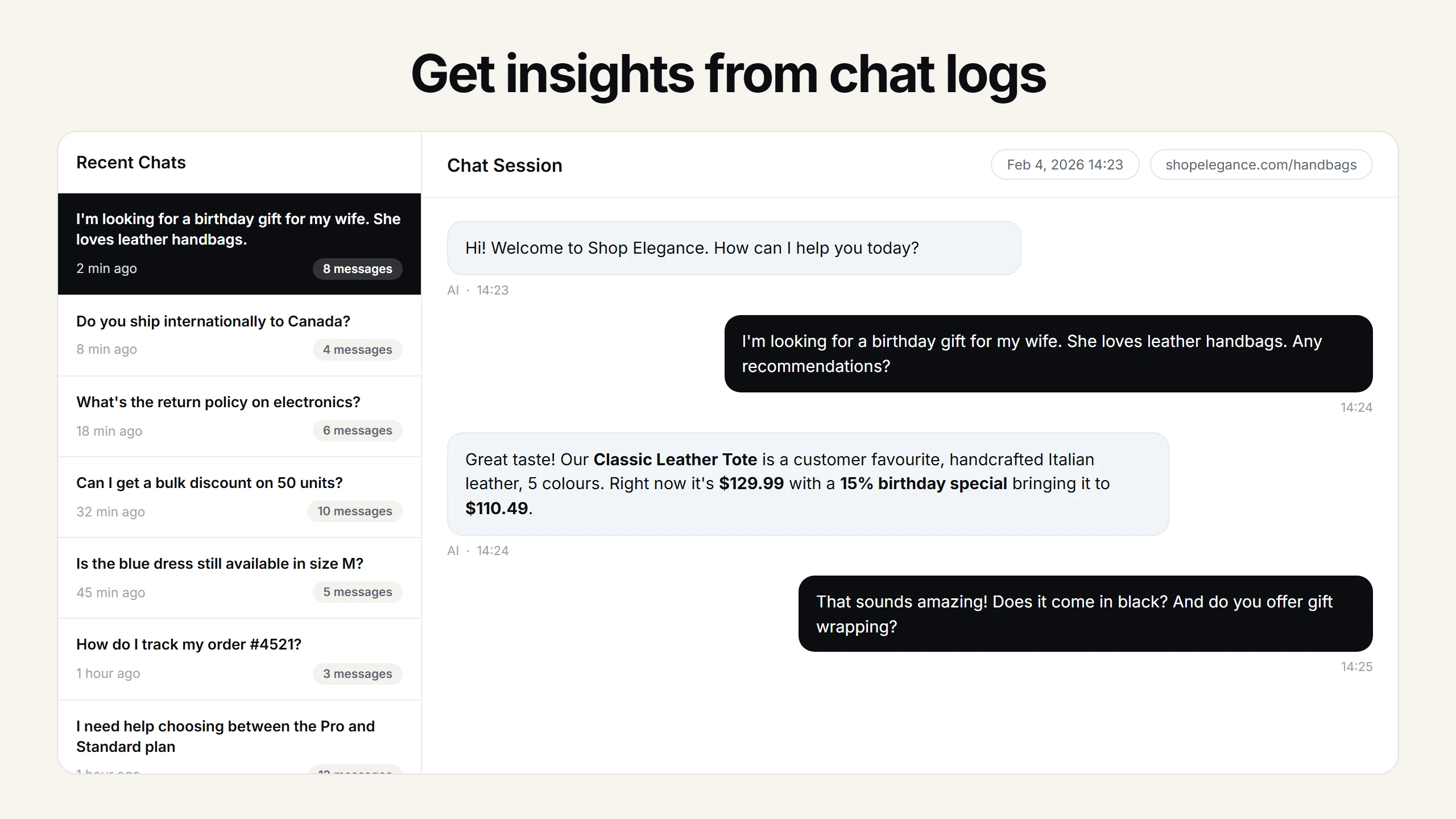
Operational analytics from chatbot transcripts give university administrators a feedback channel that traditional web analytics cannot. Page-view data tells you that 4,000 visitors hit the financial aid page last month; it does not tell you that 600 of them had a question the page did not answer. Chatbot transcripts reveal the exact questions visitors asked, the exact phrasing they used, and whether the chatbot resolved them or escalated. Over a semester, patterns crystallize — a recurring misunderstanding about a deadline that the website words ambiguously, a policy gap that three dozen students independently asked about, an entire applicant segment asking a question your marketing never anticipated. Those patterns become an evidence-based agenda for content improvements that reduce future inbound volume at the source.
Deploying a chatbot for university usually follows a phased trajectory rather than a single campus-wide launch. The typical starting point is admissions, because the volume is high, the questions are well-documented, and the team can measure impact quickly in terms of counselor time freed and applicant engagement captured. From there, the second deployment usually reaches the registrar or student services surface, where handbook-grounded answers resolve the add/drop and transcript request surge. The IT helpdesk is a third common phase — VPN setup, password resets, LMS navigation, printing issues — where the payback is measured in tickets deflected. The final phase, and the most impactful, is the student portal integration with User Context, turning the chatbot into a personalized advising layer. By that point, the institution has one assistant answering from its entire published corpus, available in 36 languages, operational around the clock, absorbing the repetitive tier of every department that publishes content students need to find.