Chatbot for employee engagement: give your team instant answers to HR, IT, and company policy questions
An AI chatbot that reads your internal knowledge base — HR handbooks, IT guides, benefits documents, onboarding materials — and answers employee questions accurately, in any language, around the clock.
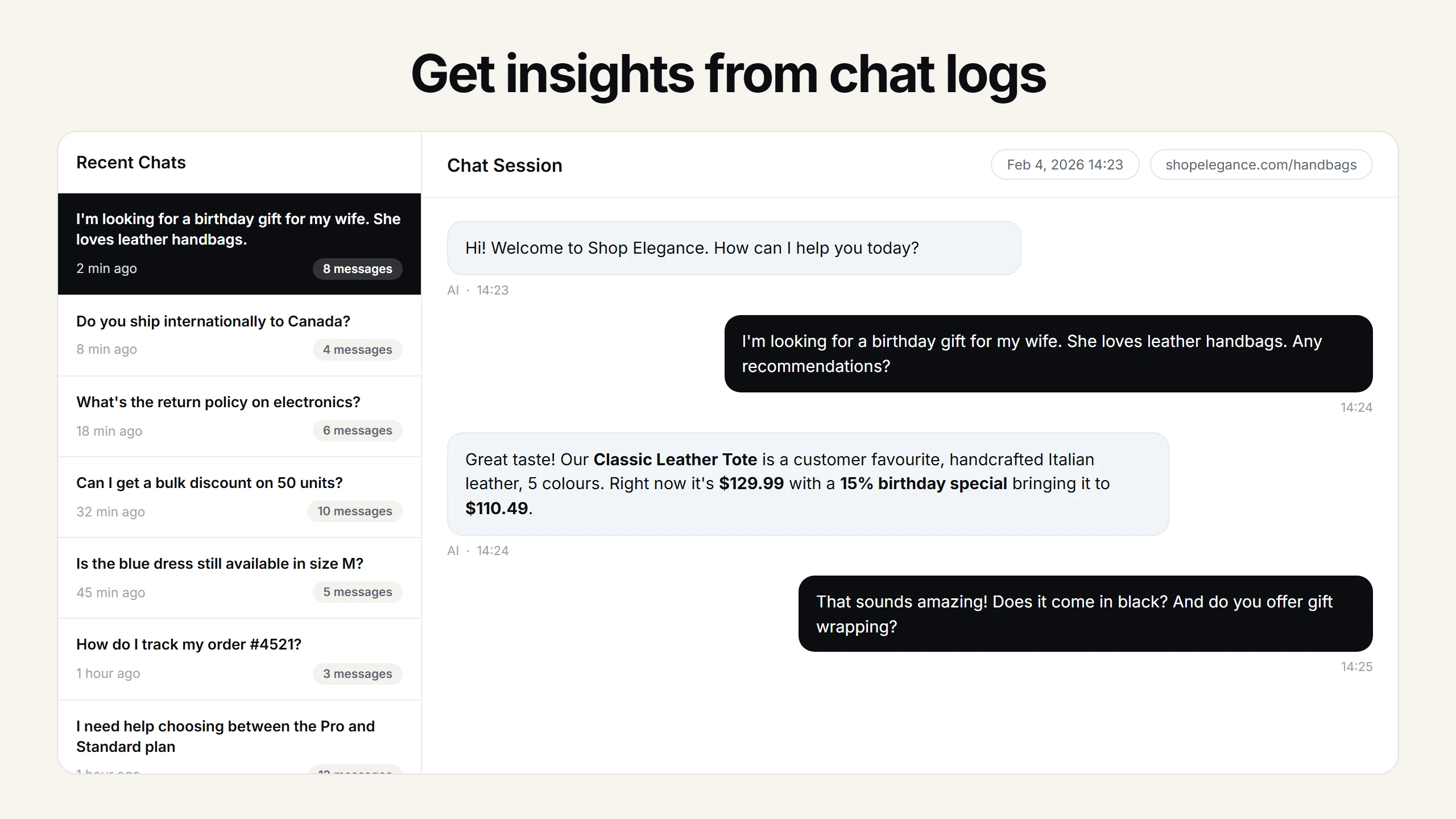
See how the AI handles real employee questions
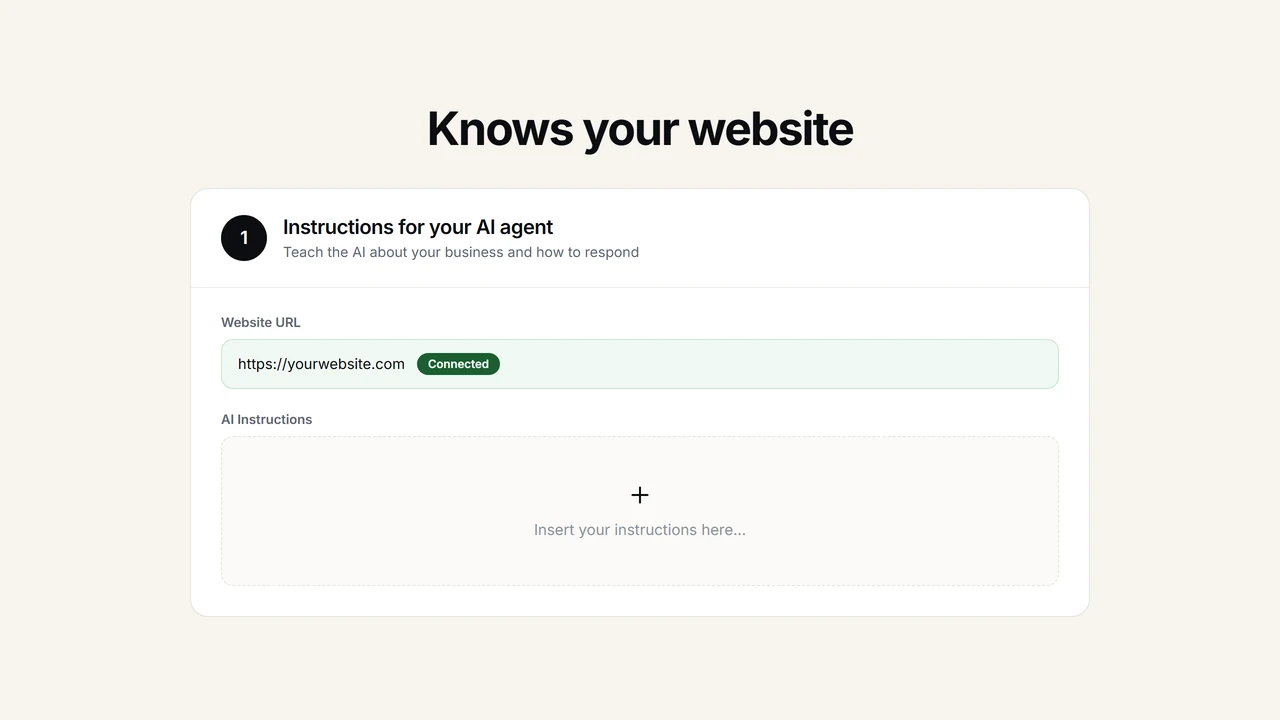
Paste your company intranet or internal portal URL below. The AI reads your pages — policies, procedures, handbooks, IT guides — and builds a working chatbot in seconds.
Your HR and IT teams answer the same twenty questions every single day
Every company has a knowledge problem hiding in plain sight. Policies exist in SharePoint folders nobody bookmarks. The employee handbook was updated six months ago but nobody read the email. IT procedures are scattered across wiki pages, PDF guides, and tribal knowledge locked in senior employees' heads. The result is predictable: employees spend an average of nearly two hours per week searching for internal information, and when they cannot find it, they default to the path of least resistance — they ask someone. That someone is usually HR, IT, or their manager, all of whom are already overloaded. An AI chatbot deployed on your intranet or internal portal intercepts those repetitive questions, answers them accurately using your own company documents, and lets your HR and IT teams focus on work that requires human judgment. It runs on every plan — Free gives you 50 messages per month to test it, Starter at $39/month handles 800 messages, Standard at $139/month covers 15,000 messages across 3 sites, and Pro at $449/month scales to 50,000 messages and 20 sites for large organizations.
- Answers HR policy questions instantlyThe AI reads your employee handbook, HR policies, and benefits documentation and answers questions in natural conversation. "How many PTO days do I get after three years?" gets an accurate answer pulled directly from your own policy documents, not a generic response. PTO rules, remote work policies, dress codes, parental leave, expense reimbursement — the chatbot handles the questions your HR team answers dozens of times per week.
- Handles IT support requests and common troubleshootingPassword reset procedures, VPN setup instructions, software access requests, printer configuration — your IT help desk fields the same issues on repeat. The chatbot walks employees through documented solutions step by step, pulling from your IT knowledge base. When the issue requires hands-on support, it captures the details and directs the employee to the right channel, reducing the volume of basic tickets your IT team handles.
- Guides new hires through onboardingThe first two weeks at a new job are overwhelming. New employees need to find tax forms, set up direct deposit, enroll in benefits, configure their laptop, learn the org chart, and absorb dozens of policies — and they do not know where any of it lives. The chatbot becomes their always-available guide, answering onboarding questions at any hour without requiring a buddy or HR coordinator to stop what they are doing.
Connect your HRIS, ticketing system, and internal tools for real-time employee lookups
Answering general policy questions from your knowledge base covers a large share of employee inquiries. But some questions need live data — "How many PTO days do I have left?" or "What is the status of my IT ticket?" With Custom Tools, available on Standard ($139/month) and Pro ($449/month) plans, the AI chatbot calls your internal systems' APIs during a conversation, retrieves the employee's actual data, and responds with specifics. The employee gets their answer without submitting a ticket or waiting for a reply; your HR and IT teams handle one fewer request.
- PTO balance and leave request statusConnect your HRIS and the chatbot can tell an employee their exact remaining PTO days, sick leave balance, and the status of any pending time-off requests. They ask in the chat, verify their identity, and get an answer in seconds instead of navigating a clunky HRIS portal or emailing HR and waiting hours for a reply.
- IT ticket creation and status trackingWhen an employee has an IT issue the chatbot cannot solve from documentation alone, it creates a ticket in your helpdesk system — capturing the problem description, urgency, and relevant details. Employees can also check the status of existing tickets through the chat. "Where is my laptop replacement request?" gets a real answer, not "please check the portal."
- Benefits enrollment and coverage detailsDuring open enrollment and throughout the year, employees have questions about their specific coverage — deductibles, copays, in-network providers, dependent eligibility. A Custom Tool connected to your benefits platform lets the chatbot pull that employee's actual plan details, not just generic plan descriptions.
- Payroll and compensation inquiriesPay stub questions, tax withholding details, direct deposit confirmation, bonus payout timelines — payroll inquiries arrive constantly and each one requires HR to look up individual records. A connected chatbot handles the lookup during the conversation, giving the employee their specific information while keeping HR out of the loop entirely.
- Facility and resource bookingConference room availability, parking spot reservations, equipment checkout, visitor registration — operational questions that seem small individually but add up to significant administrative overhead. Custom Tools connected to your facility management or booking system let employees handle these tasks conversationally, without learning yet another internal portal.
Get the chatbot live on your company intranet or internal portal
No IT overhaul required. Add your internal site URL, let the AI read your content, and paste one script tag on your portal. Twenty minutes from signup to a working internal chatbot.
- Sign up at asyntai.com/pricing — Free gives you 50 messages to test. Starter ($39/month) handles 800 messages. Standard ($139/month) and Pro ($449/month) add Custom Tools for live HRIS and IT system lookups.
- Add your intranet or internal portal URL. The AI reads your pages — HR policies, IT procedures, benefits guides, onboarding checklists, org charts — and builds a knowledge base automatically. Up to 50 pages crawled.
- Upload supplementary documents — the full employee handbook, IT troubleshooting guides, benefits plan summaries, safety procedures — to fill in details not on your internal web pages.
- Copy the embed script from your dashboard and add it to your intranet or internal portal. Works on SharePoint, Confluence, WordPress-based intranets, and any platform that supports a script tag. The chatbot appears on your portal immediately.
<script src="https://asyntai.com/widget.js"
data-id="your-site-id" async>
</script>
# One line of code. Answers employee questions 24/7.
Chatbot for employee engagement — FAQs
Common questions from HR leaders, IT managers, and operations teams evaluating AI chatbots for internal use.
Is our internal data secure if we use an external AI chatbot?
Yes. All data is encrypted in transit and at rest. The chatbot reads your internal content to build a knowledge base, and that content is stored securely and accessible only through your authenticated Asyntai dashboard. Conversation transcripts are stored with the same encryption. You can export and delete data at any time. For organizations with strict data residency or compliance requirements, review the security page for full details on data handling practices. The chatbot does not share your content across organizations or use it to improve models — your knowledge base is yours alone.
Can we deploy this on our intranet behind a corporate firewall?
The chatbot is embedded via a script tag, so it works on any web-based internal portal that allows external scripts — SharePoint Online, Confluence Cloud, WordPress-based intranets, and custom-built portals. For fully air-gapped intranets with no external network access, the script tag approach requires a network exception for the Asyntai domain. Most organizations with modern intranets (cloud-hosted or hybrid) can deploy without infrastructure changes. The embed takes one line of code and appears on the page immediately.
How does the chatbot handle sensitive HR questions like harassment or complaints?
You control this through custom instructions. You can configure the chatbot to recognize sensitive topics — harassment, discrimination, whistleblowing, grievances — and respond with the appropriate escalation path rather than attempting to answer. For example: "For concerns about workplace harassment, please contact the Employee Relations team directly at [email protected] or call the anonymous reporting hotline at 1-800-XXX-XXXX." The chatbot provides the resource and steps away. You decide which topics the AI handles and which it routes to a human.
We have employees in multiple countries who speak different languages. Does this work for a global workforce?
Yes — 36 languages with automatic detection. An employee in your Tokyo office types in Japanese and the chatbot responds in Japanese, pulling answers from your English-language policy documents. An employee in your Berlin office types in German and gets answers in German. No translated knowledge base required. No separate chatbot configuration per region. This is particularly valuable for multinational organizations where HR policies are written in headquarters language but the workforce speaks a dozen others.
Can the chatbot connect to our HRIS and IT ticketing system?
If your systems expose API endpoints — for PTO balances, ticket status, benefits details, or employee records — you can connect them as Custom Tools. The AI calls those endpoints during a conversation when an employee asks a relevant question. This is available on the Standard plan ($139/month) and Pro plan ($449/month). Common integrations include HRIS platforms for leave balances, IT service desks for ticket creation and status, and benefits platforms for enrollment details. If the system has a REST API, it works with Custom Tools.
Who manages the chatbot content? Does HR need to be technical?
No technical skills required. The chatbot reads your existing internal pages and uploaded documents — the same content your HR and IT teams already maintain. When policies change, update the source document and re-crawl the site from your dashboard. Custom instructions are written in plain English: "If someone asks about the new parental leave policy, explain that it changed effective January 1 and now offers 16 weeks paid leave." No coding, no prompt engineering, no AI expertise needed. Whoever maintains your employee handbook can manage the chatbot.
How does this help with compliance and consistent policy communication?
The chatbot answers every employee's question using the same source documents — your approved, current policies. Unlike a human who might paraphrase a policy from memory or share outdated information, the AI pulls directly from what you have published. This consistency matters for compliance-sensitive topics like FMLA eligibility, ADA accommodations, and harassment reporting procedures. You can add mandatory disclaimers through custom instructions — "Always include: This information is based on current company policy. For legal or compliance-specific guidance, contact the Legal department." — and the chatbot includes them every time, without exception.
Can we use this for multiple departments or office locations?
Yes. The Starter plan covers 2 sites, Standard covers 3, and Pro covers 20 — each with its own knowledge base and custom instructions. A large organization might deploy separate chatbots for HR, IT, and Facilities — each reading its own documentation and handling its own domain of questions. Or deploy separate instances for different office locations with location-specific policies. Every site gets its own content, its own instructions, and its own conversation history.
What if we need more than 50,000 messages or 20 sites?
The Custom Pro plan scales beyond standard Pro limits. If your organization has hundreds of thousands of employees or needs chatbots across dozens of internal portals, Custom Pro provides tailored message volumes, additional sites, and dedicated support. Contact us through the Custom Pro page to discuss your requirements.
Chatbot for employee engagement: why the company that invests in answers keeps the people who ask the questions
Every organization has a phrase that sounds helpful but functions as a dead end: "Check the handbook." It is the default answer to nearly every employee question — what is the PTO policy, how do I submit an expense report, where is the dress code documented, what happens if I need FMLA leave. The advice is technically correct. The handbook does contain the answer. But the handbook is also a 147-page PDF that was last reorganized in 2019, lives in a SharePoint folder three clicks deep, and uses section numbering that makes sense only to the person who wrote it. So the employee does what every employee does: they ask someone. They Slack their manager. They email HR. They tap the colleague who has been at the company the longest. The question gets answered, eventually, but it consumed the time of at least two people and the answer may or may not reflect the most current policy. Multiply this by every employee, every question, every day, across every department, and you begin to see the shape of a problem that most organizations have normalized but never solved.
HR departments did not set out to become help desks. The professionals who chose careers in human resources did so to work on talent strategy, organizational development, employee relations, and culture building. Instead, they spend a staggering percentage of their time answering questions that have clear, documented answers — questions that could be resolved by reading section 4.2.1 of the employee handbook, if anyone knew that section 4.2.1 existed or could find it in under ten minutes. The irony is sharp: the more thoroughly an HR team documents its policies, the more documents there are for employees to lose track of, and the more questions HR receives about where to find the information they already published. An AI chatbot breaks this cycle by sitting on top of all that documentation and making it conversationally accessible. The employee asks a question in plain language, the chatbot finds the answer in the policy documents, and the HR professional's morning is no longer consumed by explaining the bereavement leave policy for the fourth time this week.
New hire onboarding is where information fragmentation hits hardest. A person joins your company and is immediately expected to navigate systems they have never seen, follow processes nobody has explained, and locate documents they do not know exist. The onboarding checklist says "enroll in benefits by Day 5" but does not explain how. The IT setup guide references a portal that has been renamed since the guide was written. The manager says "just ask Sarah, she knows everything" — but Sarah is on vacation. New hires are reluctant to ask too many questions because they do not want to seem unprepared, so they muddle through, miss deadlines, and start their tenure feeling overwhelmed rather than supported. A chatbot on the company intranet gives new employees a private, judgment-free resource. They can ask "how do I set up direct deposit?" at 9 PM without worrying that they should already know the answer. The chatbot pulls the current procedure from the HR documentation and walks them through it step by step. No awkward emails, no waiting for someone to be available, no feeling like a burden.
There is a pattern in HR and IT request volumes that most teams recognize but few have quantified: the 3 PM Friday surge. Employees who have been meaning to ask a question all week — about their benefits, about a policy they are unsure of, about a reimbursement they need to submit — finally get to it when their task list clears on Friday afternoon. But by 3 PM on Friday, the HR team is wrapping up their own week, and the IT help desk is already triaging the tickets that arrived on Thursday. The employee sends an email or submits a ticket and waits until Monday for a response. This delay is not just inconvenient — it creates anxiety. An employee who is unsure whether their insurance covers a medical procedure they have scheduled for Tuesday cannot wait until Monday for confirmation. A chatbot answers that question in thirty seconds, using the benefits documentation the company has already created. The Friday surge becomes a non-event because the chatbot absorbs it without staffing implications.
Remote and hybrid workforces have amplified the employee knowledge problem by an order of magnitude. When everyone sat in the same office, an employee with a question could lean over a cubicle wall and get an answer. The physical proximity of coworkers functioned as an informal knowledge base — not efficient, not scalable, but functional. Remote work removed that safety net. Now the employee with a question types it into Slack, hopes someone in the right channel sees it, and waits. Sometimes the answer arrives quickly. Sometimes it arrives hours later. Sometimes it never arrives because the question scrolled past everyone's attention. In a distributed workforce, every question that does not get a timely answer is a small erosion of engagement. The employee feels disconnected, unsupported, and uncertain. An AI chatbot provides the always-available, instant-answer layer that office proximity used to deliver — except it works for employees in every time zone, not just the ones who happen to sit near the right people.
Multilingual workforces present a challenge that most internal communication strategies quietly ignore. A manufacturing company with plants in three countries publishes its safety procedures in English. A technology company with engineering teams in four countries writes its HR policies in headquarters language. The assumption is that employees will either read the documents in the published language or that local managers will translate the important parts informally. Neither assumption holds well. An AI chatbot that supports 36 languages with automatic detection changes this dynamic fundamentally. A warehouse worker in Mexico types a question in Spanish about the injury reporting procedure, and the chatbot responds in Spanish using the English-language safety manual. A developer in Seoul asks about the remote work policy in Korean and gets an accurate answer. No translated documents required, no bilingual intermediary needed. The policy is communicated with the same accuracy regardless of the employee's language, which is not just convenient — for safety-critical policies, it is a liability reducer.
IT help desk deflection is one of the most immediately measurable benefits of deploying an internal chatbot. Tier-1 IT tickets — password resets, VPN configuration, software access requests, printer setup, email signature formatting — follow documented procedures. The help desk has knowledge base articles for all of them. But employees do not search the knowledge base; they submit a ticket. The ticket enters a queue, gets assigned to a technician, and gets resolved with information the employee could have found themselves if the search experience were better. A chatbot replaces that clunky search experience with a conversation. "How do I connect to the VPN?" gets a step-by-step walkthrough pulled from the IT knowledge base. "My Outlook is not syncing" gets the standard troubleshooting sequence. The technician's time is preserved for issues that actually require diagnosis, and the employee gets their answer in seconds instead of hours. Organizations that track ticket deflection rates after deploying a chatbot consistently see 30-50% reductions in Tier-1 volume.
Policy updates and organizational changes reveal a communication gap that email cannot fill. When a company changes its remote work policy, HR sends an email. Half the company skims it. A quarter reads the subject line and archives it. The rest never open it. Three weeks later, employees are still operating under the old policy and asking their managers for clarification. The manager — who also skimmed the email — provides an approximation of the new policy that may or may not be accurate. A chatbot solves this differently. When the policy changes, you update the source document and re-crawl. From that moment forward, every employee who asks about the remote work policy gets the current version. There is no email to miss, no manager to misinterpret, no outdated PDF circulating in a Teams channel. The chatbot is always current because it reads the current documents, and employees trust it because it gives them the same answer their colleague got yesterday.
The manager bottleneck is a problem that organizations create with good intentions. Companies tell employees to go to their manager with questions. Managers are supposed to be the first line of support — the accessible, approachable bridge between the employee and the organization. In practice, this means managers spend a significant portion of their week answering questions that have nothing to do with managing: Where do I find the expense report template? What is the process for requesting ergonomic equipment? Can I carry over unused PTO? How do I add a dependent to my health insurance? These are not management questions. They are information retrieval questions dressed up as management moments. Every one of them interrupts the manager's actual work — coaching, prioritizing, removing blockers, making decisions — without adding value that a well-organized knowledge base could not deliver. The chatbot removes the manager from the information-retrieval loop without removing them from the support equation. The manager stays available for the conversations that matter — career development, performance feedback, conflict resolution — while the chatbot handles the questions that have documented answers.
Seasonal surges hit HR teams with predictable ferocity. Open enrollment floods them with benefits questions for four to six weeks every fall. Tax season brings W-2 inquiries and withholding adjustment requests in January. Annual review cycles generate a wave of questions about the performance evaluation process, rating scales, and compensation timelines. Each surge is predictable, each surge overwhelms the same team, and each surge subsides just in time for the next one to begin. A chatbot absorbs the repetitive layer of every surge. During open enrollment, it answers questions about plan options, enrollment deadlines, coverage differences, and dependent eligibility — using the benefits documentation the company publishes every year. During tax season, it explains how to access W-2s and what each box means. During review cycles, it walks employees through the evaluation form and the timeline. The HR team handles the complex cases — the employee whose life event requires a mid-year enrollment change, the manager who needs help writing a performance improvement plan — while the chatbot handles the hundred employees who just need to know when the enrollment window closes.
Employee satisfaction surveys consistently identify two factors that drive engagement more than almost anything else: feeling informed and feeling that their time is respected. An employee who spends twenty minutes searching for a PTO policy, gives up, emails HR, waits four hours for a reply, and then discovers the policy was in a document they had bookmarked but never read — that employee has had their time disrespected in a way that no pizza party or motivational poster will fix. A chatbot that answers the question in fifteen seconds sends a different message: this organization has invested in making your work life easier. The answer exists, it is accurate, and you can get it whenever you need it without depending on another person's availability. This is not a flashy engagement initiative. It is infrastructure. But it is the kind of infrastructure that employees notice every single day, and its absence is the kind of friction that silently pushes good people toward companies that have figured it out.
The distinction between a chatbot and an internal knowledge base search is worth understanding, because most organizations have tried the search approach and found it wanting. A search bar on the intranet returns a list of documents ranked by keyword relevance. The employee types "PTO policy," gets eight results, clicks the first one, finds a 40-page handbook open to page one, and has to scroll through sections on attendance, sick leave, and jury duty before finding the paragraph about PTO accrual rates. A chatbot skips all of that. The employee types "How many PTO days do I get after two years?" and the chatbot responds with the specific answer: "After two years of employment, you accrue 18 PTO days per year, accruing at 1.5 days per month." The information is the same — it came from the same handbook — but the delivery is fundamentally different. Search gives you documents. A chatbot gives you answers. For employees who are busy, frustrated, or unfamiliar with the company's document structure, that difference determines whether they find what they need or give up and interrupt someone.
Company culture is often discussed in abstract terms — values, mission, belonging — but it is built in concrete moments. The moment a new hire asks a question and gets an instant, accurate answer instead of being told to "check the wiki." The moment a remote employee in a different time zone gets help at 2 AM their time without waiting for headquarters to wake up. The moment a non-English-speaking employee gets a policy explained in their own language for the first time. These moments are small individually, but they accumulate into an experience of the organization that either feels supportive or indifferent. A chatbot does not create culture, but it removes the friction that corrodes it. Every unanswered question, every lost document, every "I will get back to you on that" that turns into three days of silence — these are culture failures masquerading as operational inefficiencies. Fixing the operational layer fixes the cultural symptom.
The ROI of an internal AI chatbot is unusually straightforward to calculate because the costs it displaces are tangible. An HR generalist's time has a dollar value. An IT technician's time has a dollar value. Every Tier-1 ticket resolved by the chatbot instead of a human has a measurable cost savings. If your HR team spends an average of five minutes per routine inquiry and handles forty such inquiries per day, that is over three hours of professional time consumed daily by questions with documented answers. At $35-50/hour loaded cost, that is over $2,500/month in HR time alone — before counting IT support time, manager interruption costs, and the productivity lost by the employee who was waiting for an answer. The Starter plan at $39/month pays for itself if it handles two questions per day that would have otherwise required staff time. Standard at $139/month breaks even at roughly six. The math is not close.
Ready to give your employees instant answers and your HR team their time back? Start with the free plan — 50 messages, no credit card — and see how the AI handles your company's real questions. Or go straight to Standard for Custom Tools and live HRIS lookups.