Chat widget for ecommerce: turn browsing shoppers into buyers with instant AI answers
An AI chat widget that sits on your online store, reads your product pages and policies, and answers shopper questions about sizing, shipping, returns, and availability — around the clock, in 36 languages.
See how the AI answers real shopper questions on your store
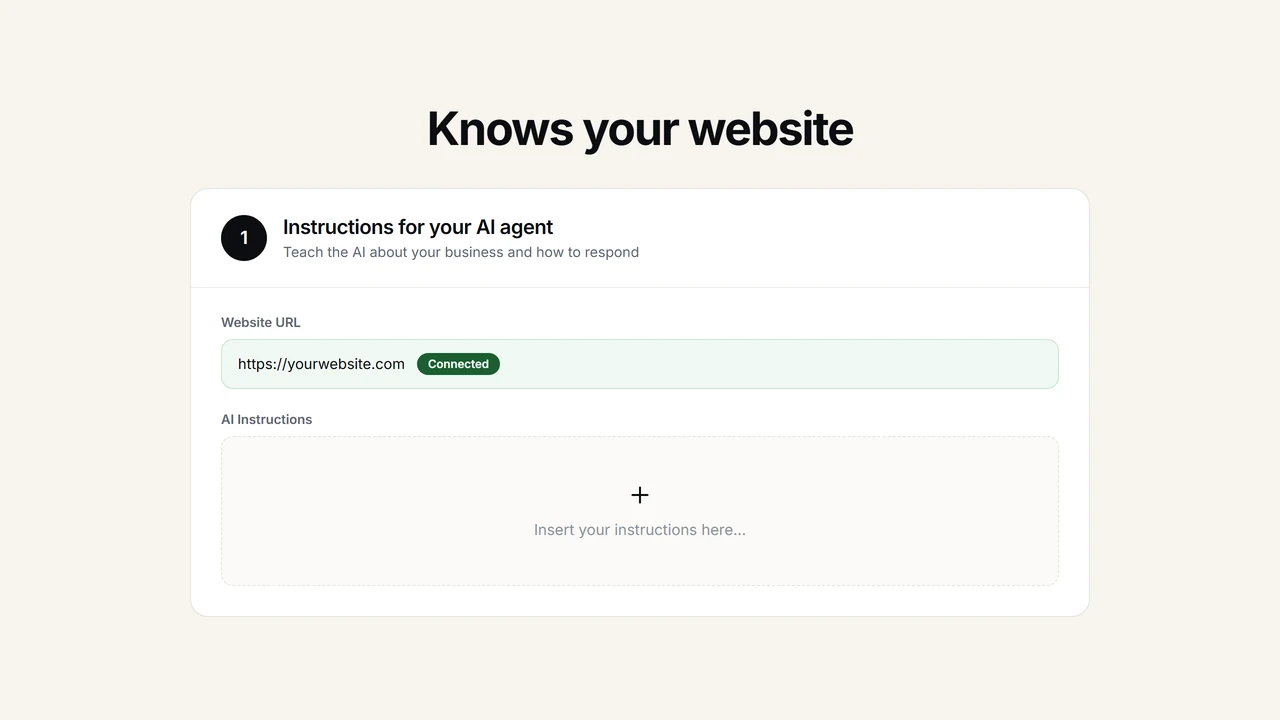
Paste your online store URL below. The AI reads your product pages, shipping policies, and return information — then answers the way your best sales associate would.
Shoppers leave your store because their questions go unanswered
Every ecommerce store loses sales to unanswered questions. A shopper finds a jacket they like but wants to know if it runs large before ordering. They check the product page — no sizing guidance beyond S/M/L/XL. They scroll down looking for a size chart — nothing. They look for a live chat button — the store has one, but it says "We are currently offline. Leave a message." The shopper leaves. They do not leave a message. They do not come back. This happens dozens of times a day on stores of every size, across every product category. The information often exists somewhere — in a returns policy buried in the footer, in a shipping FAQ three clicks deep, in a product description the shopper did not read carefully enough. But shoppers do not dig. They expect instant answers, and if the store cannot provide them, the next store is one tab away. An AI chat widget deployed on your ecommerce site reads your product pages, shipping policies, return rules, and FAQ content — then answers shopper questions instantly, 24 hours a day, in whatever language the shopper speaks. The question gets answered. The shopper stays. The sale happens.
- Product questions answered from your own catalog pagesA shopper at 11 PM wondering whether a coffee table comes in walnut finish asks the chat widget instead of hunting through your entire furniture collection. The AI reads your product descriptions, specifications, and material details, then responds with the exact options available — finishes, dimensions, weight capacity — the same way a knowledgeable sales associate would on the showroom floor.
- Shipping and return policies delivered in seconds, not clicksMost ecommerce stores bury their shipping rates and return windows in policy pages that shoppers rarely find on their own. The chat widget pulls this information from your published policies and delivers it mid-conversation: "Free shipping on orders over $75, standard delivery 3-5 business days, 30-day returns with free return label." The shopper never leaves the product page.
- Browsing visitors become leads even when they do not buyNot every visitor is ready to purchase today. But a shopper who engages with the chat widget — asking about a product, checking availability, inquiring about an upcoming sale — is a warm lead. The chat widget captures their question and contact details, giving your team a follow-up opportunity that would have been lost if the visitor had simply bounced.
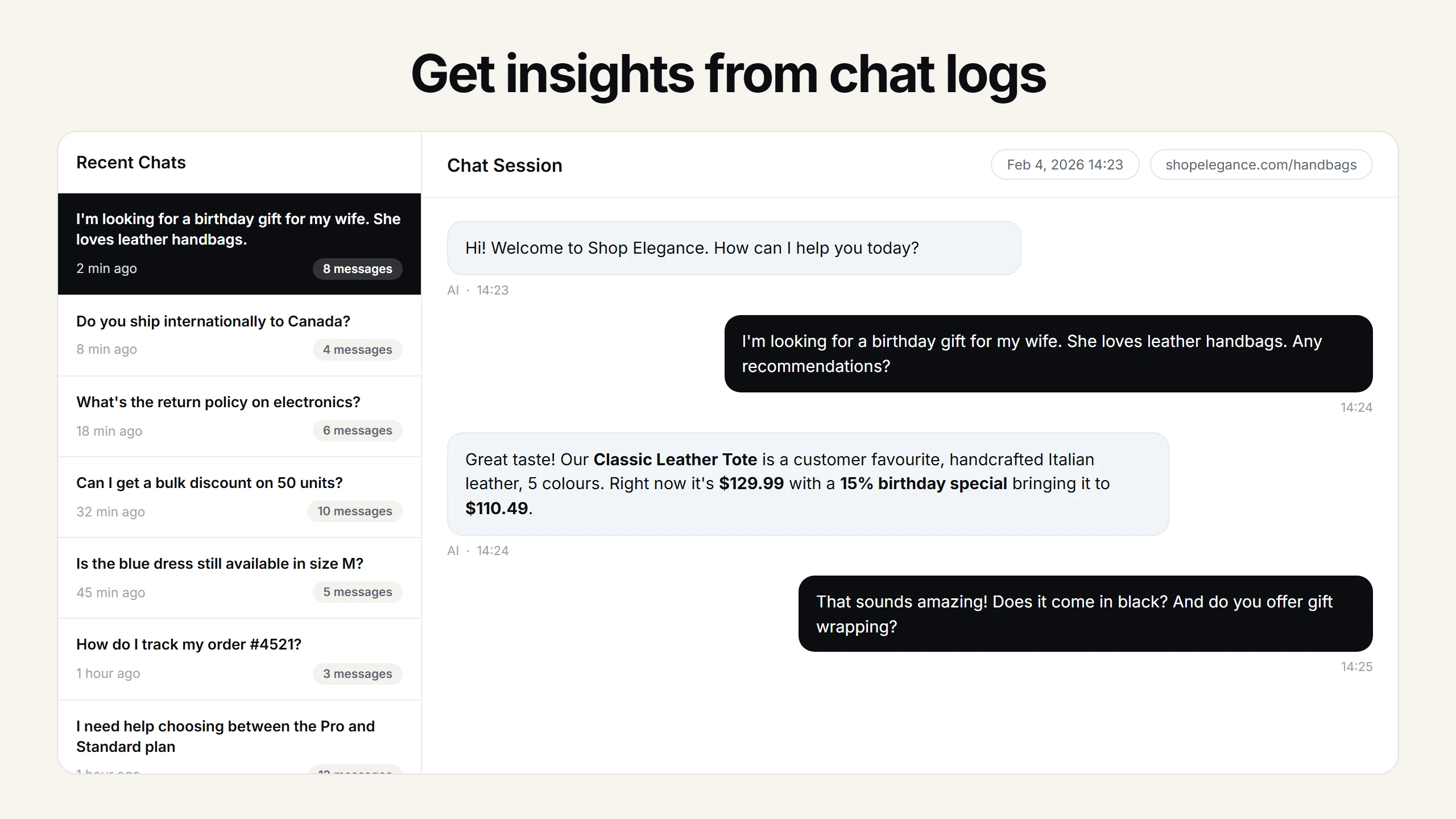
Connect your order system and let the chat widget pull live data for each shopper
The chat widget answers from your store content out of the box — product pages, shipping policies, FAQ sections. But some shopper questions need real-time data: "Where is my order?" "Has my return been processed?" "Is this item back in stock?" Custom Tools — available on Standard ($139/month) and Pro ($449/month) plans — let the AI chat widget query your order management system, inventory database, or any REST API during a conversation.
- Order tracking without a support ticketConnect a Custom Tool to your order management or fulfillment system. When a returning customer asks "where is my order?", the AI looks up the order by email or order number and responds with the current status, carrier, tracking number, and estimated delivery date — no email to support, no wait for a reply.
- Return and refund status in real timeA customer who initiated a return two days ago wants to know if the refund has been processed. Instead of emailing support and waiting 24 hours, they ask the chat widget. The AI queries your returns system and confirms whether the item has been received, the refund amount, and the expected processing time.
- Live inventory and restock notificationsWhen a shopper asks about an out-of-stock item, the AI can check your inventory system for the expected restock date and relay that information. If your system supports it, the chat widget can capture the shopper's email to notify them when the item is available again — turning a lost sale into a future one.
- Personalized product recommendationsFor stores with a recommendation engine or product catalog API, the AI can suggest related items during a conversation. A shopper looking at running shoes who asks "do you have something similar with more arch support?" gets pointed to specific products in your catalog, not a generic category page.
- 36 languages with automatic detectionInternational shoppers browsing your store get answers in their own language — Spanish, German, Japanese, Arabic, and 32 more. The AI detects the shopper's language automatically and responds in kind. Your store content does not need to be translated. The AI reads your English-language product pages and delivers the answer in the shopper's preferred language.
Get the AI chat widget running on your store
No developer required. Sign up, point the AI at your store, and paste one line of code. Works on every major ecommerce platform.
- Pick a plan at asyntai.com/pricing — the Free tier gives you 1 site and 50 messages to test with real shopper traffic. Starter ($39/month) handles 800 messages for a growing store.
- Add your store URL in the dashboard. The AI crawls up to 50 pages — product listings, category pages, shipping policies, return policies, FAQ sections — and builds its knowledge base automatically.
- Customize the chat widget to match your store's branding. Set your colors, logo, and greeting message. Add any supplementary content — size guides, care instructions, warranty information — as uploaded files to expand the AI's knowledge beyond what your public pages cover.
- Copy the single-line embed script and paste it into your store's theme or template. Works on Shopify, WooCommerce, Magento, BigCommerce, PrestaShop, OpenCart, and any platform that supports custom HTML. The widget goes live immediately.
<script src="https://asyntai.com/widget.js"
data-id="your-site-id" async>
</script>
# One script. Answers shopper questions 24/7.
# Works on any ecommerce platform.
Chat widget for ecommerce — FAQs
Common questions from store owners evaluating an AI chat widget for their ecommerce site.
What kind of shopper questions can the AI answer?
Anything covered in the content on your store. If your product pages include material specifications, the AI can tell a shopper that the dining table is solid oak with a matte lacquer finish. If your shipping policy states free delivery over $75 with 3-5 business day standard shipping, the AI relays that. If your returns page describes a 30-day return window with free return labels, the AI explains the process step by step. It reads your existing store content and uses it to answer — it does not make up product details that are not there. You can also upload supplementary documents like size guides, care instructions, or warranty terms to expand what the chatbot knows.
Does it work with my ecommerce platform?
Yes. The chat widget installs via a JavaScript snippet that you paste into your store's theme or template. It works on Shopify, WooCommerce, Magento, BigCommerce, PrestaShop, OpenCart, Squarespace, Wix, and any other platform that supports custom HTML or JavaScript. There is no platform-specific plugin to install or maintain — the embed code is identical regardless of which platform you use. If your store lets you add a script tag, the chat widget will work on it.
Can the chat widget handle order tracking and return requests?
Yes, with Custom Tools on Standard ($139/month) and Pro ($449/month) plans. You connect your order management system, fulfillment provider, or any REST API, and the AI queries it during conversations. A customer asks "where is my order?" and gets the tracking number, carrier, and estimated delivery date pulled from your system in real time. Without Custom Tools, the chatbot still answers from your published content — shipping timelines, return policies, and general process information — which handles the majority of pre-purchase and policy questions.
Will it try to sell products or just answer questions?
The AI answers the shopper's question using your store content. It does not push products aggressively or fabricate sales pitches. But it naturally guides shoppers toward purchases by removing friction — answering the sizing question that was preventing the shopper from clicking "add to cart," confirming the return policy that was making them hesitate, or clarifying that shipping to their country is available. You can also add custom instructions like "when a shopper asks about running shoes, mention that we offer free exchanges on first orders" to shape the conversation without making the chatbot feel like a hard sell.
How does it handle questions in other languages?
The AI supports 36 languages and detects the shopper's language automatically. A German-speaking visitor browsing your English-language store gets answers in German. A Japanese shopper asking about sizing gets the response in Japanese. Your store content does not need to be translated — the AI reads your English product pages and delivers the answer in the shopper's language. This is included on every plan at no extra cost.
What does it cost, and can I try it before committing?
The Free tier gives you 1 site and 50 messages per month — enough to test with real shopper traffic and see how the AI handles questions on your store. Starter is $39/month with 800 messages and 2 sites. Standard is $139/month with 15,000 messages, 3 sites, and Custom Tools for order system integrations. Pro is $449/month with 50,000 messages, 20 sites, Custom Tools, and white-label branding. All plans are month-to-month with no contracts. Upgrade, downgrade, or cancel at any time.
How quickly can I get the chat widget running on my store?
Most store owners have the chat widget live within 10 minutes. You sign up, add your store URL (the AI crawls and reads the content automatically), customize the widget appearance, and paste the embed script into your store theme. No developer is needed for any step. On Shopify you paste it into theme.liquid, on WooCommerce you add it to your theme's header or use a header script plugin, and on most other platforms there is a designated spot for custom scripts in the settings panel. The chat widget starts answering shopper questions immediately after deployment.
Will the chat widget slow down my store?
No. The script loads asynchronously, which means it does not block your page from rendering. Your product images, descriptions, and checkout flow load at the same speed whether or not the chat widget is installed. The widget itself is lightweight — a single JavaScript file with no dependencies — and it loads after your page content is already visible to the shopper.
Can I control what the AI says about certain products or topics?
Yes. You write custom instructions in plain English that the AI follows in every conversation. Examples: "If a shopper asks about wholesale pricing, direct them to our wholesale inquiry form." "When discussing our premium leather bags, always mention the lifetime warranty." "Do not discuss competitor products." "If a customer is unhappy with an order, apologize and direct them to [email protected]." These rules apply consistently to every conversation, at every hour, in every language.
Chat widget for ecommerce: the sales associate that never clocks out
Retail stores have always understood that an available, knowledgeable salesperson is the difference between a browser and a buyer. The shopper who walks into a clothing store and cannot find anyone to ask "does this come in a size 10?" walks out without purchasing. The customer examining a set of kitchen knives who wants to know whether they are dishwasher safe puts the box back on the shelf if nobody is around to answer. Physical retail solved this problem centuries ago: you hire people, you put them on the floor, and they answer questions. Ecommerce stores have the same problem — shoppers with questions that will determine whether they buy or leave — but most have no equivalent of the salesperson standing next to the rack. The product page is the rack. The chat widget is the salesperson.
The asymmetry between what a store knows and what a shopper can find is the root of most abandoned purchases. Store owners spend hours writing detailed product descriptions, comprehensive shipping policies, meticulous return procedures, and thorough FAQ pages. All of that information exists. But the shopper does not read your FAQ page. They barely read the product description past the first two lines. When a question arises — "Is this jacket waterproof or just water-resistant?" "Do you ship to Canada?" "What if the shoes do not fit?" — they want an immediate answer from someone, not a scavenger hunt through your site footer. If the answer requires more than one click, a percentage of those shoppers will leave. The chat widget eliminates that friction by reading all of your store content — product pages, policies, FAQs, size guides — and delivering the answer conversationally, on the same page the shopper is already viewing.
Pre-purchase questions are where the chat widget has the most direct impact on revenue. These are the questions that stand between a shopper and their credit card: "Will this arrive before Saturday?" "Is the medium more like a US 8 or a 10?" "Can I return this if the color does not match my existing furniture?" "Does this laptop come with a warranty?" These are not complaints. They are not support requests. They are buying signals — the shopper is interested enough to ask, which means they are interested enough to buy if the answer satisfies them. Every one of these questions that goes unanswered is revenue that walked out the door. The chat widget catches these questions at the moment of maximum purchase intent and answers them using the information the store has already published.
The after-hours problem is especially acute for ecommerce. Unlike a physical store with posted hours, an online store is open around the clock. Shoppers browse at 6 AM before work, during their lunch break, at 10 PM on the couch, and at 1 AM when they cannot sleep. If your live chat is staffed 9-to-5, you are unavailable for the majority of the hours when people are actually shopping on your site. An AI chat widget does not have a shift schedule. The shopper at midnight asking "is this espresso machine compatible with Nespresso pods?" gets the same accurate, instant answer as the shopper at noon. The information is pulled from your product page — the widget reads it and delivers the relevant detail. No staffing costs, no timezone juggling, no "we'll get back to you during business hours" messages that guarantee the shopper will buy from a store that answers right now.
International ecommerce adds another layer of complexity that the chat widget handles by default. A store based in the United States with customers in Germany, Japan, Brazil, and the Middle East faces language barriers that traditional live chat cannot solve unless you hire multilingual agents. The AI chat widget supports 36 languages and detects each shopper's language automatically. A French-speaking shopper browsing your English-language store asks about shipping to France and gets the answer in French. A Korean shopper asking about fabric composition gets the response in Korean. Your product pages stay in English. The AI reads them and translates the relevant information into whatever language the shopper is using. This is not a premium feature or a paid add-on — it works on every plan, including the Free tier.
Platform fragmentation is a real concern for ecommerce merchants, and it is one of the reasons a platform-agnostic chat widget matters. Some stores run on Shopify. Others use WooCommerce because they started with WordPress and grew into ecommerce. Magento powers larger catalogs with complex product configurations. BigCommerce, PrestaShop, and OpenCart each have their own ecosystems. Some stores run on custom-built platforms. Switching from one to another is expensive and disruptive, so merchants are understandably wary of tools that lock them into a specific platform. The Asyntai chat widget is a single JavaScript snippet that works identically on all of them. If you migrate from WooCommerce to Shopify next year, your chat widget comes with you — same script tag, same knowledge base, same conversation history. There is nothing platform-specific to uninstall and reinstall.
The economics of ecommerce customer support are brutal for growing stores. When you have 50 orders a day, you can handle support emails personally. At 200 orders a day, you need at least one dedicated support person. At 500 orders a day, you need a team, and that team needs training, management, and tools. But the majority of support inquiries at every scale are the same repetitive questions: "Where is my order?" "How do I return this?" "Do you have this in blue?" "What is your warranty policy?" "Do you ship internationally?" These questions have definitive answers that already exist in your store policies and product pages. Routing them to a chat widget that answers instantly — before they become support tickets — reduces the volume that reaches your team. The support staff you do hire spend their time on complex issues that require human judgment: damaged shipments, custom orders, escalated complaints. The widget handles the repetitive questions that would otherwise consume most of their day.
Product discovery is an underappreciated function of a chat widget on an ecommerce store. Shoppers do not always arrive knowing exactly what they want. They might know they need a gift for a 10-year-old who likes science, or a moisturizer for sensitive skin, or a laptop bag that fits a 15-inch MacBook. Your store may have the perfect product, but if the shopper has to browse through 40 category pages to find it, they are likely to give up. The chat widget lets them describe what they are looking for in plain language, and the AI searches your product content for the best match. "I need a waterproof backpack that can hold a laptop and has a water bottle pocket" returns specific products from your catalog with links to the product pages — a conversational search experience that your site's built-in search bar cannot replicate.
Seasonal traffic spikes expose the scalability advantage of an AI chat widget over human-staffed live chat. Black Friday, Cyber Monday, holiday shopping seasons, flash sales, and product launches all drive traffic surges that overwhelm support teams. Hiring temporary staff for a two-week holiday rush is expensive and the quality of answers drops because temporary agents do not know your products as well as your core team. The chat widget handles ten conversations or ten thousand with the same response quality and the same response time. It does not get overwhelmed, it does not need overtime, and it does not give wrong answers because it just started yesterday and has not finished training yet. The AI reads your store content once and answers from it consistently, whether it is a quiet Tuesday afternoon or the biggest shopping day of the year.
Cart abandonment is the single most expensive problem in ecommerce, and unanswered questions are one of its primary drivers. Industry data consistently shows that a significant percentage of shoppers who add items to their cart leave without completing the purchase. While some abandonment is inevitable — price comparison, distraction, not ready to buy yet — a meaningful portion happens because the shopper had a question at checkout that went unanswered. "Wait, how much is shipping?" "Can I use two discount codes?" "What if I need to exchange this for a different size?" These are last-mile questions that occur at the exact moment the shopper is deciding whether to enter their payment information. A chat widget that answers these questions instantly, right there on the checkout page, removes the last objection standing between the shopper and the purchase.
For stores that sell products requiring expertise — supplements, electronics, sporting equipment, skincare — the chat widget fills a knowledge gap that product pages alone cannot bridge. A shopper looking at protein powder wants to know if it is suitable for someone with a dairy allergy. A customer comparing two models of a power drill wants to know which one is better for masonry. A parent buying a bicycle for their child wants to know if the 20-inch wheel size is right for a 7-year-old. These questions require the kind of product knowledge that a specialist sales associate would have — and the answers are usually buried in product specifications, ingredient lists, or compatibility charts that the shopper does not know how to interpret. The chat widget reads all of that technical content and delivers the answer in plain language, tailored to the specific question being asked.
Trust is the invisible currency of ecommerce, and a responsive store earns more of it. When a shopper asks a question and gets an immediate, accurate, helpful answer, their confidence in the store increases. They believe the store is well-run, that someone is paying attention, that if something goes wrong with their order there will be someone to help. This perception matters far more than most store owners realize. A shopper choosing between two stores selling the same product at the same price will buy from the one that felt more responsive and trustworthy. The chat widget creates that impression by being available the moment the shopper has a question, answering from the store's own published content, and handling the conversation professionally in whatever language the shopper prefers.
Custom Tools on the Standard and Pro plans unlock capabilities that turn the chat widget from a pre-purchase assistant into a full post-purchase support channel. Order tracking is the most common integration — connecting your fulfillment system so the chat widget can tell a customer exactly where their package is without generating a support ticket. Return processing is the second — letting the customer initiate a return through the chat widget, get their return label, and understand the refund timeline, all without writing an email. Inventory checks, loyalty point balances, subscription management, and appointment scheduling are all possible through Custom Tools. Each integration connects a REST API endpoint that your systems already expose, and the AI learns when to use it based on the conversation context.
The setup process is designed for store owners, not developers. You do not need to write code, configure a server, or understand APIs to get the basic chat widget running. Sign up, enter your store URL, and the AI crawls up to 50 pages of your site — product listings, category descriptions, policy pages, FAQ sections, about pages. It builds a knowledge base from that content automatically. You customize the widget's appearance to match your store's branding — colors, logo, greeting message — and paste a single line of embed code into your store's theme. On most platforms this takes under ten minutes. The chat widget starts answering shopper questions immediately. You can refine the knowledge base over time by uploading additional documents, adding custom instructions, and connecting Custom Tools as your needs grow.
Ready to stop losing sales to unanswered shopper questions? Start with the Free plan and see how the AI handles your store's inquiries — or go straight to Standard for Custom Tools and order system integration.