A chat bot widget that actually understands what your visitors are asking
Traditional chatbots follow scripts. This one reads your website, understands natural language, and gives visitors real answers — no decision trees to build, no canned responses to maintain, no flowcharts to update.
Watch the chatbot widget answer questions from your website
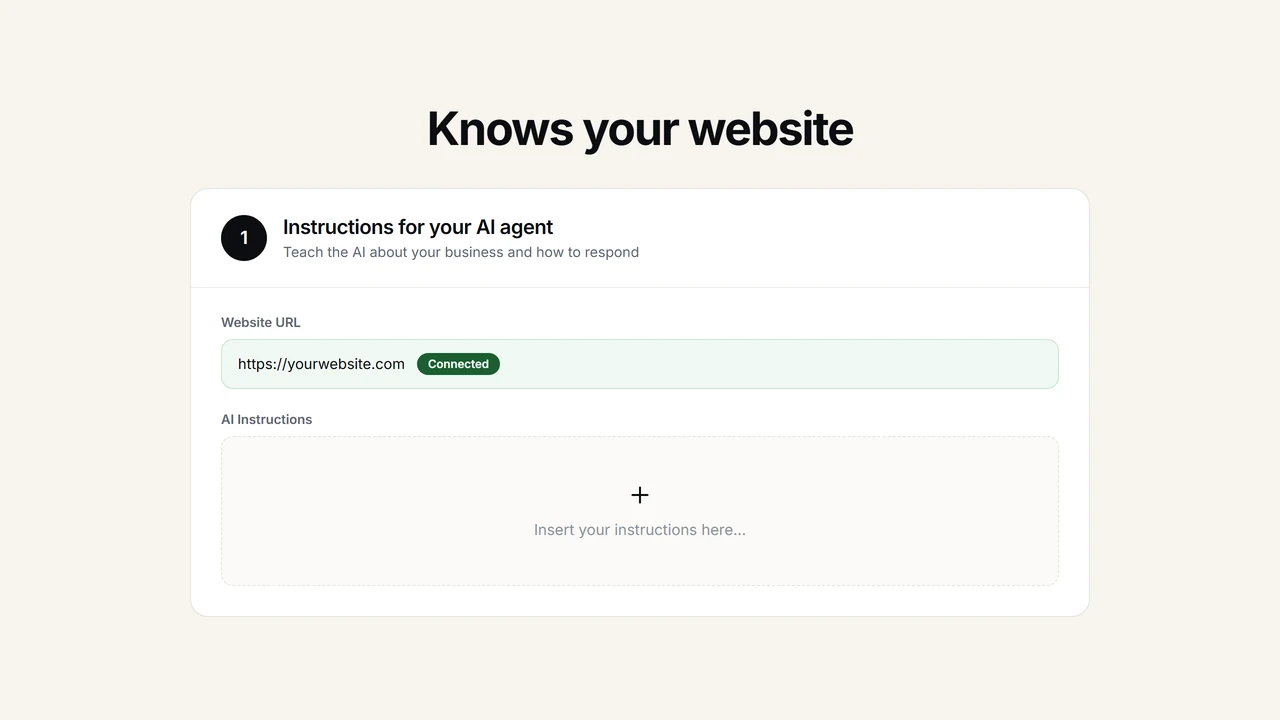
Enter your URL and see the AI read your pages. It pulls real information from your content and builds a working chatbot in under a minute — no configuration, no scripting, no decision-tree mapping.
Every decision tree you build becomes another thing to maintain — until you stop maintaining it
The first generation of chatbot widgets gave website owners a proposition that sounded reasonable: map out the questions your visitors ask, build a flowchart for each one, and the chatbot will guide people through them. In practice, this meant spending days — sometimes weeks — building decision trees that covered the twenty or thirty most common questions. Then a visitor asked question thirty-one, and the chatbot said "I don't understand that" and offered to start over from the main menu. The fundamental problem with rule-based chatbots is not that they are badly built. It is that human language is too varied, too contextual, and too creative to be captured in a branching flowchart. A visitor asking "what are your hours" and a visitor asking "are you guys open on Sundays" are asking the same thing, but a rule-based bot treats them as two completely different inputs unless someone anticipated both phrasings and mapped them to the same branch. Multiply that by every question a visitor might ask about your business, and the maintenance burden becomes unsustainable. Asyntai takes a fundamentally different approach. Instead of building decision trees, the AI reads your website content — every page, every paragraph, every detail you have published — and answers questions using that content directly. There is no flowchart to build because the AI understands natural language. There is nothing to maintain because the chatbot re-reads your content as you update it. The Free plan gives you 50 messages per month to test this on your own site. Starter at $39/month handles 800 messages across 2 sites, Standard at $139/month covers 15,000 messages and 3 sites, and Pro at $449/month scales to 50,000 messages and 20 sites.
- Reads your website and answers from your contentThe chatbot crawls up to 50 pages of your website and uses that content to answer visitor questions. When someone asks about your services, pricing, hours, or policies, the answer comes from what you have published — not from a generic language model and not from a pre-written script. You can also upload documents like PDFs, guides, and spec sheets to expand the chatbot's knowledge beyond your public pages. The answers stay accurate because they reflect your actual content.
- Understands natural language — no keyword matchingVisitors do not phrase questions the way a developer would predict. They ask "can I bring my dog?" instead of selecting "pet policy" from a menu. They write "do you ship to Canada" instead of clicking through Shipping → International → North America. The AI understands intent, not just keywords. It handles typos, colloquial phrasing, incomplete sentences, and questions that combine multiple topics in a single message — all things that break rule-based chatbots immediately.
- Zero flowcharts to build or maintainWith a traditional chatbot widget, every new product, service change, or policy update requires someone to open the bot builder, find the relevant decision tree, add new branches, test the flow, and publish the update. With Asyntai, you update your website content and the chatbot's answers update with it. There is no bot-builder interface to learn, no flowchart canvas to drag nodes around on, and no scripted responses to rewrite when your business changes. The content is the configuration.
Connect live data sources and let the chatbot widget take action
Answering questions from your website content handles the majority of visitor interactions. But some conversations require live data — checking an order, looking up an appointment, pulling account details. Custom Tools, available on Standard ($139/month) and Pro ($449/month) plans, let the chatbot call your APIs during a conversation. The visitor gets a real answer with real data, and your team handles one fewer support ticket.
- Order status and shipment trackingA customer asks "where is my order?" and the chatbot checks your fulfillment system, retrieves the tracking number and current status, and responds with specifics — "Your order #4821 shipped yesterday and is estimated to arrive Thursday." No need for the customer to find a tracking email or navigate a self-service portal. The chatbot handles the lookup inside the conversation.
- Appointment availability and bookingConnect a scheduling API and the chatbot can check open slots, suggest available times, and book appointments during the conversation. A visitor says "I need a consultation next Tuesday" and the chatbot responds with available times rather than sending them to a separate booking page. The appointment shows up in your calendar system automatically.
- Account information and balancesWhen authenticated visitors ask about their account — balance, recent transactions, subscription status, usage — the chatbot pulls the data from your system and displays it in the chat. No separate login portal, no support call, no waiting for a reply email. The visitor gets their answer in seconds.
- Returns, refunds, and case creationThe chatbot can go beyond lookups and initiate actions. A customer wants to return a product — the chatbot collects the order number, reason for return, and creates a return case in your system. A refund request gets logged with all the details attached. Your support team reviews completed cases rather than handling intake from scratch.
- Lead qualification with structured dataWhen a visitor expresses interest in your services, the chatbot asks qualifying questions and captures the responses as structured lead data — industry, budget range, timeline, specific needs. That information appears in your dashboard as a lead with all fields populated. Your sales team follows up already knowing what the prospect needs and whether they are a good fit.
Add the chatbot widget to your website
No developer required. Add your URL, let the AI read your content, and paste one script tag. Your chatbot widget is live in under twenty minutes.
- Sign up at asyntai.com/pricing — the Free plan gives you 50 messages to test on your own site. Starter ($39/month) handles 800 messages, Standard ($139/month) adds Custom Tools for live data, and Pro ($449/month) scales to 50,000 messages across 20 sites.
- Enter your website URL. The AI crawls up to 50 pages — your services, pricing, FAQ, about page, policies — and builds a knowledge base automatically. No manual content entry, no question-and-answer pairs to write.
- Upload any additional documents — product catalogs, support guides, onboarding materials — to give the chatbot knowledge beyond your public website pages.
- Copy the embed script from your dashboard and add it to your site. Works with WordPress, Shopify, Squarespace, Wix, and any platform that allows a script tag. The chatbot widget appears on your site immediately.
<script src="https://asyntai.com/widget.js"
data-id="your-site-id" async>
</script>
# One script tag. No decision trees. No flowcharts.
Chat bot widget — frequently asked questions
Common questions from business owners evaluating AI chatbot widgets for their websites.
How is this different from the chatbot widgets I have seen before?
Most chatbot widgets you have encountered are rule-based — they follow scripted decision trees where every possible question and answer must be pre-programmed. If a visitor asks something the script does not cover, the bot fails. Asyntai works differently. The AI reads your website content and uses it to answer questions in natural language. There is no script to write, no decision tree to build, and no set of canned responses to maintain. The chatbot understands what visitors are asking and responds using your actual content.
What if the chatbot gives a wrong answer?
The chatbot answers using your website content — it does not generate information from general knowledge. If your website says you offer free shipping on orders over $50, the chatbot says that. If your website does not mention a topic, the chatbot does not invent an answer. You can add custom instructions to control how the chatbot handles questions outside its knowledge — for example, "If you do not have information about the topic, offer to collect the visitor's email and let them know the team will follow up." This keeps the chatbot accurate and transparent.
Do I need to write questions and answers for the chatbot?
No. The chatbot reads your website automatically — up to 50 pages. It pulls information from your service pages, about page, FAQ, pricing, policies, and any other published content. You can also upload documents like PDFs and support guides. There are no question-answer pairs to write, no intents to define, and no training data to prepare. If the information is on your website or in an uploaded document, the chatbot can answer questions about it.
Can the chatbot handle conversations in multiple languages?
Yes — 36 languages with automatic detection. When a visitor types in French, the chatbot responds in French using your English-language content. No translated website needed, no separate chatbot configuration per language. The AI handles the language translation in real time. This is included on every plan.
How much does it cost?
Free gives you 50 messages per month on 1 site — enough to see how the chatbot handles your real visitor questions. Starter is $39/month for 800 messages on 2 sites. Standard is $139/month for 15,000 messages on 3 sites and includes Custom Tools for live data lookups. Pro is $449/month for 50,000 messages on 20 sites. There is no per-conversation fee and no setup cost.
What websites and platforms does it work with?
Any website that supports a script tag — WordPress, Shopify, Squarespace, Wix, Webflow, custom-built sites, and everything in between. The chatbot widget is a single JavaScript embed that you paste into your site's HTML. Most platforms have a "custom code" or "header scripts" section where you can add it without touching source code. The widget loads asynchronously, so it does not affect your page speed.
Can the chatbot look up live data like order status or appointments?
Yes, with Custom Tools — available on Standard ($139/month) and Pro ($449/month) plans. Custom Tools let you connect API endpoints from your business systems. When a visitor asks about their order status, the chatbot calls your fulfillment API and returns real-time data. When someone asks for appointment availability, the chatbot checks your scheduling system. You define which endpoints to connect and what data the chatbot can access.
Can I control what the chatbot says and how it behaves?
Yes. Custom instructions let you define the chatbot's personality, boundaries, and behavior in plain English. You can tell it to always greet visitors by name if available, to never discuss competitor products, to collect an email address before answering pricing questions, or to add a disclaimer to every response. These instructions apply to every conversation and let you shape the chatbot's behavior without writing code or building flowcharts.
How quickly can I get the chatbot live?
Most business owners have a working chatbot on their site within 20 minutes. Sign up, enter your URL, wait for the AI to read your content (usually under 60 seconds for a typical website), adjust the widget colors and welcome message, and paste the embed code on your site. No developer needed, no integration project, no multi-week onboarding. If you want to add Custom Tools for live data, that takes additional time depending on your API setup — typically 30 to 60 minutes per endpoint.
The chat bot widget evolved: from scripted menus to genuine conversation
The original chatbot widget was a glorified FAQ page with a text input. You typed a question, the bot scanned it for keywords, and if it found a match, it returned the pre-written answer associated with that keyword. If your question used a synonym the developer had not anticipated, or combined two topics in a single sentence, or contained a typo that broke the keyword match — the bot returned a generic fallback: "I'm sorry, I didn't understand that. Please choose from the options below." And below was a menu of five or six topics, each leading to a decision tree that felt like navigating an automated phone system with your keyboard. The visitor did not get an answer; they got a maze. This was the state of chatbot widgets for the better part of a decade, and it conditioned an entire generation of internet users to expect nothing useful from the chat bubble in the bottom corner of a website.
Decision trees fail for a reason that has nothing to do with how carefully they are built. The problem is combinatorial. A small business with ten services, five locations, three types of customers, and a return policy that varies by product category would need hundreds of decision-tree branches to cover every legitimate question a visitor might ask. And that only accounts for the questions the bot builder anticipated. The first visitor who asks something off-script — "I bought this as a gift and the recipient wants to exchange it but they live in a different city" — hits a dead end. Rule-based bots are brittle because they attempt to pre-compute every possible conversation, and conversations are not computable in advance. They are emergent, contextual, and shaped by the specific situation of the person asking.
The shift from rule-based to AI-powered chatbot widgets is not an incremental improvement. It is an architectural change. A rule-based bot matches patterns and follows branches. An AI chatbot reads content, understands intent, and generates a response that addresses the specific question asked. The difference is visible in the first interaction. A visitor asks "do you deliver to apartments, and is there a fee for that?" A rule-based bot, if it handles delivery questions at all, would need two separate branches — one for delivery areas and one for delivery fees — and no mechanism to answer both in a single response. An AI chatbot reads the delivery page on your website, finds the relevant paragraphs, and writes a single answer that covers both parts of the question: "Yes, we deliver to apartments within our service area. Delivery is free for orders over $75 — otherwise there is a $9.99 delivery fee." One question, one answer, zero flowchart branches involved.
Content-based answering changes the economics of running a chatbot. With a rule-based bot, every new piece of information requires manual work. You add a new service — someone has to update the decision tree. You change your hours — someone has to find every branch that references hours and edit them. You launch a seasonal promotion — someone has to build a new flow, test it, and publish it. With an AI chatbot that reads your website, you update your website and the chatbot's answers update with it. The maintenance cost drops from hours per week to zero, because the chatbot's knowledge base is your website itself. You are already maintaining your website. The chatbot rides along for free.
Accuracy concerns are the first objection business owners raise, and they are worth addressing head-on. When the AI reads your website and uses that content to answer questions, it is constrained by what you have published. It does not hallucinate information about services you do not offer or make up pricing you never posted. If a visitor asks about something not covered on your website, the chatbot can be instructed to say "I don't have information about that — let me connect you with someone who can help" rather than guessing. You control these boundaries through custom instructions, written in plain English. The result is a chatbot that is accurate within its knowledge and transparent about its limits — which is exactly how a well-trained human support agent behaves.
Natural language understanding is what makes the AI chatbot widget feel like a conversation instead of a menu system. A visitor types "I messed up my password and now my account is locked" and the chatbot understands this as an account recovery question, not a complaint, not a security issue, not a feature request. It responds with your account recovery process, pulled from your help center content. A different visitor types "can't get into my account, keeps saying wrong password" — same intent, completely different phrasing — and the chatbot gives the same accurate answer. A rule-based bot would need both phrasings (and dozens more) manually mapped to the same response. The AI handles linguistic variation naturally because it understands meaning, not just strings.
The visitor experience gap between a decision-tree chatbot and an AI chatbot shows up in engagement metrics. Visitors who encounter a rule-based bot and hit a dead end within two interactions rarely try again — they close the chat, and the bot becomes invisible to them for future visits. Visitors who get a genuine, accurate answer to their first question keep talking. They ask a follow-up. They ask about something else entirely. They share their email when the chatbot offers to send them more information. The conversation continues because the visitor trusts that the next response will be as useful as the first one. Trust is a function of accuracy and consistency, and an AI chatbot that answers from your own content delivers both.
Custom Tools bridge the gap between information and action. The base chatbot answers questions — what you offer, how it works, what it costs, where you are located. Custom Tools let the chatbot do things — check a delivery status, look up an appointment, verify a warranty, create a support ticket. This turns the chatbot widget from a smart FAQ into an actual self-service channel. A customer who can resolve their own question in a two-minute chat conversation is a customer who does not submit a support ticket, does not call your phone line, and does not leave a frustrated review about slow response times. Custom Tools are available on Standard ($139/month) and Pro ($449/month) plans, and each endpoint connects through a straightforward API configuration — no chatbot scripting required.
Multilingual support in a chatbot widget used to mean building separate decision trees for each language — doubling or tripling the already unsustainable maintenance burden. With an AI chatbot, multilingual is built in. The chatbot supports 36 languages with automatic detection. A visitor types in Portuguese and the chatbot responds in Portuguese, drawing answers from your English-language content. No translated website required, no separate bot configuration. This is not a novelty feature — for any business serving a multilingual community or operating across borders, it is a practical expansion of who the chatbot can help. And it works on every plan, including the free tier.
The installation process reflects the architectural simplicity. There is no bot-builder tool to learn, no conversation designer to hire, no integration project to plan. You sign up, enter your website URL, and the AI reads up to 50 pages of your content. You adjust the widget's appearance — colors, position, welcome message — to match your site's design. You copy a script tag and paste it into your website. The chatbot appears on your site and starts answering visitor questions using your content. Twenty minutes from signup to a live chatbot. Businesses that spent weeks building decision trees in their previous chatbot platform find the contrast disorienting — it should not be this straightforward, and yet it is, because the hard part (understanding language) is handled by the AI, not by the business owner.
Lead capture happens naturally in a chatbot conversation, without the forced friction of a traditional form. When a visitor asks "do you offer consulting services for small businesses?" and the chatbot answers yes with details pulled from your consulting page, the next natural step is for the chatbot to ask whether they would like to schedule a conversation or leave their email for a follow-up. The visitor has already engaged, already received value, and already established trust — the lead capture is a continuation of the conversation, not an interruption. Compare this to a pop-up form or a sidebar widget that asks for an email before the visitor has even read the page. The chatbot earns the lead by being useful first.
Scalability is invisible but important. A rule-based chatbot that handles ten conversations simultaneously handles them the same way it handles one — each conversation follows its script independently. An AI chatbot does the same, but without the ceiling that rule-based bots hit when conversation volume reveals gaps in the decision tree. When you get a spike in traffic — a social media mention, a seasonal surge, a product launch — the chatbot handles every conversation with the same quality. It does not get overwhelmed, it does not start giving shorter answers because it is busy, and it does not need you to add more scripts to cover the new questions that come with new visitors. The chatbot scales with your traffic because its knowledge scales with your content.
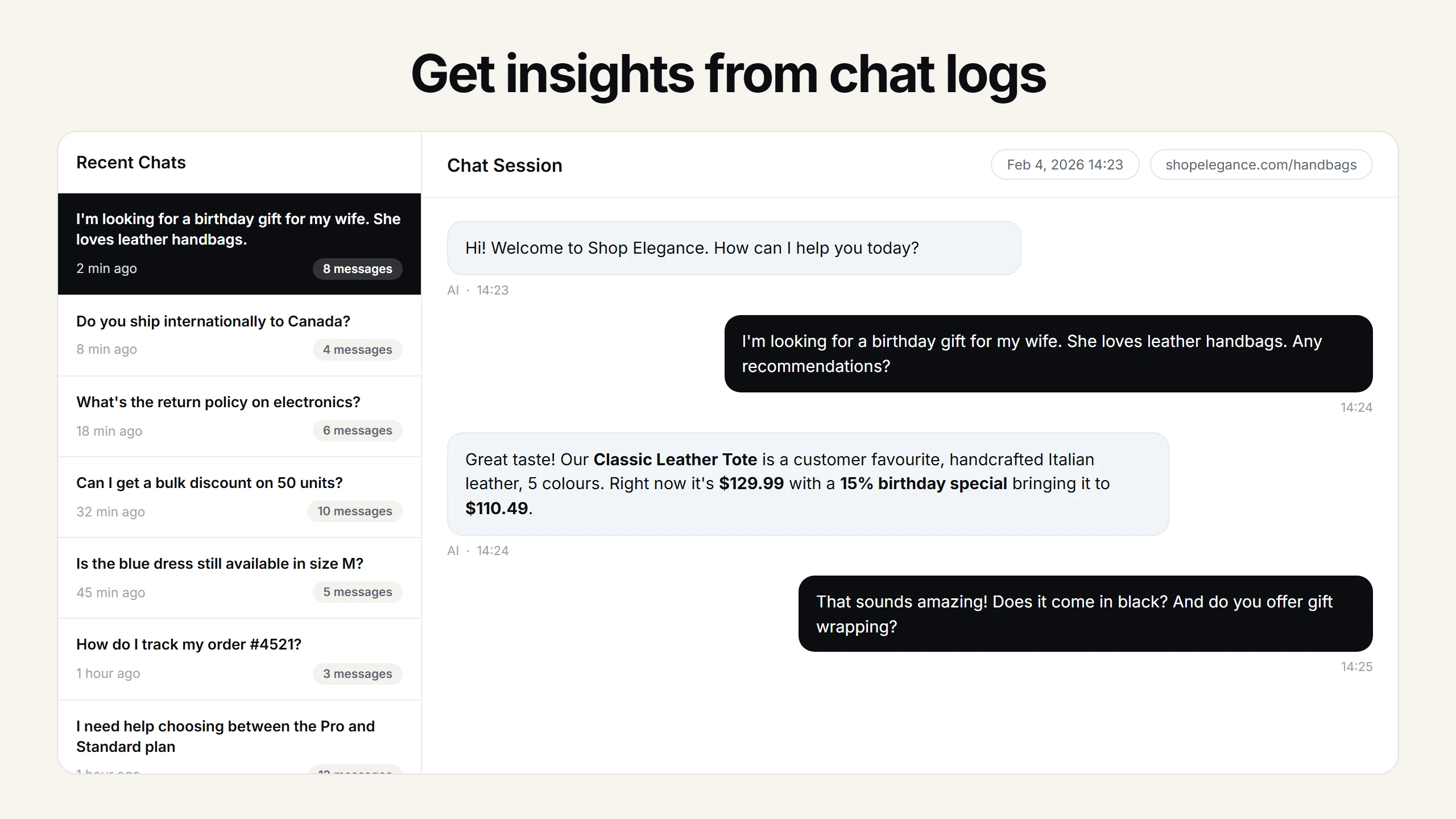
Analytics from chatbot conversations reveal what your visitors actually want to know, which is often different from what your website emphasizes. When you see that thirty percent of chatbot conversations are about your return policy — a single paragraph buried on a subpage — that tells you something your analytics dashboard cannot. The chatbot becomes a research tool: what are people confused about? What questions does your website fail to answer clearly? Where are the gaps between what you think visitors care about and what they actually ask? These insights feed back into your website content, which improves the chatbot's answers, which improves visitor satisfaction — a virtuous cycle driven by real conversation data.
The economics of a chatbot widget are straightforward when you measure them against the alternatives. A single customer support hire costs far more per month than any chatbot plan and covers business hours only. A rule-based chatbot costs less in subscription fees but demands ongoing maintenance time that has a real cost — every hour spent updating decision trees is an hour not spent on revenue-generating work. An AI chatbot that reads your website costs $39 to $449 per month depending on volume, requires no maintenance time, handles conversations around the clock in 36 languages, and improves automatically as you improve your website content. The comparison is not between a chatbot and a human — it is between a chatbot handling the repetitive informational questions and a human handling everything, including the questions that did not need them.
Done with decision trees? Start with the free plan — 50 messages, no credit card — and see the AI answer questions from your own website. Or go straight to Standard for Custom Tools and live data lookups.