BigCommerce chatbot that reads your catalog and sells for you
Paste one script tag into your BigCommerce theme and Asyntai deploys an AI chatbot that knows every product, policy, and page on your store. It handles pre-sale questions, surfaces relevant items, speaks 36 languages, and captures leads when shoppers need human follow-up.
Preview the chatbot on your BigCommerce store
Enter your BigCommerce storefront URL and watch the AI pull answers directly from your published product pages and store content
Knows every product on your BigCommerce storefront before the first shopper asks
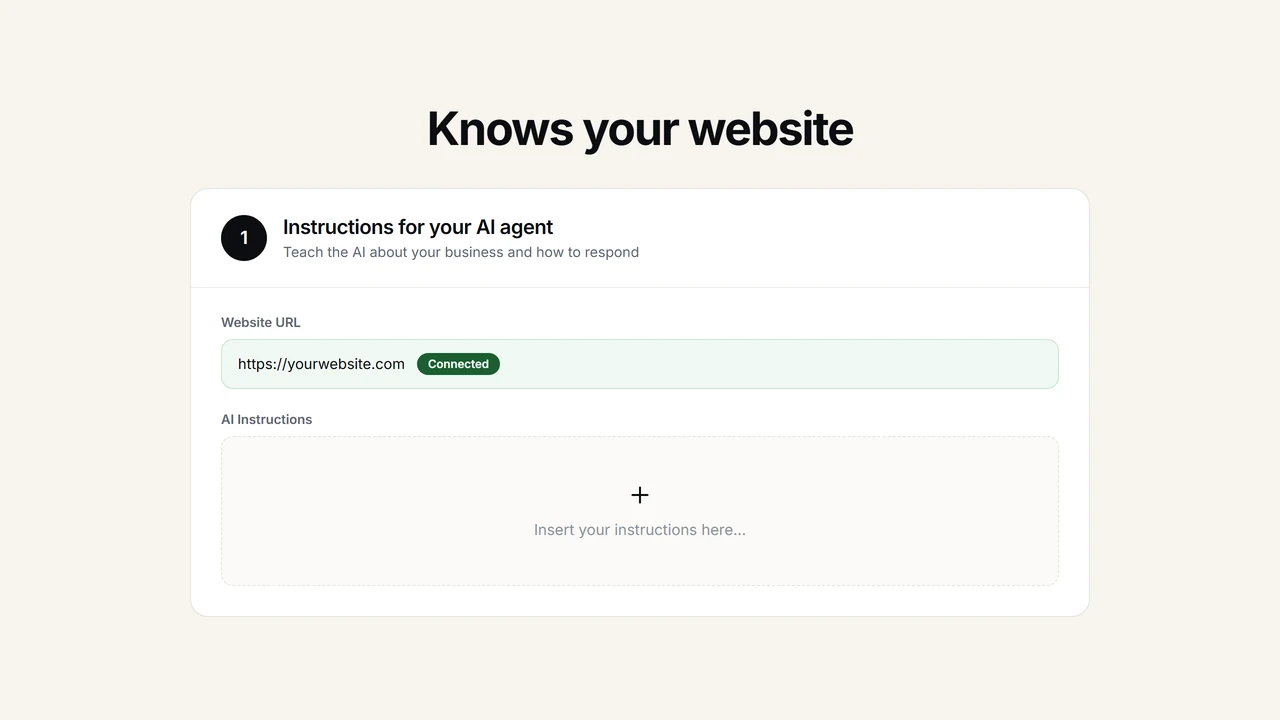
The moment you connect your BigCommerce store, Asyntai crawls every product page, category listing, brand page, and content page your theme renders. The AI digests product titles, descriptions, pricing, variant options, and availability — so when a shopper types "Is this available in blue, size large?", the chatbot responds with live details from your storefront rather than a stale data dump.
- Product pages indexed automaticallyNames, descriptions, prices, images, variant labels, and stock indicators flow into the chatbot's knowledge layer within minutes of connection. New products appear after the next scheduled crawl.
- Category and brand navigationThe chatbot understands your store's taxonomy, so it can suggest items within a category or guide a shopper from a broad interest ("waterproof jackets") to the right product listing.
- Uploaded material fills the gapsWholesale pricing tiers, supplier lead-time tables, internal return-handling procedures — upload them as PDFs via your Asyntai account and the chatbot draws on them in answers while keeping them invisible to storefront visitors.
Guides browsers toward checkout and captures those who hesitate
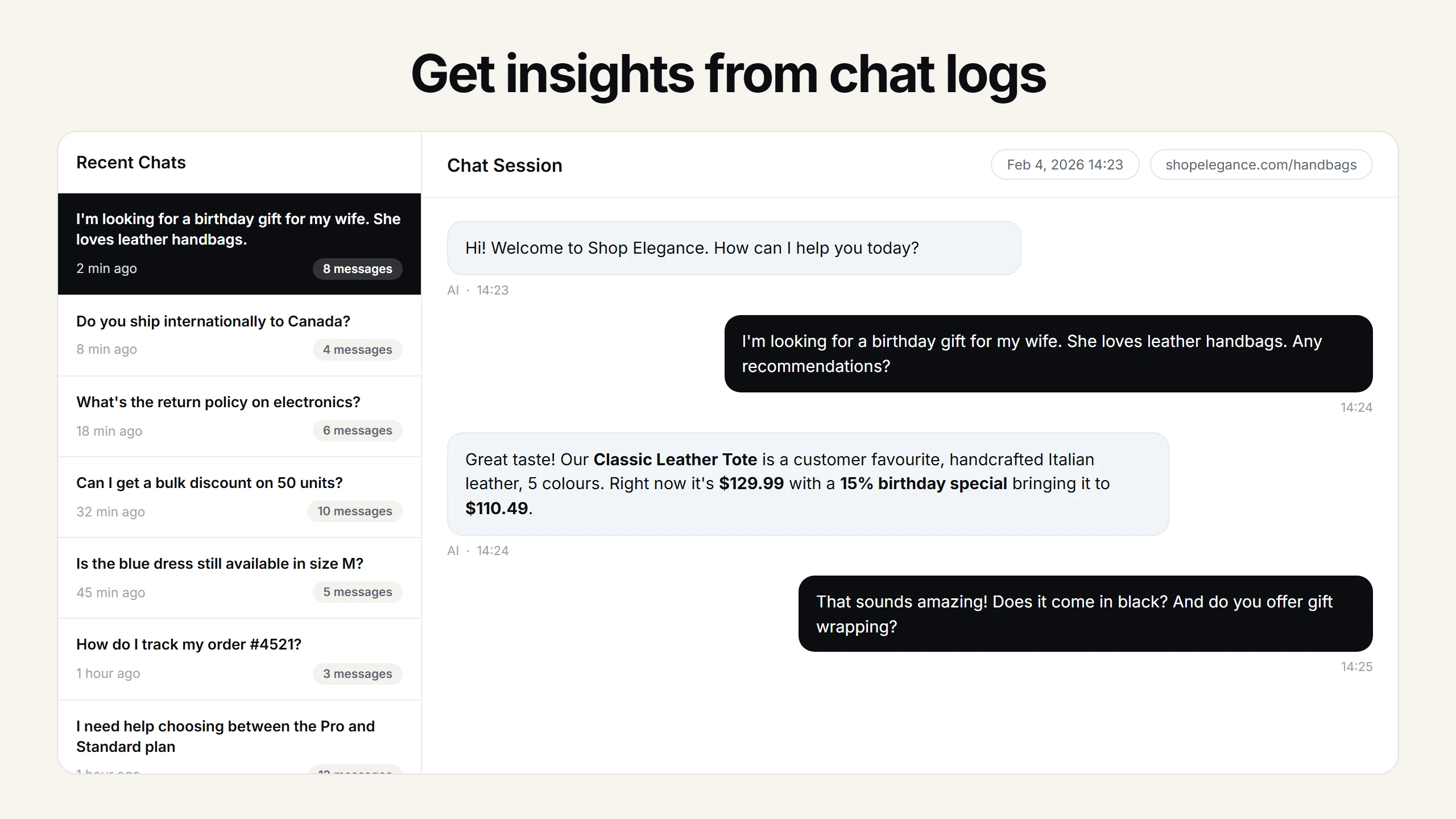
A BigCommerce chatbot sitting idle until someone clicks it misses the point. Asyntai engages at the moments that matter — when a shopper lingers on a product page, when a cart question arises, when a comparison between two items stalls. If the conversation reaches a point the AI cannot resolve alone, it captures an email and files a context-rich lead for your team.
- Pre-sale objection handlingShipping timelines, material composition, compatibility questions, return conditions — the chatbot resolves hesitations that would otherwise end in a bounced tab.
- Lead capture with full transcriptWhen a thread exceeds the AI's scope — custom bulk orders, trade account requests, damaged-goods claims — it asks for an email and records the complete conversation for human follow-up via dashboard and optional inbox forwarding.
- Multilingual without a translation appThirty-six languages work out of the box. A German shopper browsing your English-language BigCommerce store receives German answers generated from the English catalog content.
Install the BigCommerce chatbot via Script Manager
BigCommerce exposes a Script Manager inside the control panel that accepts third-party JavaScript without theme file edits. Deploying the chatbot takes one entry in that interface.
- Register an Asyntai account (free, no card) and grab the widget script tag from your Install tab.
- In your BigCommerce control panel, navigate to Storefront → Script Manager and click Create a Script.
- Set the location to Footer, the pages to All Pages, paste the Asyntai script in the Script contents box, and save.
- Open your live storefront in a fresh browser window. The chat icon shows up at the bottom of the page, already answering from your product catalog and store content.
# Storefront → Script Manager → Create a Script
Name: Asyntai Chatbot
Location: Footer
Pages: All Pages
Script:
<script src="https://asyntai.com/widget.js"
data-id="your-site-id" async></script>
BigCommerce chatbot — questions store owners ask
Practical answers for BigCommerce merchants evaluating AI chat as a storefront tool.
Does the chatbot pull live inventory data from BigCommerce?
The chatbot trains on your storefront's rendered HTML, which reflects the inventory state at crawl time. Products marked out of stock on the storefront are indexed as unavailable. For stores where stock levels fluctuate hourly, re-crawls can be triggered manually from the dashboard or scheduled at intervals that match your inventory rhythm.
Will it work with my Stencil theme or is it limited to certain templates?
The chatbot is completely theme-agnostic. It loads via a script tag injected through Script Manager, which fires on every storefront page regardless of whether you run a default Cornerstone variant, a purchased Stencil theme, or a heavily customized build. No Handlebars partial needs editing.
Can the chatbot recommend products during a conversation?
Yes. Because the AI has ingested your full product catalog — names, descriptions, categories, pricing, variant attributes — it can suggest relevant items when a shopper describes what they need. A visitor asking for "a gift under fifty dollars for someone who likes gardening" will receive suggestions drawn from your actual inventory rather than a generic response.
How does it handle multi-currency BigCommerce stores?
The chatbot indexes the prices displayed on each product page at crawl time, which reflect your default storefront currency. For stores using BigCommerce's multi-currency feature, the AI references the base-currency price in its answers and can note that the shopper's local currency equivalent appears on the product page. Price conversion itself remains handled by BigCommerce's native currency logic on the storefront.
Can I personalize chatbot replies for logged-in BigCommerce customers?
Standard and Pro tiers expose a User Context API: your Stencil theme feeds customer attributes into the window.Asyntai.userContext variable before the chat bubble appears. You can expose the customer's group name, loyalty tier, or recent order category from BigCommerce's frontend JavaScript globals, and the chatbot weaves that context into every reply — greeting a wholesale customer differently from a retail browser, for instance.
What languages does the BigCommerce chatbot support?
The widget interface and the AI's reply generation cover 36 languages. Language detection is automatic — a Spanish-speaking shopper on your English-only BigCommerce storefront writes in Spanish and gets back a fluent Spanish reply generated from the English product descriptions. No BigCommerce translation app or multilingual storefront configuration is required on your end.
How many BigCommerce stores can I connect under one account?
Free connects a single storefront, Starter doubles that to two, Standard grants three, and Pro maxes out at ten. Each store maintains a completely separate product index, behavioral ruleset, and widget appearance, so a merchant operating multiple BigCommerce storefronts for different brands or regions can manage them all from one dashboard without cross-contamination of catalog data.
What does the free tier actually give me?
One connected BigCommerce store, 50 shopper messages per month, full catalog crawl and training, all 36 UI languages, lead capture with dashboard analytics, and no credit card at sign-up. The free tier exists so you can validate the chatbot against real storefront traffic and review conversation quality before committing to a paid plan.
BigCommerce chatbot — turning product pages into guided conversations
Running an online store on BigCommerce means inheriting a platform optimized for catalog management, payment processing, and shipping logistics — but historically underserved when it comes to real-time visitor engagement. BigCommerce merchants rely on product descriptions, FAQ pages, and maybe a contact form to bridge the gap between a shopper's question and a purchase decision. That gap costs sales every day. A visitor lands on a product page, wonders whether the item ships internationally, cannot find the answer in three seconds, and leaves. A returning customer wants to know if the loyalty discount applies to a new collection, gets no immediate answer, and abandons the tab. An international shopper reads the English description, half-understands it, and decides the risk is not worth the purchase. Each of these moments is recoverable — but only if the store has something smarter than static text standing between the question and the exit.
Asyntai addresses that gap by deploying an AI chatbot directly on the BigCommerce storefront. The install mechanism is Script Manager, the built-in BigCommerce tool that lets merchants inject third-party JavaScript without touching Stencil theme files or committing code to a repository. You create a script entry, set the location to Footer and the scope to All Pages, paste the Asyntai tag, and save. The chatbot launcher materializes on every storefront page within seconds. No Handlebars template was modified. No app was installed from the BigCommerce marketplace. No developer was consulted. The entire operation happens inside the control panel interface every BigCommerce merchant already navigates when adding analytics, pixels, or conversion tracking snippets.
Training begins the instant the script fires for the first time. Asyntai's crawler visits every URL your BigCommerce storefront exposes: product detail pages with their full descriptions and variant tables, category listings that group products by taxonomy, brand pages, content pages (the BigCommerce equivalent of CMS pages), blog posts if your store runs one, and any custom pages your theme renders. The crawler treats the storefront the same way a meticulous shopper would — reading every visible piece of information and storing it in a retrieval index the model references each time a new shopper message arrives. The result is a chatbot that knows your product catalog with the same thoroughness a veteran sales associate would have after reading every product card in the stockroom.
Private documents extend the chatbot's reach beyond what the public storefront reveals. BigCommerce merchants often maintain material that belongs in the chatbot's brain but not on the website: wholesale pricing schedules distributed to trade customers, supplier lead-time matrices that affect delivery estimates for made-to-order products, internal return-handling procedures that dictate when to offer a refund versus a store credit, seasonal promotion calendars not yet announced publicly. Feed those into Asyntai by uploading PDFs or dropping in raw text via the control panel. The chatbot merges them with the catalog crawl and draws from both pools when composing each reply. A wholesale inquiry gets a response informed by the uploaded trade pricing sheet; a standard retail question gets an answer from the public product page. No document appears on the storefront or becomes accessible via URL — the upload pipeline is entirely separate from the BigCommerce content system.
Language coverage is where the BigCommerce chatbot delivers disproportionate value for merchants selling internationally. BigCommerce itself supports multiple currencies and has storefront translation capabilities, but many merchants run a single English-language storefront and rely on the product itself to transcend language barriers. That works for commodity goods with universal specifications but collapses the moment a shopper needs to ask a nuanced question — sizing guidance, material care instructions, compatibility with a regional electrical standard, warranty terms that vary by jurisdiction. Asyntai's model picks up whichever language the shopper writes in and formulates the answer from the English catalog data in that tongue. A Japanese shopper asking about garment sizing receives a Japanese explanation of your sizing chart. A Portuguese shopper inquiring about return windows gets the policy summarized in Portuguese. All thirty-six supported languages activate automatically; the merchant configures nothing per language.
Behavioral instructions let merchants shape the chatbot's personality and commercial posture without writing code. In the Asyntai dashboard, a free-text field accepts plain-language directives: "When a shopper asks about a product that is temporarily out of stock, suggest two alternatives from the same category and offer to notify them by email when the original item returns." "Never reveal supplier names or cost-of-goods figures." "If a conversation mentions a bulk order exceeding twenty units, collect the buyer's company name and email for a custom quote." These are not rigid rules that fire on keyword matches — they are strategic guidelines the AI weighs alongside the catalog content when composing each answer. The effect is a chatbot that sells the way the merchant wants to sell, not the way a generic template assumes every store sells.
Lead capture is the mechanism that turns conversations the chatbot cannot close into pipeline for the merchant's sales or support team. When a discussion reaches territory beyond the AI's training — a bespoke product modification request, a shipping exception for an unusual destination, a warranty dispute that requires human judgment — the chatbot pivots from assistant to intake agent. It collects an email from the shopper, packages the complete dialogue with time markers, and posts the lead into your account panel. Merchants who enable email forwarding receive the same transcript in their inbox within seconds. The follow-up person opens a message containing the shopper's exact questions, the chatbot's responses up to the point of escalation, and the page URL where the conversation began — context that collapses the usual two or three email exchanges needed to understand what the lead actually wants.
User Context unlocks personalization for BigCommerce stores that authenticate customers on the storefront. On Standard and Pro, your Stencil code can serialize customer fields into the window.Asyntai.userContext variable so the AI personalizes from the first message. BigCommerce's Stencil framework makes customer data available in Handlebars context — group name, order count, email, custom fields — and a small inline script can serialize the relevant attributes into the Asyntai object. Once present, the AI weaves those details into each response it generates. A wholesale customer asking about lead times gets a response adjusted for trade-tier fulfillment schedules. A VIP loyalty member asking about a new collection hears about the early-access window their membership includes. The personalization layer adds a dimension that static product pages and generic pop-up offers cannot replicate because it responds to who the shopper is, not just what page they happen to be viewing.
Analytics give BigCommerce merchants a feedback loop that product-page heatmaps and Google Analytics funnels miss entirely. Each thread the chatbot processes is logged with metadata: the product discussed, the subject cluster, which language was used, the starting URL, and whether the exchange ended in resolution, lead capture, or abandonment. Over weeks, patterns surface that no other tool captures: shoppers repeatedly ask about a fabric composition your product descriptions omit, German-speaking visitors account for a meaningful share of conversations despite zero German marketing investment, dialogues that begin on one high-interest category page generate leads at double the homepage baseline. Those signals map directly to merchandising decisions — add a materials section to the product template, experiment with German-language ad spend, promote the high-converting category more prominently in navigation. The chatbot becomes a research instrument as much as a sales tool.
Multi-store management accommodates BigCommerce merchants who operate several storefronts under different brands or regional domains. One Asyntai subscription spans several storefronts: the Free plan holds a single property, Starter opens two slots, Standard three, and Pro maxes out at ten. Each BigCommerce storefront maintains a fully isolated product index, independent behavioral rules, and a uniquely themed chat interface. A home-goods brand running separate BigCommerce stores for kitchen equipment and outdoor furniture sets up two completely separate chatbot voices within one account: the kitchen chatbot discusses recipe suitability and dishwasher safety; the outdoor chatbot addresses weather resistance and UV ratings. Billing consolidates under one subscription, and conversation analytics for each store appear in separate dashboard tabs.
Pricing aligns with BigCommerce-scale economics. The free tier asks for no payment details and grants one store with 50 shopper messages — sufficient to validate the chatbot on a staging environment or a low-traffic storefront before investing. The Starter plan at $39/month stretches the cap to 800 messages while opening a second storefront connection. Standard and Pro push higher with additional store capacity, the User Context personalization hook, and expanded message volumes. For a BigCommerce merchant already absorbing platform fees, payment processing charges, a shipping-rate calculator, and an email marketing subscription, the chatbot fits into the existing operating-cost structure rather than introducing a new procurement category. The value proposition is straightforward: every shopper question the chatbot resolves is a support ticket that never gets filed and a potential sale that does not walk away unanswered.
Deploying the BigCommerce chatbot follows a sequence that fits inside a single afternoon. Register, paste the script into Script Manager, let the crawler absorb your catalog, upload any confidential material the public storefront does not expose, write behavioral instructions that capture how your brand communicates, test a few simulated conversations in an incognito window, and go live. Nothing in your BigCommerce setup changes — products still publish through the catalog manager, orders still flow through the order pipeline, themes still render via Stencil, shipping rules still calculate at checkout. The chatbot simply layers on top of everything that already works, fielding the shopper questions your storefront would otherwise leave to FAQ pages, email support tickets, or silent bounce exits.