Best live chat software for teams that can't be online 24/7
Asyntai offers AI-first live chat software that reads your site, answers visitors around the clock, and routes complex cases to your team with full context. Installs in minutes, works on any website, in 36 languages.
Try the best live chat software on your site
Paste your website URL and see how the chat would actually handle the questions your visitors ask
Chat that already knows your site before it answers the first question
Most live chat software hands you a blank text box and an agent seat. The best live chat software assumes the AI should do the first response itself — answering from your pages, policies, and documentation — so visitors get answers in seconds, not the next business day.
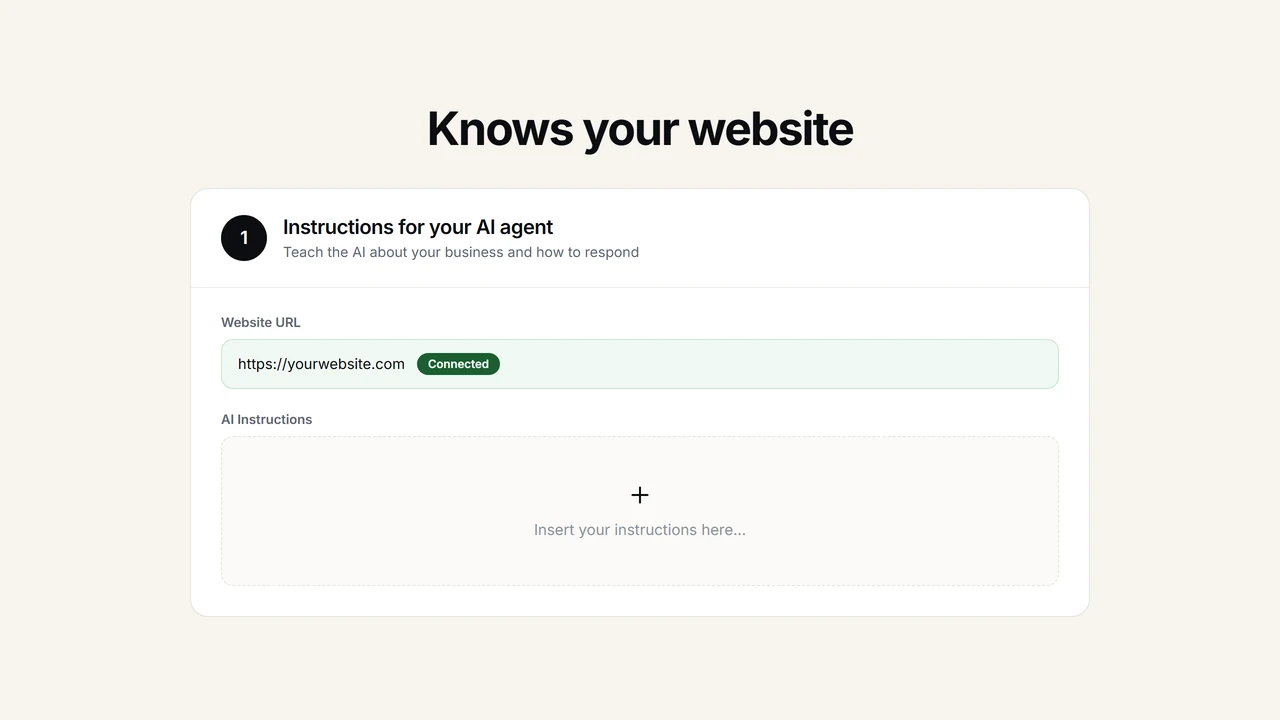
- Auto-trains on your websiteProduct, pricing, services, policies, FAQ — anything published gets absorbed in minutes with a single site URL.
- Upload internal docsSOPs, pricing tables, proposal templates, onboarding guides, technical specs — added as PDFs or pasted text, so the chat knows what your public site doesn't show.
- Custom behavior rules"Offer a demo when pricing is asked." "Escalate billing disputes immediately." "Never commit to timelines without scope." You set the rules; the chat follows them.
AI handles the repetitive volume. Humans pick up where it counts.
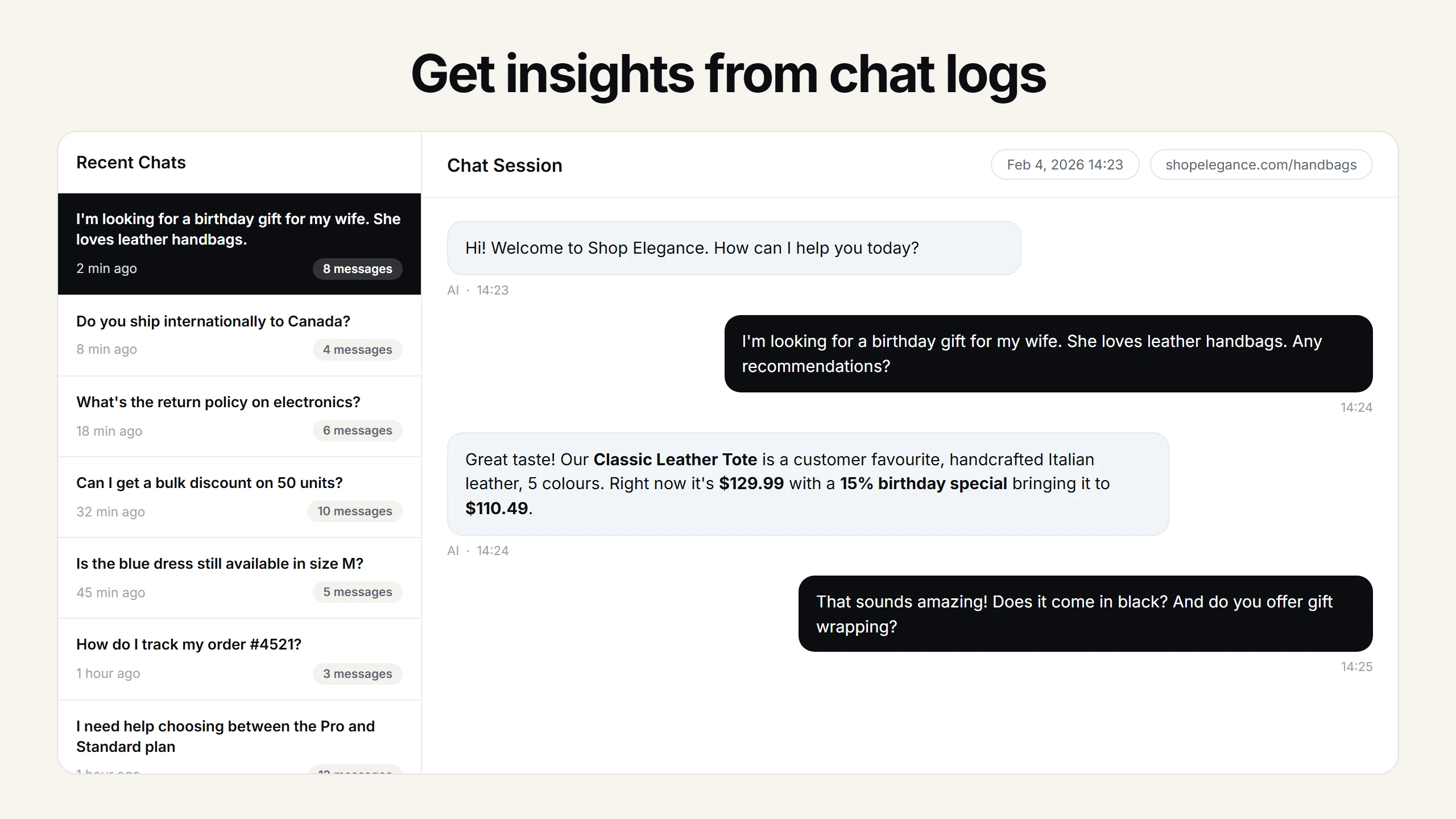
"Live chat software" used to mean a human agent typing back at every visitor. The best live chat software in 2026 is hybrid — AI handles the majority of inbound questions, and humans see only the conversations that genuinely need them, with full context already captured.
- Smart lead capture at the right momentsThe AI asks for contact details during the conversation and routes the transcript to your Asyntai dashboard.
- Email notifications in real timeTurn on notifications and every captured inquiry lands in your team's inbox the moment it happens — full transcript attached.
- User Context for known visitorsWith User Context on Standard and Pro plans, the chat greets logged-in customers by name, references their account, and gives personalized answers automatically.
Setup in minutes. Any website.
The best live chat software should go live the same day you decide to try it — not require an implementation consultant. Asyntai installs as a single JavaScript snippet on WordPress, Shopify, Webflow, Squarespace, custom sites, or any CMS. Paste, train, go live.
- Sign up for a free Asyntai account and copy your personal snippet.
- Paste the snippet into your website's
<head>via your CMS header settings, a header plugin, or the template directly. - Point the AI at your site URL so it learns your content, and upload any private docs.
- Write a handful of custom instructions, test the chat with real questions, go live.
<script src="https://asyntai.com/widget.js"
data-id="your-site-id" async>
</script>
</head>
# Live chat ready on every page of your site.
Best live chat software — FAQs
What teams evaluating live chat software typically want to confirm before switching.
Is this AI chat or human live chat software?
AI-first. Asyntai is built around an AI that reads your site and answers visitors directly, 24/7, in 36 languages. When a conversation needs a human — a complex issue, a sensitive case, a custom quote — the AI captures the details and hands the context to your team via the dashboard or email inbox. For most teams, this hybrid model outperforms a pure human-agent live chat setup.
How does it compare to traditional live chat software?
Traditional live chat software — Intercom, LiveChat, Tidio, Drift, Crisp — assumes a human types every reply. Asyntai assumes the AI handles first response, so visitors get answers even when your team is offline or asleep. For teams that can't realistically staff chat 24/7, this is usually the better shape. For teams that specifically want every interaction to involve a human agent, a traditional chat tool is a better fit.
What happens when the AI can't handle something?
It captures the visitor's email and the full conversation, then delivers everything to your Asyntai dashboard. If email notifications are on, the same transcript arrives in your team's inbox in real time. Your team picks up the conversation with full context — so handoffs don't feel like starting from scratch.
Does it work in multiple languages?
Yes. The widget UI is available in 36 languages and the AI detects the visitor's language from their first message. A French visitor gets French, a Japanese visitor gets Japanese, a German visitor gets German — without any translation plugin or manual configuration on your end.
Can it personalize replies for logged-in customers?
Yes, via User Context on Standard and Pro plans. Your website passes the logged-in visitor's data — name, account tier, order status, subscription info — into a JavaScript object before the widget loads. The AI uses that context to give personalized answers without needing any backend API integration.
What platforms does it work on?
Any platform. Asyntai installs as a JavaScript snippet, so it works the same on WordPress, Shopify, Webflow, Squarespace, Wix, Ghost, custom stacks, and any CMS that lets you add a script tag to the header. We also have dedicated plugins for popular platforms if you prefer a native install flow.
What does it cost compared to traditional live chat tools?
Free tier covers 50 messages per month. Paid plans start at $39 per month for 800 messages. Compared with per-seat pricing on traditional live chat software, where costs scale linearly with the size of your team, AI-first chat scales with conversation volume instead — which is usually much more favorable for small and mid-sized businesses.
Can I run it on multiple websites?
Yes on paid plans. Free: 1 site, Starter: 2, Standard: 3, Pro: up to 10. Each site gets its own separately trained AI — useful for agencies managing client sites, multi-brand operators, or founders running several businesses.
Best live chat software — how to actually pick one
The "best live chat software" question is harder than it looks, because the category itself has quietly split in two. On one side you have the original live chat tools — Intercom, LiveChat, Drift, Tidio, Crisp, Zendesk Chat — built around the assumption that a human agent is typing every reply. On the other side you have the newer AI-first tools, where the chat window is powered by a language model answering from your own content, with humans reserved for the genuinely complex cases. Both are called "live chat software," but they solve very different problems and cost very different money to run. Pretending the category is still one thing leads to bad software decisions. The right question isn't "which live chat tool is best" in the abstract — it's "which shape of live chat fits how my business actually handles visitor questions."
The economics of human-agent live chat are well understood at this point. Per-seat pricing models mean the cost scales with the size of your support team — $25 to $80 per seat per month is typical — and coverage caps at the hours your agents are actually at their desks. Most companies discover within a quarter that 24/7 human chat isn't realistically affordable, so they pull back to business-hours coverage. That means a shopper or prospect arriving at 11 PM gets a "we're offline" placeholder, leaves a form, and maybe returns when someone emails them back — or, more often, doesn't. If your visitor traffic is spread across time zones or peaks outside office hours, traditional live chat software leaves a large fraction of your audience unserved.
AI-first live chat software changes the math by removing the agent-seat bottleneck. Asyntai, for example, prices based on conversation volume rather than on seats — 50 messages free, 800 messages at $39/month, scaling from there. Once installed, the chat is live on every page of your site, in every language, at every hour of the day, without anyone needing to be at a desk. The coverage that traditional live chat software makes unaffordable becomes the default in AI-first systems. That shift alone is what makes "AI-first" the honest contender for "best live chat software" in 2026, for any business that isn't dedicating a full-time agent roster to chat.
The obvious counter-argument is that AI can't really handle the variety of questions visitors ask, especially on complex products. This was true two years ago and is decreasingly true now. The quality gap between a well-trained AI and a junior human agent on routine questions has narrowed dramatically, and for businesses where the chat is answering questions that are already written somewhere on the site — pricing, services, shipping, policies, product specs, scheduling — the AI wins on speed, consistency, and availability. For questions that require judgment or empathy — a refund dispute, a real complaint, a complex sales negotiation — the AI should hand off, and the best live chat software in the AI-first category makes that handoff invisible to the visitor.
Training is the part most evaluators underestimate. Traditional live chat software comes with empty template libraries and maybe a couple of macro slots to prefill common responses. The actual knowledge lives in the agents' heads. AI-first chat flips this: the knowledge has to live in the system, and the quality of training determines the quality of every reply forever. Asyntai crawls your site on signup and absorbs your public content directly, which gets most businesses to production-grade answers on day one without manual curation. Anything internal — private pricing, SOPs, internal FAQ documents — gets uploaded as PDFs or pasted text. Voice and policy are controlled through plain-English custom instructions. There's no Q&A-pair spreadsheet to maintain, no decision-tree flowchart to update, no retraining cycle when you publish new content.
Languages reveal the biggest practical difference between the two categories. Traditional live chat software that claims multi-language support usually means "we have translated the UI of the chat widget into other languages" — while the actual replies still come from whoever's typing them, which is usually a single-language human team. If your French traffic grows to meaningful size, you need to hire a French-speaking agent. AI-first chat, by contrast, detects the visitor's language from their first message and responds in kind. Asyntai supports 36 languages this way. A French visitor, a Japanese visitor, a Brazilian visitor, and an American visitor all get served from the same installation, by the same system, at the same speed. For any business with international reach, this alone is often the deciding factor.
Consistency is an underrated feature of AI-first chat that traditional live chat software structurally cannot match. A 15-person support team will answer the same policy question 15 slightly different ways, because each person absorbed the policy document differently. That variation is fine most of the time and a real problem when a policy is being interpreted inconsistently across paying customers. AI pulls from one knowledge base every conversation, every language, every time. If the return window is 30 days, it's 30 days in every reply. If the consultation offer is 20 minutes, it's 20 minutes in every conversation. Businesses in regulated industries — fintech, healthcare-adjacent, insurance — often find this consistency is worth more than the raw efficiency gain.
Escalation handling is where the quality of hybrid live chat software is really judged. Even the best AI will hit questions it shouldn't try to answer. A damaged shipment complaint, a billing dispute over a specific charge, a custom enterprise quote, a sensitive complaint about service quality — these belong with a human, and the transition from AI to human shouldn't feel like starting over. Asyntai handles this by capturing the visitor's email, the full conversation transcript, any details they shared, and routing everything to your Asyntai dashboard and optionally your team inbox in real time. Your human agent picks up the thread already aware of the context. The visitor experiences one clean conversation, not a relay race between systems.
Customer-specific answers used to be the feature that separated expensive enterprise live chat software from everyone else. The original Intercom pitch was that logged-in users would get personalized replies, because Intercom saw your user records. That model is easy to sell and expensive to run. Asyntai offers the same capability — via the User Context feature on Standard and Pro plans — by having your own website push user data into a JavaScript object before the chat loads. You control exactly what the AI sees, no integration project required, no broad API permissions granted. A returning customer asking "where is my order" gets a specific answer because your site passed the order data in. You keep control of every piece of customer data the chat ever sees.
Analytics in traditional live chat software tend to focus on agent performance metrics — average response time, tickets closed per hour, customer satisfaction scores after each conversation. Those metrics matter if your chat operation is a call-center-shaped thing. In AI-first chat, the useful analytics are different: what are visitors actually asking, which pages generate the most chat volume, where in the site is the bounce-to-chat ratio highest, what questions come up in every language versus specific to one. Asyntai surfaces all of this in the dashboard, and the patterns tend to drive specific website improvements — a product page gets a new FAQ section, a pricing page adds clarification, a services page gains a scope bullet. Over time, the best live chat software isn't just answering questions; it's making your site good enough that fewer questions arise.
Pricing comparisons favor AI-first chat for most non-enterprise companies, but the comparison depends on volume. Traditional live chat software at $40 per agent per month, with three agents covering business hours, costs $120 monthly for roughly 8 hours a day of English-only coverage. Asyntai at $39 per month covers 2,500 conversations across 24 hours and 36 languages, with humans only needing to engage on escalated cases. For businesses with moderate conversation volume, the cost per resolved question is usually an order of magnitude lower in AI-first systems. For enterprise operations where every conversation genuinely needs a domain expert, seat-based pricing still makes sense, and Asyntai pairs with existing support workflows rather than replacing them.
The businesses where AI-first is clearly the best live chat software fit are predictable. SaaS companies with a trial-to-paid motion win on prospect qualification and self-service pricing answers. Ecommerce stores win on pre-purchase and post-purchase question volume. Service businesses win on scheduling and qualification. Agencies and consultants win on intake filtering. Subscription businesses win on renewal, pause, and cancellation handling. International businesses win on language coverage alone. The businesses where traditional human-agent live chat still wins are narrower: high-touch enterprise sales where every conversation is a six-figure negotiation, regulated industries where AI-generated responses create compliance risk, and high-end hospitality where the chat is explicitly a luxury signal.
Choosing the best live chat software comes down to an honest read of what the chat is actually for. If it's a lead-qualification and 24/7 answer engine, AI-first wins on cost, coverage, and consistency. If it's a premium human service channel where the point is that every message has a human on the other end, traditional live chat tools still make sense. The right answer for most small and mid-sized businesses sits firmly in the AI-first category — and the setup is fast enough that you can install Asyntai in an afternoon, see how it handles your actual visitor traffic for a week, and decide with real data rather than a sales demo.