Your website already knows the answers — let your customers ask
Small businesses don't need a CRM to serve customers well. Asyntai turns your existing website content into an AI assistant that answers product questions, explains policies, and guides buyers — all without a database migration or a monthly seat fee.
See how your site content becomes a customer resource
Paste your URL below and watch the AI pull answers directly from your pages
Your site already holds what customers are searching for
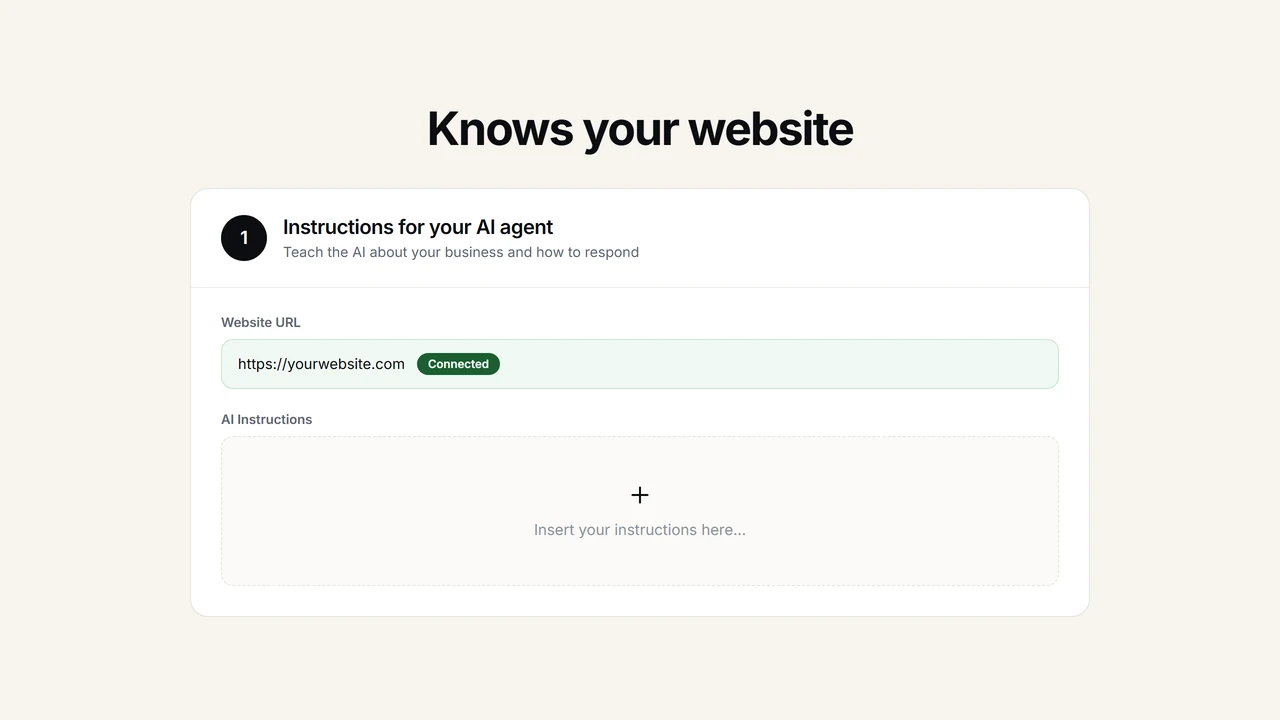
Every small business website is a quiet knowledge repository. Product specs live on listing pages. Return windows sit in policy footers. Shipping rates occupy a table nobody scrolls to. Hours are on the contact page, and sizing charts hide behind a tab. Customers land with a specific question, browse for ninety seconds, and leave without finding the answer that was two clicks away the entire time. Asyntai scans up to 50 of your pages and turns that scattered information into a single conversational entry point — an AI assistant that answers using your own content, not generic scripts.
- Automatic content ingestionPoint Asyntai at your URL and it reads through product pages, FAQs, policy documents, and blog posts — building a knowledge base without you copying a single paragraph.
- Always current, never staleWhen you update a price or change a return window on your site, a re-crawl refreshes the assistant's answers. No duplicate records to maintain, no sync to break.
- Understands how visitors actually askCustomers don't search by SKU or page title. They type things like "do you ship to Canada" or "can I return a sale item." The AI interprets intent and pulls the right answer.
Connect live data when your business outgrows static pages
Some questions can't be answered from a webpage alone. "Is my order shipped?" or "What's my account balance?" require real-time data. Custom Tools on Standard ($139/month) and Pro ($449/month) plans let the AI assistant call your own endpoints — inventory lookups, order tracking, appointment availability — and weave live results into the conversation. Your small business starts with content-based answers and graduates to dynamic ones without switching platforms or rebuilding anything.
- Order status in the chatPush a customer's order ID through User Context and the assistant answers shipping questions with real tracking data, not a generic "check your email" redirect.
- Inventory and availabilityConnect a stock endpoint and let the chatbot confirm whether an item is in stock, what sizes remain, or when a restock is expected — all in the same conversation.
- Appointment and booking lookupsService businesses can wire up a calendar API so the assistant checks openings and helps visitors pick a slot without leaving the chat window.
- No engineering team neededCustom Tools are configured through the dashboard with a URL, a description, and a test call. If you can use a form, you can set up a live data connection.
Go from zero to live in one sitting
No database to configure, no contacts to import, no fields to map. The setup takes less time than writing a single FAQ page — and the result answers more questions than any FAQ ever could.
- Create a free account and paste your website URL
- The AI scans up to 50 pages and builds a knowledge base from your content
- Copy the one-line embed snippet into your site header
- The chatbot goes live — answering visitor questions in 36 languages
<script src="https://asyntai.com/widget.js"
data-id="your-site-id" async>
</script>
</head>
# One snippet. Every answer on your site, instantly accessible.
Customer database software for small business — your questions
Practical answers for small business owners evaluating whether they need a CRM or something simpler.
How is this different from a traditional customer database or CRM?
A CRM stores contact records, deal stages, and interaction histories. That's valuable when you have a sales team managing pipelines. But most small businesses asking "what customer database should I use" actually mean something different: they want customers to find answers without emailing. Asyntai solves that problem directly. It reads your website content and lets visitors ask questions in natural language, getting instant answers drawn from your own pages. No contacts to import, no fields to customize, no per-seat fees.
I only have a basic website with a few pages. Is that enough content?
Even a five-page site carries meaningful information — your product or service descriptions, pricing, location, hours, and policies. Asyntai works with whatever you have published. If a customer could find the answer by reading your site carefully, the AI can surface it conversationally. You can also upload PDFs or paste additional text for anything not yet on your public pages.
What happens when I update my website content?
Trigger a re-crawl from your dashboard and the assistant's knowledge refreshes to match your current site. Changed a price, added a new product, updated your holiday hours — one click brings the AI up to date. There is no separate database to edit or sync.
Can the chatbot handle questions in languages other than English?
Yes. The widget interface renders in 36 languages and the assistant replies in whichever language the visitor types. A customer writing in Spanish gets a Spanish answer drawn from your English source content. For small businesses serving multilingual communities or selling internationally, this replaces what would otherwise require multilingual staff or translated FAQ pages.
What does it cost compared to a CRM subscription?
Asyntai starts with a free tier — 50 messages, one site, no credit card. Paid plans begin at $39 per month for 800 messages and two sites. Standard is $139 per month for 15,000 messages and three sites. Pro is $449 per month for 50,000 messages and up to twenty sites. Compare that to per-seat CRM pricing that often starts at $25–$75 per user per month before you've even configured anything.
Does the AI ever make up answers that aren't on my site?
The assistant is grounded in the content you provide — your crawled pages and any uploaded documents. When a question falls outside that scope, it says so honestly and offers to collect the visitor's details for follow-up. You can further tighten behavior with custom instructions specifying topics to defer to a human on.
Can I use this alongside my existing tools?
Absolutely. Asyntai doesn't replace your email, your spreadsheet of orders, or your invoicing software. It sits on top of your website and handles the front-line questions that would otherwise land in your inbox. Think of it as the customer-facing layer of your business knowledge — it answers questions so you can focus on fulfilling orders and delivering services.
What if I grow and eventually need a real CRM?
Asyntai isn't mutually exclusive with a CRM — many businesses use both. The chatbot continues handling visitor questions on your site regardless of what back-office tools you adopt later. And if you grow into Standard or Pro, Custom Tools let the assistant pull live data from whatever systems you run, so the two layers complement each other rather than competing.
Why the best customer database for a small business might already be your website
Search for "customer database software for small business" and the results read like a catalog written for companies with dedicated IT departments. Contact management platforms with pipeline views. CRM suites that charge per seat and require a three-week onboarding program. Marketing automation tools with workflow builders more complex than anything the business actually needs. Behind every recommendation sits an assumption: that what a small business lacks is a place to store customer records. But talk to the bakery owner answering the same "are you open on Mondays" question for the fourteenth time this week, or the Etsy seller whose inbox is full of messages asking about international shipping rates that are plainly listed on the website, and a different picture emerges. The gap isn't a missing database. It's that the information already published on the business website isn't reaching customers at the moment they need it.
Consider what your website actually contains. If you sell products, your pages list descriptions, prices, dimensions, materials, and care instructions. If you offer services, your site explains what's included, how scheduling works, and what the cancellation policy looks like. Your FAQ page — if you have one — addresses the twenty questions you've already answered hundreds of times by email. Your shipping page spells out rates, timelines, and regions. Your about page tells visitors who you are and why you started the business. All of this is customer-facing knowledge, organized and published for the explicit purpose of helping people decide whether to buy. In a very real sense, your website is already your customer database — the database of everything a customer might want to know. The problem is that customers can't query it the way they'd query a person.
That's the gap Asyntai fills. Point it at your website URL and the AI reads through up to 50 pages of your published content — product listings, policy pages, blog posts, FAQs, service descriptions, anything publicly accessible. From that crawl it builds a knowledge base, not a separate copy of your site, but an index that allows the AI to retrieve the specific paragraph or detail that answers a visitor's question. When someone lands on your site and types "do you deliver to rural addresses" into the chat widget, the assistant doesn't generate a generic answer. It finds the part of your shipping page that covers delivery zones and responds with your own information, phrased in a way that directly answers what was asked.
For a small business, this matters because the alternative — the traditional customer database approach — creates work rather than removing it. A CRM needs contacts imported, fields customized, integrations configured, and staff trained. Those are worthwhile investments when your sales process involves multiple touchpoints, long deal cycles, and a team of account managers. They're overhead when what you actually need is for the customer standing in the metaphorical doorway to get an answer before they walk away. The AI chatbot approach inverts the effort. Instead of building a system to organize information about customers, you let customers access the information you've already organized about your products and services. The work you did writing your website becomes the foundation, and the AI is the interface.
Language coverage is one of those details that seems minor until you realize how much business it quietly unlocks. Asyntai's widget operates in 36 languages. When a visitor types a question in Portuguese, they receive a Portuguese answer — drawn from your English content, translated on the fly, with no additional configuration. For a small business selling handmade goods internationally, or a local service provider in a multilingual neighborhood, that's the kind of capability that previously required either multilingual staff or a professionally translated version of the entire website. Now it happens automatically, for every visitor, on every page.
The skeptic's question — doesn't every business eventually outgrow this? — has a practical answer. Growth for most small businesses means more customers asking more questions, not necessarily more complex data structures. A bakery that goes from 50 orders a week to 200 doesn't suddenly need Salesforce. It needs the 150 additional "do you do gluten-free" and "can I pick up on Sunday" questions handled without hiring someone to answer them. The AI chatbot scales with volume because each additional conversation costs nothing beyond the plan's message allotment. And if a business does grow into needing live data — order tracking, appointment scheduling, inventory checks — Standard and Pro plans offer Custom Tools that let the assistant call external endpoints, so the same chat widget graduates from static content answers to dynamic, real-time ones without a platform change.
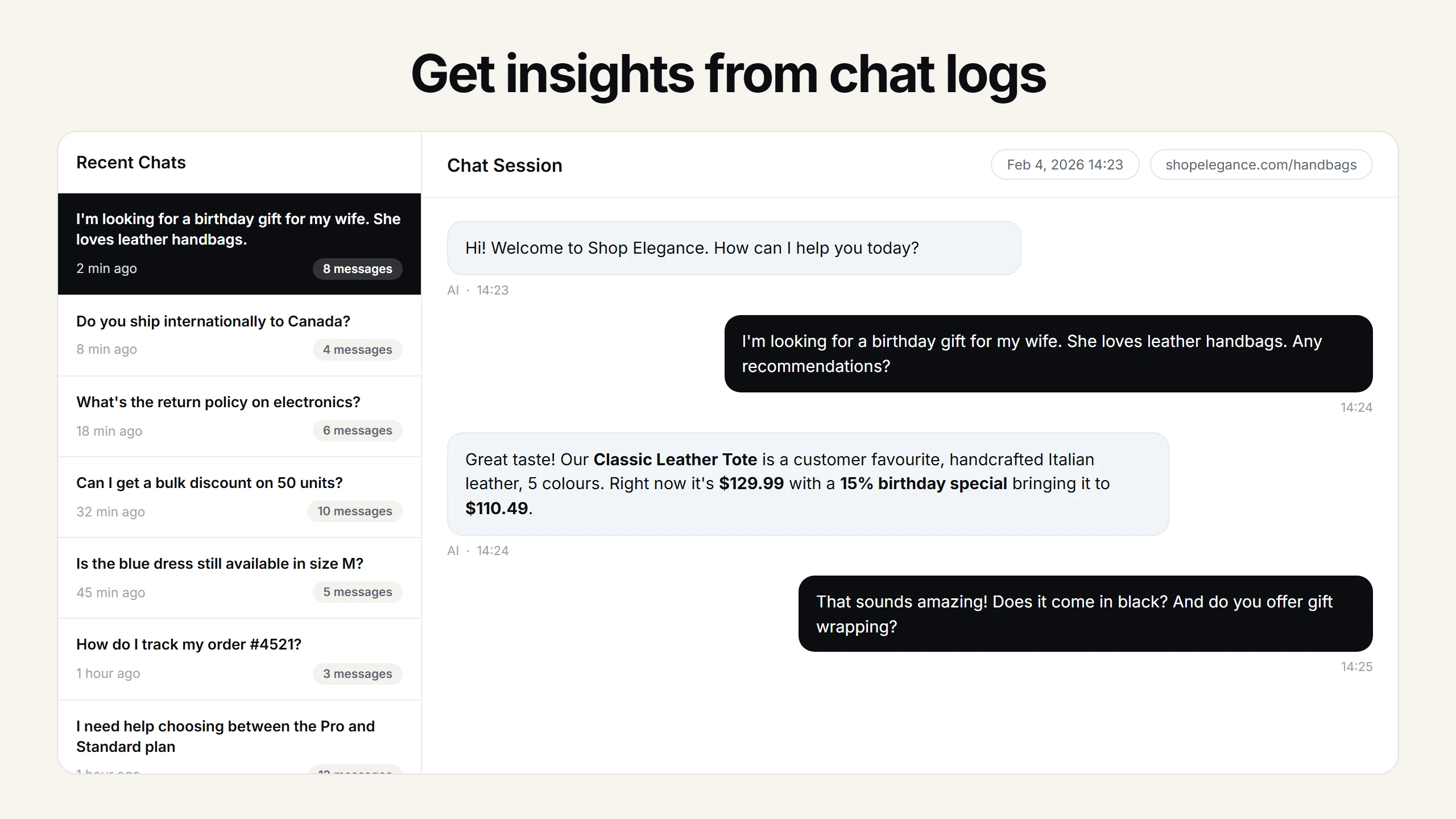
One pattern that emerges quickly after deployment is the diagnostic value of the questions themselves. Every question a visitor asks the chatbot is a signal about what your website communicates well and what it doesn't. If dozens of people each month ask about return shipping costs and the answer is buried in the third paragraph of your returns page, that's a content problem you can fix in five minutes — and once fixed, the AI immediately starts giving a clearer answer. The conversation log becomes a feedback loop: customers tell you, through their questions, exactly where your site falls short. No survey needed, no analytics interpretation required. The questions are the data.
Privacy and control are concerns that surface early in every conversation with small business owners, and rightfully so. Asyntai's model is straightforward: the AI answers using the content you choose to share — your public website pages and any documents you upload. It doesn't harvest visitor data, build profiles, or sell information. Conversations are stored in your dashboard for review but belong to your account. You control what the assistant can discuss through custom instructions — topics it should defer on, questions it should escalate, areas where it should suggest the visitor email you directly. The assistant operates within boundaries you set, not ones it decides for itself.
The economics deserve a plain comparison. A CRM with two user seats, basic contact management, and email integration typically runs $50 to $150 per month. Add a chatbot plugin to that CRM and the cost climbs further. Asyntai's free tier gives you 50 messages and one site at no charge — enough to evaluate whether the approach works for your business. The Starter plan at $39 per month covers 800 messages and two sites, which for most small businesses represents months of visitor questions. Standard at $139 per month handles 15,000 messages across three sites with advanced features like Custom Tools. The math isn't even close when you consider what each dollar actually produces: a CRM stores records you may never act on, while the chatbot resolves questions that would otherwise become emails you spend time answering manually.
There's an irony in how the software industry has addressed small business customer management. The tools keep getting more powerful — more fields, more automations, more integrations — while the core need stays remarkably simple. Customers want answers. They want them quickly. They want them without creating an account, submitting a form, or waiting for business hours. A small business that meets those expectations stands out not because it deployed sophisticated technology, but because it removed the friction that larger companies inadvertently create with their elaborate systems. Your website, plus an AI that makes it conversational, is often the entire customer database a small business needs — not because the business is small, but because the approach is precisely right for what customers are actually trying to do.