Finding the best AI chatbot for customer support means matching the tool to your queue
Intercom, Zendesk, Freshdesk, Tidio, Chatbase, and Asyntai each solve different slices of the support problem. This page walks through what each does well, where each stumbles, and how to run a bake-off that actually tells you which one belongs in your stack.
Test an AI support chatbot on your own content right now
Paste your support site or knowledge base URL and see how AI-grounded answers compare to what your team writes manually
The six filters that separate a strong support chatbot from a mediocre one
Review sites score chatbots on feature checklists. Support leaders should score them on operational impact. These are the dimensions that move resolution time, deflection rate, and customer satisfaction — not the ones that look good on a comparison grid.
- Grounding fidelity on your own help articlesFeed each candidate twenty real tickets from last month and measure how often the reply cites your actual documentation versus inventing plausible-sounding nonsense. This single test eliminates half the shortlist.
- Escalation behavior when the bot reaches its limitA chatbot that says "I don't know" is useless; one that collects context, summarizes the issue, and hands a warm lead to a human agent is the difference between deflection and abandonment.
- Language coverage that matches your real ticket geographyIf fifteen percent of your tickets arrive in Spanish or Portuguese, a chatbot limited to English deflects zero percent of that segment. Count the languages and test detection accuracy on mixed-language threads.
- Time from sign-up to first useful deflectionA platform that requires three weeks of intent mapping before it answers a single ticket has a hidden cost your comparison spreadsheet probably ignores: the salary hours burned during setup.
- Pricing model alignment with support volumePer-agent licensing punishes growing teams; per-resolution pricing sounds fair until you discover the vendor's definition of "resolved." Map your monthly ticket volume to each vendor's billing unit before the demo.
- Transparency about what the AI cannot doThe best vendor is the one that tells you upfront which ticket types their bot will fail on, rather than demo-ing only the golden path. Ask every candidate: "Show me a failure case."
Asyntai's position in the support chatbot market — and the gaps it does not pretend to fill
Asyntai is not a help desk. It does not replace Zendesk's ticketing pipeline or Intercom's product tours. It occupies the pre-ticket layer: an AI that answers from your documentation, captures what it cannot resolve, and forwards the rest to whatever system your agents already work in. Here is what that scope includes and excludes.
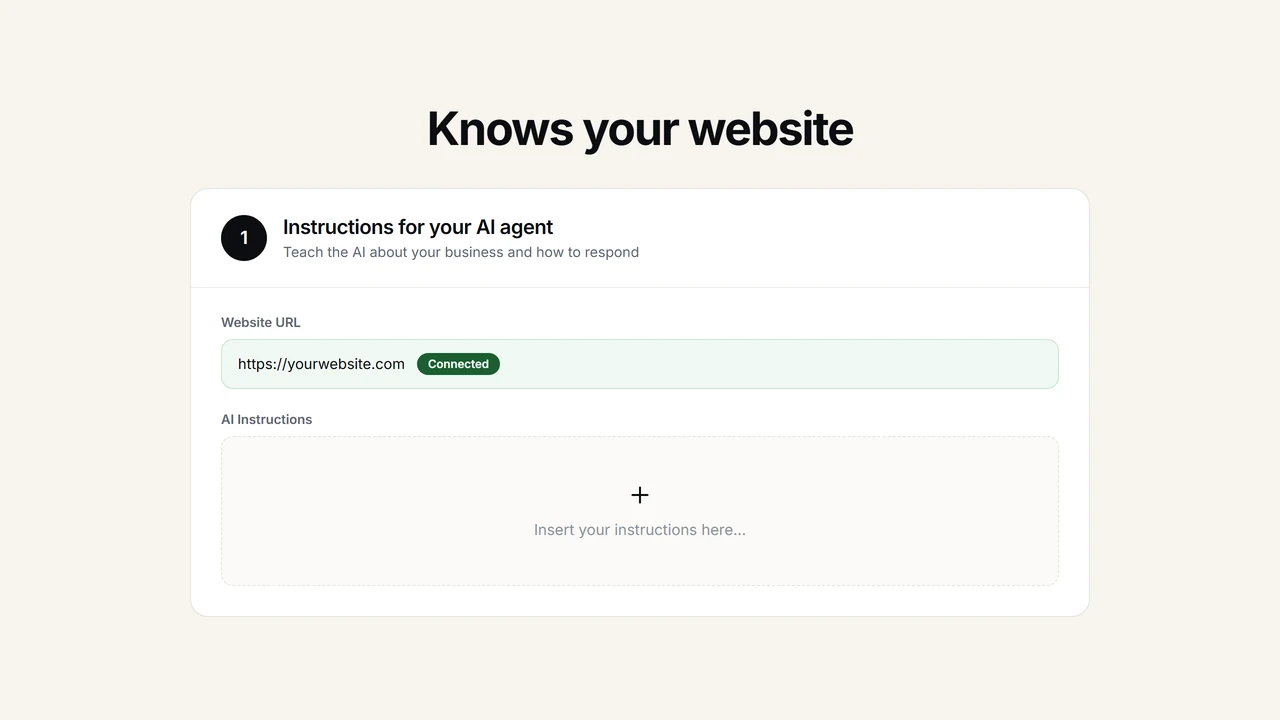
- Content-grounded deflection from your own pages and docsHand the chatbot your help center URL plus internal PDFs and it answers the repeat questions your agents handle on autopilot — shipping, returns, password resets, feature explanations — without hallucinating details.
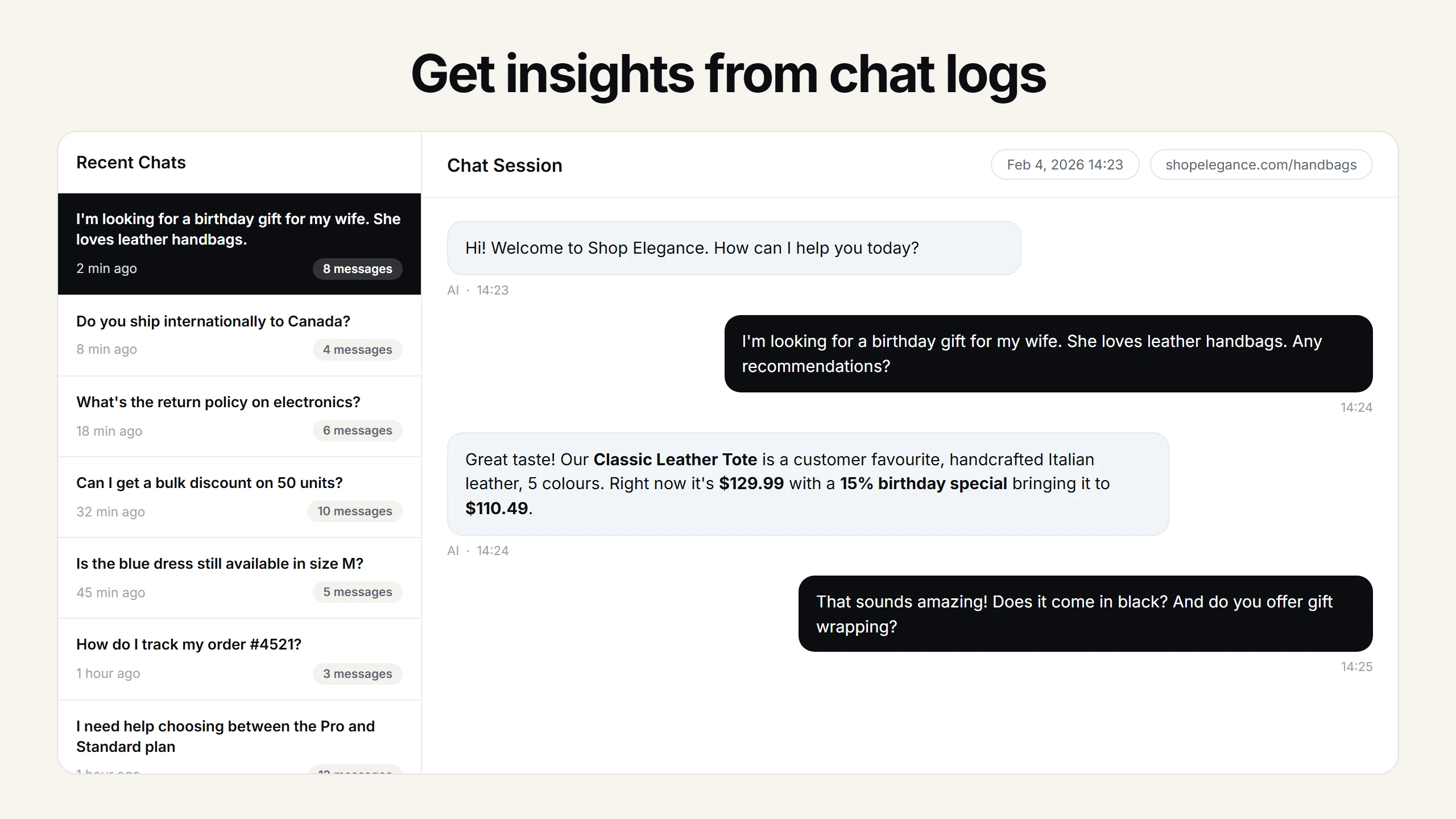
- Warm handoff with full transcript and contact dataWhen the chatbot cannot resolve a question, it collects the customer's name, email, a summary of the issue, and the entire conversation — then delivers all of it to your dashboard and your nominated inbox.
- Thirty-six-language detection with no configurationEvery incoming message is language-detected automatically. A Portuguese customer writes in Portuguese and gets a Portuguese reply referencing your English-authored help articles, translated on the fly.
- No agent seats, no per-resolution billing, no platform lock-inPaid tiers start at $39 monthly for 800 messages. The free tier covers 50 messages for piloting. Your entire support team can log in to review transcripts without adding cost.
Plugging the support chatbot into your existing stack
Asyntai does not ask you to migrate your help desk. It sits in front of your website as a JavaScript snippet, deflects what it can, and pushes everything else into the inbox your agents already monitor. Installation is the same regardless of whether you run Zendesk, Freshdesk, HubSpot, or a shared Gmail.
- Register for a free account, copy the widget snippet from your Asyntai dashboard.
- Add the snippet to your website's
<head>— directly in the template, through a CMS header injection, or via a tag manager. - Point the chatbot at your help center, knowledge base, or support documentation URL and upload any internal policy documents separately.
- Write escalation rules in plain English — "always hand off billing disputes to a human," "collect order number before answering shipping questions" — test against recent tickets, then publish.
<script src="https://asyntai.com/widget.js"
data-id="your-support-id" async>
</script>
</head>
# Deflecting repeat support questions from next page load.
Best AI chatbot for customer support — evaluator questions
What support managers, CX directors, and ops leads typically ask while narrowing their vendor shortlist.
How does Asyntai compare to Intercom Fin for customer support deflection?
Intercom Fin is deeply integrated into Intercom's ecosystem — tickets, inbox, product tours, outbound campaigns — and is strongest when your team already runs the full Intercom suite. Asyntai is platform-agnostic: it sits in front of any website, trains from any help center URL, and forwards unresolved conversations to whichever inbox or help desk you already use. If you want a single vendor for the entire support stack, Intercom is a credible choice with pricing to match. If you want an AI deflection layer that drops into your existing setup without a platform migration, that is where Asyntai fits.
Where does Zendesk's AI stand, and when should I use Asyntai instead?
Zendesk's AI features — Answer Bot, tone shift, generative replies — are strongest for teams embedded in the Zendesk ticketing ecosystem. The trade-offs show when you want the AI on your public website rather than inside the ticket interface: Zendesk's public-facing chat relies on their messaging widget, which ties you further into the platform. Asyntai works as a lightweight pre-ticket layer on any site, routing captures into Zendesk by email when needed. Teams often run both: Zendesk for the ticket pipeline, Asyntai on the website for first-touch deflection.
Is Freshdesk Freddy AI a better option for budget-conscious teams?
Freshdesk Freddy is bundled into certain Freshdesk tiers, which makes it feel free if you already pay for those tiers. The AI quality for open-ended content grounding, however, is narrower than dedicated tools — Freddy excels at canned-response suggestion and ticket classification rather than generating nuanced, docs-grounded answers. If your support volume is high and your questions are repetitive and template-able, Freddy handles it. If visitors ask varied, content-heavy questions that require synthesizing across multiple help articles, a grounding-first tool like Asyntai typically produces better answers.
Tidio has a free tier with AI — why pay for something else?
Tidio's free tier is generous for live-chat-first workflows, and their Lyro AI add-on handles basic FAQ deflection. The gap appears in three areas: multilingual depth (Asyntai covers 36 languages versus a smaller set), content grounding from arbitrary URLs and uploaded documents, and lead capture with full transcript forwarding. For a solo operator who mostly wants live chat with a bot fallback, Tidio is a reasonable starting point. For a support operation that needs AI-first deflection across languages and content sources, the tooling diverges.
Chatbase lets me upload a PDF and get a support bot — how is Asyntai different?
Chatbase pioneered document-grounded chatbots and remains clean for single-document Q&A. The feature gap widens when support operations need custom escalation rules, structured lead capture, multi-site deployment with separate knowledge bases per property, logged-in user recognition, and conversation analytics beyond basic message counts. Asyntai includes those capabilities natively. If your entire support surface is a single FAQ document with no growth plans, Chatbase covers it. If the support role is expected to expand, starting on a broader platform avoids a migration later.
Can the chatbot recognize logged-in customers and personalize support answers?
On Standard and Pro plans, your site populates window.Asyntai.userContext with whatever customer data you choose — account status, subscription tier, recent order ID, renewal date. The chatbot weaves that context into its replies: "I see you're on the Pro plan — the feature you're asking about is available under Settings > Integrations. Want me to walk you through it?" This is not a CRM integration — it is a JavaScript data pass your page controls entirely.
What happens to conversations the chatbot cannot resolve?
The chatbot collects the customer's name, email, and optionally phone number, attaches the full conversation transcript with the unresolved question clearly identified, and delivers the package to your Asyntai dashboard plus any email address you configure. Most teams point that email at their existing help desk — Zendesk, Freshdesk, Help Scout, or a shared inbox — so the handoff enters the same queue as organic tickets, with context already attached.
How do I run a proper bake-off between these tools?
Pull your last fifty resolved tickets. Categorize them by type: FAQ-answerable, policy-dependent, account-specific, and requires-human. Feed the FAQ and policy tickets to each shortlisted vendor and score grounding accuracy, tone, and hallucination rate. Test the escalation path for the requires-human set. Compare setup time honestly — include the hours your team spent configuring each tool, not just the subscription cost. The vendor that wins on your tickets with your content in your languages is the right one, regardless of what any comparison page says.
How to actually pick the best AI chatbot for customer support
Searching for "best AI chatbot for customer support" returns a wall of listicles, each ranking the same six vendors in a different order depending on who paid for the placement. The rankings rarely help because they evaluate tools against a generic rubric instead of against the specific support operation you run. A 200-person SaaS company with a mature Zendesk instance has radically different needs from a 15-person ecommerce brand whose founder still answers half the tickets personally. This page names the real contenders, describes what each does well, identifies where each falls short, and explains how to run a comparison that produces a trustworthy answer for your queue.
The vendor landscape in 2026 breaks along clear lines. Intercom Fin generates answers grounded in your Intercom help center articles — tightly coupled to the ecosystem, exceptional if you already run the full suite, limiting if you do not. Zendesk's AI capabilities live inside the Agent Workspace: generative reply suggestions, ticket classification, and Answer Bot for help center content, strongest inside the ticket interface and weaker as a standalone public-facing widget. Freshdesk Freddy handles canned-response suggestions and routing well but lags in open-ended content grounding. Tidio's Lyro add-on suits small teams that want a human-first inbox with automated fallback. Chatbase occupies the document-upload niche — clean for narrow Q&A, limited when the operation outgrows a single knowledge source.
Asyntai enters from a specific angle: an AI-first website chatbot that grounds answers in your documentation, captures unresolved inquiries with full context, and routes them wherever your agents already work. It does not replace your help desk or ticketing system — it sits upstream, deflecting the questions your help articles already answer and packaging the rest for human review. Asyntai differentiates in three areas: installation speed (a JavaScript snippet rather than a platform migration), language breadth (36 languages with automatic detection versus the smaller sets most competitors support), and pricing transparency (flat monthly tiers based on message volume, no per-agent fees, no per-resolution billing).
The grounding question is where most vendor evaluations should start and where most buyers spend too little time. Every AI chatbot vendor claims their tool answers from your knowledge base. The material difference is how accurately and how faithfully. A loosely grounded chatbot paraphrases your documentation so aggressively that the answer no longer matches your actual policy; a tightly grounded one cites the relevant article and stays close to the source text. The only way to measure this is to test it yourself. Take twenty recent tickets that your team resolved using existing help articles, strip out the agent's response, and feed the customer's question to each shortlisted chatbot. Score each response on three criteria: did it reference the correct article, did it accurately represent the content of that article, and did it avoid inventing details not present in the source? Any chatbot that scores below eighty percent on accuracy-to-source across those twenty questions will cause as many problems as it solves once deployed to real customers.
Escalation behavior is the second dimension that separates a deflection tool from a frustration tool. The worst outcome in support automation is a chatbot that confidently gives a wrong answer and closes the conversation — the customer walks away with incorrect information and never reaches a human. The second worst is a chatbot that says "I can't help with that" and offers no path forward. The ideal behavior is a chatbot that recognizes its limit, acknowledges it clearly, collects the context a human agent would need to pick up the thread, and routes the inquiry without making the customer repeat themselves. When evaluating vendors, explicitly test the failure path: ask questions the chatbot should not be able to answer and observe what happens. Does it fabricate? Does it dead-end? Does it collect contact information and summarize the issue? Does that summary actually reach your agents in a usable format? Asyntai's approach is to collect name, email, and the full transcript, then push the package to both the dashboard and a nominated email address — designed so the handoff enters your existing ticket queue with zero manual re-entry.
Language coverage is routinely underweighted in vendor comparisons because English-speaking evaluation teams naturally test in English. If your support queue receives even a modest share of non-English tickets — and if you sell internationally, it almost certainly does — the chatbot's language handling becomes a deflection multiplier or a deflection ceiling. A chatbot that handles English brilliantly and ignores Portuguese tickets deflects zero percent of Portuguese volume. Asyntai detects the customer's language from their first message and replies in that language, drawing on your English-authored help articles and translating the grounded answer on the fly. Thirty-six languages are covered without configuring a single language setting. Intercom Fin supports a growing but smaller language set; Zendesk's AI language support varies by feature; Tidio's Lyro covers a limited range; Chatbase's multilingual capability is improving but narrower. If fifteen or twenty percent of your tickets come in non-English languages, test each vendor in those specific languages before signing.
Setup time is a hidden cost that comparison grids systematically ignore. A tool that requires four weeks of intent mapping and dialog-tree authoring before it deflects a single ticket costs your team those four weeks of salary on top of the subscription fee. Intercom Fin's setup is relatively fast if your knowledge base already lives in their help center — but migrating content into Intercom to use Fin is a project in itself. Chatbase ingests a URL or PDF in minutes. Asyntai likewise ingests a URL and uploaded documents in minutes, with no requirement that your content live in a particular vendor's ecosystem — teams on Notion, Confluence, or a static site avoid a content migration nobody budgeted for.
Pricing structures across this market deserve honest unpacking because the billing models are deliberately hard to compare. Intercom prices per seat with additional Fin resolution charges — a ten-person team can land in four-figure monthly territory. Zendesk gates AI behind higher-tier agent plans. Freshdesk bundles Freddy but caps AI sessions. Tidio charges separately for Lyro beyond a limited free allocation. Chatbase runs on conversation tiers. Asyntai charges a flat monthly rate by message volume: free for 50 messages, $39 per month for 2,500 on the first paid tier, higher tiers for heavier traffic. No per-agent surcharge, no per-resolution billing. For a team processing a few thousand chatbot interactions monthly, the annual gap between per-seat enterprise pricing and flat message-based pricing can reach tens of thousands of dollars.
Multi-site deployment matters for businesses running separate support surfaces — a marketing site, a product documentation portal, an app login page, a partner portal. Zendesk and Intercom scope their AI to a single workspace per subscription, with additional workspaces adding cost. Asyntai includes multiple sites per plan: one on free, two on Starter, three on Standard, up to ten on Pro. Each site gets an independent chatbot with its own knowledge base, its own rules, and its own escalation routing. An agency managing support chatbots for three client websites runs all three under a single Standard plan rather than purchasing three separate subscriptions.
Personalization for logged-in users is a feature that closes the gap between a generic FAQ bot and a support agent who knows the customer's context. When a subscriber asks "when does my plan renew?" a generic chatbot points to the billing FAQ; a personalized one answers "your Pro plan renews on May 12th." Intercom and Zendesk achieve this through their native user identity systems. Asyntai achieves it through window.Asyntai.userContext, a JavaScript object your page populates with whatever account data you want the chatbot to reference — subscription tier, renewal date, recent order ID, account status, feature access. Available on Standard and Pro plans, it requires no backend integration and no CRM connector. For SaaS companies and membership-based businesses, this is often the dividing line between a chatbot that reduces ticket volume and one that merely delays it.
Where Asyntai is genuinely not the right pick deserves the same candor as where it wins. Large enterprises that have already invested in Intercom or Zendesk and want their AI tightly coupled to their existing ticketing, routing, and reporting pipeline should evaluate the native AI within those platforms first — the integration depth at that scale is a real advantage. Businesses that need HIPAA-compliant or FedRAMP-certified infrastructure should look at vendors built specifically for regulated environments. Support teams whose primary workflow is human-staffed live chat with AI as a secondary assist — luxury brands, concierge services, high-touch consulting — will find dedicated live-chat platforms better suited to their model. Asyntai's lane is AI-first deflection for content-answerable questions, warm handoff for everything else, and a pricing model that does not scale with headcount. If that matches how your support operation works or wants to work, it belongs on the shortlist.
The only evaluation methodology that produces a trustworthy recommendation is a bake-off on your own content. Pull fifty recent resolved tickets, sort them into buckets — FAQ-answerable, policy-dependent, account-specific, and requires-human — then feed the first two buckets to each shortlisted vendor and grade accuracy, tone, and hallucination rate. Measure setup time in hours, not just calendar days. Calculate annual total cost including agent seats, overage fees, and professional services. The vendor that wins across accuracy, escalation quality, language coverage, and total cost on your own data is the right one — no listicle, including this page, substitutes for that test.
If Asyntai makes your shortlist, the next step takes about an hour. Register for the free tier, paste the snippet on a staging page, point it at your help center URL, upload internal policy documents, write escalation rules matching your triage logic, and run the fifty-ticket set through it. You will know within that session whether the grounding quality and handoff behavior meet your bar. If they do, scale up. If not, you have lost an hour and gained a data point — still more useful than another comparison grid.