The best AI agent for customer support doesn't just talk — it acts
Asyntai goes beyond scripted replies. It retrieves accurate answers from your own content, calls your APIs for live order and account data, and hands complex cases to humans with every detail intact. One snippet, 36 languages, zero decision trees.
Watch the AI agent work on your own website
Paste your URL and see the agent retrieve real answers from your pages — no setup required
Every answer traced back to your own content, never fabricated
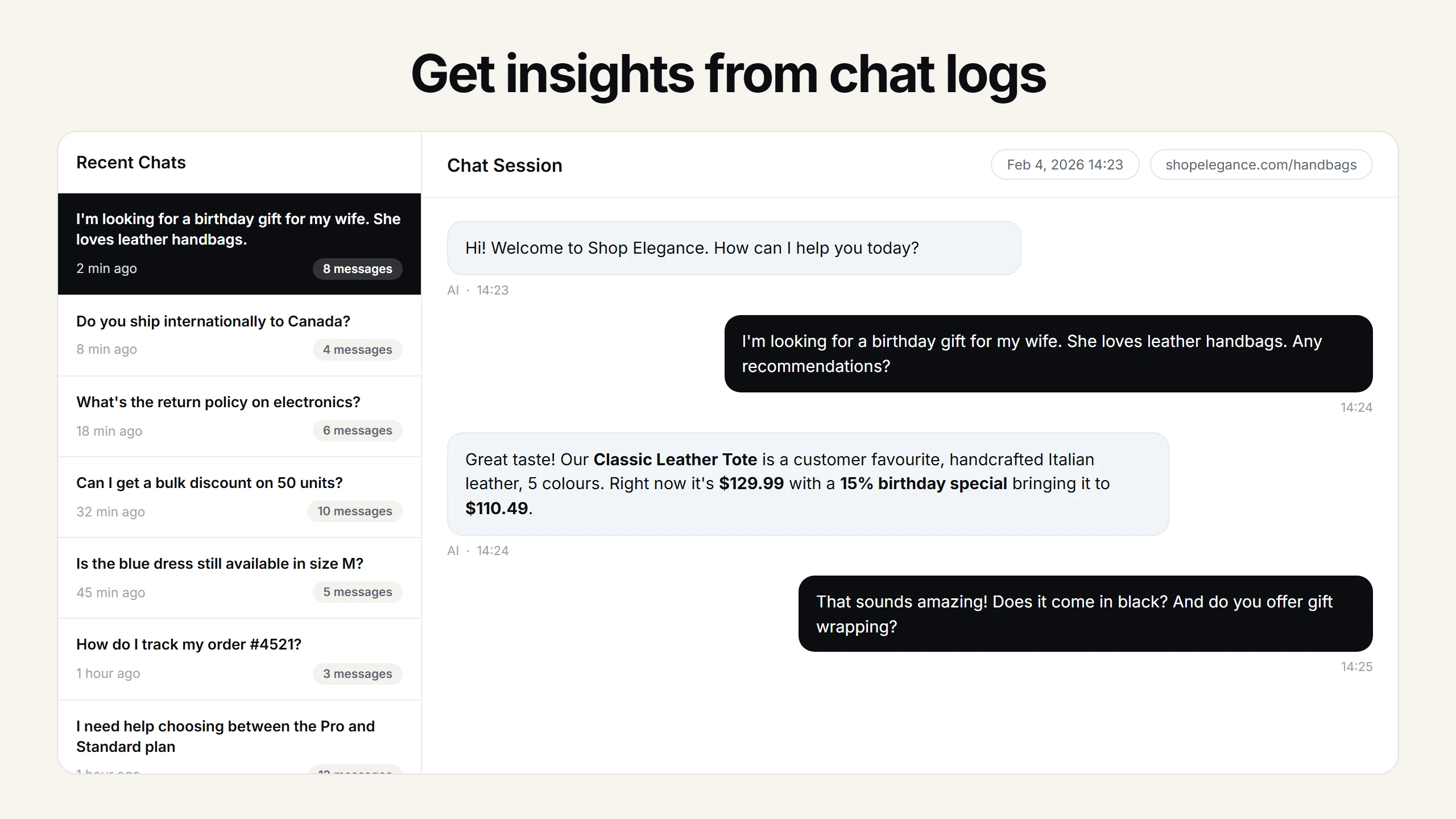
The difference between a useful AI agent and a liability is whether it invents or retrieves. Asyntai uses retrieval-augmented generation to pull answers directly from your website pages, help articles, uploaded PDFs, and internal documents. The AI locates the specific paragraph that addresses the visitor's question and composes a response grounded in that source material. When no relevant content exists, it says so and offers to connect the visitor with your team — it does not guess, hallucinate, or improvise policy.
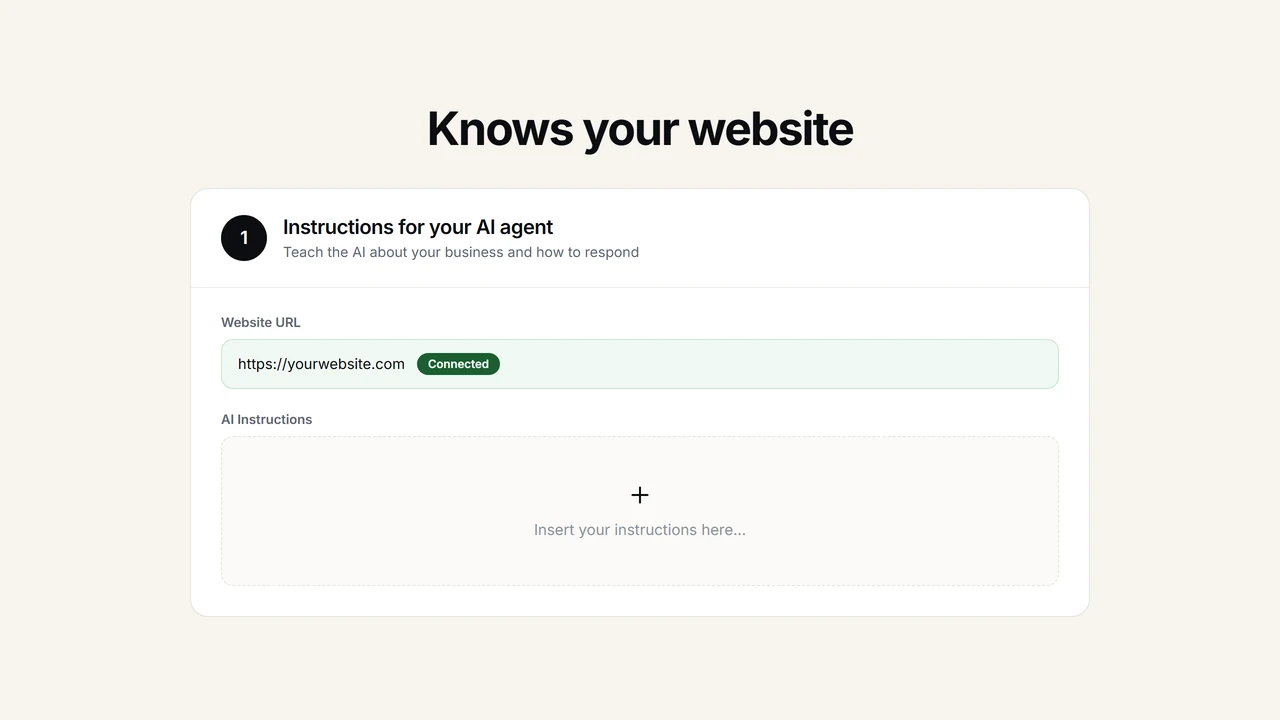
- Crawls your live websiteProduct pages, pricing tables, policy documents, help articles, blog posts — the agent indexes up to 50 pages and uses them as its knowledge foundation for every conversation.
- Accepts private document uploadsInternal procedures, warranty playbooks, partner-specific pricing sheets, staff-only guides — upload as PDF or pasted text and the agent references them alongside public content.
- Cites sources transparentlyThe agent can reference the exact page or document it drew an answer from, so visitors can verify and your team can audit accuracy at any time.
Custom Tools let the agent pull live data and trigger real workflows
What separates an AI agent from a chatbot is the ability to do things, not just say things. On Standard ($139/month) and Pro ($449/month) plans, Asyntai's Custom Tools feature lets the agent call your own API endpoints mid-conversation — checking order status, looking up account details, initiating returns, scheduling appointments, or any action your backend supports. The visitor gets an answer drawn from live systems, not cached content.
- Order and shipment lookupsThe agent calls your order API with the customer's reference number and returns real-time tracking status, delivery estimates, and item details within the conversation.
- Account and subscription checksVerify plan tier, renewal dates, usage limits, or payment status by connecting the agent to your user management endpoints.
- Return and refund initiationConfigure the agent to trigger return workflows through your backend, collecting the required details from the visitor and submitting the request programmatically.
- Appointment and booking creationConnect your scheduling system and let the agent check availability, propose time slots, and confirm bookings — all within the chat conversation.
- Any endpoint you exposeCustom Tools works with any REST API. If your system has an endpoint for it, the agent can call it. You define the parameters, the agent handles the conversation flow.
Deploy the AI agent on your website in one sitting
No SDK integration, no developer sprint, no migration project. Copy a snippet, point the agent at your content, write a few behavioral rules, and your support operation has a new frontline responder before the day ends.
- Create a free Asyntai account — the Free plan covers 1 website and 50 messages per month at $0, enough to validate the agent on real visitor traffic.
- Copy your unique JavaScript snippet from the dashboard and paste it into the
<head>of your website — via your CMS header settings, a tag manager, or the template directly. - Provide your site URL for automatic content crawling, then upload any private documents the agent should reference. Upgrade to Starter ($39/month, 2 sites, 800 messages), Standard ($139/month, 3 sites, 15,000 messages), or Pro ($449/month, 20 sites, 50,000 messages) as volume grows.
- Write behavioral instructions in plain language — escalation thresholds, tone guidelines, topics to avoid — then test with real questions and go live.
<script src="https://asyntai.com/widget.js"
data-id="your-site-id" async>
</script>
# AI agent live — answers, actions, escalations handled.
Best AI Agent for Customer Support — FAQs
The questions operations teams settle before putting an AI agent on the front line.
What makes this an "agent" rather than a chatbot?
A chatbot answers questions from a script or a knowledge base. An agent does that and also takes actions — looking up order status, checking account details, initiating returns, booking appointments — by calling your own API endpoints during the conversation. Asyntai's Custom Tools feature on Standard and Pro plans is what enables this distinction. The agent decides when to call an endpoint based on the visitor's question, passes the right parameters, and weaves the live result into its response.
How does the agent avoid making things up?
Asyntai uses retrieval-augmented generation, which means the AI searches your indexed content for relevant passages before composing a response. If no relevant content exists for a question, the agent acknowledges the gap rather than fabricating an answer. You can also write behavioral instructions that restrict the agent to specific topics or require it to escalate certain categories of questions to your human team.
Can the agent handle conversations in languages my team doesn't speak?
Yes. The agent detects the visitor's language from their first message and responds in kind across 36 supported languages. Your content can be entirely in English — the agent handles the translation layer automatically. A visitor writing in Japanese gets a Japanese response grounded in your English documentation, with no separate language configuration required.
What happens when the agent can't resolve a question?
It collects the visitor's name and email, preserves the full conversation transcript, and delivers everything to your Asyntai dashboard and email inbox. Your human agent picks up the thread with complete context — what was asked, what the AI answered, and where it got stuck. No cold restarts or repeated explanations.
How do Custom Tools connect to my systems?
You define each tool in the Asyntai dashboard by specifying the API endpoint URL, the HTTP method, the parameters the agent should collect from the visitor, and authentication headers. When a visitor asks a question that requires live data, the agent calls your endpoint, receives the JSON response, and uses it to compose its reply. No SDK or code changes on your side — just an accessible API endpoint.
Is there a risk the agent will perform actions I didn't authorize?
No. The agent can only call endpoints you explicitly configure as Custom Tools, with the exact parameters you define. It cannot discover or invoke endpoints you haven't registered. Behavioral instructions add a second layer — you can require confirmation before certain actions, restrict the agent to read-only lookups, or mandate escalation for anything involving refunds above a threshold.
What does the agent cost?
The free tier covers 50 messages per month on one website, enough to validate the agent on real traffic. Starter is $39/month for 2 sites and 800 messages. Standard is $139/month for 3 sites, 15,000 messages, and access to Custom Tools. Pro is $449/month for 20 sites, 50,000 messages, Custom Tools, and automatic white-label branding. Each AI response counts as one message.
Can I white-label the agent so it matches my brand?
On Pro plans, white-labeling is automatic — Asyntai branding is removed and replaced with your own. On Standard plans, white-labeling is available by contacting [email protected]. Colors, avatar, greeting text, and the assistant name are fully customizable on every plan.
How quickly can I get the agent live?
Most teams go from signup to live agent in under an hour. The snippet install takes two minutes. Content crawling takes a few minutes more. Writing behavioral instructions and testing a handful of real questions is the only step that requires thought — and even that rarely takes more than an afternoon.
What actually makes an AI agent the best choice for customer support
There is a quiet revolution happening inside support departments, and it has nothing to do with hiring more agents or adding another shift. Companies are discovering that the majority of their inbound conversations follow a remarkably narrow pattern: a customer asks something that already has an answer sitting in a help article, a product page, or a policy document — and a human agent spends five minutes locating that answer and retyping it in conversational form. The best AI agent for customer support is the one that eliminates that translation step entirely, going from question to grounded answer in seconds, without a human ever touching the keyboard.
But answering questions is table stakes. The word "agent" carries a specific promise that "chatbot" does not: the ability to act. A chatbot that can tell a customer "our return window is 30 days" is useful. An agent that can look up order #4821, confirm it shipped on Tuesday, pull the tracking number from your fulfillment system, and present it within the conversation — that is a fundamentally different capability. Asyntai bridges this gap through Custom Tools, a feature on Standard and Pro plans that lets the AI call your own API endpoints mid-conversation. The visitor asks where their package is; the agent calls your shipping API, retrieves the live status, and delivers the answer. No tab-switching, no "let me check on that," no hold music.
Accuracy is the fault line that separates a trustworthy agent from a dangerous one. Large language models are powerful, but left unsupervised they will confidently state things that are not true — inventing return policies, fabricating shipping timelines, quoting prices that do not exist. Asyntai neutralizes this risk through retrieval-augmented generation. When a visitor asks a question, the system first searches your indexed content — website pages, help articles, uploaded documents — for passages that address the query. Only then does the AI compose a response, grounding every claim in material you actually published. The agent does not reach into its general knowledge to fill gaps. When it lacks relevant content, it tells the visitor honestly and offers to connect them with a human. This is not a nice-to-have; for any business where incorrect information carries financial or legal consequences, it is the minimum viable standard.
Language reach is where AI agents create value that no human team can economically replicate. Hiring a support representative who speaks Korean costs the same as hiring one who speaks English — but the Korean-speaking rep only serves Korean-speaking customers, sitting idle when no Korean tickets arrive. An AI agent that handles 36 languages simultaneously serves every visitor in their preferred language without any incremental cost per language. Asyntai detects the visitor's language from their opening message and responds accordingly, drawing from your content regardless of the language it was written in. A Brazilian visitor gets Portuguese answers from your English help articles. A Turkish visitor gets Turkish. The linguistic math that makes multilingual human teams prohibitively expensive simply does not apply.
The behavioral layer is what transforms raw AI capability into a reliable support operation. Without guardrails, even the most accurate AI agent can wander into territory you would rather it avoided — quoting a competitor's pricing, speculating about features on your roadmap, agreeing to refund amounts above your policy threshold. Asyntai lets you write instructions in plain sentences that bind every conversation: "never discuss competitor products," "escalate refund requests over $200 to a human," "always recommend the Standard plan when asked about Custom Tools." These instructions execute consistently across every language, every time zone, every conversation — the kind of consistency that a human team of twenty achieves only on its best days.
Escalation design reveals whether an AI agent was built for demos or for production. A demo-grade agent treats escalation as failure — the conversation ends, the visitor fills out a form, and a ticket enters the queue with minimal context. A production-grade agent treats escalation as collaboration. Asyntai captures the visitor's contact details, preserves the complete conversation history, notes why the AI chose to escalate, and delivers the full package to your dashboard and inbox in real time. The human who picks up the thread already knows the visitor's question, the AI's partial answer, and the specific gap that triggered the handoff. First response time for the human drops because half the diagnostic work is already done.
Personalization is where the "agent" label earns its weight most convincingly. On Standard and Pro plans, your website can push customer-specific data into a JavaScript variable before the chat widget loads — account tier, subscription status, recent order IDs, loyalty level, geographic region. The AI agent weaves this context into its responses naturally. A Pro subscriber asking about API rate limits gets the Pro-tier answer. A free-tier user asking the same question gets the free-tier answer plus a mention of what upgrading would unlock. This is not segmentation configured in a marketing platform; it is real-time contextual awareness happening inside the support conversation itself.
The operational shift for support managers is worth understanding before it arrives. Traditional support metrics revolve around human performance: average handle time, first response time, tickets per agent per hour. With an AI agent handling the frontline, those metrics become less relevant. The new questions are: What percentage of conversations did the agent resolve without escalation? Which topic clusters generate the most escalations? Where are the content gaps that cause the agent to fall short? The manager's role evolves from scheduling shifts and coaching reps to curating knowledge and refining behavioral instructions. It is a different job, arguably a more strategic one, and teams that make the transition deliberately tend to find it liberating rather than threatening.
Multi-site deployment matters for any organization that operates more than one digital property. A retail brand with separate storefronts for different product lines needs independent agents with independent knowledge bases and independent behavioral rules. An agency managing support for multiple clients needs clean separation so Client A's product information never leaks into Client B's conversations. Asyntai scales through plan-based site limits: one site on Free, two on Starter, three on Standard, and twenty on Pro. Each site maintains its own content index, its own Custom Tools configuration, its own instructions, and its own conversation archive. The agent serving your European storefront knows nothing about your North American inventory, and vice versa.
White-label capability rounds out the agent's fit for businesses where brand consistency matters. On Pro plans, Asyntai branding is automatically removed — the chat widget appears under your name, your colors, your avatar. On Standard plans, white-labeling is available by contacting [email protected]. For agencies deploying the agent on client websites, this means the end customer never sees a third-party brand. For enterprise teams with strict brand guidelines, it means the support experience feels native rather than bolted on.
Cost structure deserves a clear-eyed comparison. A single full-time support agent costs between forty and eighty thousand dollars annually depending on location, covering eight hours a day in one language. Asyntai's Starter plan at $39 per month covers 2,500 conversations across 36 languages, 24 hours a day. Standard at $139 per month adds Custom Tools and 15,000 messages. Pro at $449 per month adds 50,000 messages and twenty sites. The unit economics are not incrementally better — they are categorically different. The AI agent does not replace the need for human judgment on complex cases; it replaces the need for human labor on the sixty to eighty percent of conversations that were never complex to begin with.
Integration depth is deliberately lightweight by design. Some platforms sell themselves on the number of native integrations they maintain — hundreds of connectors, each requiring configuration, each potentially breaking when the third-party API changes. Asyntai takes a different approach: one JavaScript snippet for installation, one content crawl for knowledge, and Custom Tools for anything that requires live data from your systems. You bring the API endpoints; the agent brings the conversation intelligence. This architecture means fewer moving parts, fewer permissions to manage, and fewer vendor-specific coupling points that create migration risk down the road.
The trajectory of customer expectations makes AI agents less optional with each passing quarter. Visitors who interact with AI-powered support on one website recalibrate their expectations for every website. A two-minute wait for a live agent starts to feel unreasonable when the last three sites they visited answered instantly. Businesses that delay AI agent adoption are not standing still — they are falling behind a rising baseline of customer experience. The question is no longer whether to deploy an AI agent but which one to deploy, and the answer hinges on accuracy, action capability, and operational reliability under real-world conditions.
Asyntai was built for that answer. Retrieval-grounded accuracy that does not fabricate. Custom Tools that fetch live data and trigger real workflows. Thirty-six languages without per-language configuration. Escalation that preserves context instead of discarding it. Behavioral guardrails written in plain sentences. A single JavaScript snippet that installs in minutes. The free plan covers 50 messages — enough to test the agent on real visitor traffic and see whether it meets the bar. For teams ready to scale, paid plans start at $39 per month and grow with your conversation volume. The best AI agent for customer support is the one that handles your actual questions accurately, acts on your actual systems reliably, and routes the rest to your actual team with full context. That is what this does.