B2B customer support built for products that need explaining
Your buyers evaluate complex products across long cycles with multiple stakeholders. Asyntai answers their technical questions instantly — using your own documentation, specs, and guides — so deals keep moving and accounts stay satisfied.
See how AI handles your technical documentation
Enter your site URL and watch the assistant answer the kind of questions your B2B buyers actually ask
Support that speaks your buyers' language
B2B customers don't ask simple questions. They ask about API rate limits, integration compatibility, SLA terms, deployment prerequisites, and the difference between your Enterprise and Professional tiers. A generic chatbot built on marketing copy can't handle that. Asyntai answers using your own content — technical documentation, implementation guides, changelogs, compliance pages, and product specs — so the response matches the depth your buyer expects. The assistant treats every question as though it came from someone who read the datasheet first.
- Documentation-grounded answersEvery response pulls from your published specs, API docs, setup guides, and knowledge base articles — never from generic web content or assumptions about your product.
- Multi-stakeholder clarityWhether the visitor is a developer checking integration requirements or a procurement lead comparing license tiers, the assistant adapts its answer to the question's complexity level.
- After-hours coverage for global accountsB2B deals involve buyers across time zones. The assistant delivers the same technical depth at 2am Tokyo time as it does during your team's business hours in New York.
Connect your systems so answers stay account-aware
B2B support fails when the assistant can't tell the difference between a trial user and a six-figure account. With Custom Tools on Standard ($139/month) and Pro ($449/month) plans, Asyntai calls your own endpoints during a conversation — pulling live contract details, license status, or usage metrics so the answer reflects the specific account asking. The assistant doesn't guess what plan a customer is on or whether their subscription includes a particular module. It checks, then answers.
- Live contract lookupsThe assistant queries your CRM or billing system mid-conversation to confirm renewal dates, seat counts, or module entitlements before answering the customer's question.
- Usage and quota visibilityWhen a customer asks why something isn't working, the assistant can check their API usage, storage consumption, or rate-limit status through your endpoints and explain what's happening.
- Escalation with full contextWhen a question requires a human — contract renegotiation, custom SLA discussion, security review — the assistant hands off with the full transcript and account details attached.
- User Context for signed-in buyersYour application pushes account-level data into a JavaScript object the widget reads. The assistant knows who's asking before the first message, and answers accordingly.
- Selective data exposureYou control exactly which fields the assistant can see and reference. Internal margin data, sales notes, or negotiation history stay invisible — only customer-appropriate information flows through.
Deploy B2B support in one afternoon
No IT project, no vendor onboarding cycle. One snippet on your site, one scan of your documentation, and B2B-grade AI support is live for every visitor on every page.
- Create a free account and paste your website URL
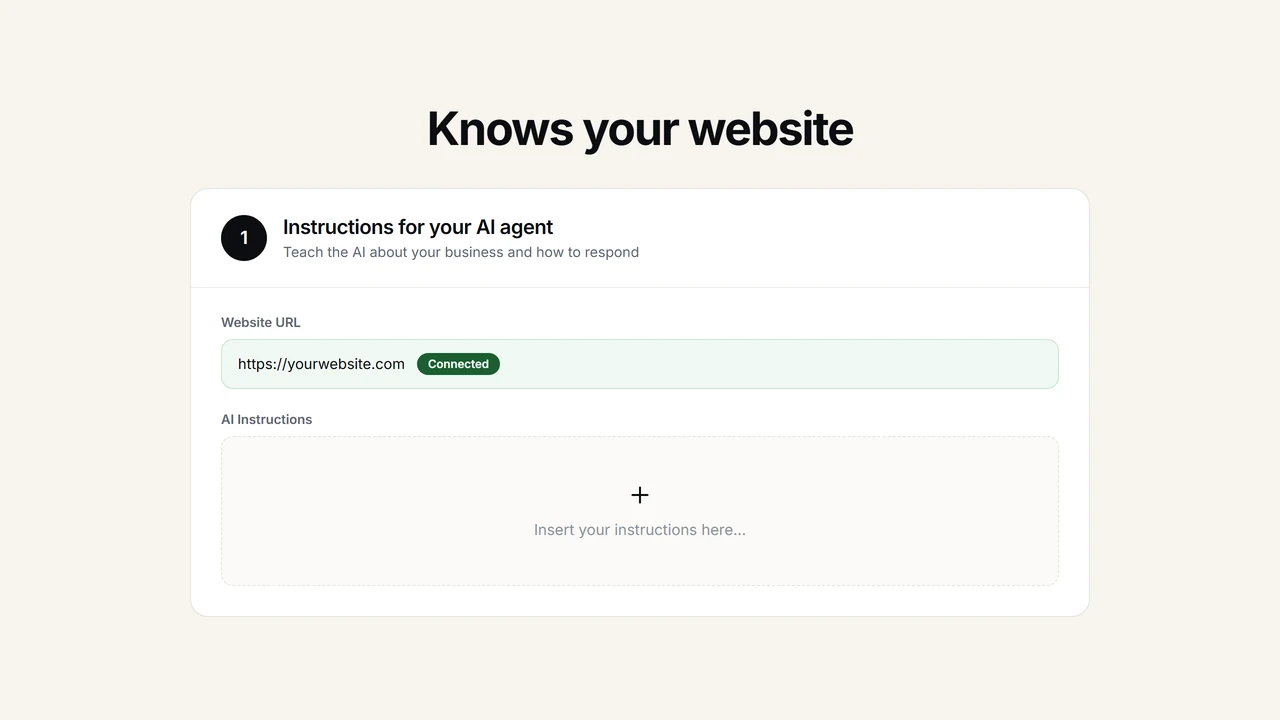
- The AI scans up to 50 pages and builds a knowledge base from your content
- Copy the one-line embed snippet into your site header
- The chatbot goes live — answering visitor questions in 36 languages
<script src="https://asyntai.com/widget.js"
data-id="your-site-id" async>
</script>
</head>
# Technical support, live on every page.
B2B customer support — questions before deployment
What technical leaders, support managers, and ops teams typically ask before rolling AI support into a B2B product.
Can the assistant handle deeply technical product questions, or is it limited to surface-level FAQs?
The assistant answers using your own content — whatever depth your documentation provides, the AI reflects. If your API reference explains rate-limiting behavior with code samples and error codes, the assistant cites that material in its response. If your implementation guide covers multi-tenant deployment with specific configuration steps, the AI walks through those steps when asked. The ceiling is your content, not the AI's capability. Teams that invest in thorough documentation see the assistant resolve questions that would otherwise require an engineer on a call.
How does this differ from the chatbot on a consumer website?
Consumer chatbots handle high-volume, low-complexity questions — order tracking, return windows, store hours. B2B questions tend toward the opposite pattern: lower volume, but each question may involve product architecture, integration nuance, licensing logic, or security posture. Asyntai handles both modes because its answers are grounded in whatever content you provide. The difference isn't in the AI engine — it's in what you feed it. A B2B company pointing Asyntai at comprehensive technical docs gets a support assistant that behaves like a product specialist, not a generic greeter.
Can the assistant pull live data from our CRM or billing system during a conversation?
Yes, through Custom Tools on Standard and Pro plans. You define endpoints — your CRM, your billing API, your license management system — and the assistant calls them when a question requires live data. A customer asking "how many seats do we have left" triggers a lookup against your system, and the answer reflects their actual account. You control which endpoints are exposed and what data the assistant can share.
Our buyers are in Europe, Asia, and the Americas. Does the assistant handle multiple languages?
The widget interface renders in 36 languages, and the assistant replies in whichever language the visitor writes. A prospect in Munich typing in German receives German. An engineer in Seoul typing in Korean receives Korean. All answers draw from the same English-language source documentation — the AI handles the translation layer so your team doesn't need to maintain multilingual knowledge bases.
What happens when the question is too sensitive or complex for an AI to handle?
You write escalation rules in plain language — custom instructions that tell the assistant when to hand off. Common B2B rules include: escalate any pricing negotiation, escalate security questionnaire requests, escalate anything involving contract modifications, escalate if the customer mentions "legal" or "compliance review." The assistant follows those rules and passes the conversation to your team with a full transcript and any account context it gathered.
How does pricing work for a B2B use case with lower volume but higher-value conversations?
Pricing is based on message volume, which tends to work well for B2B. The free tier includes 50 messages on one site for evaluation. Starter at $39/month covers 800 messages across two sites. Standard at $139/month covers 15,000 messages across three sites and includes Custom Tools for live data lookups. Pro at $449/month covers 50,000 messages across twenty sites. Most B2B companies with moderate documentation traffic find Standard more than sufficient.
Can we use this alongside our existing ticketing system?
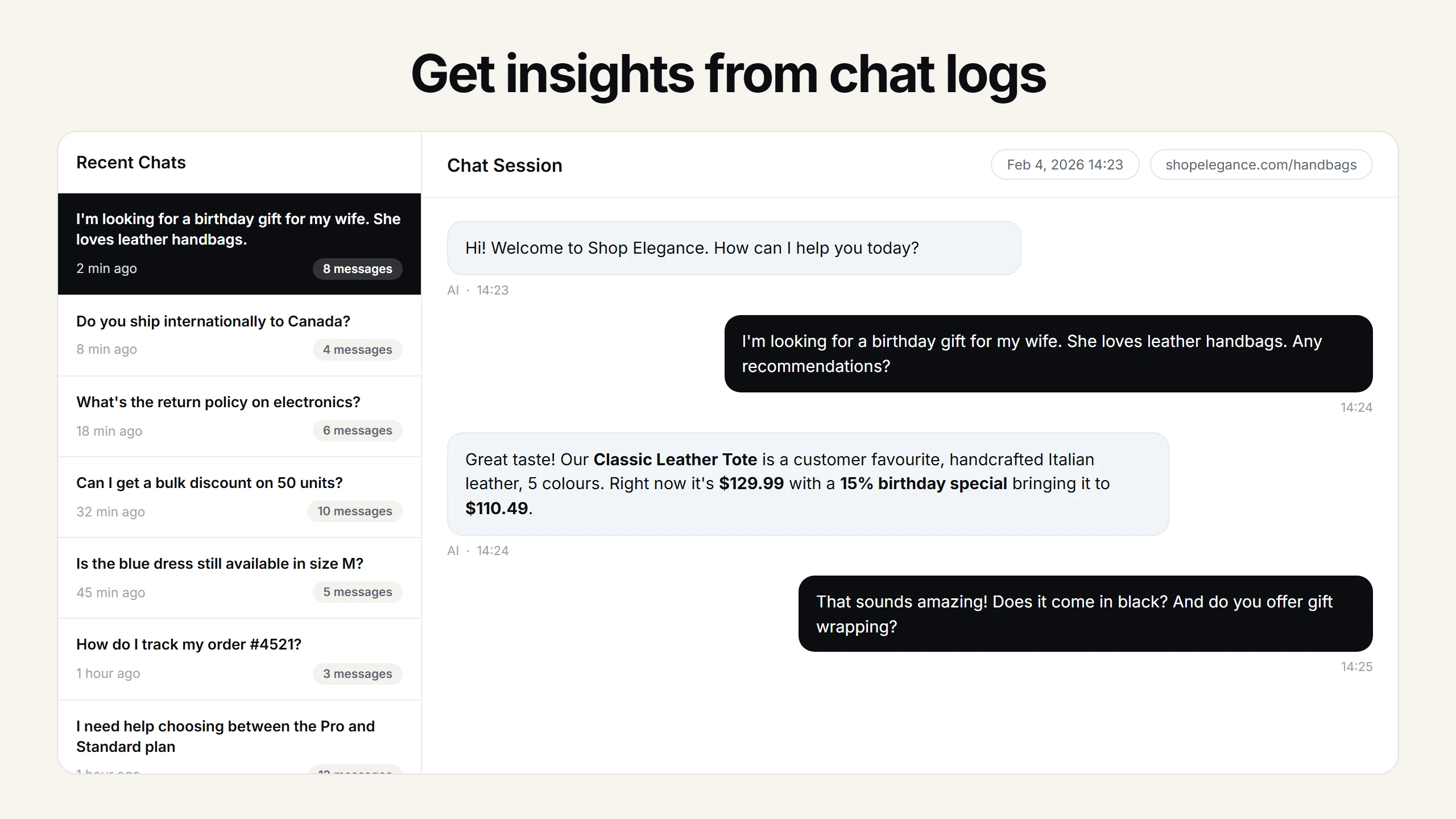
Asyntai sits in front of your ticketing system, not instead of it. Questions the assistant resolves never become tickets. Questions that need a human get escalated with a full conversation transcript attached, so the agent who picks up the ticket has context before they type a word. The widget doesn't replace your helpdesk — it reduces the volume that reaches it, and improves the quality of what does.
Does the AI ever fabricate answers about our product?
The assistant is anchored to the content you provide. When a question falls outside the scope of your crawled pages and uploaded documents, it says so directly and offers to connect the visitor with your team. You reinforce this behavior with custom instructions — particularly important in B2B contexts where incorrect technical information can affect integration decisions or contract discussions. The assistant treats the boundary of your documentation as the boundary of its knowledge.
Why B2B support demands a different kind of AI
There is a fundamental asymmetry in B2B customer support that most software ignores entirely. A consumer brand might handle ten thousand conversations a day, each lasting two or three exchanges, each about a problem worth twenty dollars. A B2B company might handle two hundred conversations a day, but each one involves a product that costs five figures annually, a buyer who spent weeks evaluating alternatives, and a question that touches on integration architecture or contractual terms. The cost of getting the answer wrong in that second scenario isn't a refund — it's a lost renewal, a failed implementation, or a deal that stalls in procurement because someone couldn't get a straight answer about data residency on a Friday afternoon.
Most AI support tools were built for the first scenario. They optimize for deflection rate — how many tickets can we prevent? That metric makes sense when the average ticket costs three dollars to handle and the average customer lifetime value is forty. It makes far less sense when each account represents recurring revenue measured in tens of thousands and the support interaction is often part of an ongoing relationship that spans years. In B2B, the goal isn't to deflect the question. It's to answer it so thoroughly that the customer's confidence in your product actually increases after the interaction.
Asyntai approaches this problem by anchoring every answer to your own content. When the assistant responds to a question about webhook retry behavior, it draws from your API documentation. When someone asks about the difference between your Professional and Enterprise tiers, it references your published comparison page. When a prospect wants to know whether your platform supports SSO via SAML 2.0, the answer comes from your security documentation, not from a generic understanding of what SSO means. The depth of the answer is a direct function of the depth of your documentation — which, for most B2B companies, is substantial.
The technical surface area of B2B products is what makes generic chatbots fail in this context. A SaaS platform might have an API with hundreds of endpoints, each with its own authentication requirements, rate limits, pagination behavior, and error codes. A manufacturing company might sell equipment with dozens of configuration options, compatibility requirements, and maintenance schedules. An enterprise software vendor might offer deployment modes that vary by cloud provider, region, and compliance framework. Visitors asking about these products need answers that reflect specific parameters, not vague assurances. Asyntai scans up to 50 pages of your published content and absorbs whatever additional material you upload — technical PDFs, configuration guides, release notes, compliance certifications — so the assistant's answer matches the specificity the question demands.
Multi-stakeholder buying is another dimension where B2B support diverges from consumer support. A single account might generate questions from a developer evaluating API capabilities, a project manager checking implementation timelines, a procurement officer comparing license terms, and a CISO reviewing your security posture — all within the same evaluation cycle. Each person asks at a different level of abstraction. The developer wants code samples. The procurement officer wants pricing transparency. The CISO wants to know where data is stored and who can access it. An AI assistant that handles all four needs to draw from different parts of your documentation depending on who's asking and what they're asking about. Because Asyntai grounds its responses in your full published content rather than a narrow FAQ list, it handles that range naturally.
The after-hours problem is uniquely painful in B2B because the accounts that need support outside business hours are often the most valuable. Enterprise customers operate globally. An implementation engineer in Singapore troubleshooting at 9pm local time shouldn't have to wait twelve hours for your San Francisco-based team to wake up. Neither should a European prospect evaluating your platform at 8am CET, three hours before your US support queue opens. The assistant runs continuously, answering in 36 languages, pulling from the same documentation your human team would reference. The quality of a midnight answer matches the quality of a midday answer because the source material is the same.
Custom Tools on Standard and Pro plans address the most common gap in B2B AI support — the need for live account data. Static documentation can answer "how does your billing work," but it can't answer "what plan is our company on" or "when does our license renewal come up." With Custom Tools, the assistant calls your own endpoints mid-conversation. You define what's exposed: a CRM lookup that returns the account's contract tier, a billing API that confirms the next renewal date, a usage endpoint that shows how close the account is to its rate limit. The assistant asks the question, gets the data, and folds it into a natural-language response — no dashboard login required from the customer's side.
Escalation in B2B contexts carries different stakes than in consumer support. When a $200,000 account asks to renegotiate terms, that's not a chatbot conversation — it's a relationship conversation that belongs with a human. When a prospect's legal team sends questions about your data processing agreement, the assistant shouldn't attempt to interpret contractual language on the fly. Asyntai handles this through plain-language custom instructions: you write the rules that define when the AI steps back. Escalate contract negotiations. Escalate security questionnaires. Escalate anything that mentions "legal review" or "compliance audit." The assistant follows those boundaries and hands off with a full transcript so the human picks up mid-conversation, not from scratch.
The economics of B2B support make AI adoption straightforward to justify. A single senior support engineer costs well over $100,000 annually in salary, benefits, and tooling. That engineer handles perhaps twenty to thirty complex conversations per day, and their expertise is concentrated in business hours within one time zone. Asyntai's Standard plan at $139/month covers 15,000 messages across three sites with Custom Tools included — a fraction of the cost of a single hire, running around the clock across every time zone your customers occupy. The calculation isn't about replacing engineers. It's about letting your engineers focus on the conversations that actually require their judgment while the AI handles the volume that's important but answerable from existing documentation.
Documentation quality is the multiplier that determines how much value a B2B company extracts from AI support. Companies that maintain thorough, current technical documentation — detailed API references, step-by-step implementation guides, clearly written security and compliance pages — see the assistant resolve a large share of inbound questions without human intervention. Companies with thin documentation see less resolution but still gain value: the assistant captures questions it can't answer, revealing exactly which topics need documentation investment. Over weeks, the pattern of unanswered questions becomes a roadmap for content creation that directly reduces support load in the next cycle.