An AI website assistant that lives where your visitors already are
Asyntai embeds an AI website assistant directly into your pages — not a separate portal, not an external tool, not a link that pulls visitors away. One JavaScript snippet, and every page on your site gains an assistant that answers from your own content, fluent in 36 languages.
Watch the assistant run on your actual pages
Enter your URL and preview how the embedded assistant would interact with visitors on your real site
Embedded on the page, not bolted on from outside
Most AI tools ask visitors to leave your website — open a new tab, log into a portal, or navigate away from the page they were reading. An AI website assistant should be the opposite: woven into the browsing experience so seamlessly that visitors never realize they've crossed into a different product. Asyntai renders inline, loads with your page, and inherits your site's visual rhythm.
- Zero navigation frictionThe assistant appears on the same page the visitor is already reading. No redirect, no popup window, no new-tab handoff — the conversation happens right where the question arose.
- Persistent across page transitionsNavigate from your pricing page to your FAQ and the conversation continues. The assistant remembers the thread without the visitor having to repeat anything.
- Matches your site, not oursLauncher color, position, welcome message, and suggested questions are all configurable from your dashboard. Visitors see your brand, not a third-party overlay.
Draws from your pages and documents, nothing else
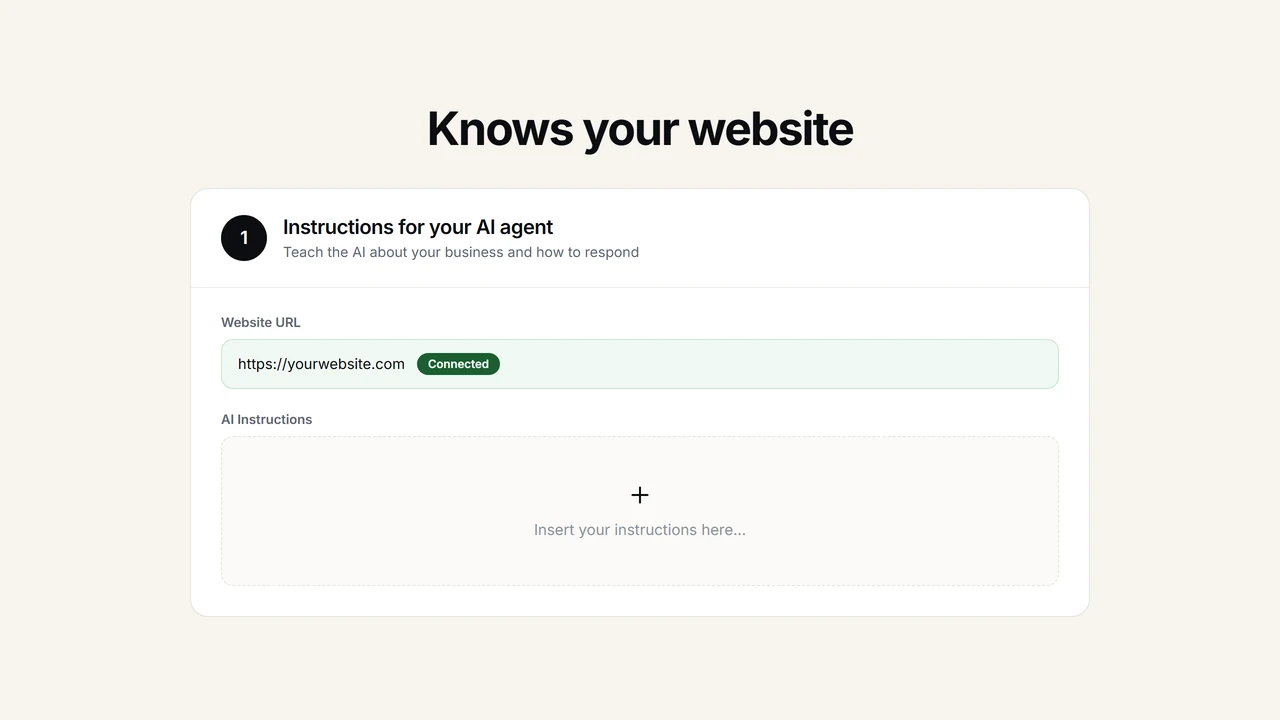
An AI website assistant earns trust only when its answers come from material you control. Asyntai crawls the public pages of your site and absorbs uploaded PDFs and pasted text — then answers strictly from that combined source. When a question falls outside the knowledge boundary, the assistant collects contact details and routes the conversation to you instead of guessing.
- Automatic site crawlPoint the assistant at your domain and it indexes published pages — product listings, service descriptions, blog articles, policy pages, help docs — building a working knowledge base without manual entry.
- Private document layerInternal guides, pricing sheets, onboarding PDFs, and anything not publicly listed can be uploaded separately. The assistant references them alongside your public content.
- Guardrails over hallucinationCustom plain-English instructions shape the assistant's behavior: when to escalate, how to handle pricing questions, which pages to link to. The AI follows the script you wrote, not a generic prompt.
One snippet turns every page into an assisted page
Paste a single JavaScript snippet into your site's <head> — through a CMS header field, a tag manager container, or a raw template edit — and every page on your domain gains the AI website assistant automatically. No per-page configuration.
- Create a free Asyntai account and copy the snippet assigned to your domain.
- Insert it into the site-wide header — CMS settings panel, Google Tag Manager, or the HTML template directly.
- Enter your site URL so the assistant crawls and learns your published content; upload any private documents.
- Preview a few conversations, adjust the launcher style, and go live.
<script src="https://asyntai.com/widget.js"
data-id="your-site-id" async>
</script>
</head>
# Every page on the domain now has an assistant.
AI website assistant — questions answered
Practical details site owners want covered before embedding the assistant.
What makes this different from a standalone chatbot tool?
A standalone chatbot typically lives in its own interface — a separate URL, a branded portal, or an external window your visitors navigate to. An AI website assistant is the opposite: it renders inside your page, loads with your layout, and the visitor never leaves the content they were reading. The distinction matters because every redirect is a drop-off point. Keeping the conversation embedded means the visitor stays on your site, stays in context, and stays closer to a conversion.
Does the assistant work on sites built with different platforms?
Yes. The snippet is plain JavaScript, so it runs on anything that accepts a script tag — WordPress, Webflow, Squarespace, Wix, Shopify, Ghost, static HTML, React SPAs, Django apps, custom frameworks. The behavior and feature set are identical regardless of what builds your pages.
Can I control what the assistant says and how it behaves?
Entirely. You write plain-English instructions in the dashboard — escalation rules, tone guidelines, pages to recommend, topics to avoid. The assistant follows those instructions across every conversation and every language. You can update the rules at any time and the changes take effect immediately.
How does it handle visitors who speak different languages?
The widget interface ships in 36 languages, and the AI detects a visitor's language from their first message. A visitor typing in Turkish gets Turkish replies; one typing in Japanese gets Japanese. No per-language setup, no translation plugin, no separate assistant per locale — the same embedded instance handles all of them.
Can the assistant give personalized answers to logged-in users?
On Standard and Pro plans, the User Context feature lets your site pass session-specific data — name, account type, order status, membership tier — into a JavaScript object before the widget loads. The assistant uses that data to answer personal questions accurately, without any API plumbing. You decide what to share on each page load.
Where do leads and contact details collected by the assistant go?
Every captured contact appears in your Asyntai dashboard with the full conversation transcript attached. Enable email notifications and the same details arrive in your inbox in real time — ready to slot into whatever CRM, spreadsheet, or follow-up workflow you already use.
What does pricing look like for a single-site owner?
The free tier covers one site and 50 messages per month — enough to test and evaluate. Paid plans start at $39 per month for 800 messages and two sites. Standard allows three sites, Pro up to ten, with higher message allowances. You get email warnings before reaching the cap so the assistant never silently stops.
Does it slow down my pages when it loads?
The snippet loads asynchronously. Your page renders its content, images, and interactive elements on the usual schedule; the assistant initializes in the background and becomes available shortly after. The launcher itself is a lightweight button — the full conversation panel only loads when a visitor chooses to open it.
The case for an AI website assistant that never leaves your pages
There is a quiet architectural decision behind every website you visit: the site either keeps you inside its own walls or sends you somewhere else the moment you need help. Click "support" and you land on a Zendesk subdomain. Click "chat" and a third-party window detaches from the page. Click "help" and a knowledge base opens in a new tab with a different header, different footer, different visual language. Each of those handoffs carries a cost the site owner rarely measures — the fraction of visitors who lose momentum, forget what they were doing, or simply close the tab because the seam between the site and the help layer felt like an exit. An AI website assistant built the right way eliminates that seam entirely. The assistant lives on the page the visitor is already reading, opens without leaving that page, and closes without disrupting whatever the visitor does next. No redirect, no portal, no context switch.
The word "embedded" does real work in this category and deserves scrutiny. Plenty of tools call themselves embedded when they actually inject an iframe from a foreign domain, load a separate application inside a floating frame, or pop open a window that merely overlaps the page without being part of it. Genuine embedding means the assistant is a component of the page itself — loaded by the same document, governed by the same lifecycle, dismissed with the same gestures the visitor uses for every other interactive element on the site. Asyntai delivers this through a single JavaScript snippet placed in the page header. The snippet loads asynchronously, waits for the page to be ready, and renders the assistant launcher as part of the page. When a visitor opens it, the conversation panel slides in without opening a new context. When they close it, they are exactly where they left off. This matters more than it sounds like it should, because every extra layer of navigation is a decision point, and every decision point leaks visitors.
The strongest argument for keeping an assistant page-native is that the visitor's intent is highest at the moment they look up from the content. Someone reading a pricing table and wondering whether the annual plan includes onboarding has a question right then, on that exact page. If the mechanism for asking requires them to navigate, the question has to survive the transition — and often it doesn't. They click away, the new page asks them to formulate the question from scratch, the context they were just looking at is no longer visible, and the effort suddenly feels disproportionate to the curiosity. A page-native assistant sidesteps all of that. The visitor glances at the launcher, taps it, types, and the answer arrives while the pricing table is still in view. The question was born on the page and answered on the page. Nothing interrupted the arc.
Grounding the assistant in your content is what separates a website-native assistant from a generic language model floating on top of your layout. The Asyntai assistant crawls the public pages of your domain and stores a working index of everything it finds — products, services, policies, blog posts, documentation, FAQ entries, team bios. For material that isn't published on the open web, you upload PDFs or paste text directly: internal pricing guides, partner terms, onboarding checklists, anything the assistant should reference but visitors should not browse to independently. Together, these two sources form a bounded knowledge base. When a visitor asks a question that falls outside it, the assistant does not fill the gap with a plausible-sounding guess. It acknowledges the limit and offers to capture the visitor's contact details so a human can follow up. Trustworthiness comes from that boundary, not from the breadth of the model's general knowledge.
Language coverage expands the surface area of every page on your site without requiring you to build or maintain translated versions. The assistant interface supports 36 languages natively, and the AI detects the visitor's language from a single message. A Dutch visitor browsing an English-language product page types a question in Dutch and receives a Dutch reply sourced from the English content. A Korean visitor does the same in Korean. The site stays monolingual in its published form while the embedded assistant acts as a live translator between the content and anyone who arrives speaking something else. For sites with international organic traffic — which, after a few months of indexing, includes most sites with decent SEO — this recaptures a segment of visitors who would otherwise bounce the moment they realized the content wasn't in their language.
Visitor identity, when available, transforms the assistant from a generic FAQ layer into a personalized concierge. Sites that have logged-in areas — member portals, customer dashboards, subscription panels — can use the User Context feature on Standard and Pro plans to pass session-specific data into the assistant before it loads. The mechanism is a small JavaScript object your page populates: a name, an account tier, an order reference, a renewal date, any field you choose. The assistant reads that object once per session and weaves the details into every answer. A subscriber asking when their plan renews gets their actual date, not a generic paragraph about billing cycles. A customer asking about a recent order gets the status of that specific order, not a vague "check your account page" deflection. The data flows one way — from your site to the assistant — and you decide per page load exactly what to expose.
Lead capture within an embedded assistant works differently from a standalone form, and the difference is psychological. A contact form asks the visitor to initiate: open a page, fill fields, craft a message, hit send. The assistant inverts that sequence. The visitor has already been talking, already received a useful answer, already formed a micro-relationship with the tool. When the assistant suggests exchanging an email so the team can follow up with more detail, the ask feels like a natural continuation rather than a cold transaction. Captured details arrive in the Asyntai dashboard with the full conversation attached, and optionally land in your inbox via real-time email notification. You don't get a name and an email address with no context — you get a name, an email, and a complete record of what that person actually wanted to know.
Running multiple sites under one account is a practical concern for anyone managing more than a single web property. Freelancers often maintain a portfolio site and a client project. Agencies manage a dozen domains. Small business owners sometimes operate two or three related brands. The free tier covers one site. Paid plans expand the limit: two on Starter, three on Standard, up to ten on Pro. Each site gets its own separate assistant with its own knowledge base, so a question on Site A never pulls in content from Site B. This is the architecture that matters when websites serve genuinely different audiences — the assistant on a B2B consulting site should not accidentally reference inventory data from the e-commerce store on the neighboring domain.
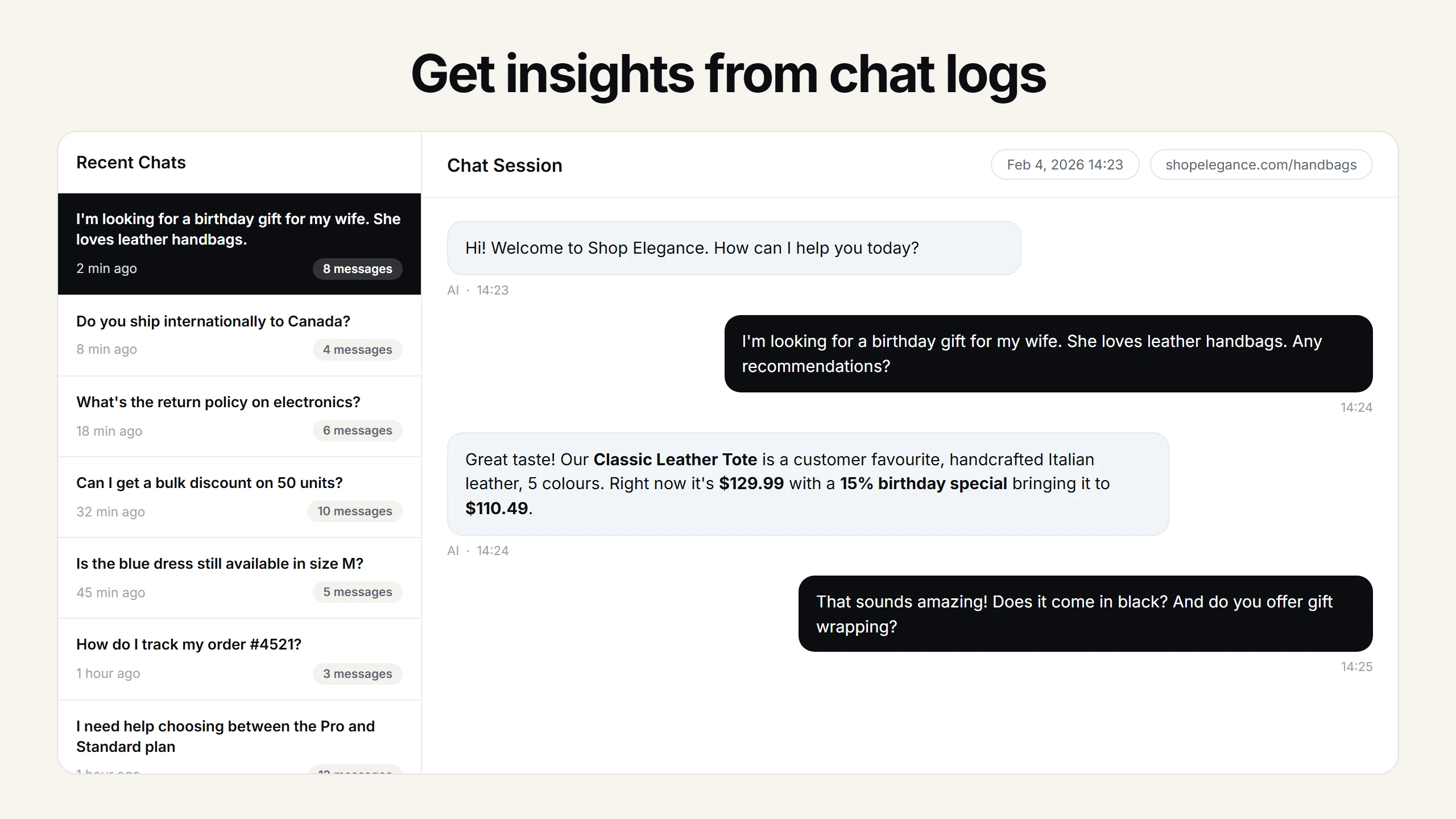
Conversation data from the assistant doubles as the most direct feedback loop your site has ever had. Analytics dashboards, heatmaps, and session recordings show you where visitors clicked and how far they scrolled, but they cannot tell you what the visitor was thinking. Conversations can. When three different visitors this week asked the same clarifying question about your shipping policy, the data is unambiguous: that section of the page is not doing its job. When visitors on a particular product page consistently ask about compatibility, the product description needs a compatibility note that doesn't currently exist. The assistant's conversation log becomes a running, zero-effort usability study that surfaces exactly the gaps your published content is leaving open. Over weeks and months, the site improves because the assistant has been quietly cataloging every point of confusion.
Pricing is built around the assumption that an AI website assistant should be testable at zero cost and affordable long before it pays for itself. The free tier provides 50 messages per month on one site — sufficient for a low-traffic site or for a thorough evaluation period before committing. Paid tiers begin at $39 per month for 800 messages across two sites, a threshold that covers most small-to-medium traffic volumes comfortably. Higher plans increase both the message ceiling and the site count, topping out at Pro with ten sites. Email alerts fire before any tier reaches its monthly cap, so a sudden influx of traffic from a press mention or a social share doesn't catch you off guard. Starting free, measuring the real impact, and scaling the plan up only when the numbers justify it is the intended path — and the path most site owners follow.
The setup sequence, in practice, is shorter than the evaluation that precedes it. Sign up, paste the snippet into your header, let the crawler work through your pages while you do something else, upload any internal documents, write a few plain-English behavioral instructions, test half a dozen conversations, and publish. From that point forward, the assistant handles the repetitive questions your content was supposed to answer but visitors didn't feel like searching for. It captures the contact details of the people who would have left without a trace. It shows you, in dashboard form, the exact gaps between what your pages say and what your visitors actually want to know. For any site where the distance between a visitor's question and the published answer is more than one scroll or one click, an embedded AI website assistant closes that distance — silently, on every page, around the clock.